


To acquire immunity to eloquence is of the utmost importance to the citizens of a democracy.
—Bertrand Russell
(of course, there’s probably also such a thing as going too far in that direction…)
🤧 I’m wondering about the impact of what the world went through on other common diseases, post-pandemic.
If you do something for long enough, it has a better chance of becoming a habit: hand-washing, more likely to stay home/WFH when sick, or at least wear a mask when symptomatic (this is an aside, but places that we associate with better public hygiene and mask-wearing, like Japan, Singapore, SK, etc, weren’t always like that, just like Amsterdam and Copenhagen weren’t always so bike-friendly — but once it happens, we kind of assume they were always like that and we couldn’t possibly do the same because “they’re different, we’re not like them”); when you learn something new in enough detail, the knowledge stays and can impact future decisions (most of us had extremely basic knowledge of viral contagion, R0, etc); investments in things like better ventilation will stick around, and hopefully become a mandatory part of building codes.
So are we going to see fewer common colds and stomach bugs and things like that? Is the vaccine science and infrastructure that we built up going to be useful to target other diseases that had been out of reach or just not worth investing into before? What I wouldn’t give for a universal common cold vaccine (or even a yearly one, I’d take it, and I suspect most people with young kids would).
Hopefully it’s a bit like all that dark fiber after the dot-com boom and we find good uses for all this.
🃏 Speaking of after the pandemic, everybody knows that tech stocks and high-growth SaaS only did well because of the pandemic, and so when the pandemic ends, they're going back to doing as badly as they were doing before all this happened...
🛀 Maybe it’s just me and my natural disposition, but I always found it weird that “YOLO” (‘you only live once’, for the boomers reading this) became a rallying cry for taking huge risks (including financial ones, WSB-style).
I mean, I get it, you can see it from that angle, as in “take your chance, you may not have another one like this!”.
But to me, when I hear those words, the first thing that comes to mind is “be careful, you don’t respawn, you have to get it right the first run through.”
So if someone asks me if I want to go racing Japanese motorcycles, and I say no, and then they say “come on, you only live once”, it primes me to an even stronger “no”, not an increase in the chances that I’ll switch to “yes”.
But hey, maybe it’s just me… ¯\_(ツ)_/¯
🐞 Life’s small mysteries. I don’t understand quite how, but I’ve had ladybugs in my house this winter, mostly on very cold January and February days. I’m not quite sure where they’re coming from or if they can find anything to eat, but my wife and I have found many (maybe 5-10?) over a few weeks.
My main theory is that at the end of the summer they somehow get in and go hide in in the air ducts and hibernate there. And then on very cold days, the furnace works more than usual and somehow this is enough heat for long enough to tell them “hey, you can stop hibernating” and they all wake up and end up in the window next to my desk, for me to puzzle at where they’re coming from. ¯\_(ツ)_/¯
💚 🥃 Thank you so much to all the new Supporters (💚) who have put a few bucks in the tip jar, and thank you also to those who are considering it but just haven’t pulled the trigger yet (¡bang¡).
Lately, I’ve had this song stuck in my head:
Thank you for being such a friend
You're by my side through thick and thin
And when these days come to an end
I know I'll be with you again
For all the times we're up and down
You know you never let me down
We've turned the page so many times
There's still so much more left to write

Thank you for all you let me be
And for euphoric memories
For the 15 minutes of fame
And all the pretty ugly things
For filling empty rooms with light
And all the sins thrown in the sea
For flowing in and out my eyes
And the taste of life between my teeth

I'll say it now while I still have the opportunity to breathe
I suffocated for so long and then you gave my heart its beat
We may be oceans far apart but deep inside you're still with me
I know we'll always be together every time I hear you sing...
(ok, it’s maybe a little dramatic, but hey, it’s a song… I didn’t write it, but it’s fitting)
The support really means the world to me. It’s still early days, so it’s not a success yet, but with your help, we’ll get there; I’m slowly working my way up to the minimum wage in Botswana, so there’s that!
🛣 A good one to meditate on, by Tim Urban:
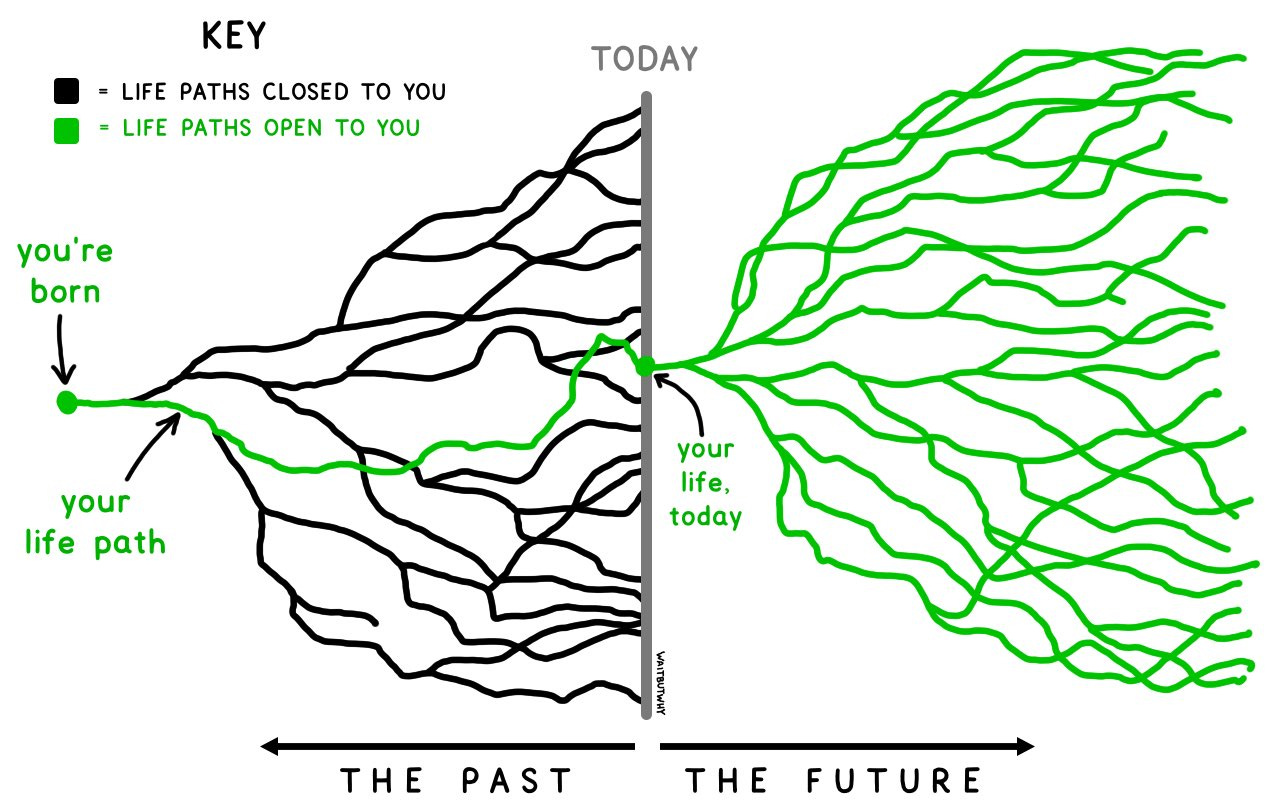
We think a lot about those black lines, forgetting that it’s all still in our hands.
Investing & Business
Owning Overvalued Stocks
💸 If you want to own a really good company for a long time, you have to be ready to own it when it's overvalued.
It’s up to you to decide how far you’re ready to go on that — there are levels of overvaluation, and maybe someone can handle “a little” and someone else “a pretty big amount”, but they’d sell at “crazy bonkers wut?!” levels (the funny thing is, usually when you look back at a really good company, what everybody considered expensive at the time turned out not to have been that expensive because the stock kept over-performing from those levels and you could’ve paid a lot more to match the market).
There's almost no chance you'll jump in and out as it swings between undervalued and overvalued, and still ride it as it compounds over years. You're much likelier to jump out, and then wait for an entry point point that feels good (beware anchoring!), but then have "missed it" and watch it fly away. I know from experience.
This is hard for many to accept, and the answer I usually get is: “just rotate between your best ideas to something cheaper and come back later”.
Awesome if you have enough truly top notch ideas and can execute that strategy, but I haven’t found myself able to do it in a way that is more effective than if I had just done nothing and held through the ups and downs ¯\_(ツ)_/¯
Jeff Green, The Trade Desk CEO, on Google’s Chrome Changes
He’s not a neutral actor in this, but I’ve always found his viewpoint insightful, as someone who’s trying to get the open-internet to band together to better compete against the big walled-gardens:
Google stated that “today, we’re making explicit that once third-party cookies are phased out, we will not build alternate identifiers to track individuals as they browse across the web, nor will we use them in our products.” [...]
cookies only impact the browsing internet. That’s about 20% of data-driven ads today. 20% is meaningful, but the open Internet has already created an alternative to third-party cookies -- Unified ID 2.0. Additionally, cookies don’t matter much to the fastest growing areas of the digital advertising ecosystem, such as CTV. With CTV, consumers log in with an email or phone number and that login helps create everything from customized viewing recommendations to a better ad experience that features fewer, more relevant ads. And this is critical for content owners, who rely on advertising to pay for that expensive content. In this new golden era of TV content quality, ad revenue is crucial to almost every content creator except for Netflix. [...]
For sure a lot of the people reading this won’t want to see ads and are more than ready to pay for that, but what works for those in the higher income brackets may not work for the many in the bottom layers of the pyramid. And even high earners usually tap out after a few subscriptions.
Google is doubling down on its own properties, such as search and YouTube and adding bricks to the walls around those properties. The trade-off is that Google no longer values serving ads on the rest of the internet as much -- certainly not as much as they once did. [...]
compared to the properties they own and operate, Google makes comparatively little revenue from the open internet. So, perhaps this is a smart strategic move.
But let's be clear. Google is not abandoning targeted advertising. In fact, it could be argued that they want to be the only one to provide targeted advertising and they’ll base it on their 2 billion-ish email-based logins (something they don’t want others to do). [...][Google] seems to be expanding the scope of “first party data,” giving themselves room to use their email-based SSO data around the rest of the internet. (Source)
Seems pretty hypocritical — and anti-competitive — for Google to make such a stark distinction between tracking with 1st party data and 3rd party data when what matters to people is “am I tracked or not, what is public about me and what is private, and do I have control over it?” rather than the exact mechanics.
In short: Unless we start to subscribe to everything, someone has to pay for content. If there’s going to be ads, there should be fewer of them that are of higher quality (rather than many at low-CPMs that blanket everything and show you things you have no interest in). And if that’s the case, it shouldn’t be just a couple tech giants that have the ability to do that, further entrenching them and pulling up the ladder for new entrants; the open internet should be able to finance itself with targeted ads. So let’s just build the tech that allows for that while respecting people’s privacy.
Ben Thompson summarizes the concerns well (sub $ required):
this is the state of the privacy debate: Google can own over half of the digital advertising market, cut its direct rival off at the knees, and receive widespread praise for having done so, even as users give out less personally identifiable information in exchange for being more easily profiled. Yay?
This situation with Google and its influence over the whole web (in good part through its browser dominance with Chrome) is kind of starting to give me PTSD flashbacks of Microsoft in the Internet Explorer 6 era, both in how they’re using it to advantage themselves against the ad-selling competition, but also with the ad-buying competition (since they do both — sell the ads, and own large properties where you can buy inventory).
Never good to have one player have so much influence over the web, especially because even if they start out with good intention (and I believe Google did), eventually, power corrupts, and self-interest takes precedence over the common good.
So let’s find some more checks & balances.

‘John McAfee indicted on cryptocurrency fraud charges’
In the “scalping” scheme, McAfee and his team allegedly bought large amounts of cheap cryptocurrency altcoins, then aggressively promoted them online with “false and misleading endorsement tweets” to artificially inflate their market prices.
“McAfee Team members collectively earned more than $2 million in illicit profits from their altcoin scalping activities,” the Department of Justice alleges. [...]The team would use social media to tout crypto startups’ fundraising events while concealing that they were being compensated for the promotional tweets, the press release alleges.
McAfee, Watson and the rest of his team earned “more than $11 million in undisclosed compensation that they took steps to affirmatively hide” from investors, the grand jury indictment says. (Source)
Surprising! Shocking! Who could’ve seen this coming?
Somehow it’s always the malignant narcissists who run twice for president and make exaggerated claims about themselves and their achievements — including claiming they would eat their own genitals on live TV if X didn’t happen — that turn out to be grifters and criminals. What a strange world…
P.S. Whatever black-market, illicit stuff McAfee is doing to stay young — he seems like the kind of guy who would do parabiosis and stem cell therapies and intravenous vitamin C and metformin and rapamycin and resveratrol at the same time — seems to be fighting very hard against all the other illicit substances and hard living...
He somehow manages to look like he both has a lot of mileage and young for his 75 years of age.
Octahedron’s 2020 Q4 Slides
A short, 97-page presentation on stuff that Ram Parameswaran and the Octo-people have learned last quarter, mostly covering their areas of focus in digital advertising, gaming, payments & fintech, e-commerce and software:
Octahedron is a great name (and a cheap .com domain, as Ram mentioned in interview), especially because it sounds really fancy and brain, but in reality, it’s just this thing.
Capital Battle: Amazon vs Shopify
$AMZN has invested $60 B since 2014 in building out fulfilment warehouses, leasing airplanes and buying delivery vans - BOA research.
$SHOP plans to invest $1 B over the next 5 years
h/t Alice Chikara
Here’s the kind of day Friday was…
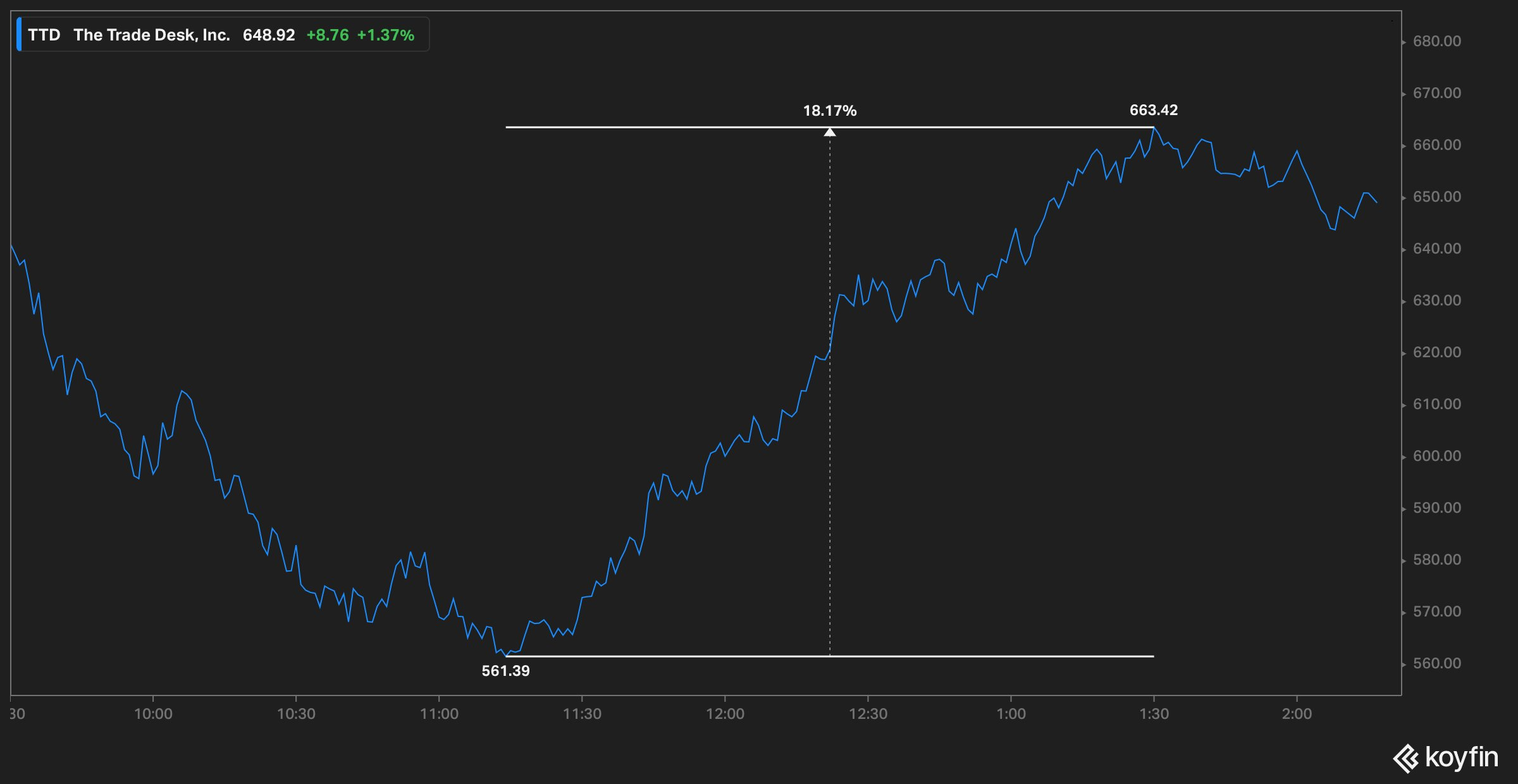

18% intraday swing on a $30bn market cap company...
Science & Technology
The Lost Art of Daydreaming
I daydreamed a lot as a kid. I suspect most kids do. In fact, my childhood was probably about 50% daydream…. But it’s one of these things that we seem to lose as adults, along with — too often — the ability to have fun (what’s the point of life without fun? Who wants to be a miserable billionaire?).
When left to their own devices, people could choose to enjoy their own thoughts. But recent work suggests they do not. When given the freedom, people do not spontaneously choose to think for pleasure, and when directed to do so, struggle to concentrate successfully. Moreover, people find it somewhat boring and much less enjoyable than other solitary activities. One reason for this is that people may not know how to think for pleasure. (Source)
Do you even daydream anymore? What about?
What if it’s a skill, and you can get better at it? Wouldn’t you want to?
The first step is recognizing that while it might look easy, daydreaming is surprisingly demanding.
“You have to be the actor, director, screenwriter and audience of a mental performance,” she said. “Even though it looks like you’re doing nothing, it’s cognitively taxing.” [...]
We don’t intuitively understand how to think enjoyable thoughts.
“We’re fairly clueless,” she said. “We don’t seem to know what to think about to have a positive experience.”
Westgate wants to help people recapture that daydream state, which may boost wellness and even pain tolerance. [...]
When we’re nudged to think for fun instead of meaning, we tend to default to superficial pleasures like eating ice cream, which don’t scratch the same itch as thoughts that are pleasant but also meaningful. But when Westgate provided participants with a list of examples that were both pleasant and meaningful, they enjoyed thinking 50% more than when they were instructed to think about whatever they wanted. That’s knowledge you can harness in your everyday life by prompting yourself with topics you’d find rewarding to daydream about, like a pleasant memory, future accomplishment, or an event you’re looking forward to, she says. (Source)
Interview: Dr. Roger Seheult from MedCram (Vitamin D, Sleep, Sauna & More)
Good interview by the indefatigable Rhonda Patrick. It covers a lot of stuff, including a lot of the science surrounding Vitamin D and possible benefits against COVID19 (among other things — don’t stop taking it when the pandemic ends!).
I wasn’t familiar with it before, but Dr Seheult’s Youtube channel, MedCram, seems like a good resource.
If you want more, I covered a bunch of stuff about vitamin D and COVID19 in edition #69.
‘Vaccine Efficacy, Statistical Power and Mental Models’
Another good post by Zeynep Tufekci. Some highlights:
Mental models matter, because they are our conceptualization of what the world—and dynamics within it—are like. If they are wrong, we can quickly get in trouble.
Mental models are likely to go awry when we hit specialized or unfamiliar territory. [...]
A parallel in finance may be how early in my investing career, it was obvious to me that a company that couldn’t turn a profit was a terrible business. But then you learn from Malone and Bezos and Salesforce and others how things are more complex than that.
A lot of our discussions seem to treat the immune system like a wall with a fixed height: if a taller wave comes over it, it will wash over the wall. Like the sea wall that was meant to protect the Fukushima nuclear reactor from tsunami waves but was too short to do so. [...]
If that’s what the vaccine trials were measuring—the height of the wall that is our immune system comparing vaccine effectiveness would make a lot of sense. Many high-profile, highly-credentialed people have been (misleadingly) describing it exactly in that manner: that if a vaccine is 95% effective, those 5% are left “unprotected.” If Moderna and Pfizer and 95% efficacious, and if Johnson and Johnson is 66%—well, that would mean that 34% of the people are left “unprotected.” right?
Wrong. To get to why that assumption is not right—and why those vaccine efficacy numbers are not the height of the wall that represents the immune system—let me first mention something important The two mRNA vaccines do appear to be spectacular, but they were tested under conditions where those pesky “variants-of-concern”—the B.117 (UK one) and B. 1.351 (South Africa) and P1--were not widespread. If tested now, under equal conditions, those numbers may be closer. Plus, Johnson & Johnson is a single-shot with a trial with a booster underway. So those efficacy numbers may well be much closer in reality than they appear from the trial results. But let’s leave that aside for a moment. [...]
Which brings me back to vaccine efficacy. The vaccine trials have as any endpoint any symptomatic disease, rather than hospitalization or death [...]
But the converse is not true: an inability to prevent mild disease does not necessarily signal an inability to prevent severe disease, hospitalizations and death. That would be the case if vaccinations and the immune system, indeed, had operated like a wall; if a wall can’t stop a five-foot wave because it is too short, it certainly can’t stop a nine-foot wave.
Instead, though, the immune system is a tiered (and very complicated) system. [...] the place where “intuition goes to die.” [...]
So where does this leave us? [...] So far, in all six trials, there are no deaths reported among the vaccinated group, almost no hospitalizations (a few definitions are wonky), and little to no severe disease. That is very encouraging!
Amazon AI to automatically dub videos into other languages
Ever wish you could automatically dub foreign film dialogue into another tongue? Amazon is on the case. In a paper published this week on the preprint server Arxiv.org, researchers from the tech giant detailed a novel “speech-to-speech” pipeline that taps AI to align translated speech with original speech and fine-tune speech duration before adding background noise and reverberation. They say that it improves the perceived naturalness of dubbing and highlights the relative importance of each proposed step.
automatic dubbing involves transcribing speech to text and translating that text into another language before generating speech from the translated text. The challenge isn’t simply conveying the same content of the source audio, but matching the original timbre, emotion, duration, prosody (i.e., patterns of rhythm and sound), background noise, and reverberation. (Source)
This is an insanely hard problem, especially if the goal is to eventually have no humans in the loop, because any big-enough error has a chance of ruining the experience for the viewer (ie. something that doesn’t work with the plot, or makes a serious moment funny, etc).
Here’s Amazon’s paper on this, if you want to go deeper in the weeds on this:
h/t Brad Slingerlend
The Arts & History

Freedom Simulator
Few video game experiences feel as good as the first few times you use the paraglider in Zelda: Breath of the Wild.
When you climb up to a high point on the map, look around at the beautiful landscape (that could be a painting from almost any angle — the amount of craftsmanship and attention to detail in this game is mind-boggling), and then jump off to glide down to some interesting spot far away.
That’d be a cool VR experience, if somehow we could figure out how to temporarily disable and/or hijack our inner ear’s sense of balance and make it match the view…
New David Simon HBO Show… Set in Baltimore… With Corrupt Police…
I’m so there. h/t Kevin Holloway (the Charlie Utter to my Calamity Jane)