


The real problem of humanity is the following: we have paleolithic emotions, medieval institutions, and god-like technology.
—E. O. Wilson, who died today
🎄🎁 When newsletter and life intersect: The best gift I received this year is a 2lbs wedge of Parmigiano-Reggiano that my in-laws gave me. 🧀
(someone on Twitter seemed surprised and asked me if this was hard to find in Canada. No, it isn’t. Gifts don’t have to be rare or expensive to be good, all that matters is it makes me happy.)
🛀 I think most people tend to under-value being proactive rather than reactive on many things.
For example, years ago I read a book on depression while I was feeling fine because I wanted more tools to avoid getting to that point and better know what to do it I did.
Same idea as: It’s better to do maintenance on your car while it’s running well than wait for it to break down and do repairs… One ounce of prevention worth a pound of cure, etc.
Not a new concept, but one we tend to forget. Maybe I’m writing this as a reminder to myself… 🤔
💰 Totally random and arbitrary question, but can you think of someone very famous over years (let’s define it as: 30% of the population of the US would know who they are) that lived a long life and never had more in assets, or made more income, than the median US person at the time? (adjusted for their age)
At first I was thinking maybe some scientists or soldier, but that famous and under median income/wealth until death..? That’s tough.
🤔 I like this line by James Clear (🍀):
An expert is someone who, over many years, manages to remain confident enough to keep trying and humble enough to keep learning.
In other words, they become professional at having a beginner's mind.
💚 🥃 For the price of one alcoholic drink, you get 12 emails per month (plus 𝕤𝕡𝕖𝕔𝕚𝕒𝕝 𝕖𝕕𝕚𝕥𝕚𝕠𝕟𝕤) full of eclectic ideas and investing/tech analysis. That’s 77¢ per edition for the serendipity engine.
If you make just one good investment decision per year because of something you learn here (or avoid one bad decision — don’t forget preventing negatives!), it'll pay for multiple years of subscriptions (or multiple lifetimes).
As Bezos would say of Prime, you’d be downright irresponsible not to be a member, it takes 19 seconds (3 secs on mobile with Apple/Google Pay — if you don’t see paid options, it’s because you’re not logged into your Substack account):
Investing & Business

🪖 Wrong Battle Lines, Crypto vs non-Crypto edition ▉⛓
I recently remembered the graph above (well, the concept of it — not the actual thing and I had to ask the hive mind on Twitter for help — h/t to Mikey Mendoza), and think it applies to crypto/web 3.
I think too many people want to draw battle lines between the crypto bros and web3’ers on one side and the no-coiners, anti-crypto, and crypto-agnostics on the other. Kind of like this:
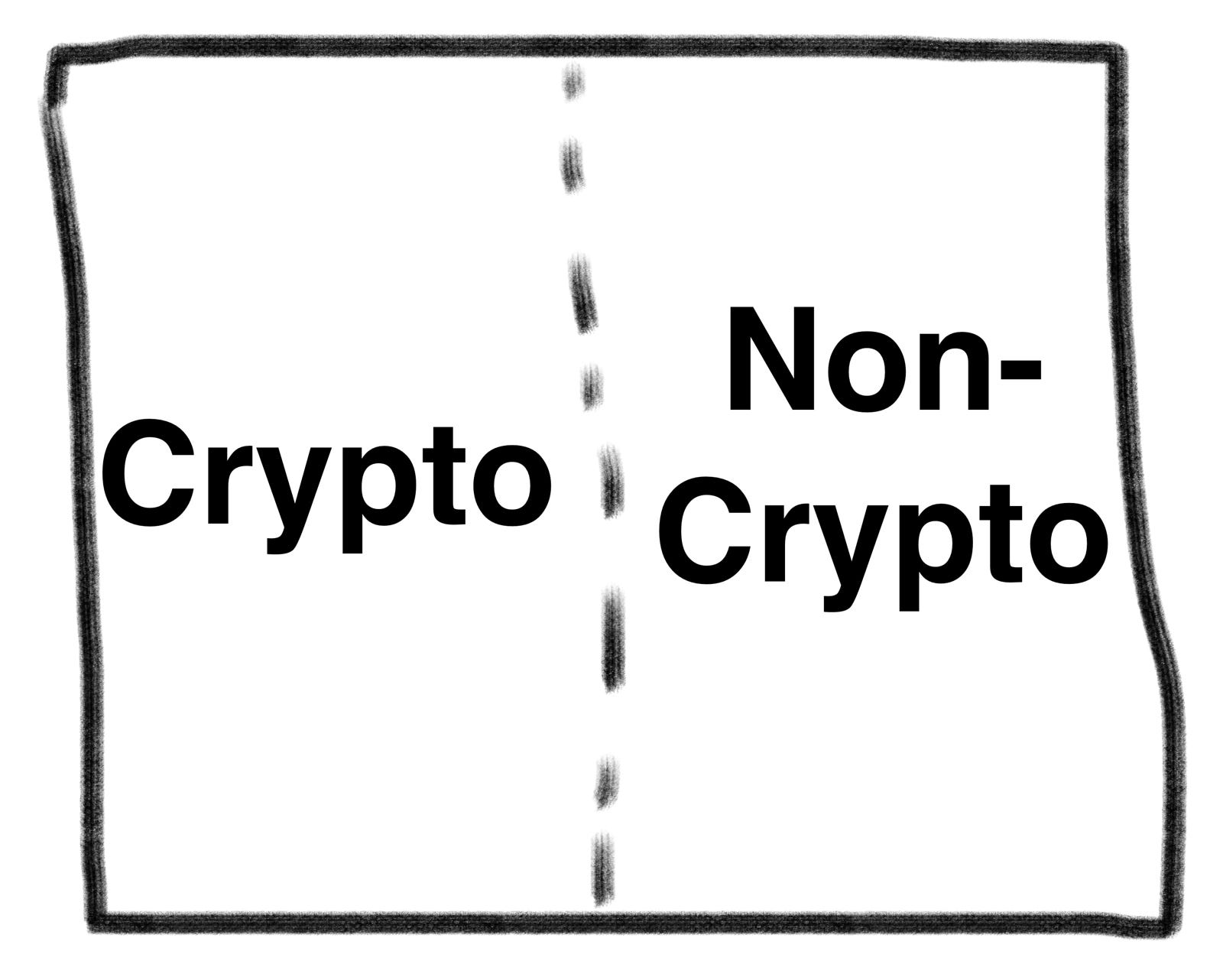
I think it’s far from the best way to slice things. Here’s how I’m looking at it:
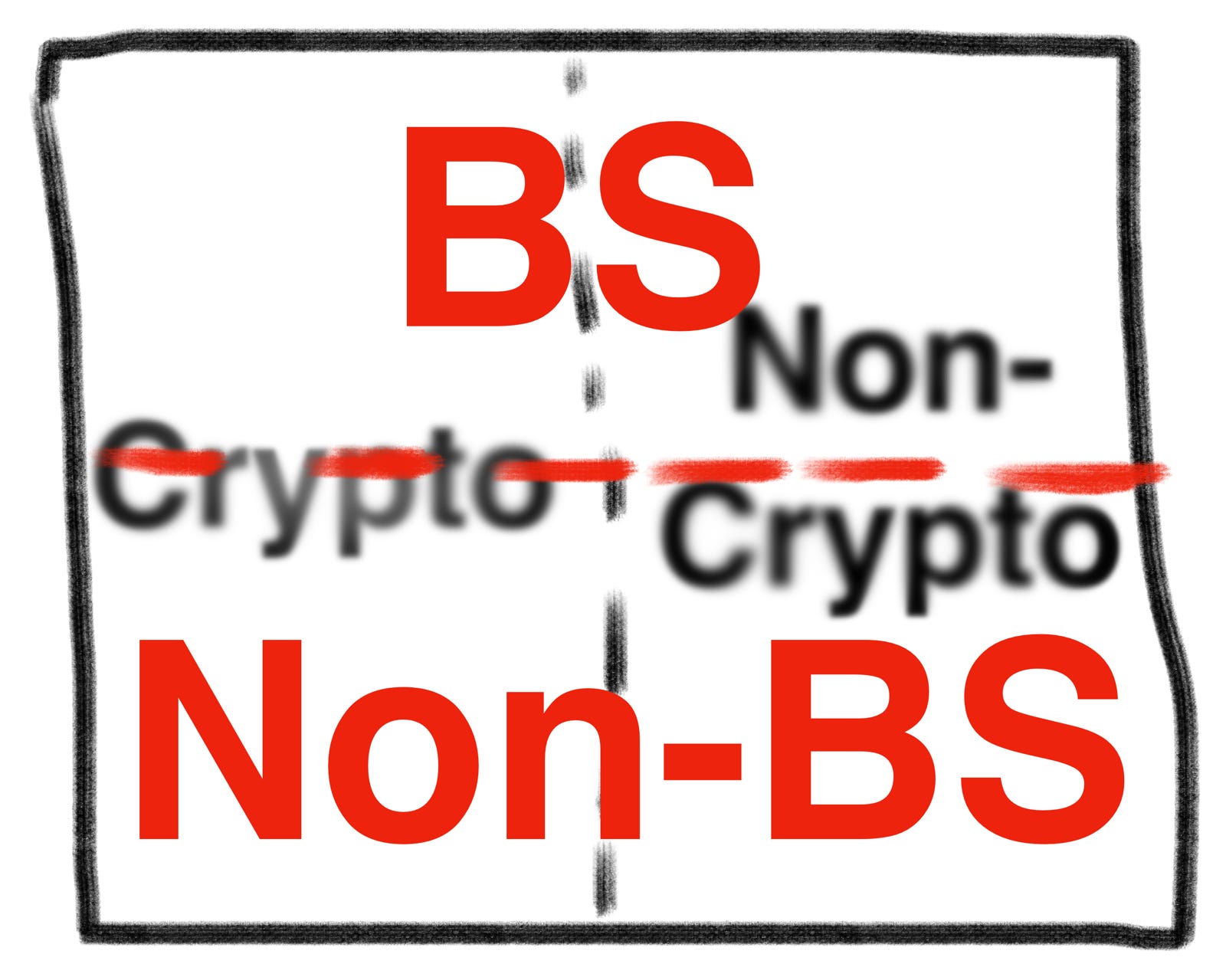
I want to support people who are creative, productive, solve real problems, create useful technologies and tools (the building blocks that others will use to make more cool things), creating non-zero sum systems, etc.
And I want to ignore or denounce those who are bullshitters, fraudsters, grifters, pump & dumpers, encouraging unsophisticated people to gamble or become greater fools, ponzis, creating zero-sum systems, etc.
How Bezos asked Andy Jassy to be Amazon CEO & more
“I’m contemplating stepping away from the CEO role at Amazon,” Bezos said, as recounted to me by Jassy. “I’m happy to keep doing the role, but I’ll only stop doing it if you’re excited about being the next CEO and my successor.”
Sounds like a dream job? Well, at that scale, it’s almost like becoming a politician too, which is a lot less fun..
This job would inevitably lead him to be dragged in front of Congress, cameras glaring and angry politicians trying to tear him apart, where he would be forced to answer questions about Amazon’s monopolistic business practices and a slew of antitrust issues. He’d be ridiculed on TV, turned into a million unflattering animated GIFs on social media, and see his name and face shackled to the front pages of a thousand newspapers. It was a role that would put him on the front lines of the war with Amazon employees trying to form unions, where he would have to personally hold at bay tens of thousands of competitors and stave off foreign governments that want to break Amazon into a million little pieces
This is from a (very uneven in quality) profile of Jassy in Vanity Fair. Some other highlights from the piece:
Jassy is a creature of habit and tradition to an unusual degree. He meets each of his two kids, a son and a daughter, for breakfast once a week (always independently), on the same day at the same time, and has done so for years. He hosts the same weekly, monthly, and annual sports gatherings at his house. He schedules two hours for himself on his calendar once a week to read (often Amazon-related memos), and on Tuesdays, as he’s done for the past 25 years, he has a date night with his wife, Elana.
I don’t know if this says more about Jassy or about the journalist:
When I’ve written about other tech CEOs—Jack Dorsey, Mark Zuckerberg, Steve Jobs, even Bezos—there has always been a seemingly infinite line of former employees, old friends, or cofounders, usually those who felt they’d been wronged, who have been all too happy to vociferate in great detail how fucked up their old bosses were as human beings. When it comes to Jassy, though, I couldn’t find one person who could—or would?—say a bad thing about him. (And trust me, I tried.) All anyone would say was how nice and unpretentious he is.
His college roommate, Tom Salentine, told me he’d seen Jassy’s niceness back in their Harvard dorm-room days. (Once Jassy was worried that a fellow student studying for a test wasn’t eating enough, so he began leaving food by his door each night.) [...]
I came away from two dozen interviews unsure if either the Amazon communications staff had cleverly debriefed everyone who had ever interacted with Jassy over the last 53 years to say almost exclusively nice things about him
What’s the worst they could find about Jassy? Apparently he has too-much attention-to-detail (it’s like the old job interview joke):
some employees say Jassy’s attention to detail can sometimes be maddening—that he gets into the weeds on issues far beneath his pay grade and obsesses about them. One example took place a few years ago, when a hurricane knocked out power to one of the AWS data centers. Generators had been installed precisely for a situation like this, but when an employee flung open a door to the generator room, the back of the door hit an emergency shutoff button, which took the entire data center down. According to someone who worked with Jassy, rather than just tell people to move the switch, he held countless meetings about the incident and became personally involved in deciding where in the room the switch was moved.
¯\_(ツ)_/¯
They do talk about some of the company’s problems, and kind of imply Jassy may be involved (“With his reputed attention to detail, is it possible he didn’t know?”), but I think that with almost 2 million employees, you’ll *always* be able to find things going wrong inside Amazon, just like you can always find plenty of people doing things wrong in a city of 2 million people.
I don’t think that’s avoidable, though of course, the captain of the ship should steer it in the best direction possible. 👨✈️🛳
Did computers reduce the value of having a photographic memory?
Friend-of-the-show and Extra-Deluxe (💚💚💚💚💚 🥃) supporter Byrne Hobart had a line that made me stop and think in this post:
Milken worked insane hours and apparently had a nearly photographic memory, a bigger competitive advantage when records weren't digitized and easily searchable.
Interesting observation.
If the value of a photographic memory went down with the rise of the computer and of powerful tools like Google, when was it highest, and in what field... 🤔
Were some emperors and kings of the past relying on advisors with high intelligence and photographic memories to help run their empires and keep track of things? Were they actively seeking such people in the populace, and elevating them to important positions inside their organizations as one of the only ways to quickly keep track of very large and very complex systems?
Steve Jobs & Larry Ellison Anecdote
Ho Nam reminded me of this great Steve Jobs anecdote with his tweet:

Here’s the anecdote:
On this walk, Ellison and Jobs talked about ways they might together regain control of Apple. At the time, Jobs was the CEO of Next, the computer company he founded after being pushed out of Apple, and of Pixar, the animation company he later sold to Disney.
At the time, Apple was in "severe distress," Ellison said, and had faltered badly after Jobs's exit years earlier. People wondered if the company would survive. "It was all too painful to watch and stand by and do nothing. So the purpose of that particular hike through the Santa Cruz mountains on that particular day was to discuss taking over Apple Computer."
Ellison's idea was to buy Apple and immediately make Jobs CEO. It made sense. Apple was worth only about $5 billion at the time, and, as Ellison said, "We both had really good credit, and I had already arranged to borrow all the money. All Steve had to do was say yes."
Jobs proposed what Ellison called "a more circuitous route." He would persuade Apple to acquire Next, and then join Apple's board. "Over time the board would recognize that Steve was the right guy to lead the company." As we all know, that's exactly what happened the following year.
"I said okay. That might work," Ellison said. "But Steve, if we don't buy Apple, how are we going to make any money?"
Ellison went on: "Steve stopped walking and turned toward me. We were facing each other and he put he left hand on my right shoulder and his right hand on my left shoulder."
Jobs then said to Ellison: "Larry, this is why it's so important that I'm your friend. You don't need any more money. ... I'm not doing this for the money, I don't want to get paid. If I do this I need to do this standing on the moral high ground."
Ellison retorted: "Well, that just might be the most expensive real estate on Earth."
But Ellison knew that he had lost the argument. Jobs, he said, made up his mind, right then and there on that hike, how he was going "to save Apple his way," Ellison said.
🍎
📊 Ode to Brooklyn Investor 💰
This blog was an inspiration for me to put this steamboat in the water 🚢.
I was just looking at its RSS feed, and it hit me just how infrequently they post.
The most recent entry is from May 2021, before that you have to go back to January 2021, then there’s 6 posts total in 2020, and then 4 total in 2019, and then 5 in 2018…
Incredible how they managed to influence me so much and have such a well-defined writing voice while posting less than 10 times a year. I wish I was that talented… But hey, practice practice practice… 🎹
Science & Technology
Simple Technical Explanation why Apple Seems Like Its “Slowing down your 5-year-old iPhone on Purpose”
First of all, it’s a lot easier for this issue not to make headlines if you just stop supporting old devices with new OSes the way a lot of Android handset manufacturers do. But that’s an aside.
Go to this page and look at the progression over time (and hit “multi-core” too, because that’s even more steep — higher numbers are better).
Unfortunately I couldn’t find the graph that I was looking for, which would show the CPU performance of every single iPhone from the very first one to the most recent one, but here’s what it looks like with just a subset of models:

That’s single-core, but the difference is bigger multi-core because early iPhones were single-core, and the most recent ones have 6 cores (4-fast and 2-low power). If you look at GPU power and machine learning accelerators (which weren’t even present until the iPhone 8/X), you have an even steeper climb.
Why am I talking about all this? What has this to do with Apple slowing down people’s old phones with new OS updates?
Well, if you’re Apple engineering, when you develop a new OS and the new apps, your target hardware is the brand new phone that is going to be released at the same time as the new version of iOS. This new phone may have multiples of the processing power of a phone of a few generations ago, because smartphone silicon is still improving pretty fast.
For example, the iPhone 13 scores 4601 on Geekbench muti-core and a 5-year-old iPhone (iPhone 7) scores 1287 on the same benchmark. That’s quite the difference!
So it’s great to test new OSes on older hardware and do your best to optimize for it, or to create cut-down versions of certain features that run faster, but there’s only so much you can do to.
Even if you think 5yo is too much, models 3-year apart are still dropping from 4601 to 2460.
And even that’s a simplified view of things, because that’s just the CPU. Computers are systems, and the end performance depends on all the parts.
An old iPhone has slower storage, a smaller amount of RAM that is also slower, a slower GPU, etc. Software tends to get more complex over time, so it takes more space on disk, uses more RAM, has bigger graphic assets, requires more compute, uses AI/ML accelerators, etc..

I think this pretty convincingly argues that even if you did everything you could NOT to make very old phones slower on new OSes, it’s very hard to do unless you make different trade-offs and decide to cripple your modern OS so that it runs faster on old hardware, but isn’t as good on new hardware as it could be if you used the whole power of the new thing.
Making a Pan-coronavirus "super vaccine”
How does the “super” vaccine work?The main approach taken by research labs is to find people called “elite neutralizers” who have had COVID19 or been vaccinated (or both) but have an incredibly rare and unique response. These are people who can make very potent antibodies (called broad neutralizing antibodies; bnAbs) that bind to parts of the virus well beyond the spike protein—parts of the virus that are present in all of the coronavirus family, remain unchanged despite mutations, and are hidden (“cryptic” epitope sites). These elite neutralizer people are rare, but there’s basically a treasure chest of protection lying within them. [...]
The vaccine presents a protein that looks like a soccer ball with many different faces (see figure below). Each face presents instructions for a different part or version of a virus. Then our body makes antibodies for each one of these faces and ensures that our antibody factories (called B-cells) remember these different designs.
This looks a bit like this:

Such a vaccine is entering phase 1 trial. Let’s hope it’s a good candidate.
The Arts & History

“The Beatles: Get Back”, More Thoughts & Podcast
If you enjoyed the documentary and want even more, here’s a 1.5-hour discussion of it on the Incomparable podcast:
The film was unlike anything I’ve seen on the Beatles before. The magic of it is I now feel like I kind of know who they were as people.
Through this footage, I feel like I spent enough time with them not being fully on guard/on stage to see through the public facade (if only a little — do we ever know someone fully, even ourselves?).
Without this, it’s easy to forget that they’re real people. With larger-than-life people, it’s easy to resort to caricature based on a few data points (hippie clichés or whatever)
This documentary also made me want to re-watch the Anthology documentary form the 1990s, which I haven’t seen since my parents taped it on VHS from a TV broadcast, with French subtitles because I didn’t understand English back then…
I wonder: If I had a choice between being re-incarnated as Paul or as Ringo in 1960, which would I choose? Paul is clearly a creative genius, but is Ringo happier and on the same ride while feeling a lot less pressure? Which would you choose?
Disney+ Firefly Reboot
Apparently Disney is working on a reboot of Firefly for D+.
While the project is in the early stages, it doesn’t seem to include Joss Whedon, and who knows what it’s going to look like (I have very low expectations for them recapturing the magic — it’s a case of “it’s not because something has the same name as something else that it’s the same thing”), but hey, I’m glad they’re trying, because once in a blue moon the stars align and it works, while if they weren’t trying at all, the odds are 0%.
Interesting points about the photographic memory! I think successful people are not processing all the information, but are able to ask for the most important information (or even feel what really matters?) It's almost a paradox; the more information you have available, the worse it can get, because you can so easily get lost and create a lot of overhead. (God forbid you are struggling with decision making on top!)
For example, I remember our Corporate controlling catalog at Daimler Financial had over 100 pages of definitions and KPIs, but what really mattered was just small parts of it.
Probably emperors and kings were just as good with people and asking the right questions to make good decisions as today's best leaders are? I guess its about correctly reading the information and people. And then if you are not really a numbers guy maybe get a numbers guy to sit next to you.
I feel readily available information overload is both, a blessing and a curse.