


Interview people you know, even if they’re not famous or experts in any particular thing.
Just write down 10 questions and hit record. You’ll learn a lot and deepen the relationship.
📉 I love how everyone is playing it cool on Twitter while many widely owned stocks are down 40-50-60% from peak.
My portfolio is down ˜10% YTD, in less than 2 weeks (there’s a few points of FX in there, as the CAD-USD has been moving too, but whatever).
Oh well, it happens, part of the game. ¯\_(ツ)_/¯
It always feels worse to be down 10% than it feels good to be up 10% (I was up 30% last year and felt nothing special, but if I had been down 30%, I’d surely have felt something). This asymmetry is something to keep in mind, a good reminder to zoom out and keep things in perspective based on the numbers, not just on how things feel.
Part of that perspective is also reminding yourself of the pros and cons of the approach you’re taking.
No approach is all rainbows and puppies 🌈 🐶 🐶 🌈 without any downsides, no vehicle does as well on the racetrack as off-road 🏎 🛻
My approach is to be mostly fully-invested, so when things are going well, I benefit fully, without a big cash drag.
But when things get choppy, I don’t have a bunch of cash to deploy, so I mostly just wait it out and let the CEOs of my companies do smart things for me (buybacks or M&A at lower multiples or hiring and investing in R&D as their weaker competitors slow down, etc).
Someone who comes into a downturn with a ton of cash may feel great, but that’s the flipside of feeling frustrated by that cash drag during other periods.
It’s also about knowing yourself: I know I’d personally have done worse over the years if I had tried to move in and out of positions constantly, because almost all my mistakes have been these types of moves. Others may be great at that, and should do it if it works for them.
Personally, I tend to do better when I identify good companies and hold them for years, while monitoring their execution.
It does mean that I sometimes own things that get expensive, and then multiple compress (no truly good company can compound rapidly for 5-10 years while *never* appearing expensive), but I’ve found that I rarely re-buy what I sell. I end up watching a company I know well and wish I could own for the long-term get away from me, and still do well despite multiple corrections in the stock (anchoring is hard to avoid, even when you know about it…).
Just one approach among many, but this one is mine.
👀 🧠 I love when someone helps me see something in a new light.
In his podcast with Tim Ferriss, Andrew Huberman described our eyes as “pieces of our brain outside our skull”, a part of our nervous system poking out to sense light, etc.
I have to admit, I was looking at my wife’s eyes a bit differently after listening to that podcast…
🛀 Don’t forget to do stuff:

📝 Really cool illustration showing the purpose of Obsidian (the free note-taking software that I’ve been using for a few months):
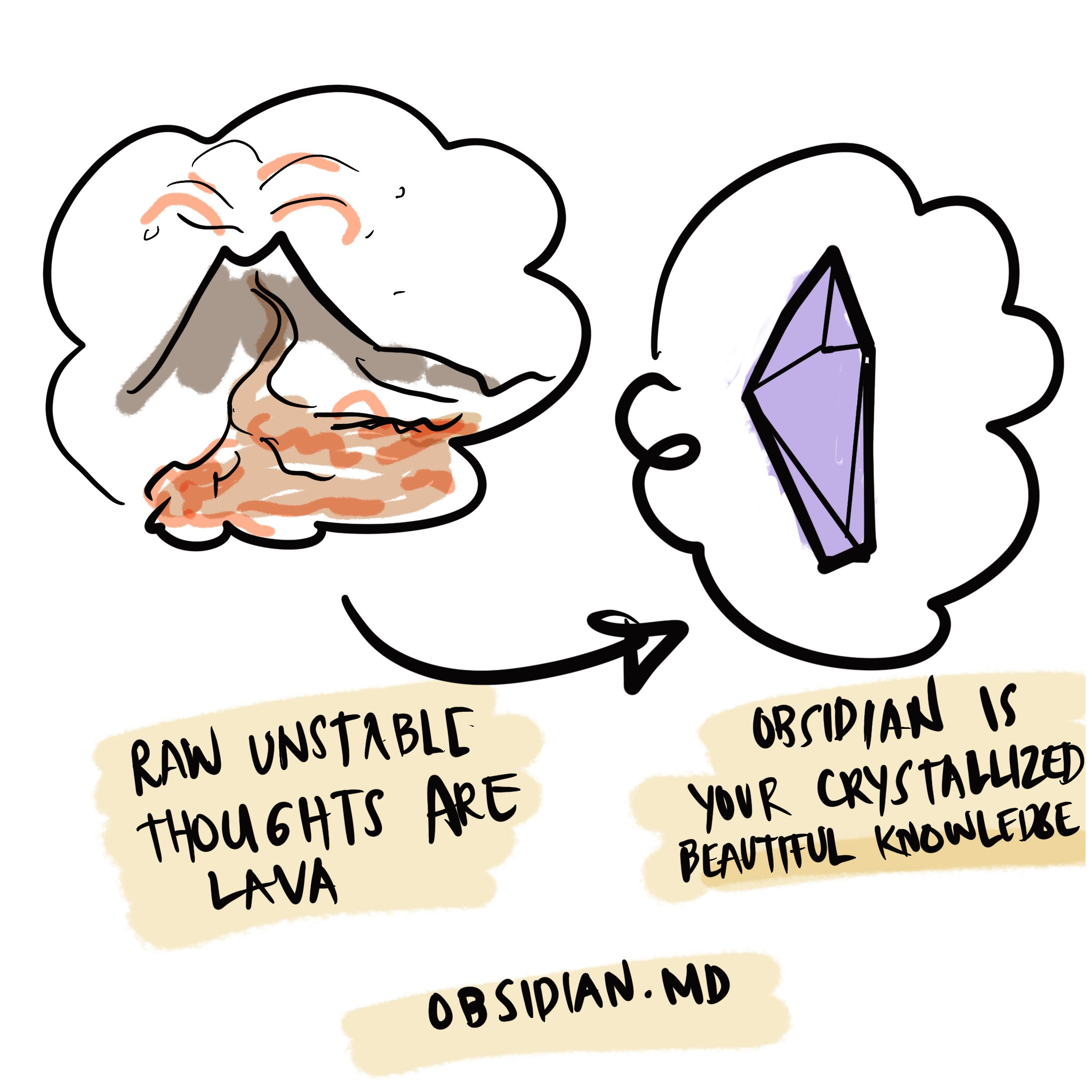
I’m not sure who drew it, but I found it here from Ely.
💚 🥃 For the price of one alcoholic drink, you get 12 emails per month (plus 𝕤𝕡𝕖𝕔𝕚𝕒𝕝 𝕖𝕕𝕚𝕥𝕚𝕠𝕟𝕤) full of eclectic ideas and investing/tech analysis. That’s 77¢ per edition for the serendipity engine.
If you make just one good investment decision per year because of something you learn here (or avoid one bad decision — don’t forget preventing negatives!), it'll pay for multiple years of subscriptions (or multiple lifetimes).
As Bezos would say of Prime, you’d be downright irresponsible not to be a member, it takes 19 seconds (3 secs on mobile with Apple/Google Pay — if you don’t see paid options, it’s because you’re not logged into your Substack account):
Investing & Business
Sentiment Check: Zoom is basically trading where it was on March 23rd, 2020

💰 TSMC capex über alles 💰
There’s this sentence at the end of TSMC’s Q4 press release:
The management further expects the 2022 capital budget to be between US$40 billion and US$44 billion.That amount is just bonkers. They’ve got capex coming out of every orifice. 💰💰💰💰
Intel and Samsung gave big numbers, but this is next-level (if you come at the king, you better not miss…).

This graph shows where their revenues are coming from (on the left), and how fast each segment is growing (right). Clearly HPC is overtaking the much more mature smartphone segment, and while small, auto is rapidly expanding.
Elastic CEO and Founder Switches from CEO to CTO Role
I don’t know what to think of this one.
There can be “good” reasons for this change — some founders just don’t enjoy the role of CEO and want to focus on just products and tech — and so it makes sense to have them focus on their strengths and find someone else who’s better at the other stuff to be in charge. If this change improves both products AND management, it’s a big win.
But there can also be “bad” reasons for this kind of move: There could be problems at the company that Shay just couldn’t solve, and maybe he realized it himself, or was convinced to step aside by the board..?
We can’t know from the outside, but I’m guessing that the reason isn’t that they looked at Everbridge and saw how well the abrupt CEO transition went, so they decided they wanted some of that too…
‘the rate at which tech industry is going global is still under-appreciated’

(Patrick is the CEO of Stripe and Matthew of Cloudflare)
‘Time spent using smartphones is rising by about 30 min. per year’
We’re going to run out of hours… But the way my kid plays Minecraft on the Nintendo Switch *while* watching a Minecraft video on Youtube, I suspect there’s a lot of ‘second screen’ usage in there.
Brian Jellison & Roper 2.0
Brian Jellison took the helm of an industrial conglomerate built around pumps (the original Roper Pumps) and transformed it into a quite different animal over his tenure.
His ideas still guide the company today (I guess you could call it Roper 2.5). after his unfortunate and rather sudden death in November 2018.
At times he sounded more like a professor than a CEO, a big fan of the socratic method.
Here’s a good thread on Jellison’s time at Roper, with excerpts from the book ‘Lessons from the Titans’, by friend-of-the-show and supporter (💚 🥃) Frederik Gieschen.
Interview: Denise Shull, the inside game of investing
This one by friend-of-the-show and supporter (💚 🥃) Bill Brewster made me think about how if you keep going long enough in investing, what you find at the bottom is not what you'd expect, like accounting or secret tricks to value companies or checklists of moat signals…
Instead, what you find is basically psychoanalysis.
I think lots of people are kind of figuring that out over time.. early on, people read all these books about investing and accounting, and later on, they read books about the stoics and meditation and psychology 🤔
Richest Canadian: Changpeng Zhao, Founder and CEO of Binance (worth around $100bn — who knows?)
Changpeng Zhao, 44, is worth about $100 billion and owns 90% of Binance and an unknown amount of cryptocurrency. Zhao was previously a member of the team that developed Blockchain.info and also served as chief technology officer of OKCoin. [...]
Binance and Binance USA combine to have 4-5 times the trading volume of Coinbase. [...]
In September 2019, the exchange began offering perpetual futures contracts, allowing leverage as high as 125 times the value of the contracts. (Source)
Science & Technology
🐷🫀 Pig heart transplanted to human for the first time
Amazing in itself, but here’s what makes this next-level sci-fi:
The heart used for this transplant did come from a genetically modified line that was specifically engineered to reduce the chance of rejection by the human immune system. [...]
it's difficult to know exactly what genes were modified in these pigs. The University of Maryland's press release indicates that there were three pig genes knocked out to lower its immune profile and avoid rejection, and a fourth knocked out to block "excessive growth" of the porcine cells. In addition, six human genes were inserted into the pigs to enhance the human immune system's tolerance of the foreign cells. While it's easy to speculate on what these genes might be, the potential list of targets is much larger than what has actually been edited. (Source)
🔌 Nuclear Regrets ⚡️
The more I've learned about nuclear power over the past 10 years, the more I think that one of humanity's biggest self-own is bungling it so badly.
So many things on Earth would be better if we had been able to be rational about it all (meanwhile: millions die and get sick from air pollution, or just have lower quality of life, global warming, lower-cost power, etc).
You know that concept in investing where you say: what if I was starting over again today, would I buy what’s in my portfolio?
I think there’s kind of a similar effects going on with nuclear. If we were starting from scratch, we wouldn’t rebuild everything the way it is right now, but coal came on the scene before everything else, and we kind of got used to it before we even knew how problematic it was, so for a long time it got a bit of a free pass. It was kind of grand-fathered in.
But if you were starting again from scratch, coal’s downsides would be a lot less acceptable.
If nuclear had come first, and we were thinking about replacing nuclear with coal, I think people would protest and feel it’s very irrational. Yet it’s kind of what we are doing in places like Germany and Japan, the end result is the same.
Too many people seem to think that anything with *any* impact should be opposed, but the reality is that if you block something with demonstrably very very low impact and it gets replaced with something with very high negative impact, you’ve made a pretty bad trade.
Motivated-reasoning and double-standards are so frequent when it comes to this kind of stuff..
Same for birds & wind-turbines. Yes they kill some, but not even close to the same order of magnitude as how many birds are killed by power lines, buildings, cars, house cats, etc.. but if it's a vivid picture, it sticks.
It’s not about facts, it’s about emotions.
I also think the impact of nuclear on poorer countries would’ve been higher than it may seem at first, because of the second-order effect:
If nuclear had kept being developed in a sane way by richer countries (ie. don’t ratchet up the costs of regulations every time you have efficiency gains, making sure that price can never go down and only up), it would’ve lowered costs massively through climbing the learning curve and economies of scale, and clean, reliable baseload power would’ve been available to mid-income and low-income countries too, making the lives of their citizens much better.
Oh, and one more random thing I was thinking about:

As much as I love the peak-era Simpsons as a TV show, I think that their depiction of Homer at the nuclear plant has subconsciously made millions trust the technology and industry a lot less and misunderstand it more than they would have others.
I don't think they did this on purpose, it was just to be funny, but it’s really too bad.
2021 was sixth warmest year on record

The Arts & History

Pixar lunch of 1994
Four of Pixar’s leading directors- John Lasseter, Andrew Stanton, Pete Docter, and Joe Ranft (who unfortunately died in a car accident in 2005) had a lunch meeting one day in 1994, when the production of their first movie Toy Story was almost finished. Four of Pixar’s movies were born from that one meeting.
Their next idea for a movie was Bugs Life. Bugs, like toys, would be easier to animate and thus an easier option. They were trying to build on the Aesop fable, the ant and the Grasshopper. Andrew Stanton and Joe Ranft suggested that the grasshoppers, unlike the fable, would just take the food from the ants.
Toy Story was based on the belief that kids thought toys came to life when nobody was looking. Pete Docter, who says that after the movies release, everyone started believing that the toys really did come to life when they weren’t looking. For one of their next films, Docter suggested that they come up with another popular belief, that monsters were hiding in the children’s closet ready to come out and scare them.
Andrew Stanton got inspired to come with Finding Nemo, from many of his experiences. First, he remembers as a child watching the fish in the tank at the dentists office, and wondering if the fish wanted to go home. In one of his trips to Marine World (Six Flags Discovery Kingdom), he saw a shark which he thought could be done so well in animation (like Bugs Life and Toy Story, at that time animation was restricted and advance materials could not be made). He also got the idea of an over-protective father when he was doing the something with his son at the park one day. He got the idea of clown fish, by seeing a photo of a clown fish and decided it was perfect for his purpose.
At the lunch meeting, after discussing these movies they finally discussed the last movie Walle-E. Andrew Stanton asked “What if mankind “What if mankind had to leave Earth and somebody forgot to turn off the last robot?”
🤘 TSMC (if you come at the king, you better not miss…) 🤘
Pixar lunch of 1994- Liberty, this story was so good, I finally read it to my teenage kids today. They grew up on Pixar! 🙏 1 Lunch!! 🍌🍌🍌