


When you lead, your real job is to create more leaders, not more followers.
—Kevin Kelly
🗓️ 2️⃣0️⃣2️⃣6️⃣ 🎆 2026!
We’re now closer to 2050 than to 2000.
That feels a bit weird 🤔
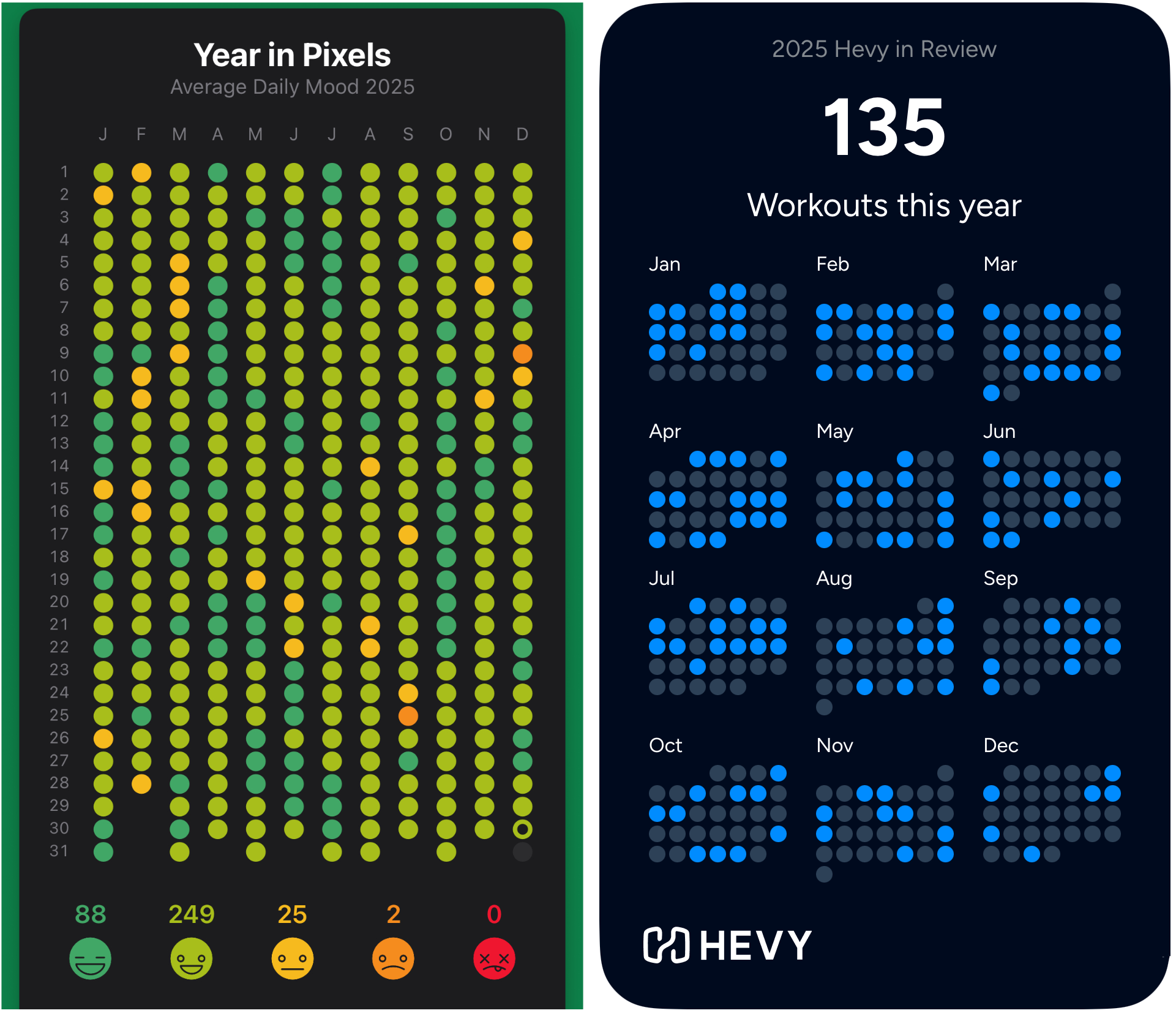
On the left is my mood-tracking for the year (I use an app called Daylio), and on the right is my workout tracking (app: Hevy).
My mood remains pretty stable, and my baseline is pretty happy. I know there are many factors behind this, some have to do with conscious life choices (surrounding myself with good people, working on things I find meaningful), some are luck or genetics.
I didn’t exercise as much as I wanted to. I did better in the first half of the year than in the second. I want to be more consistent in 2026.
I don’t need to do anything heroic, just get to a level where I notice improvements, which become a self-reinforcing dynamic (improvements → motivation). And I want to avoid the opposite: negative momentum, which is also self-reinforcing and hard to break.
👶👨👩👦 My friend MBI wrote a great piece about his first year as a dad.
I recommend that you check it out. And if you aren’t a parent yet, I encourage you to actively seek out positive views of parenting to balance out the pervasive narrative about how creating a family is defined by what you lose (free time, money, sleep, etc).
Too few talk about what you gain, which is far more meaningful.
In fact, it’s very asymmetric: the hard parts fade rapidly (aka the Fading Affect Bias). I haven’t thought about all the diapers I changed or sleepless nights with a sick kid in years, until I needed examples for this paragraph.
The struggles are temporary, but the deeper joy is permanent. To paraphrase a great writer: Each family becomes a civilization in miniature, and watching that unfold is the best.
🔎📫💚 🥃 Exploration-as-a-service: your next favorite thing is out there, you just haven’t found it yet!
If this newsletter adds something to your week, consider becoming a paid supporter 👇
🏦 💰 Liberty Capital 💳 💴
🎙️ Patrick O’Shaughnessy: Clean Fuel vs. Dirty Fuel ⛽❤️🔥
Over the holidays, with the kids home and both families visiting, I read less, but listened to a lot of podcasts (while shoveling snow or before bed). Among the highlights was this excellent conversation between my friend David Senra (🎙️📚) and Patrick O’Shaughnessy (☘️).
Patrick’s usually the one doing the interviewing, and while we’ve all learned a bunch about him through his questions, it was great to get an episode where he’s on the other side of the mic, focused on him and how he thinks about life & business.
One metaphor that I loved, and will try to integrate into how I look at things, is “clean fuel vs dirty fuel”:
David Senra: This is something I learned from you. This idea of making sure that your source of fuel and energy and ambition is generative and not negative. […]
It’s like I’m getting to the point where I push myself because I love it. I’m way nicer to myself than I have ever been because I’m like, “Oh, this doesn’t serve me anymore.” I will be successful because I love it. And if I love it, I’ll do it all the time. And if I do it all the time, I’ll get really good at it. And if I get really good at it, money will come as a result because it’s an act of service.
Patrick O’Shaughnessy: Yeah. The clean fuel/dirty fuel debate is really interesting. And look, a lot of—many, most, nearly all of the books that you’ve read were people that were fueled by dirty fuel.
A famous example of this is Michael Jordan being fueled by anger, so much so that when he wasn’t angry, he would invent reasons to be (making up insults from others, etc).
Or David Goggins, who largely appears to be fueled by escaping his painful past, or Larry Ellison, who talked about a deep need to prove his adoptive father wrong.
Patrick: Dirty fuel works really well, but it consumes the person in a way that I would far rather die nobody knowing who I am with no worldly success, but having people that could count on me, rely on me, I was faithful to, that I was loyal to—like that’s what I want at the end.
I also love how clear Patrick’s purpose in life is (he talks about this elsewhere in the episode).
Clarity is powerful: once you can say what you want in a sentence, decisions get easier and others understand you better (be easy to interface with).
🗣️ Benedict Evans: A More Skeptical Take on AI’s Impact
There are so many bullish takes on AI these days that I actively seek out people who are more tepid or skeptical. This interview of Benedict Evans by Ben Bajarin and Jay Goldberg fits the bill.
I agree with some of what Evans says, I disagree with some, and I just don’t know about a lot of it. But I do know that it’s good for calibration to not just hear one side of the debate, so I encourage you to check it out.
Here’s a highlight where Evans discusses whether the models are becoming commoditized:
Benedict Evans: there's a value capture question here, I think, which is that if the models as as as we stand today like general purpose models are are commodities. […]
It’s important to make the point that commodity can be very expensive and very difficult but still be a commodity…
this week GPT-5.2 is at the top and next week it will be Gemini and the week after that it will be Claude and they’re all sort of within five percentage points on the sort of the more generalized benchmarks […]
fundamentally, [an average] weekly active user probably wouldn’t pass a double blind test between Gemini, Claude, and ChatGPT [...]
there’s a question here which is do you just carry on spending the money to make an undifferentiated product with no winner takes all effects. Do you just keep hiring more people and throwing more product out there?
When do you get to the point that like, you’re exactly the same as everybody else’s thing except your logo is different and you’ve got different the buttons arrive in a slightly different order.
There’s a thought experiment I used to do with hardware vs software.
I’d ask people: Would you rather have an iPhone running Android, or a Samsung phone running iOS?
Would you rather have a MacBook Pro running Windows or a Dell laptop running MacOS?
I think there’s a similar thing we can do here: Would you rather have the ChatGPT app running Gemini/Claude, or have the Gemini app running GPT-5.2/Claude, etc.
To some users, the model will matter most (coders are in love with Opus 4.5 and Codex 5.2 these days). To most ‘consumers’, the scaffolding around the model, the product, the UX, will matter most (and ChatGPT is pretty far ahead there — I can’t believe how many papercuts and obvious bugs there still are in the Gemini mobile app).
🐜📈 Why RAM is Being Sold Like Lobster 🦞
This is a fun overview of what’s going on in RAM these days. Yes, AI demand is bottomless, yes, OpenAI bought up 40% of supply for a while, but there’s a lot more to know about the situation: DDR vs HBM, who are the big 3? How many new fabs are they building? What’s the impact on consumer products? Etc
Here are a few highlights:
The funniest part is when they explain that RAM supply is so tight and prices so volatile that some stores have started selling memory like it’s lobster. You go in and basically ask about the “catch of the day” and hope they have something good that fits your budget. 🦞
Where that RAM is going:
Samsung and SK Hynix, they may have contributed as much as 40% of the world's entire supply of memory to a single project at OpenAI going on right now to create a massive set of AI infrastructure there.
🤯
Building a chip, right? You know, like a leading edge chip, whether it’s memory or you know, say a phone chip, a phone CPU or phone memory, right? Or laptop memory or laptop chip. That takes over 5,000 process steps, right?
…and any defects ruin the chip.
Will high prices lead to more competition and new entrants?
I think semiconductors are a very tough business, right?
Memory specifically went from like over 30 companies on the leading edge to just three, right? And in a couple decades, right? Every boom and bust more companies go bankrupt.
The barrier to entry is so high, despite the fact that there is an oligopoly of sorts in many industries. In fact, most of the semiconductor industry is sort of leveled out to like, hey, there's a player with like 70% share. There's a player with like 25% share and there's like this crappy company with 5% barely hanging on, right? [...]
The thing about this industry is that it's very easy to be bullish, but the most bullish person tends to go bankrupt, right? And so that's the scary thing about this industry is if you overbuild the most that's good, you end up going bankrupt. And that's how we've gone from 30 to three, right?
Is this time different? That depends a lot on what happens with AI and where in that cycle we are.
🇻🇪 Venezuela’s Slippery Oil Reserves 🛢️🛢️🛢️🛢️🔍🤔
John Arnold, who knows a thing or two about energy, dropped a reality check:
The enormous caveat is that OPEC just publishes the numbers given to them by its members without any independent audit. In late 2000s, Chavez tripled the reported reserves without commensurate new exploration, seeking increased int'l and domestic prestige. 300 billion is made up.

Investors: that number comes from JP Morgan
JPM: that number comes from OPEC
OPEC: that number comes from Venezuela
Venezuela: that number came from um (checking)…… Hugo Chavez?!?!?!?!
To be clear, Venezuela does have a lot of oil, but let’s not take their numbers at face value. It also matters how hard the oil is to get at. Venezuela's crude is largely extra-heavy and expensive to extract.
Hannah Ritchie has more context on Venezuela’s oil production.
🧪🔬 Liberty Labs 🧬 🔭
🏎️🔥 Nvidia’s Relentless Cadence: Meet Vera & Rubin (and 4 Other Insane New Chips) 🚀
Just as everyone is starting to get used to how crazy fast Blackwell GPUs are, Jensen officially announced the next generation of chips: Vera (CPU) and Rubin (GPU).
“Today, I can tell you that Vera Rubin is in full production.”He also announced four other upgraded chips: The NVLink 6th-gen switch, the Connect-X9 SuperNIC, the BlueField 4 DPU, and the Spectrum-X 102.4T Co-Packaged Optics (so the silicon photonics are integrated directly into the chip).
That’s a lot of silicon being upgraded on a very fast cadence! That’s a brutal pace for competitors to chase.
How big is the jump in performance from Grace Blackwell to Vera Rubin?
“Rubin GPU delivers 50 petaflops of NVFP4 compute for AI inference.”
“The Rubin platform harnesses extreme codesign across hardware and software to deliver up to 10x reduction in inference token cost and 4x reduction in number of GPUs to train MoE models, compared with the NVIDIA Blackwell platform.”
Both chips, Vera and Rubin, will be fabbed by TSMC on a 3nm process.
The Vera CPU has 88 cores, 1.5TB of LPDDR5X system memory (3x more than Grace), and 227 billion transistors.
The Rubin GPU has 288GB of HBM4, 22 TB/s of HBM4 bandwidth, and 336 billion transistors.
The transition from Blackwell to Rubin should, in theory, be smoother than from Hopper to Blackwell since the switch from air-cooling to water-cooling was a much bigger lift than between most generations.
And because big numbers are cool: A single NVL72 Vera Rubin rack has 220 trillion transistors and 260 TB/sec of scale-up bandwidth (which is twice the whole internet’s bandwidth today) 🤯 🌐
Another interesting upgrade: Vera Rubin now supports fully encrypted data at rest and during compute (aka Nvidia’s 3rd generation of Confidential Computing) to protect both the proprietary AI models and user data. Thanks to this cool cryptography, someone can deploy a model without the ability to decrypt the model.
How does that work? 🔐
The CPU has a dedicated encryption engine that encrypts data leaving the CPU die. RAM content is encrypted with keys that exist only inside the processor itself. Even someone with physical access to the machine who freezes the RAM chips and reads them directly gets only ciphertext.
The Trusted Execution Environment creates an "enclave"—a protected region of memory that even the operating system, hypervisor, and cloud provider's administrators cannot read or tamper with. The CPU enforces this at the hardware level; any access attempt from outside the enclave is blocked.
The model weights are decrypted only within the enclave's protected memory. Inference runs inside this boundary. Inputs and outputs can also be encrypted end-to-end with users.
Of course, it’s not entirely foolproof, and very sophisticated attacks can no doubt find entry vectors, especially if they have control of the hardware, but it’s much better than just running things unencrypted.
Nvidia said that Microsoft and CoreWeave will be among the first companies to begin offering services powered by Rubin chips later in 2026. Two major Fairwater AI data centers that Microsoft is currently building in Georgia and Wisconsin will host thousands of Rubin chips.
📱📱Nvidia's Alpamayo: The Android to Tesla's iOS 🚙🤖
Competing with Tesla’s FSD, Nvidia is releasing the Android-equivalent open autonomous-vehicle Vision-Language-Action (VLA) stack to enable others to control self-driving vehicles and robotaxis:
The Alpamayo family introduces chain-of-thought, reasoning-based vision language action (VLA) models that bring humanlike thinking to AV decision-making.
These systems can think through novel or rare scenarios step by step, improving driving capability and explainability — which is critical to scaling trust and safety in intelligent vehicles — and are underpinned by the NVIDIA Halos safety system.
They’ve been working on self-driving for 8 years, so this isn’t a new project, but opening it up is a massive strategic shift.
Among other things, this family of assets includes:
Alpamayo 1: A 10-billion-parameter architecture that uses video input to generate trajectories alongside reasoning traces, showing the logic behind each decision.
Developers can adapt Alpamayo 1 into smaller runtime models for vehicle development, or use it as a foundation for AV development tools such as reasoning-based evaluators and auto-labeling systems.
Alpamayo 1 provides open model weights and open-source inferencing scripts.
Future models in the family will feature larger parameter counts, more detailed reasoning capabilities, more input and output flexibility, and options for commercial usage.
AlpaSim: A fully open‑source, end-to-end simulation framework for high‑fidelity AV development, available on GitHub. It provides realistic sensor modeling, configurable traffic dynamics and scalable closed‑loop testing environments, enabling rapid validation and policy refinement.
During the CES keynote, Jensen showed a video of a Mercedes driving autonomously through San Francisco for 30 minutes with no human intervention.
Making it open isn’t a bad strategy: Tesla may keep its technology to itself to differentiate from competitors, but from Nvidia’s point of view, the more automakers (who can’t compete with Tesla on their own) pick their stack, the better, because on top of simulated miles, they will get real-world data too, and the compute required in vehicles and in the cloud will be on their chips.
Nvidia wants to be the Android to Tesla’s iOS.
But the fact that they got as far as they did without a large fleet like Tesla seems to show that the “real-world data moat” isn’t as large as some thought it was 🤔
🏴☠️ Beware of Fake Whistleblowers (More Will Come)🕵️
It’s now easier than ever to create convincing, but fake, posts that pretend to be from an employee exposing corporate wrongdoing.
A recent viral Reddit post claiming to be from an employee at a food delivery app made the rounds and was one of the top stories online before it was debunked.
We’re lucky it was even debunked at all. When reached by Casey Newton for more details, the hoaxer sent a photo of an Uber Eats employee badge and an 18-page technical document titled “AllocNet-T” describing the alleged “desperation score” system.
Many journalists would’ve been fooled by this. Especially since there aren’t that many experienced investigative journalists on payrolls anymore, and most are on tight deadlines and don’t have much time (or inclination) to verify everything.
In this era of clickbait and getting paid by the pageview, many would have just run with it.
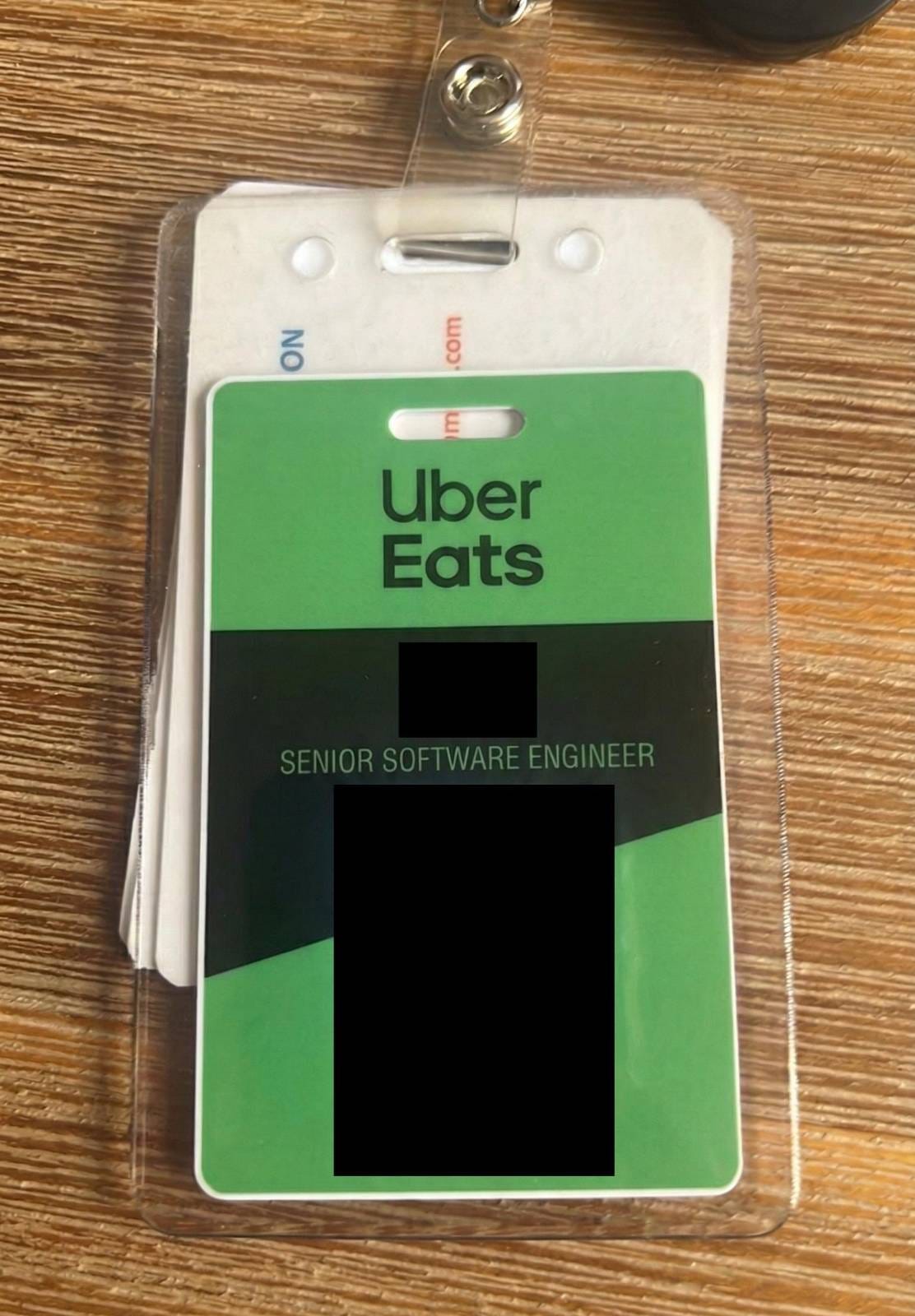
Thankfully, Newton was suspicious and looked for Google’s SynthID watermark in the photo, revealing it was AI-generated.
But this type of fraud will only get more convincing and harder to catch.
There will be effective ways to strip out watermarking. Fake documents and photos will get more convincing.
In fact, how do we know we haven’t already been fooled many times by undiscovered fake whistleblowers?
Who does this kind of thing?
It could be someone from a company trying to damage the brand/reputation of a competitor. (Corporate Saboteurs)
It could be someone trying to make money via market manipulation, trying to profit from a stock plunging on what seems to be a scandal or bad news (or betting on a competitor’s stock rising, or both). (Market Manipulators)
It could be a bored kid in their parents’ basement, looking for a thrill. (Trolls!)
That’s on top of the usual psyops from nation-states, which will no doubt become more sophisticated and targeted.
The immune response is probably to switch to a ‘disbelief by default’ posture, but that has many downsides. We don’t realize how win-win living in a relatively high-trust society is until it’s gone.
🎨 🎭 Liberty Studio 👩🎨 🎥

🇳🇴 🎬 Sentimental Value and The Worst Person in the World
Two films by Joachim Trier, a Norwegian director who was new to me, but made quite an impression.
I saw Sentimental Value (2025) first. While it’s not perfect and I would have made a few different choices, I still REALLY enjoyed it. It is strong across the board: Acting, writing, music, and cinematography (Kasper Tuxen did a great job, so many stunning shots, great blocking and composition, use of shadows, color).
I was already a fan of both Stellan Skarsgård and Elle Fanning going in, but the Norwegian cast was also very strong.
The film explores a bunch of complex themes in a nuanced way: family dynamics and estrangement, the tension between art and personal connection, the limits of communication, memory (how the past leaks into the present), mortality and regret… and how we all try to create a home in our own way 🏡
It’s not for everyone, and it can get heavy and dramatic, but it’s also funny at times.
This made me want to check out Trier’s other films, so next I watched ‘The Worst Person in the World’ (2021).
I really liked it too. I think many aspects of it are brilliant (acting, cinematography, writing, music).
But it’s also not for everyone. It’s very much a “slice of life” study of human nature. On the surface, it almost seems like a romantic comedy done by someone trying to subvert the genre, except very naturalistic, and there’s not much plot (though there are many themes). No action or explosions, but some wild moments with special effects!
Note: There are a few scenes that can be shocking to some, and some nudity, so pearl-clutchers beware.
Joachim Trier, Kasper Tuxen, and lead actress Renate Reinsve are now on my ‘keep track of what they do’ list. 👍👍
🎸 The Golden Era of the Fender Stratocaster 🗓️
A closer look at an iconic instrument. I learned a bunch of things watching this.
Who originally said the bit you paraphrased?
“Each family becomes a civilization in miniature, and watching that unfold is the best.”
Thanks for promoting parenthood. I have recently been around some middle aged people who are belatedly realizing that they may have been happier, and less lonely, if they spent more time building a family instead of “living their best lives.” Additionally, having a family gives you more respect for your parents and grandparents. I love it when my parents hear about things my kids are doing and just smile. I then remember things I did that were even more challenging for them. Attempting to be a caring parent and son is a humbling experience that is healthy for everyone.