


Judge talent at its best and character at its worst.
—Lord Acton
🕳️🐇🤔 Curiosity is almost always considered an unambiguous good. But as friend-of-the-show Gurwinder wrote:

The way I look at it:
Passive curiosity = letting others take over your attention
Active curiosity = curating your attention
It's one more argument for high agency, a little boat captain in your brain plotting the course for the voyage rather than a little Huckleberry Finn napping on a raft drifting wherever the currents lead. ⚓🚢🧑✈️
If you’re drifting, you’ll end up where all the other drifters end up. It’s hard to expect original outputs if your inputs are the same as everyone else.
You need variety AND quality.
If the quality’s missing, the variety will kill you. You’ll basically be running your brain on whatever the internet happened to spill on the floor that day. Garbage in, garbage out 🗑️🧠
🔎📫💚 🥃 Exploration-as-a-service: your next favorite thing is out there, you just haven’t found it yet!
If this newsletter adds something to your week, consider becoming a paid supporter 👇
🏦 💰 Business & Investing 💳 💴
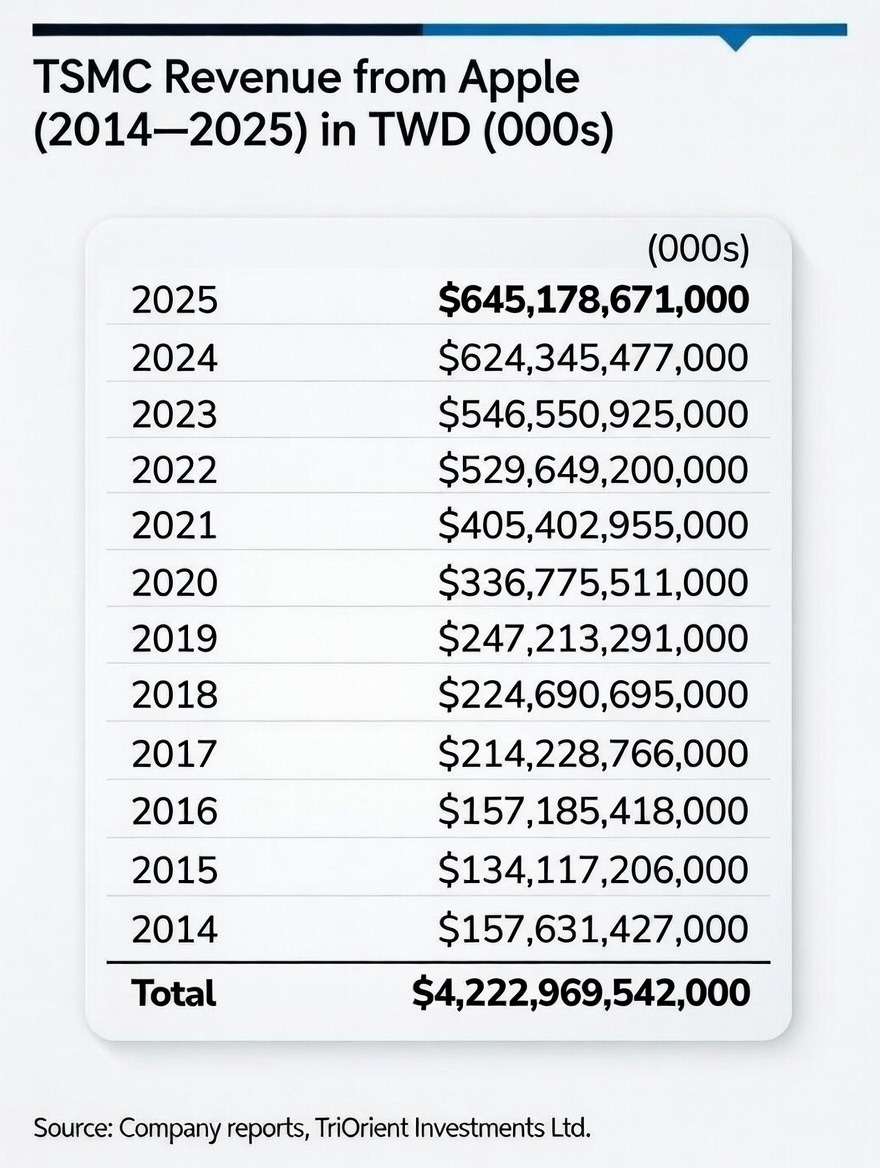
🇹🇼 Apple Spent $132 Billion at TSMC and Still Got Dethroned by Nvidia 🍎
After more than a decade in the top spot, Apple lost the top spot to Nvidia in 2025.
Dan Nystedt added up TSMC’s cumulative revenue from Apple since 2014 👆 The numbers are in Taiwanese dollars. Converted to USD, it’s $132 billion since 2014. 💰
While TSMC doesn't name customers, it discloses those representing over 10% of revenue, and Apple was the top of that list for over a decade. 🥇
In relative terms, Apple peaked at 26% of TSMC’s revenues in 2021. Last year it was 17% vs 19% for Nvidia.
For the backstory, Dan writes:
Apple originally had its iPhone chips made by Samsung, but in 2010 formed a partnership with TSMC after a dinner between TSMC founder Morris Chang and Apple COO Jeff Williams. By 2013-2014, Apple was TSMC’s top client.
The details of how Apple switched from Samsung fabs to TSMC are a good reminder that massive deals often happen because of very small-scale, personal moments. Morris Chang tells the full story himself in his interview with the Acquired guys, if you want more.
🥾 Boots on the Ground vs The Panopticon in a Box 👁️
I don’t really want to be thinking about AI+political power, but here we are.
Liberal democracy is largely about putting hard limits on state power to protect individual rights. Anyone who reads history knows this is a rare and special system. Most of the attention goes to things like courts, elections, legislative oversight. And for good reason, that’s the first line, the load-bearing beams. But there’s an implicit layer that has mattered a lot historically: the people who actually have to carry out the orders. 👮♂️🪖👩💼👨💼
The Pentagon Papers happened because Daniel Ellsberg worked at RAND and the DoD. COINTELPRO got exposed because Hoover needed thousands of agents and analysts to run it which left a huge paper trail. Nixon’s abuse of the FBI was ultimately checked by Mark Felt, the FBI’s #2 at the time, who leaked to Woodward and Bernstein. Frank Serpico exposed systemic NYPD corruption as a cop inside the machine who refused to go along. Authoritarianism has always required boots on the ground. And implementers can refuse, slow-walk, leak, or simply not show up.
To be clear, I know this is messy.
On paper, it’s much neater to say: “Let elected representatives make all these decisions!” But in practice, a system is much more resilient if it has decentralized checks and balances and multiple layers of defense against people who would trample hard-won rights and liberties. I’m not defending bureaucrats slow-walking lawful policy, a real problem too. I'm talking about a narrower thing: refusal to carry out clearly unlawful or unconstitutional orders, and the exposure that comes from needing many people to execute programs that can't survive if exposed to daylight. 🧛♂️☀️
The US military’s oath to the Constitution rather than to a leader is based on something older: armies that won’t march, judges and juries who won’t convict. The “friction of implementation” has been a real and underappreciated check on the worst impulses of people in power.
AI could change this by collapsing the human layer.
Up to now, the economics and logistics of mass surveillance made a true panopticon impossible. You couldn’t hire enough secret police to watch everyone, or enough analysts to read through everything they collect. That forced authoritarian regimes to pick targets selectively. Machine-learning was already making this easier, but LLMs have taken it to another level entirely. Modern AI is rapidly removing that barrier and shifting the limiting factor from “can we afford and implement this?” to “do we want to?”
The calculus of repression is changing massively.
And when something goes wrong or you get caught spying, “the model flagged it” becomes a universal excuse. The diffusion of accountability that large bureaucracies created accidentally, AI creates structurally.
Autonomous weapons follow the same logic. Soldiers might refuse unlawful orders, they increase the surface area of accountability and transparency. War crimes happen in front of witnesses. Autonomous systems directly controlled by people thousands of miles away remove human judgment from the front lines.
Now, I’m not claiming the human layer was always reliable…
Milgram’s experiments, My Lai, Nuremberg, the Stasi’s 90,000 full-time goons and 170,000 civilian informants. People have shown a depressing willingness to carry out orders they know to be wrong. So the question isn’t “perfect check vs. no check.” It’s how much the possibility mattered. Even if only one person in a thousand is ready to object, it’s still more than zero. My guess is that it has always mattered in ways we don’t even realize, and if Mao or Stalin had powerful AI tools to implement their will directly, their reigns would’ve been much worse.
Here’s something Byrne Hobart (💚💚💚💚💚 🥃 ) pointed out about how AI is different from physical weapons manufacturing in a crucial way. When Henry Ford built B-24 bombers at Willow Run, the production was binary. He could hope the planes would only be used on military targets, but with 1940s technology you couldn’t do anything about it once they left the factory. AI companies do have that capacity. The relationship isn’t binary. It’s a gradient, a continuously-updated service. They can constrain what their models will and won’t do at the point of use, which creates a genuinely new kind of moral dynamic between them and potential unlawful or unconstitutional uses of their products.
There's nuance here. We don't want unelected AI labs dictating tactical deployment terms to the DoD. But look at what Anthropic was actually asking for: no domestic mass surveillance and human-in-the-loop accountability for still-unreliable lethal autonomous weapons. Guardrails against things that would likely be illegal under existing law anyway (and new, very clear laws should be written for the AI age, this shouldn’t be left to procurement contracts or interpretation of decades-old laws).
Anthropic was declared a supply chain risk for this, a drastic legal tool not even applied to Chinese AI companies.
The DoD had accepted these terms in 2024 when Anthropic became the first lab used for classified military work, and again in 2025 when it renewed the deal. The military is the one that decided to renegotiate in 2026. Switching suppliers would've been justified if they couldn’t agree, but trying to destroy a leading AI lab is making the US weaker militarily and in AI, which goes directly against the government's own stated objectives. ¯\_(ツ)_/¯
AI doesn’t fully eliminate veto points. They move around.
The new chokepoints are: who has access to the model, who trains and tunes it, who controls the compute infrastructure, which vendors can push updates. These can be real checks but they can also become a single point of capture. What determines this is whether they get deliberately hardened with oversight by democratic institutions with accountability and teeth, or quietly consolidated during procurement decisions behind closed doors.
What’s a bit upside down here is that usually when there’s a new potentially dangerous technology, government intervention is about constraining use. Here it’s inverted, as the company is trying to constrain the government’s use, and the government is pushing back against those constraints.
Nuclear weapons created obvious, immediate, catastrophic destruction, which generated political will for multiple layers of physical controls, two-man rules, and barriers engineered into the technology itself. Policy AND structure.
The panopticon + killbots scenario is more insidious because it isn’t visibly catastrophic until it’s too late. It deploys gradually, against unpopular targets first, each step normalized before the next. “All lawful uses” with laws written long before today’s AI capabilities were even dreamt up has loopholes large enough for an aircraft carrier. New laws and oversight are needed to explicitly safeguard citizens’ rights and liberties in this new era. ⚖️
🚇 Applied Economics 101: BART Installs Tall Gates, Reduces ‘Corrective Maintenance’ by 95% 🚉
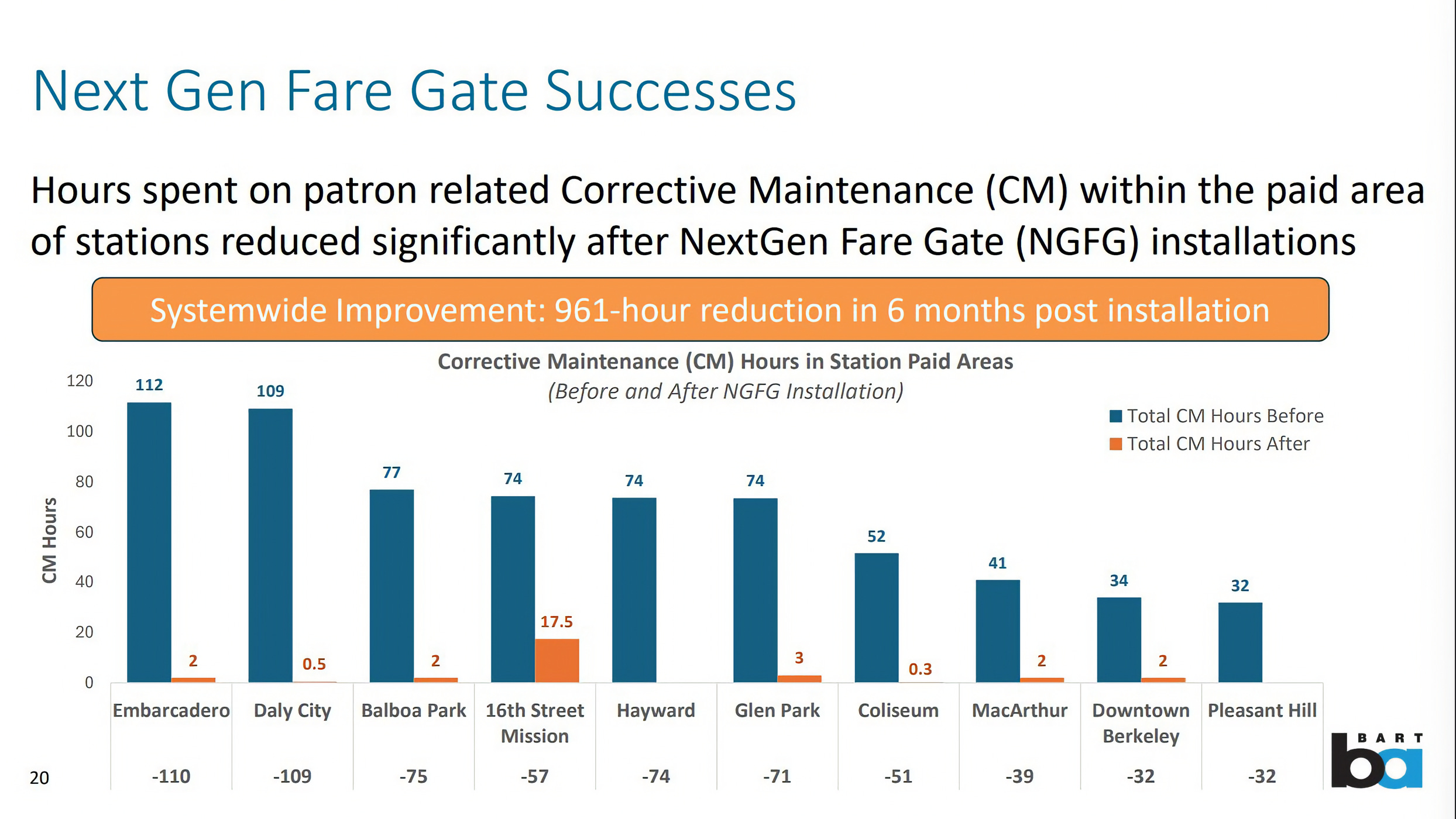
Bay Area Rapid Transit writes:
Measure RR, a voter approved investment into BART’s capital budget, has allowed BART to replace 50 year old infrastructure. We replaced our entire legacy fleet thanks to federal, state and local money such as bridge tolls (which BTW can’t be used to run service.)
We also replaced all 700+ fare gates. The new gates are bringing in $10M annually of new revenue.
The new gates are at least 72 inches tall and designed to prevent people from jumping over (what a novel concept, right? *slaps forehead*).
Well, it turns out that if you keep the people who would get in without paying, you not only get more $ in fares, but you also reduce your maintenance costs MASSIVELY, since a small number of bad apples cause most of the problems. And I’m sure the experience for all other riders is better too, in ways that may be hard to quantify.
Every transit system that hasn’t already done it should do it. More details here.
🧮 Coase Conjecture: Open Source Might Actually Help Frontier Labs Keep Prices… Higher?! 💰💸🤔
Can frontier AI labs hold onto pricing power as open source closes the gap? Soren Larson applied the "Coase Conjecture" to the situation to find out.
The Coase Conjecture, a 1972 economics puzzle, asks: if a monopolist owns all of a durable good and faces no competitors, what price does it charge? The answer is: less than it would like. That’s because if the good is durable and the marginal cost of selling more is near-zero, buyers know the monopolist will eventually lower prices to clear inventory. So they wait. The monopolist ends up competing with its future self.
The interesting twist is that open source actually helps the monopolist. A 2014 paper by Board and Pycia in the American Economic Review showed that when buyers have an outside option, the Coasian unraveling breaks down. Why wait for Anthropic to lower prices when you can just defect to a cheaper open source model today? Buyers who care about price leave; buyers who stay are willing to pay full price. This might explain why Anthropic can charge high margins even as near-frontier open source models like GLM 4.7 cost a tenth the price.
BUT
Margin preservation and revenue growth & durability are different things. Even if a monopolist keeps 90% margins, those margins apply to a shrinking pool of buyers. As open source closes the capability gap, fewer customers find the frontier premium worth paying. High margins on a collapsing revenue base isn’t much of a moat.
I encourage you to read the full piece here.
Apple is exercising the Coase Conjecture
They’re waiting for open source models to get better, applying pressure to frontier lab pricing eg rejecting Anthropic overtures
It may rather be that impatient buyers have adverse selection, revealing actually poor business positioning
Everyone said Apple missed the boat, but maybe they’ll have the last laugh? 😅
h/t my friend MBI (🇧🇩🇺🇸)
🧪🔬 Science & Technology 🧬 🔭
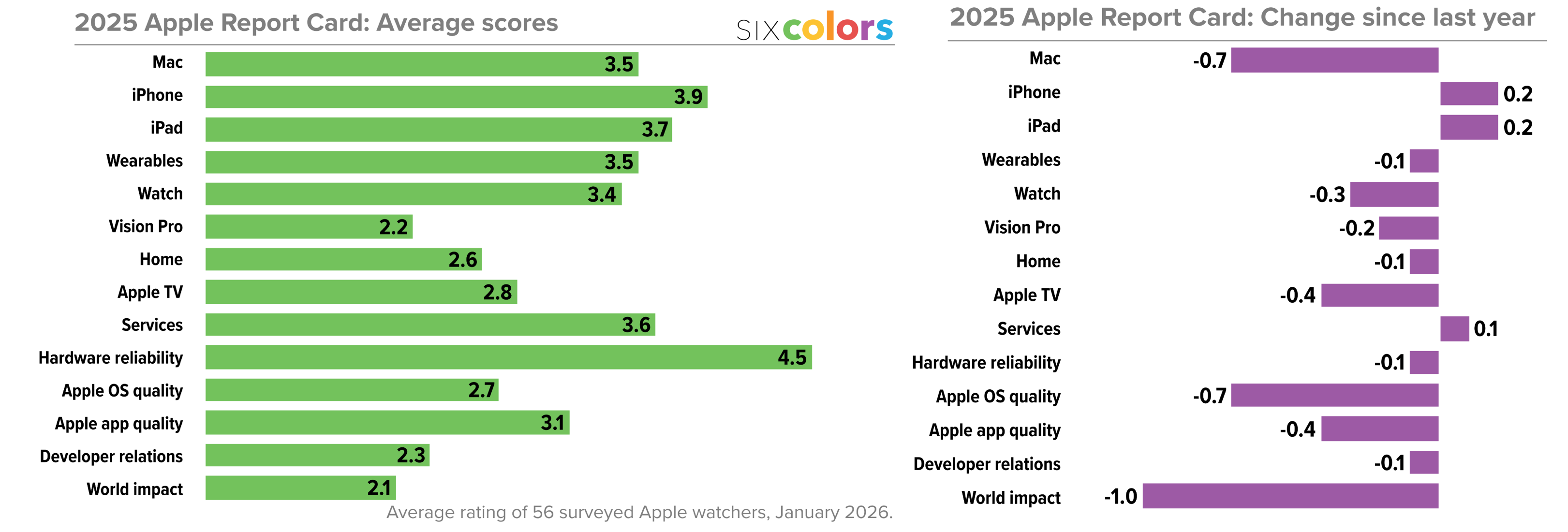
Apple’s 2025 Scorecard: The Good, The Bad, and the Ugly
Every year, Jason Snell compiles a scorecard for Apple, asking over 50 Apple-watchers and technologists to rank various product lines and aspects of the company. The consensus this year is more critical than usual, both for the trends and the specific problems the company is facing.
On the 🏆 side, the iPhone, Mac, and iPad are strong. Hardware reliability overall gets a near-perfect score and only the Vision Pro and Apple TV get ugly scores, likely because they feel like abandoned platforms that failed to meet their potential.
On the 🍅 side, OS quality, developer relations, and Apple app quality all get most of the anger from the Apple community.
Some choice quotes:
“Yearslong growing concerns over the direction of Apple’s software design reached a breaking point with MacOS 26 Tahoe. It’s so bad — or at least, so much worse than MacOS 15 Sequoia — that I’m refusing to install it.” — John Gruber
“I’ve gotten more unsolicited negative comments and queries about the 26 releases from friends and family than any other OS release in recent memory, and that’s almost all Liquid Glass complaints.” — Jeff Carlson
“I’d love to see Apple take a release cycle to focus on quality, but with the catch-up they’re currently doing for Apple Intelligence, that seems unlikely.” — Craig Hockenberry
“Liquid Glass really drags down the average this year. It also completely wiped out Apple’s ability to make improvements to existing features, which is at the core of Apple’s longstanding software quality crisis. Apple really needs to shift the balance between new features, bug fixes, and performance improvements. The process of polishing existing features is vastly undervalued by today’s Apple.” — John Siracusa
I really wish that the company would go back to its roots, the maniacal focus on design quality that defined it. Human interface used to be its bread & butter and now it’s often an afterthought. But there’s hope, since lead designer Alan Dye left the company for Meta, along with his inner circle.
Gruber and Snell discuss the full scorecard on The Talk Show if you want more.
🖥️ The Apple Studio Display Gets Its First Update Since 2022 (Four years for a better webcam 😬)
I’ve been using an Apple Studio Display since it came out. I love it. 27 inches, 5k resolution, great color calibration. Even the integrated speakers are pretty good! Only the webcam is aggressively mediocre, but it does the job.
When I saw that a new Studio Display came out, I was excited. Maybe I should upgrade! It’s going to have a much better panel with 120Hz refresh, high-dynamic range (HDR), more backlight zones, and more nits of brightness, surely!
Well, play the sad trombone because the “new” Studio Display has the same panel as before. The only updates: better webcam, better speakers. Ugh.
This wouldn’t be bad if they updated this product every year or two, but this is the first update since 2022 😬
They also released a Studio Display XDR that has 120Hz and HDR, but I’m not paying $3,300 for a display 💸
The iPhone 17e seems like a good value SKU in the lineup. Not much to say about it.
💻 M5 Pro and Max: Apple's Most Performance-Aggressive Chips Yet 🏎️
The new M5 chips do things differently: They are fusing two dies — Apple calls it 'Fusion Architecture' — to create the more powerful variants of the M5, the Pro and Max. This gives them 18 CPU cores, with 6 “super cores” (a rebranding of the core family that used to be called “performance”) and 12 all-new performance cores (which sit between efficiency and the supers). That’s 4 more CPU cores than the M4 Pro.
The regular M5 has 10 CPU cores, but the mix is different. It has 4 ‘super cores’ (using the new name) and 6 efficiency cores. Unless I’m misunderstanding what they’re saying, the Pro and Max versions don’t have any efficiency cores, and so are tuned way more aggressively for performance than ever before.
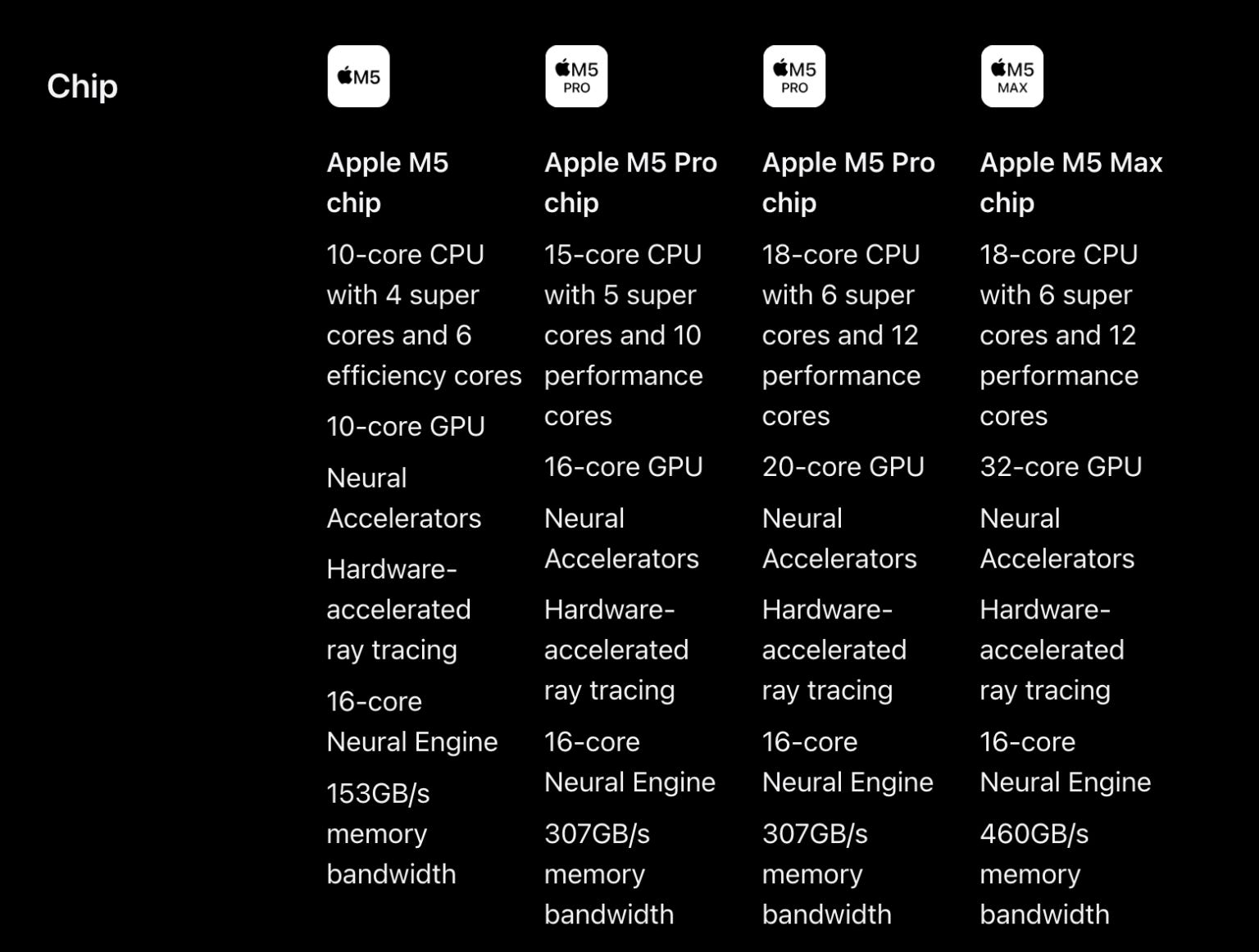
They are trading battery life for raw compute muscle 💪
(At least, on laptops. For desktop users like me, it's all upside)
The Max gets up to 40 GPUs cores, while the Pro tops at 20. Apple claims: “With a Neural Accelerator in each GPU core and higher unified memory bandwidth, M5 Pro and M5 Max are over 4x the peak GPU compute for AI compared to the previous generation.”
They claim that M5 Max is “up to 8x faster [for AI workloads] than M1 Max”, which is what I have in my Mac Studio. Hmm, I’m starting to feel like an upgrade may be worth it 😅💸
⚛️🇺🇸 The U.S. Nuclear Comeback May Have a Fuel Problem
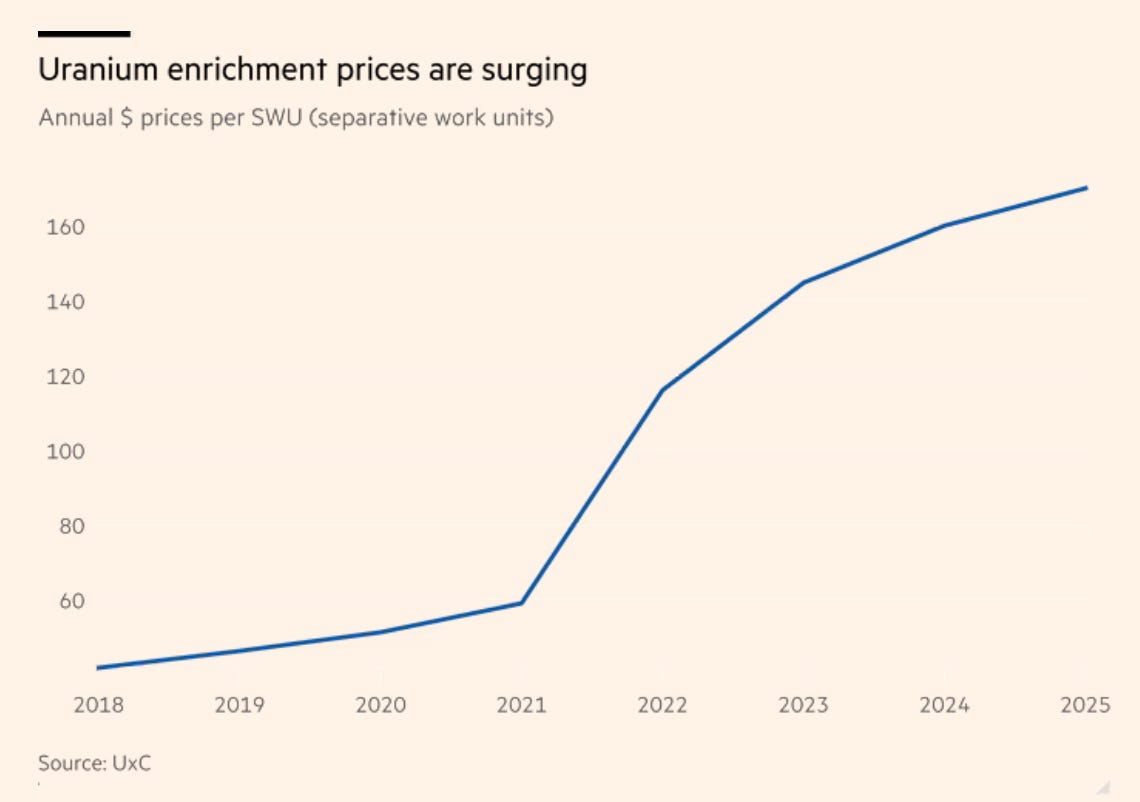
One of the great things about nuclear power is that fuel costs are a tiny fraction of operating costs (typically low single digits), so volatility in the price of uranium has relatively little impact on production costs.
BUT
You still need to get the fuel, and if there’s a shortage, the fact that it’s a small percentage of costs won’t save you:
One of the largest suppliers of enriched uranium fuel to US nuclear power plants has warned of a looming supply crunch because of fast-rising demand and a ban on Russian imports.
Centrus Energy chief executive Amir Vexler told the FT the company is racing to build enrichment capacity at its Ohio plant to meet a $2.3bn backlog in sales of enriched uranium to customers. But the restart of several US nuclear plants and upgrading of the reactor fleet to boost electricity output would put pressure on the handful of western suppliers of enriched uranium — a critical component in nuclear fuel, he said. [...]
Experts warn shortages of enrichment services threaten to derail President Donald Trump’s strategy to “unleash America’s next nuclear renaissance”. Prices have soared 167 per cent since Russia’s invasion of Ukraine in February 2022 to a record $173 per separative work unit or SWU — a measurement of enrichment services — according to UxC, a nuclear industry data provider.
Russia supplied somewhere around 20% of the enriched uranium used by US nuclear reactors in 2024 (down from 27% in 2023). Imports continued even after Congress banned them because the DoE can issue waivers through January 1, 2028, if no alternative source is available, or if the import is deemed to be in the national interest.
There’s been some progress, but the AI boom’s demand for electricity means that it hasn’t been enough:
Last month, the Trump administration awarded Centrus, Orano and new entrant General Matter each $900mn in funding to strengthen domestic enrichment services. It is also offering energy companies access to weapons-grade plutonium to convert into fuel in an attempt to break Russia’s stranglehold over nuclear fuel supply chains.
🎨 🎭 The Arts & History 👩🎨 🎥
👀🔦 Catchlight: The thing making actors' eyes alive on screen (ever noticed it?)
This is a rabbit hole I fell down recently. I don’t even remember how it started, but on some closeup shot I kept noticing light reflected in actors’ eyes, and how much of a difference it made in professional cinematography vs amateur close-ups where it was missing.
The technical term is catchlight, and it's one of those invisible filmmaking tricks that, once you know to look for it, you can't unsee. Sorry in advance.
Human eyes are naturally moist and reflective. Without a light source bouncing off them, eyes go flat on camera. A catchlight is what makes an actor look alive and emotionally engaged. It also guides the audience’s gaze subconsciously: when the actor’s eyes move, the reflection shifts, making the movement more legible.
The shape of the catchlight reveals the shape of the light source. Round ones come from bare bulbs or ring lights. Square or rectangular ones mimic a window, which is why they feel naturalistic.
There’s also the Obie light, an on-axis “eye light” generally traced to the 1944 production of The Lodger. It’s a small lamp mounted beside the camera lens, named after actress Merle Oberon. Her cinematographer, Lucien Ballard, invented it to hide her facial scars (she was in an accident). The sparkle in her eyes was a happy accident. The two later married 💍
I like that origin story. A clever technical workaround born from one person’s specific situation that became standard practice across the entire industry. 🎥💡👀
The Moon is a Harsh Mistress - a timely read. Remarkably prescient with Ai companion and war discussions….
Smooth segue!! Have a great weekend.
“If you’re drifting, you’ll end up where all the other drifters end up. It’s hard to expect original outputs if your inputs are the same as everyone else.
You need variety AND quality.
If the quality’s missing, the variety will kill you. You’ll basically be running your brain on whatever the internet happened to spill on the floor that day. Garbage in, garbage out 🗑️🧠
🔎📫💚 🥃 Exploration-as-a-service: your next favorite thing is out there, you just haven’t found it yet!”
PS: the piece on democratic safeguard was well articulated and important. The unbelievable power of the technology combined with the authoritarian-like tendencies of the current administration doesn’t sit well with me.