


Something, in excess, can become its opposite. An obsession with security breeds a feeling of insecurity.
—Tim Ferriss in conversation with Josh Waitzkin
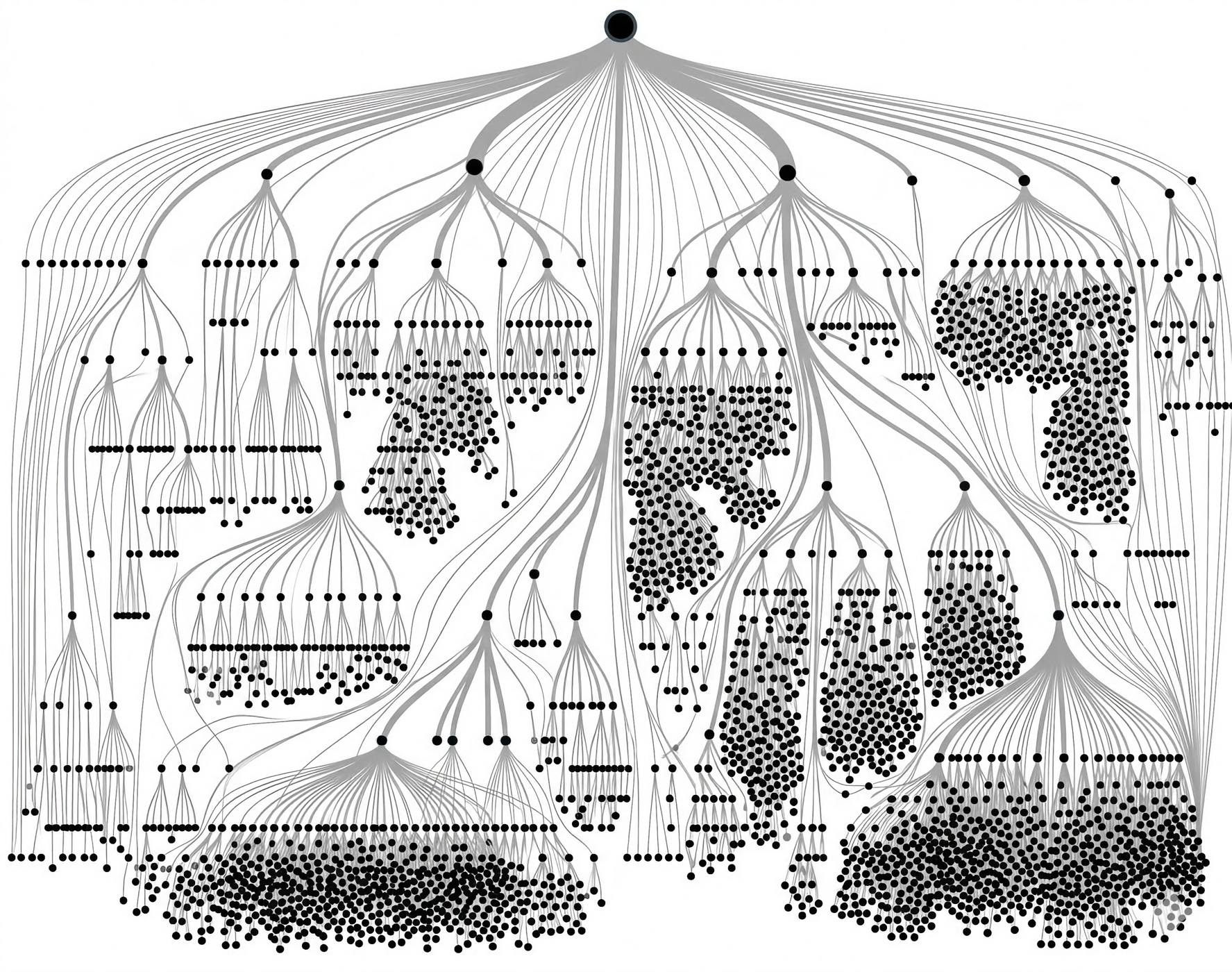
🌐🤖🔀🦋 Every day, billions of decisions get made on this planet. Some big, some small.
What to eat? How to cook it? What to watch on TV? How to respond to that email? How to solve that problem at work? Where’s the nearest bar? Where to go on vacation? 🏝️
Then there are the automated decisions. Things that happen with no humans in the loop. Recommendation systems decide what YouTube or Instagram shows you next. Insurance pricing models, credit scoring, financial trading systems (roughly 60-70% of U.S. stock trades are now handled algorithmically), etc.
What’s the ‘AI market share’ in decision-making? 📊
Two numbers interest me: what fraction of all decisions now involve AI anywhere in the chain and, within that, the slice where humans remain meaningfully in the loop.
We can track how AI is spreading through some industries (more on that later in this Edition), but a lot of it is invisible, even to those interacting with the output.
You may be reading an email from someone without realizing that an AI helped them decide what to tell you and how to write it. You may be smiling at a joke in a YouTube video without knowing that an AI helped write the script. You may be receiving medical test results that were triaged, flagged, and prioritized by AI. People may get hired, or not, after AI systems screen resumés, rank candidates, and flag risk signals. The tomatoes you buy may have been grown with AI tools that helped decide where to plant, and how much water and fertilizer to use. 🍅
Entire relationships, including children, may be downstream of two people flirting on a dating app with chatbots as wingmen. 💘
So the share of decisions where AI assists or acts on behalf of a human is clearly growing. But over time, that will be dwarfed by a faster-growing category: AI agents making decisions with no human in the loop at all. That could include operating large sections of manufacturing plants, financial trading strategies, discovering drug molecules with computational biology + automated labs, monitoring industrial sensors, and managing cybersecurity operations.
Google didn’t replace our decisions, but it quietly steered many of them. AI will do that across more domains, and increasingly make the decisions itself.
🏦 💰 Liberty Capital 💳 💴
🐜🇹🇼 Gregory Allen: Why We Can’t Count on China’s Dependence on TSMC 👀🇨🇳
An argument against chip export controls was that they would accelerate China’s push for semiconductor independence. If we sold them chips, we would keep them dependent on TSMC, creating a kind of silicon shield for Taiwan that could help prevent (or at least delay) an invasion.
In this interview with Ben Thompson (💚 🥃 🎩), Allen explains why he thinks that strategy has already expired:
Gregory Allen: when you think about Taiwan, where people often ask, “Why does Taiwan want to buy F-16s? Why does Taiwan want to buy these things?”, these are not actually the capabilities that would matter the most to the defense of Taiwan. Well, it’s because their military is not actually their national security strategy, their national security strategy is TSMC and remaining essential.
I think, unfortunately, that was a good national security strategy in 2011 and I don’t think it’s a good national security strategy in the Xi Jinping era, because I do believe that he is, come what may, willing to do whatever it takes to eliminate Chinese dependence upon TSMC. I actually don’t think it’s in the option set to preserve long-term Chinese dependence upon TSMC, because I think even if we were willing to eliminate all restrictions, I still think they would be willing to say, “Okay, but every company has to have a plan to transition off of TSMC capabilities, we’re going to provide minimum, quotas of what share of your data centers has to be domestic, and that’s going to increase to 90 to 100% over time”. All the sort of, “TSMC has a natural monopoly”, “ASML has a natural monopoly” arguments […]
And I don’t think they wrestle with the reality of a country that has the industrial scale that China does, and the political will that China does, and the intelligence and espionage capabilities that China has. It’s not an apples-to-apples comparison, to ask, “Could Japan create an alternative to TSMC and ASML”, versus, “Could China create an alternative to TSMC and ASML?”.
The optimistic version of the old argument was that dependence on TSMC would keep China cautious. Allen’s point is that it may do the opposite: create urgency.
If a country with China’s scale and political will has decided that dependence is unacceptable, “natural monopoly” is not a permanent strategy. It’s just a temporary obstacle.
This doesn’t mean China catches up tomorrow. Frontier semiconductor manufacturing is arguably the hardest thing humans do. But a war over Taiwan is one of the things that worries me most.
🐜🔦 Why Nvidia Put $4bn in Photonics Companies
The industry will try to stick with copper as long as it can because photonics is hard, and the transition will be expensive and disruptive. But when that transition happens, you want to be in the best position to do it well and fast.
Once you have GIGANTIC GPU clusters, the networking fabric that ties it all together starts to matter almost as much as the chips themselves. If the network is slower, less reliable, or burns too much power, your expensive GPUs sit idle, and you get a lower ROI on your capex.
That’s not something you want to outsource fully to a third party and just hope they get it right. That is likely part of why Nvidia committed $2bn to Lumentum and $2bn to Coherent, alongside multiyear purchase commitments: not just to secure supply, but to help shape the roadmap and make sure these technologies mature in the directions Nvidia cares about:
