


I see my age in my children.
—Dave Chappelle
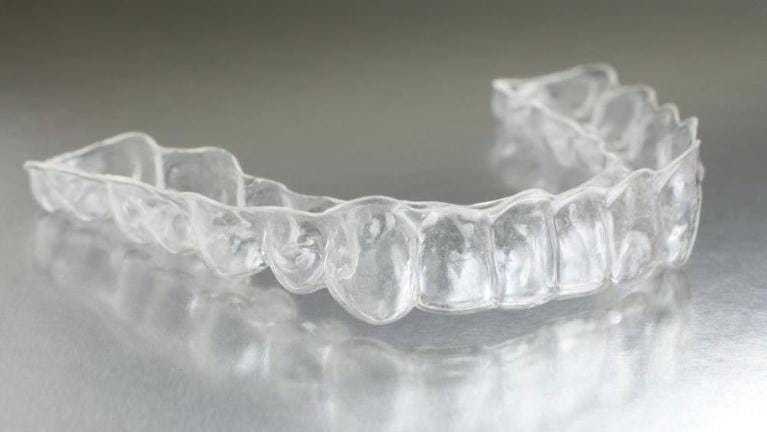
🛀💭🦷 Invisalign as a microplastic delivery system?
I wonder if plastic aligners have been tested for how much microplastics they release while they’re slowly rearranging your face-bones.
At least they’re not exposed to high heat or UV rays too much, which are generally factors that make plastics degrade faster. But having had these things in my mouth for a year, it’s hard not to wonder what happens when you add up plastic + saliva + mechanical friction + time 🤔
(not that I’m one of those people who believe that microplastics are the root of all evil, but I also doubt they’re good for ya)
So I looked it up, of course. 📄 🔍
Turns out several teams have actually run this experiment. The 2025 PLOS One study found that Invisalign aligners released the fewest microplastic particles among the brands tested, but the ones it did release were the smallest (12–23 μm long), which from a “could it cross a cell membrane” perspective is arguably the wrong direction to be best at (😅). The 2023 saliva-immersion study found all seven brands they tested released microplastics within a week.
So yes, plastic + saliva + friction + time does what you’d expect.
🕷️👦 We found a tick on my youngest son’s head.
He told my wife he felt like he got bitten on the back of the neck and there was a little bump. Thankfully, instead of just telling him “it happens, it’ll go away”, she had a look and saw the tiny little bloodsucker (I hate these just as much as I hate mosquitoes 🦟).
Luckily, it wasn’t engorged and probably hadn’t been there long, but we didn’t take any chances and checked with a pharmacist, got a 1-dose preventive antibiotic, and kept an eye out for any other symptoms in the following days.
This little adventure got me thinking about how much parasites and the diseases they carry must’ve sucked for humans in pre-modern times.
People got fevers, rashes, joint pain, facial palsy, neurological weirdness, chronic arthritis, and fatigue. But nobody could point to a clear cause, so it was all just folded into vague categories like rheumatism, palsy, summer fever, arthritis, wasting, “bad blood,” or hand-wavy stuff like “he was never quite right after that fever.”
(Honestly, 'pre-modern' is generous. Lyme disease wasn't recognized as a distinct syndrome until the mid-1970s, and its bacterial cause wasn't nailed until 1981–82 by William Burgdorfer at the NIH. The 1975 Connecticut cluster that finally cracked the case was initially mistaken for juvenile rheumatoid arthritis until two mothers, Polly Murray and Judith Mensch, kept calling the health department because too many kids in their town were sick. Borrelia burgdorferi has been in New England for ~60,000 years; we figured out what it does to us about 50 years ago. 🕵️♀️)
🏦 💰 Liberty Capital 💳 💴
🤖🔐 AI Cyber Attack Capabilities: Doubling Every 4–5 Months (and Accelerating) 🔓🔑🏴☠️
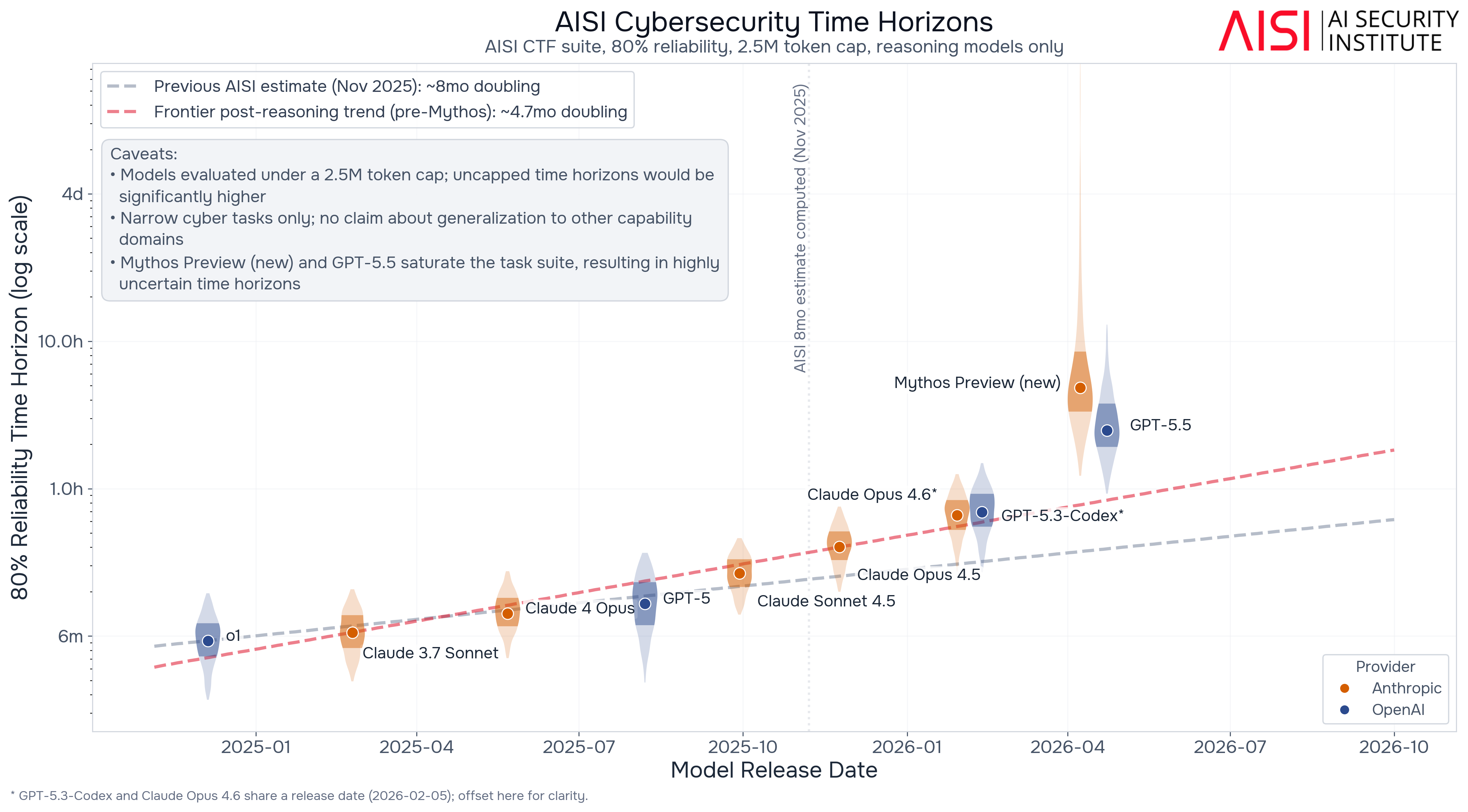
It’s impossible to be precise about this, but it’s possible to get an idea of the rate of change, and this is what the AI Security Institute (AISI) has been trying to do:
In February 2026, we estimated that frontier models’ 80%-reliability cyber time horizon had doubled every 4.7 months since reasoning models emerged in late 2024, given a 2.5M token limit.
This was around half our November 2025 doubling time estimate, which was 8 months for both 50% and 80% reliability.
If a doubling every 4.7 months WASN’T fast enough for ya 😅
Claude Mythos Preview and GPT-5.5 have since significantly outperformed this trend. At the time of writing, it's unclear whether Mythos Preview and GPT-5.5 represent an isolated break from existing rates of progress or are part of a new, faster trend.
Mythos Preview and GPT-5.5 have large upper-bound error bars due to near-100% success rates on our narrow cyber suite’s longest tasks, even with the 2.5M token limit. Our tasks are also not long enough to determine how sharply the models’ reliability would deteriorate at higher task lengths. This places some of the latest models at the limit of what our narrow test suite can measure.
And the kicker: “Without the 2.5M token cap, success rates are so high that time horizons become impossible to calculate.”
😬
On April 7th, Anthropic wrote:
“Over 99% of the vulnerabilities we’ve found have not yet been patched”
How long did it take us to get ready for Y2K? Patching all software is much more complex than fixing a single known bug.
Palo Alto Networks, one of the big security players, recently said:
For the last several months, we have had early, unbounded access to the latest frontier AI models. What we’ve seen from that vantage point has made it clear that the window for organizations to get ahead of what’s coming is shorter than most leaders realize.
We have moved past the era of incremental AI improvements into a threat landscape shift. Our testing has revealed a step-change in capability that demonstrates an intuitive understanding of software vulnerabilities. [...]
The latest frontier models, including OpenAI’s GPT-5.5-Cyber, Anthropic’s Mythos and Claude Opus 4.7, and the specialized variants emerging across major labs, represent roughly a 50% improvement in coding efficiency over their predecessors. That number sounds incremental, but in practice, it’s the threshold at which AI crosses from a helpful assistant into an autonomous operator.
They see four main categories that, when happening all at the same time, redefine the “modern threat landscape”:
Vulnerability Discovery at Scale: Frontier AI is exceptionally effective at identifying vulnerabilities across massive, complex codebases. In [Palo Alto’s] testing, three weeks of model-assisted analysis matched a full year of manual penetration testing, with broader coverage.
Exploit Chaining & Synthesis: What is more consequential than individual discovery is the models’ ability to think like an attacker. They link multiple lower-severity issues into single, critical exploit paths, seeing full-stack logic, including SaaS and public-facing surfaces, in ways traditional scanners cannot.
Attack Cycle Compression: In AI-assisted scenarios, the time from initial access to exfiltration has collapsed to as little as 25 minutes. Detection and response measured in hours is no longer a viable standard; single-digit MTTR (Mean Time to Respond) is the new floor.
The Unsupervised Attack Surface: Rapid AI development and decentralized innovation are creating a massive, unsupervised attack surface in real-time. As local AI agents become commonplace, every desktop is now effectively a server, yet most organizations lack visibility into the code their own employees are generating and deploying.
(Worth noting: Palo Alto sells security products, so they aren’t exactly a disinterested observer. But they also won’t do well if their customers get PWNED)
Even the NSA, an agency that surely has seen it all, is reportedly impressed:
