


Unthinking respect for authority is the greatest enemy of truth.
—Albert Einstein
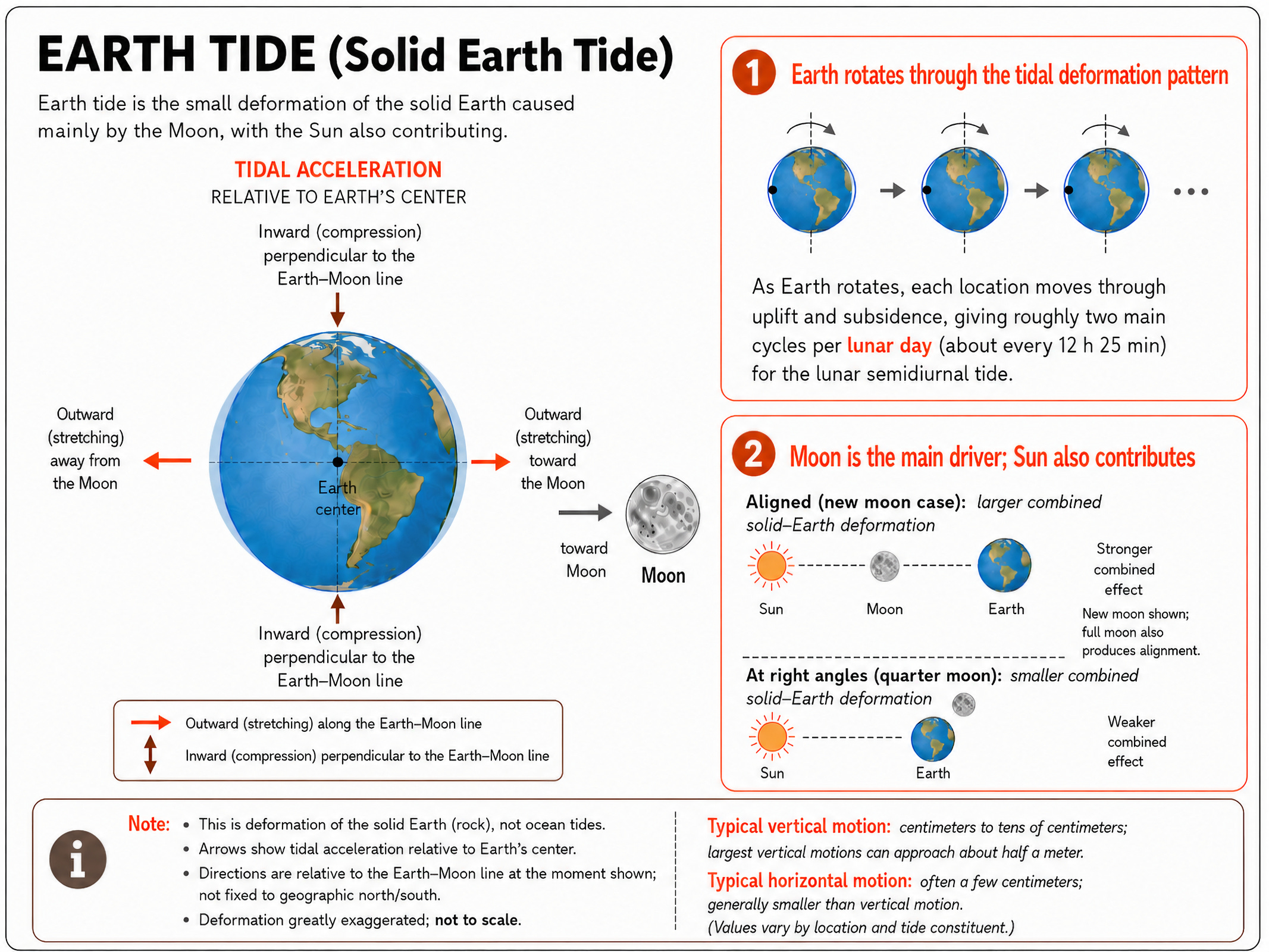
🌖↔🌎 I think most people know about ocean tides, even if few people understand all the variables that make them so complex to accurately predict (it’s not what I want to get into today, but it’s an interesting phenomenon).
But there’s another kind of tide that I didn’t know about until recently:
Solid-Earth tide!
Yep, gravity doesn’t care if you’re a liquid or a solid. It pulls, and over something as large as the Earth, you get an actual tide in the crust too (which is why they also call it crustal tide, but that sounds a lot yuckier).
The ground under your feet can rise and fall by several inches (tens of centimeters) over a tidal cycle. You don’t notice it because everything is moving very slowly with it (buildings, roads, whole cities). It’s probably happening right under you right now!
Earth tides, like ocean tides, vary a lot based on latitude, local geology, and the lunar/solar alignment.
This has to be taken into account if you want very precise spatial positioning. The International Association of Geodesy (I had never heard of it before) says: “The entire planet’s surface rises and falls by up to about 30–40 centimeters twice daily. This deformation affects geodetic reference frames, satellite orbits, and precise positioning, requiring continuous modeling and correction in space geodesy.” 🛰️
One of the things that didn’t make immediate sense to me about tides (water or crust) is that there isn’t just a bulge in the direction of the moon. There’s also a bulge on the other side. 🫤
What unlocked my understanding was when I learned that tides are caused by differences in gravity across Earth, not just the direction of gravity.
So imagine three cars driving at the same speed in a line: 🚙 🚙 🚙
If the front one accelerates a lot, the middle car accelerates moderately, and the back car only accelerates a little (gravity pulls more strongly on what is closest than what is farther away), then from the point of view of the middle car, it looks like the line has stretched in both directions.
That’s the two-sided tidal bulge.
Wait, why am I writing about Earth Tides? I guess we don’t always pick the rabbit holes we fall in! 😅
🔎📫💚 🥃 If you want Liberty’s Highlights to continue, this is the moment. Become a paid supporter.
Without your support, this steamboat sinks 🌊🚢⚓
🏦 💰 Business & Investing 💳 💴
✨ Constellation Software’s ✨ 2026 Annual Meeting
First, I gotta say, I’m a little disappointed in myself. After years of wishing they would go back to an in-person meeting, they finally do, and I wasn’t there. I didn’t have a huge scheduling conflict or anything, I dithered a little too much, time flew, and the date snuck up on me and it was kind of too late (well, I was also really busy with lots of projects and family stuff, but when is that not the case?).
So I didn’t get a chance to see my old friends in person, or to make new ones. Next year!
The meeting was over 4 hours long, but friend-of-the-show Trevor Scott (🍁) made this supercut (👆), condensing it into 36 minutes. That’s a good way to get some highlights.
Here are mine.
First, like everything else in the world of technology, AI was a huge focus. It’s both what shareholders are uncertain about AND the main technological driver of change these days, so it’s everywhere.
As a sentiment check, they were in a good enough mood to make a joke about changing the name of the company:
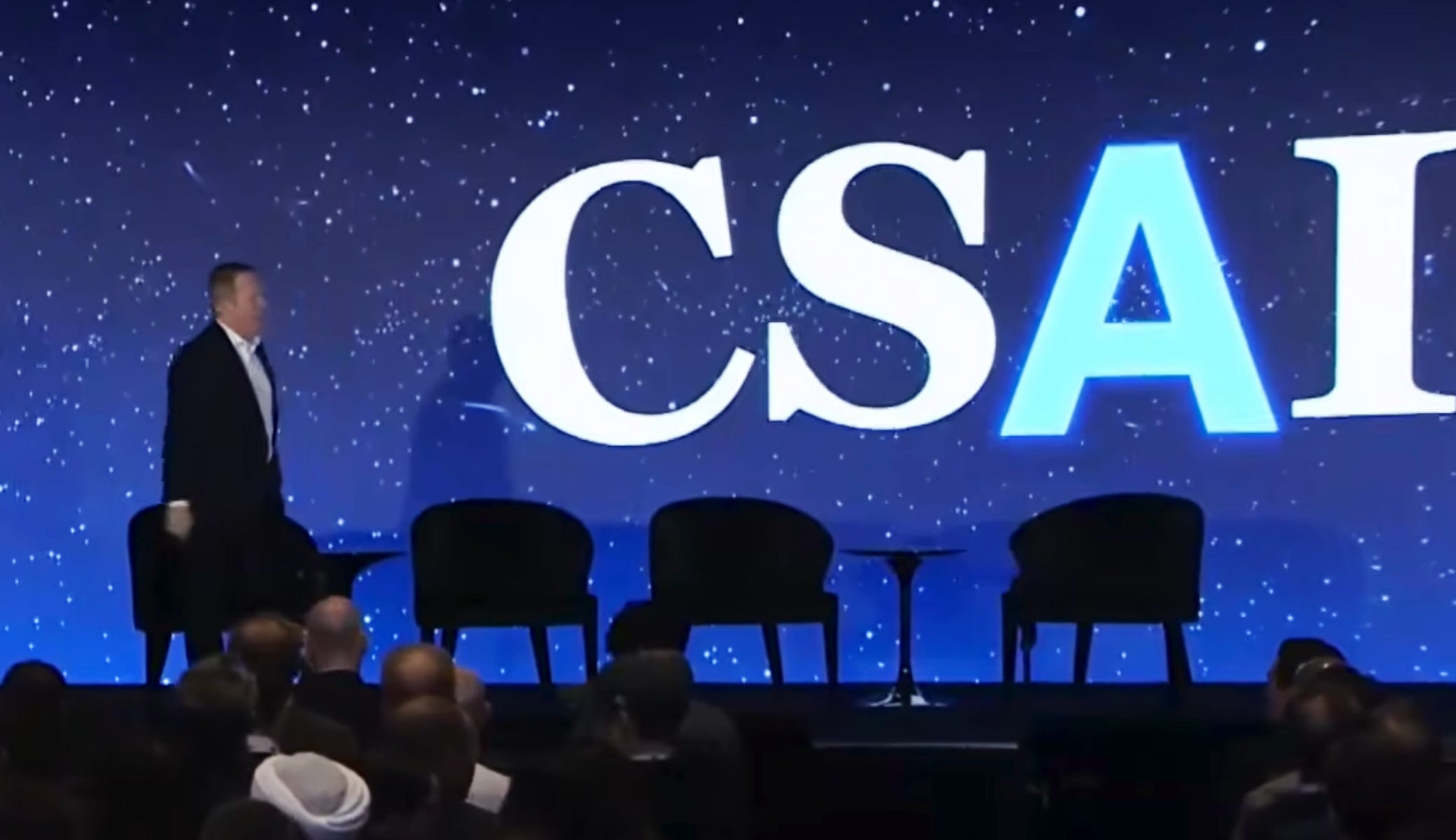
"I don't believe in one corporate culture. We believe in a culture of cultures.”
Speaking of culture, Mark Miller followed in Mark Leonard’s footsteps and has elected not to receive a salary or bonus as President (Constellation doesn’t have a CEO). Leonard had stopped taking a salary in 2014, and in 2015, he also decided to drop other bonuses and incentives too.
Mark Miller: Yes. I just carried on what Mark Leonard did. And I really care a lot about this company, and I took this job to help this company and the shareholders in it.
John Billowits: Mark wanted 0 comp, and we wanted to pay him something.
Something stood out to me at this AGM. Not with huge certainty, but I moved my thinking in that direction a bit: CSU's weird structure may be unusually well-suited for this moment, at least compared to most other software companies.
Decentralization plus running lots of experiments and scaling up what works is how markets work. With 1,500+ small units that can each experiment close to customers and share what works with the rest, interesting ‘invisible hand’ effects are emerging.
AI Case Study: When 50x Faster Changes the Question 💡
David Wilkes: I experienced one of the Volaris AI workshops back in March last year. And I went away from that with one question, which was simply how fast can we go. And what I did on day 1 was I stopped all development across both businesses.
So [at] CELCAT and Bullet [we] stopped for the whole month of April last year, and went on an intensive learning program, to learn what we could do with the technology. And I think if I look back and then we look now at the outcome of that, it’s actually pretty straightforward.
I like this idea of taking an actual pause to really focus on learning. Too many try to learn complex new workflows and tools on the side while doing things in the old way, and that’s rarely very effective, or at least, it isn’t for everyone in the org (some nerds will always race ahead).
At the outset, we came back in May, and we were going faster. If you think of a cycle time from concept through to production software, typically for us, that was measured in months. When we came back in May, we already started measuring that in weeks. And as we went through last year, we turned that from weeks into days. And today, our cycle time is measured in hours.
We can cycle from concept through to production in hours. And that means a road map that might have taken, say, a whole year […] that can be literally a week now.
So this pace at which we produce software is no longer a problem that we have different challenges instead. But it’s fundamentally transformational in terms of what it means for our business.
Jeff Bender: And how are your customers reacting to this? Can you talk to that?
David Wilkes: Yes, yes. Well, let me put that first in the context of growth. So if I go back to the end of last year, our growth was running at about 12% per annum. To date, it’s running at 23% per annum. Our vision is that we’ll double our revenues by 2029.
I think I’ve also been told I’m sandbagging on that. The interesting thing there is that growth. It’s not driven by going faster. It’s driven by us asking a totally different question, and that is, if we can go 50x faster than what does that look like for our customers. So what does 50x faster look like for our customers?
Speed can go from quantitative to qualitative if there’s a big enough change in velocity. You don’t just do the same thing faster, you do whole different things, you do more and create new value.
That's exactly what you'd predict in a Jevons-paradox-of-software world. Nice to see it confirmed by an operator.
And for us, that meant we’ve literally rebuilt our product from scratch. We’ve, in effect, reimagined what a new category of product might be. If you think about our old product, it was a system of record. You created, read, updated, deleted data. Our new product is a system of action.
It thinks, it predicts, it gives you insights. It does really clever stuff for you. So that creates a huge value for our customers and with value comes new price points doesn’t it? And with that, we are driving growth, and we’re seeing the results of that already.
If development goes from months to hours, the roadmap stops being a fixed annual plan and becomes more like a live conversation with customers. Ideas that used to be too small, too weird, or too low-ROI to justify engineering time can suddenly become worth trying.
"System of record" → "System of action"
Agents Need Managers & Names (and Slack Accounts) 🏷️
Interesting anecdote about the use of AI agents, and how to integrate them in the human org:
Andrew Jones: Rather than having support agent #1 and support agent #2 and support agent #3, we decided to name them... we wanted to get adoption of the agent. [...]
They all have a Teams [chat] account. So rather than you having to go to some web page or try to find it, you Teams them. You communicate with them exactly as you would with anyone else within ClickDimensions. And I think that’s the most important thing. [...]
The other thing is as well is by giving the agents names, you also have a human who’s a manager of them, because again, this is really vital when you set up agents is. If you set up an agent and you leave it to its own devices, it will go off. And over a period of time, it will go on a tangent. You need to have a human manager who manages those agents all the time. So by giving them a name and managing it, that’s the way we move forward with it. [...]
It took us about 4 weeks to do it after going through those various steps. We launched it in January of 2026. And what we found was that with our customers’ interactions with this chat agent, conversational agent rather than being a lookup agent, it was a problem resolution agent.
It effectively resolved 82% of all our Tier 1 tickets that went through the chat agent, which is fantastic.
These agents may not be as good as talking to a human, but at a lot of companies, that’s not where you start anyway. Replacing more limited agents can help solve a lot of customer problems faster and free up human agents to deal with the more complex cases.
The AI Hackathon That Built Solutions Nobody Deployed 💾
I’ll leave you with this anecdote told by a shareholder:
Ashwin Annamalai: In Waterloo, there was a hackathon called Anhackathon that was organized for university students where they were like businesses come with their problems, use AI and solve our problems. Like this is amazing. So with the help of AI with Claude and all these tools, they should be able to solve all these problems. So you know what, they did manage to solve the problems. But at the end of it all, zero solutions were deployed for the business.
That’s when — it was the lightbulb moment for me. And I was like, yes, building code is one part of the solution, but having the ownership and the trust is really important. The very next day, like started buying Constellation.
Mark Miller’s response: Success is not judged on your ability to develop products. Success is judged on your ability to go out and convince the customers that they want to use your product.
Now, I don’t read too much into this because in reality, it’ll most likely be competitors that adopt AI and use it to compete better, and they’re likely to have a lot more existing customer relationships and sales knowledge than university students.
But it also means that as long as you don’t fall behind those competitors, it’s more of an arms race than bringing a knife to a gun fight. 🔪
🏎️ Innovation cycles vs procurement cycles 🐌
A good reminder that it’s not because you innovate fast that you can sell fast:
Bill Delaney at Modaxo: They’re asking us about the pace of change from an innovation perspective. And we looked at the research, and it was clear that innovation cycles were compressing right?
From months to weeks and soon to be days. And I looked around the room and I said, but what’s happening with procurement cycles.
Now we deal with large government procurements that have — it takes multiple years for a procurement even to come to tender, then they run the tender process, you do a multiyear project and then you have 10 years of maintenance. Those procurement cycles and government are getting even longer. So we’ve got this dichotomy of extended procurement cycles compressing innovation cycles.
Even if the tech is perfect, that's not what wins the deal:
Bill Delaney: The elements of those tenders that really people should have a look at there’s elements around product capability and functionality and — but then most of the scoring goes to your experience, your ability to contract on the heavy-duty terms that they’re putting forward — and they need somebody to take liability, right? Governments like to shift risk — so you have to have capacity to take liability that might be through accepting LDs if we don’t perform, posting bonds or guarantees. You’ve got to have a scale on our capacity to do that.
That’s a big advantage that incumbents have in public or highly regulated industries. A new entrant with a perfect product that they sell for 1/10th the cost may still struggle.
AI = Layoffs? ✂️
In response to a shareholder asking whether AI productivity gains will lead to layoffs:
Bill Delaney: I don’t see us doing large-scale layoffs. No, not at the moment. We’re so focused on how to leverage this capacity because what you want to understand is we just have an enormous backlog of our customers wanting us to do things for them. Some of those things that just didn’t make business sense now do make business sense.
On the backlog/organic opportunity:
Barry Symons (Jonas): I do the hypothetical, if the business gods came down from above and said, ‘Barry, here’s the deal for you. You will never ever, ever win another customer again in Jonas’ history. But at the same time, you will never ever, ever lose a customer that you currently have in the Jones organization. Would you take that deal?’ And I say 150%, I would take that deal because there’s so much more we can do for our customers. And AI just makes it so much easier.
But wait, why weren’t they doing all this before?
Time to trot out Jevons' paradox again.
Cheaper development reveals a giant backlog of work that wasn’t ROI-positive before (or at least, wasn’t a higher ROIC than other ways to spend the capital, such as M&A).
But are they seeing organic growth from this yet? 🤨
Mark Miller (President): I’d love to see more organic growth. I’d love it to be yesterday […] I also haven’t seen a lot of new revenues from AI as well. So we’re just being -- we’re just trying to drive adoption of the usage of it, and we’ll monitor it internally
Like most things, investment comes before return, so this isn't a surprise yet.
Jamal Baksh (CFO) on cost: It wasn’t a material increase in that COGS line that. yes, I would believe that, yes, we’re probably outpacing revenue with cost today because we’re investing a lot. But it’s not a material impact on margins.
Has AI caused any customer attrition yet? 💸
This was a recurring topic:
Mark Miller: We really haven’t seen any AI specific attrition at any point.
Jamal Baksh (CFO): I look at about 900 of the businesses and look at trending of organic growth... there are a couple of things that might have been popped out and both of them had nothing to do with AI.
Jeff Bender: There’s no specific evidence to date of any significant or material attrition as it relates to AI. But I do believe it’s coming... Stay paranoid right? Like always.
💰 On Capital allocation (the core competency) 💰

The biggest challenge for the company has long been to deploy its free cash at high ROIC, and most of that has been through M&A. This remains the core function:
Bernie Anzarouth (CIO): We had a slide up there earlier that said we had how much, $3 billion of dry powder. We're trying to invest that capital, and it's a very tough slog. It's tough despite the number of VMS businesses that are out there, it's tough to use to redeploy all of our capital. And that's why we came up with the idea of PEMS [...]
How’s the runway? How’s the runway? Everybody always asks about the runway… Bernie doesn’t seem worried:
Our database of these software companies is still quite large, and it's still building.
I’m trying to remember the last number I heard. I think it was ~60k VMS that they were tracking. Probably way more now, my number is dated.
Bernie: And if you think of what the software world is all about, especially now with AI tools that are out there that you can get more software businesses that are created on a regular basis, the number of acquisition targets that are here today will be multiplied several fold over the next 10 years or so.
On the investments in public companies (PEMS):
Bernie Anzarouth (CIO): If you think of the way that we've done acquisitions to date, we buy businesses lock, stock and barrel, and it takes 1, 2, sometimes 3 years to get them up to speed with the best practices that we use to run our businesses. And so if you think of a minority shareholder and how much influence you can have on a business that you do not own 100%, it will obviously take a little while longer in order to influence management to do the right thing. And so what we believe is that we have to get them at a lower price than the businesses that we are actually acquiring at 100%. And so you will see if we measure ourselves at the same IRR that we measure 100% ownership, we would have to get these businesses at a lower price.
Sounds like it’s currently possible to get that extra discount because publicly traded software has been hit a lot harder than the private market. But maybe it’s just a lag, and private acquisitions will get more attractive… which may make PEMS less so.
Billowits had a good line:
We do believe that we want to have the opportunity to take advantage of which could be a dislocation in the market for a period of time. So keep selling vertical market software businesses. We want valuations depressed as long as possible.
🫡
Mark Miller (President): 25 years ago, we — we used to buy minority stakes in public companies and those companies ended up being put into play. It generated external high return... but the average tenure of our investments were very short. And nearly always 90% of the time got outbid by a third party when the businesses were sold... That short-term activism was profitable, but it was a poor strategic fit with our objective of being good permanent holders of vertical market software businesses. So we stopped doing it.
Buy and hold forever, we’re in it for the long run, and [PEMS] is another tool. The other part of the [PEMS] thesis is that the companies we want to invest in have the potential to benefit from an engaged minority shareholder. We want our [PEMS] or public portfolio companies to be run by people we respect — we want their incentives aligned with those of long-term shareholders. We like the businesses to generate high returns on incremental invested capital, and to return any excess capital to their shareholders.
PEMS is not the old short-term activism playbook, even though that worked out financially, and it’s possible that investees will get acquired and the “permanent” part of PEMS will turn out to be short.
The biggest open question is: Can they successfully influence companies they don’t control enough to improve them and unlock value?
And is 'permanent' really the right target? Or is it aspirational, like Buffett's 'ideal holding period of forever'? Will they really hold even if a company takes a wrong turn or gets wildly overvalued? 🤔
Bernie seems to confirm it really is permanent:
Bernie Anzarouth (CIO): I mean selling the businesses, if the price runs away with us, that just doesn't make sense tax-wise. It just would be tax inefficient. And I think what we would do is have or just see like-minded investors piling to the business that we're in. and just keep holding on to it for the long haul. We're not in the business of selling high-priced shares to people that are unaware of what's going on within the business. We're literally in there permanently.
But we’ll see how that turns out in practice, or if they change their minds over time.
On Buybacks 💵 ↩️
John Billowits: The way we think about it is we're using the same hurdle rates for making both decisions. We're buying businesses at a value that is far beneath what we're trading at and what other companies are trading at even after we fix them. So we still believe we can generate much higher returns by buying companies than we can by buying our own shares at these prices.
Mark Miller: Yes, I don't want to buy back shares. Definitely.
Customers as M&A Radar 📡
This one is from Lumine’s CEO:
David Nyland: So we’ve got some big customers worldwide, big brand names and -- they have a lot of intelligence. And so we learn a lot by speaking to them by finding out what the problems are, and obviously now supporting a portfolio of companies that sell into those customers. But also as they navigate their assets, they’re important assets, they start to share with us ideas about what else we could acquire to help them provide security with some of those assets that are in transient ownership at this point. So you have to kind of earn the position to have that conversation.
It takes some time, but the power of that relationship is unbelievable.
In fact, customers may want them to consolidate a space because it makes things easier and more predictable for them:
David Nyland: We mainly get new logos through acquisitions right? It’s very hard to go into a large media or telco business and become a new vendor. They want less hurdle. They want consolidation.
And if there’s something risky in the environment that they’re going to want us to do it. They’re not going to want some new name company that they don’t know. So they will always give us the first chance, so we can move quick, we should be able to capture that business.
Not a bad position to be in.
It’s kind of software as distilled customer trust, to riff on a metaphor used by Mark Leonard. The code matters, but the customer intimacy may matter more.
If you’re newer to Constellation and want a primer on the company, check out the podcast I did with my friend MBI (🇧🇩🇺🇸). It’s a few years old now, so it doesn’t include the latest developments, but I think it gives a lot of context on the business:
Andrej Karpathy Joins Anthropic Pre-Training Team 😮
Anthropic’s winning streak continues. One of the essential minds in AI wrote:
Personal update: I've joined Anthropic. I think the next few years at the frontier of LLMs will be especially formative. I am very excited to join the team here and get back to R&D. I remain deeply passionate about education and plan to resume my work on it in time.
Karpathy has moved around a lot over the years, but clearly not randomly. He has been:
Internships during his PhD:
Google Brain (summer 2011)
Google Research (summer 2013)
DeepMind (summer 2015)
Then one of the founders of OpenAI
Then at Tesla to lead Autopilot and be the director of AI
Then at OpenAI again (mid-training and synthetic data work)
Founded Eureka Labs to focus on AI education (2024–2026), where his videos have taught AI fundamentals to more people than probably anyone.
Now he’s joining Anthropic’s pre-training team.
Nicholas Joseph, the head of pre-training at Anthropic, wrote: “He'll be building a team focused on using Claude to accelerate pretraining research itself.”
Claude training Claude. The recursive loop 🔁. Andrej has been working on Autoresearch lately (82k GitHub ⭐s!), a project that uses agentic loops to optimize the performance of models automatically. Will he work on a scaled-up version of that?
Demis Hassabis is an Angel Investor in Anthropic 🏆🫡
This reminds me of how Jeff Bezos is an early investor in Google (he invested $250k in 1998) and, if he kept it, would be a billionaire even without Amazon.
The FT writes:
Sir Demis Hassabis, the founder of Google DeepMind, was an early investor in Anthropic, a previously undisclosed stake [...]
People familiar with the matter said Hassabis was an angel investor in Anthropic
And that’s probably not his only valuable personal angel investment:
Hassabis, who sold his London-based AI lab to Google for £400mn in 2014, is also an angel investor in businesses founded by former colleagues.
This includes Inflection AI, launched by DeepMind co-founder Mustafa Suleyman before he joined Microsoft in 2024, and Ineffable Intelligence, founded by longtime collaborator David Silver. [...]
Start-ups founded by former DeepMind employees include well-funded companies such as Mistral, Harvey, AMI Labs, Recursive Superintelligence, Latent Apps, Reflection AI, Cursive AI and Orbital Materials, among others.
Well, good for him. It does create an interesting conflict, as Anthropic is both a competitor and a big customer of Google, though. Not that he doesn’t have a much bigger stake in Google’s success, but it’s still a piece on the board. ♟️
I wonder if Demis was involved in the decisions at GCP to sell a boatload of TPU capacity to Anthropic a little while ago. 🤔
🧪🔬 Science & Technology 🧬 🔭
🤰📲 Is Fertility Dropping Because of Smartphones? 📉
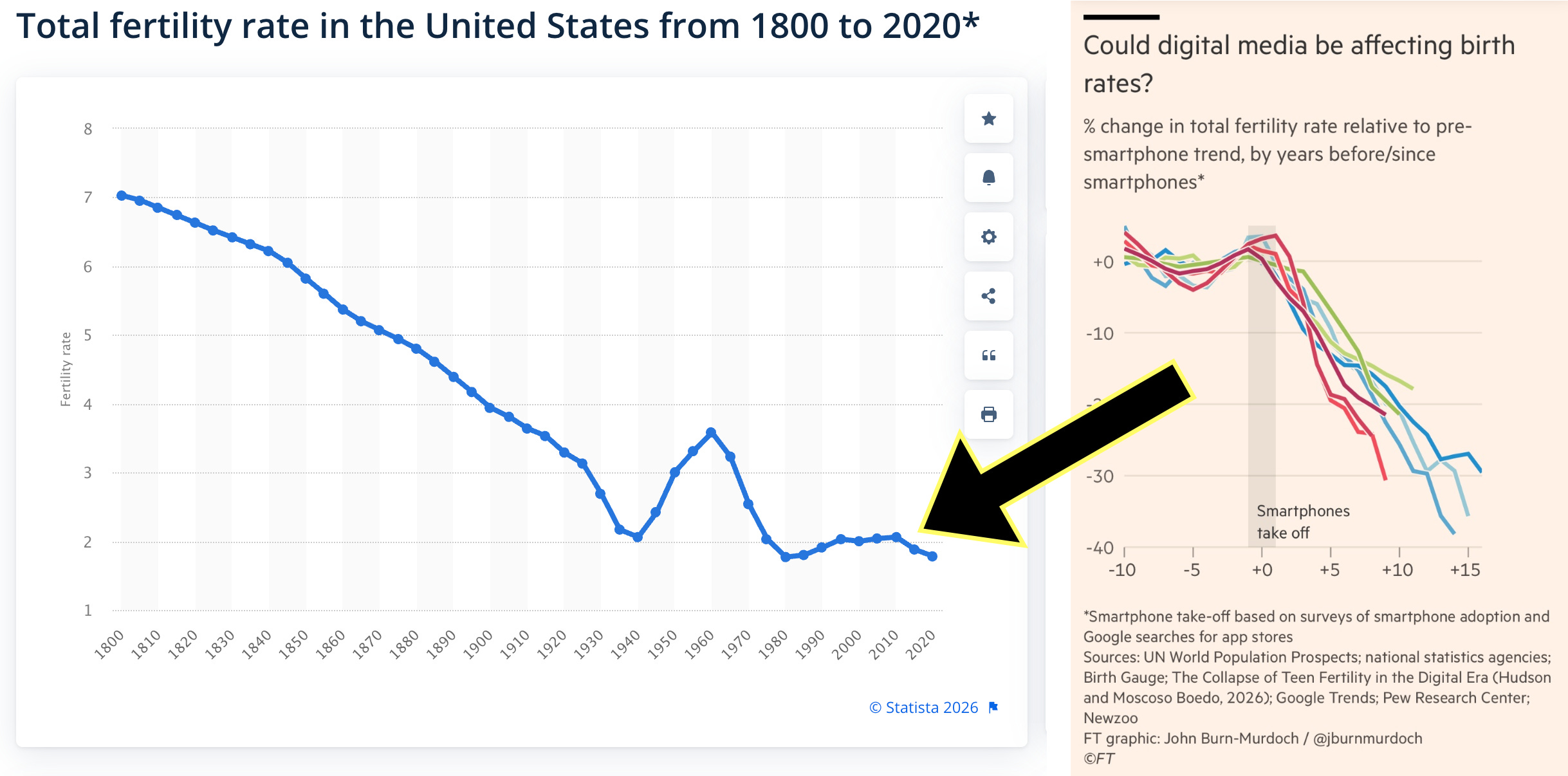
I’ve long covered the fertility beat. It’s a big problem for humanity to be below the replacement rate in most places and still dropping. We could mitigate the problem by curing some of the diseases of aging and extending lifespans (and most importantly, healthspans), but that won’t replace creating new people.
There’s a very popular narrative right now that cellphones are to blame, and it makes a lot of intuitive sense. In fact, I'd be shocked if smartphones didn't have some impact. They reshaped dating, free-time use, and the nature of social gatherings. The carefree partying of the pre-pocket-camera age is gone. 📸
BUT
If we zoom out, we can also see that whatever impact came from Steve Jobs going on stage in 2007 is part of a larger process.

The fertility decline has been running for over 150 years in some places, and was already rapid by 1970. And if we didn’t have Africa, the planet's average would look a lot worse:
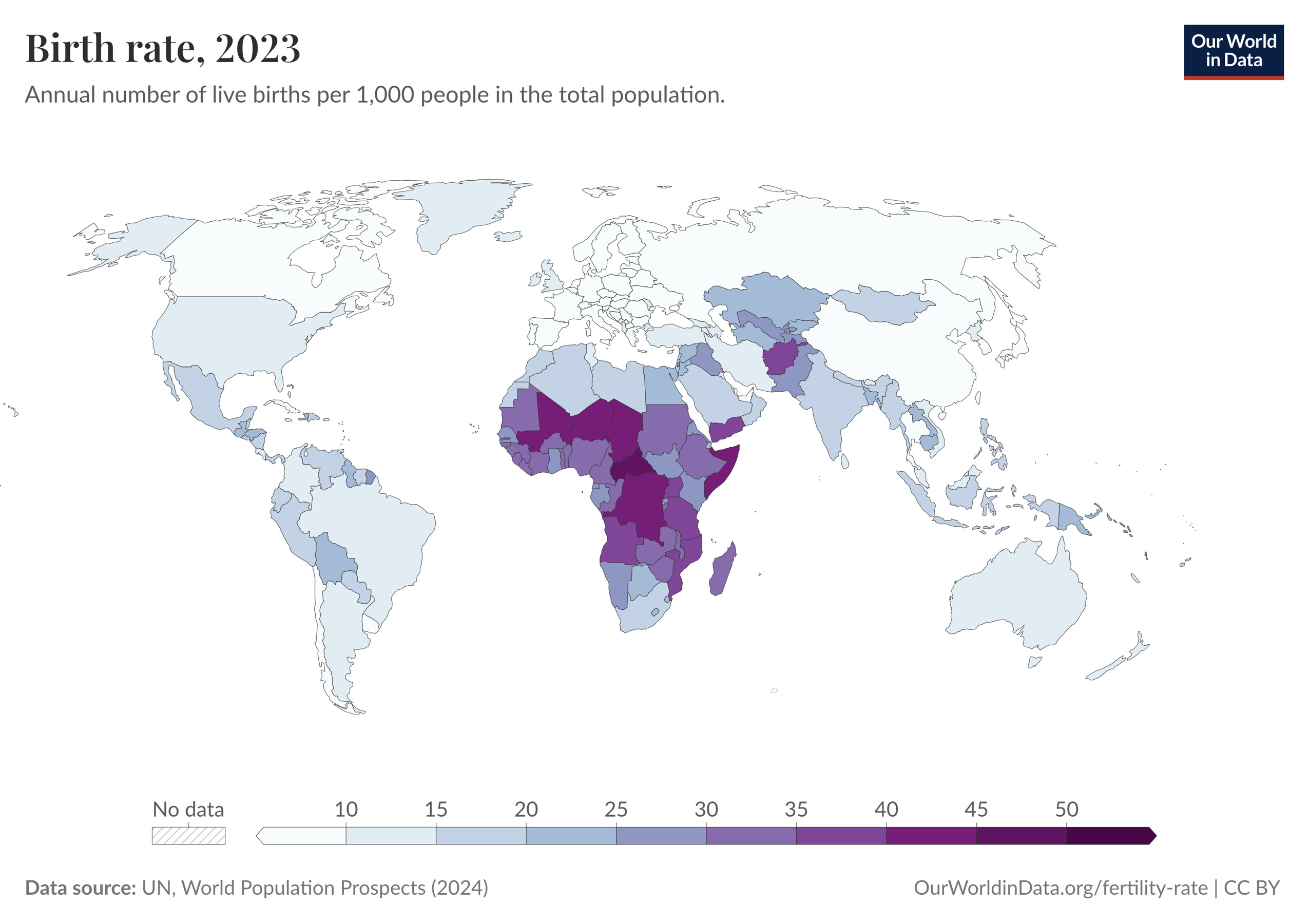
The harder question is 'what would actually reverse the trend?' And I don't think anyone has a convincing answer yet.
h/t Tyler Cowen
🧠 Creative Practices Keep Your Brain Younger (Including StarCraft II) 🎮
This study asks: Do creative skills give you a younger-looking brain?
Researchers trained a brain-age model on EEG data from 1,240 people, then turned it loose on 232 with different flavors of creative expertise: tango dancers, musicians, visual artists, and StarCraft II players (Oh yeah!).
The metric they were looking for was "brain age gap." Does your brain activity look older or younger than your actual age?
Across all four creative domains, experts came out with negative gaps. Their brains "looked" 4–7 years younger than their chronological age, with an overall expertise effect of ~5.5 years.
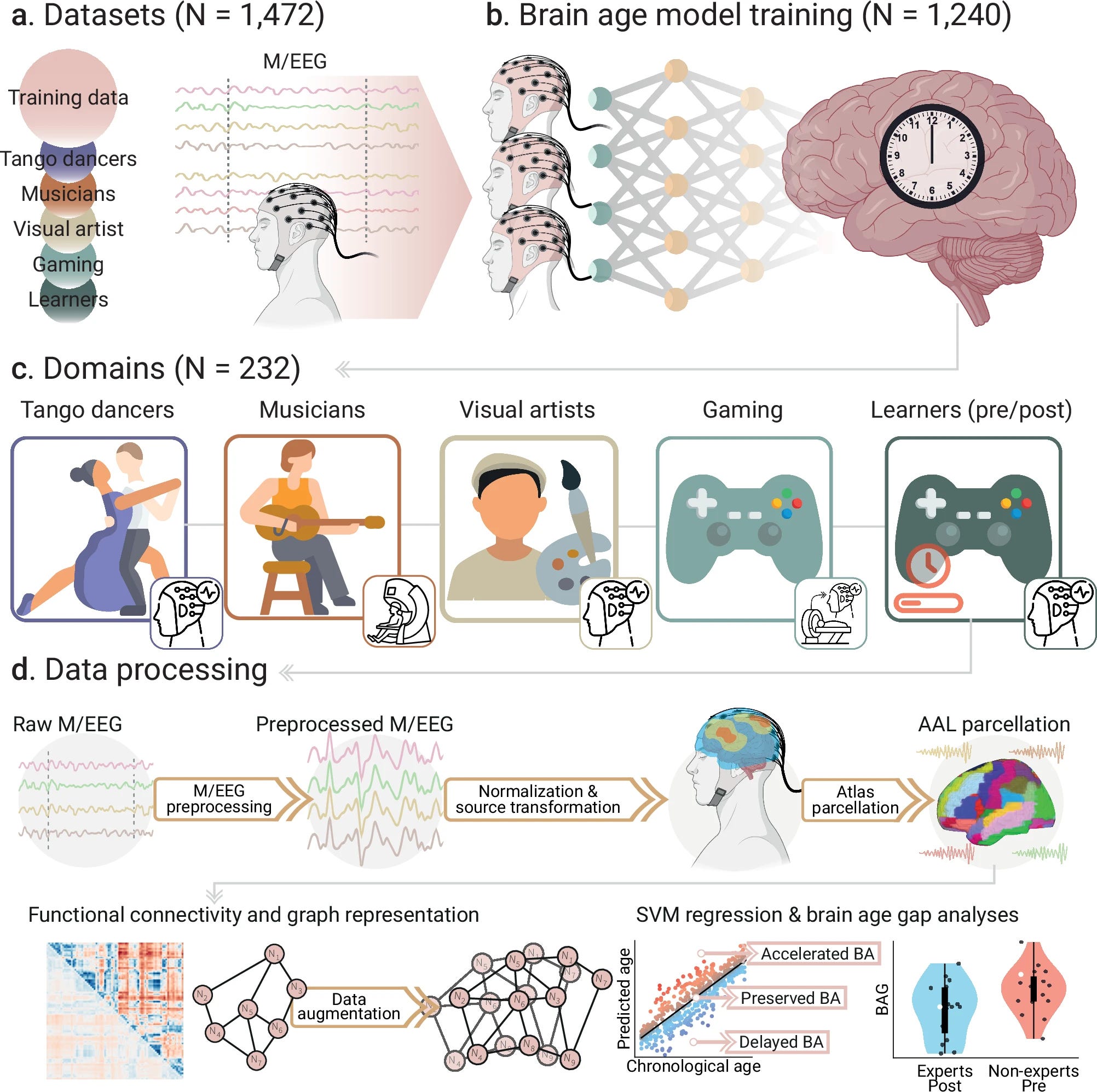
There was also a small training arm: non-experts who trained on StarCraft II for 30 hours showed a ~3-year reduction in brain age gap, while an active control group showed nothing.
As an aside, the control group was trained on Hearthstone: “The Hearthstone game was selected due to its more rule-based and turn-based mechanics, with limited improvisation and creative play compared to StarCraft II’s real-time decision-making”.
There was a dose-response curve, so the more your game improved, the more your brain age gap did too.
The study’s proposed mechanism: creative practice strengthens or preserves connectivity in the brain networks most vulnerable to aging. Especially frontoparietal hubs (attention, motor control, coordination, visual processing). They also found higher local and global network efficiency, plus stronger biophysical coupling. The effects were bigger in long-term experts than in short-term learners.
Now let me throw a bit of cold water on this before you download Starcraft (well, you should anyway, or at least an instrument 🎸🎹).
Most of the expertise study is observational, so selection effects are still possible (maybe the kind of people who stick with tango for a while had different brains to begin with 💃). But however noisy the study is, it’s a pretty common-sense idea that creativity and learning difficult skills are good for you. It’s just nice to have one more reason to motivate us!
🚂 🎩 This LLM Only Knows the World Before 1931 📰 🕰️
This is a clever way to talk with the past:
we introduce talkie-1930-13b-base, a 13B language model trained on 260B tokens of historical pre-1931 English text. Additionally, we present a post-trained checkpoint turning our base model into a conversation partner without relying on modern chat transcripts or instruction-tuning data.
Very clever.
You might think pre-1931 wouldn’t give you much training data. We keep hearing that most text ever written by humanity was created in the past few years. But the talkie team is finding ways to scale it up significantly:
talkie is the largest vintage language model we are aware of, and we plan to continue scaling significantly. As a next step, we are training a GPT-3-level model, which we hope to release this summer. A preliminary estimate also suggests we can grow our corpus to well over a trillion tokens of historical text, which should be sufficient to create a GPT-3.5 level model—similar in capability to the original ChatGPT.
GPT-3.5 was the model used by the original ChatGPT, so while it won’t be anywhere near the frontier, it should be interesting to chat with (especially since modern algos and hardware should give it some advantages over the original GPT-3.5).
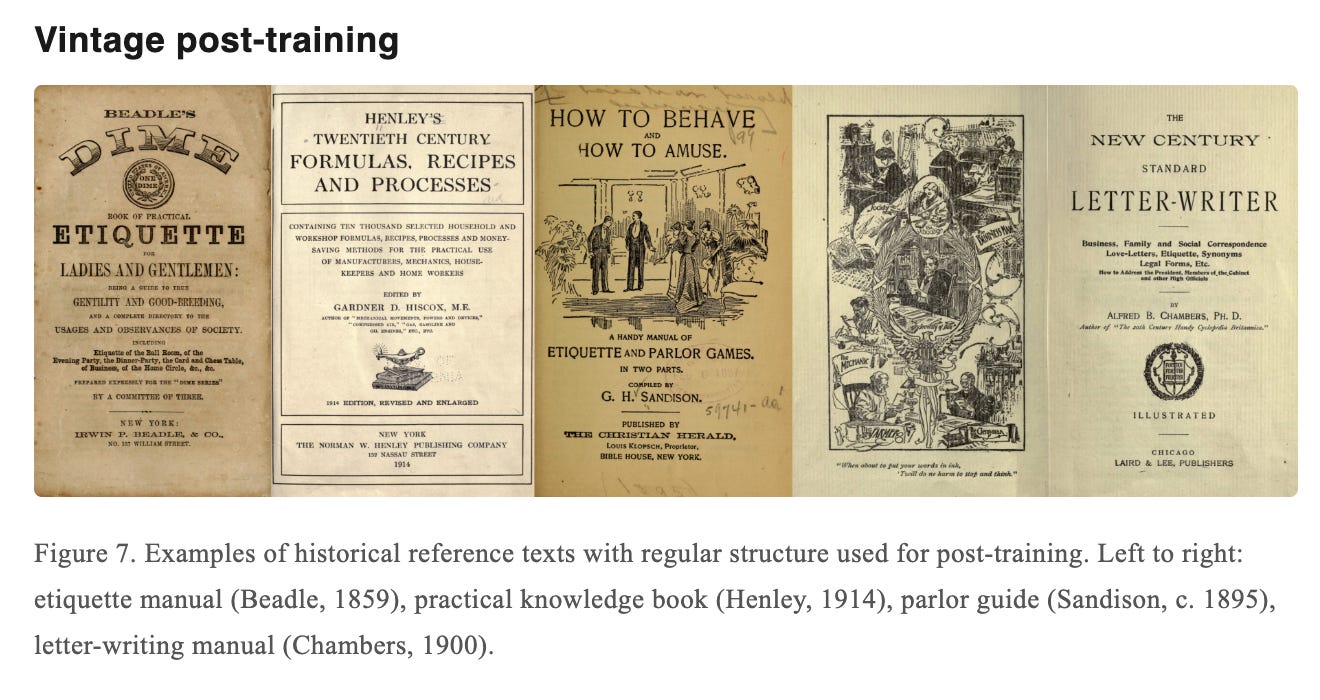
Why pre-1931?
Because, as of January 1, 2026, US works published through the end of 1930 are in the public domain.
One of the big challenges is to avoid ‘temporal leakage’.

That sounds pretty Doc Brown, but all it means is that in such a large pile of documents, some will have bad metadata, be mislabeled, mis-dated, of some old documents have modern footnotes. That kind of thing.
🎨 🎭 The Arts & History 👩🎨 🎥
🎞️ Treasures of the Past: Why You Should Make Your Kids Watch Old Movies 🍿
Last weekend was a three-day weekend in Canada.
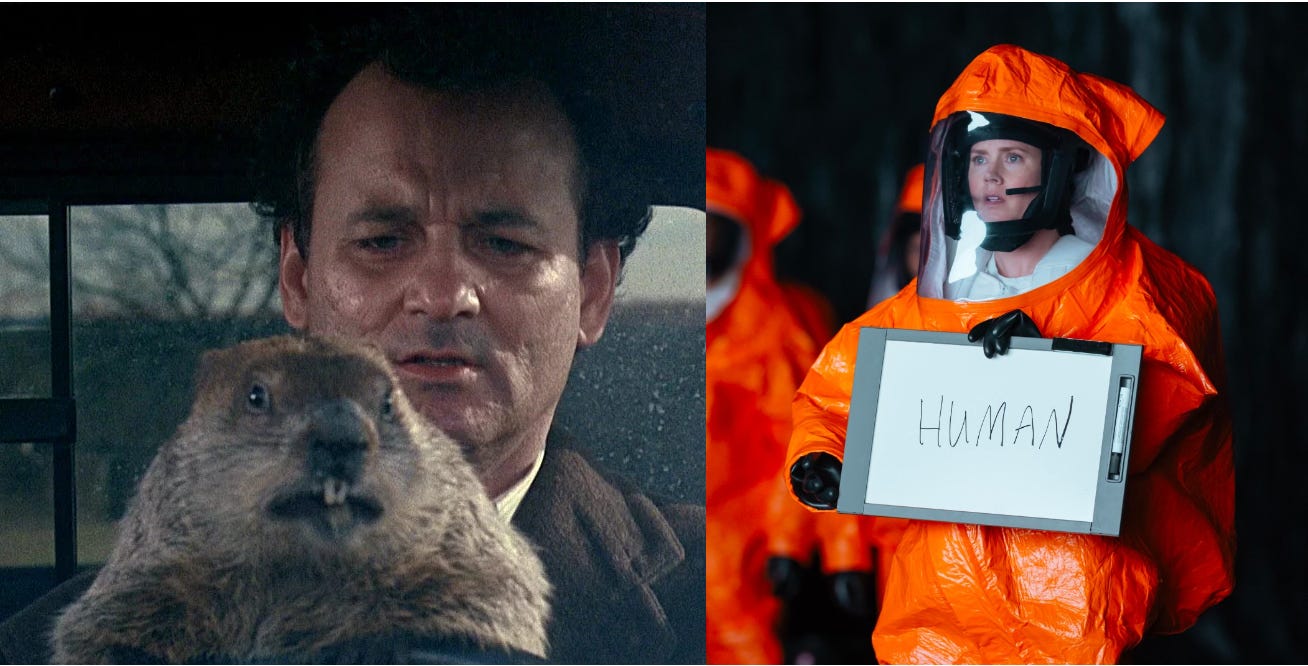
On Sunday night, we had a family movie night. We watched Groundhog Day (1993, Bill Murray), which was my kids’ first time seeing it. And, well, my wife and I have no idea how many times we’ve seen that film because it’s almost impossible to say. 😅
After you've seen it once, you feel like you've seen it multiple times. After a few times over decades, the only way to tell if a specific memory is real is by checking how unfamiliar the very beginning and very end feel (they're the only parts that play once).
In any case, my kids loved it. It was a nicely teachable moment. We had a good discussion about the difference between doing things because you think that’s what others want, and doing them just because they are the right thing to do, to grow and help others. It sounds a bit trivial when you write it out, but it’s profound, and a great thing to discuss at that age.
Then on Monday, my wife went out with the 8yo, so the 12yo and I stayed home and we watched…. Arrival (2016, by my boy Denis Villeneuve! 🫎).
I was really looking forward to it, and it didn’t disappoint. I hadn’t seen the film in a few years and really enjoyed it, but most importantly, my son LOVED it. He said something like: “When I have kids, I’ll be showing this to them when they’re old enough!”, which is a cool sentiment and nice endorsement of the film.
He also said he wanted to rewatch it so that he can now see things differently, now that he knows the ending, and that he wants to show it to his little brother when he’s old enough.
It also generated some great discussions about time and language. But also, about why it’s important to go back and watch older films, if only because there’s going to be a lot more good ones if you pick and choose from the past 60 years or whatever than if, like many people, you mostly just watch recent things from the past 2-3 years.
Same for music, same for books. 📚🎶
I’m glad to be sharing these moments with my kids, and helping open their minds to a wider horizon in my own little way.