


65: Snowflake's Slootman, Shopify's Finkelstein, Bezos Considering Building Shopify Rival, Apple vs Qualcomm, Twitter & AWS, Zoox Robotaxis, and Liberty Latin America
"while we're sitting here laughing and having fun and telling jokes, the competition is planning to assassinate us"

One lesson from the success of podcasts and YouTube: there is an enormous market for digital companionship.
We are profoundly social creatures. Modern life can be lonely. We miss the chatter of the ancestral campfire.
We import voices to fill the silence and feel less isolated.
I’ve been listening to the Cortex podcast since it began in 2015. It’s basically part of the ‘two dudes talking’ genre, with co-hosts CGP Grey, best known for his Youtube animated videos (this one is a good introduction to his style), and Myke Hurley, co-founder of Relay FM and co-host to a hojillion other shows.
One of the recurring themes is the tools and techniques of creative people and their projects. They’ll talk for hours about how they do research, organize notes, which apps are best to write markdown scripts, time-tracking, email clients, how they set up their offices, etc. They also frequently go into all the psychological aspects of this kind of work, and the joys of having side-projects as creative outlets.
It may sound super-boring, but it’s like one of these TV shows where the description of the plot is flat, but it’s still really good because of the characters and not the action.
I’ve always been a big admirer of creative people — which is kind of why I started this, because I was seeing so many interesting things and wanted to share them — but never really thought I had anything that could be turned into one of these creative side-projects.
Investing is a rather lonely pursuit when it comes down to it, at least for me, and while it’s great to chat with a bunch of smart folks, we’re not exactly building something together… Or maybe we are, but not quite in the way that would scratch that particular itch.
As I was listening to the most recent Cortex episode, a kind of yearly retrospective and a look-forward at the themes that they want to work on next year, I had that “lightbulb over my head” moment when I realized, wait a minute!, I’ve now stumbled accidentally into having one of these creative side-projects.
It does feel really good to be creating something; to have no roadmap and no blueprint, to just kind of make it up as you go; to have nobody else responsible for success (or screwups); to have somewhere to put ideas as they pop up and see how some resonate and others don’t; to see multiple paths forwards and have to pick one, etc.
Anyway, I wrote about all this in the intro of edition #43 where I encouraged you to throw your hat in the ring if you’re on the fence at all about contributing more to the online discussion, or creating your own thing.
This is a reminder to go for it.
You don’t have to be able to visualize how the whole thing will unfold before you start. Nobody ever knows where things are really going (William Goldman was right). Just one foot in front of the other, and eventually you get somewhere.
Investing & Business
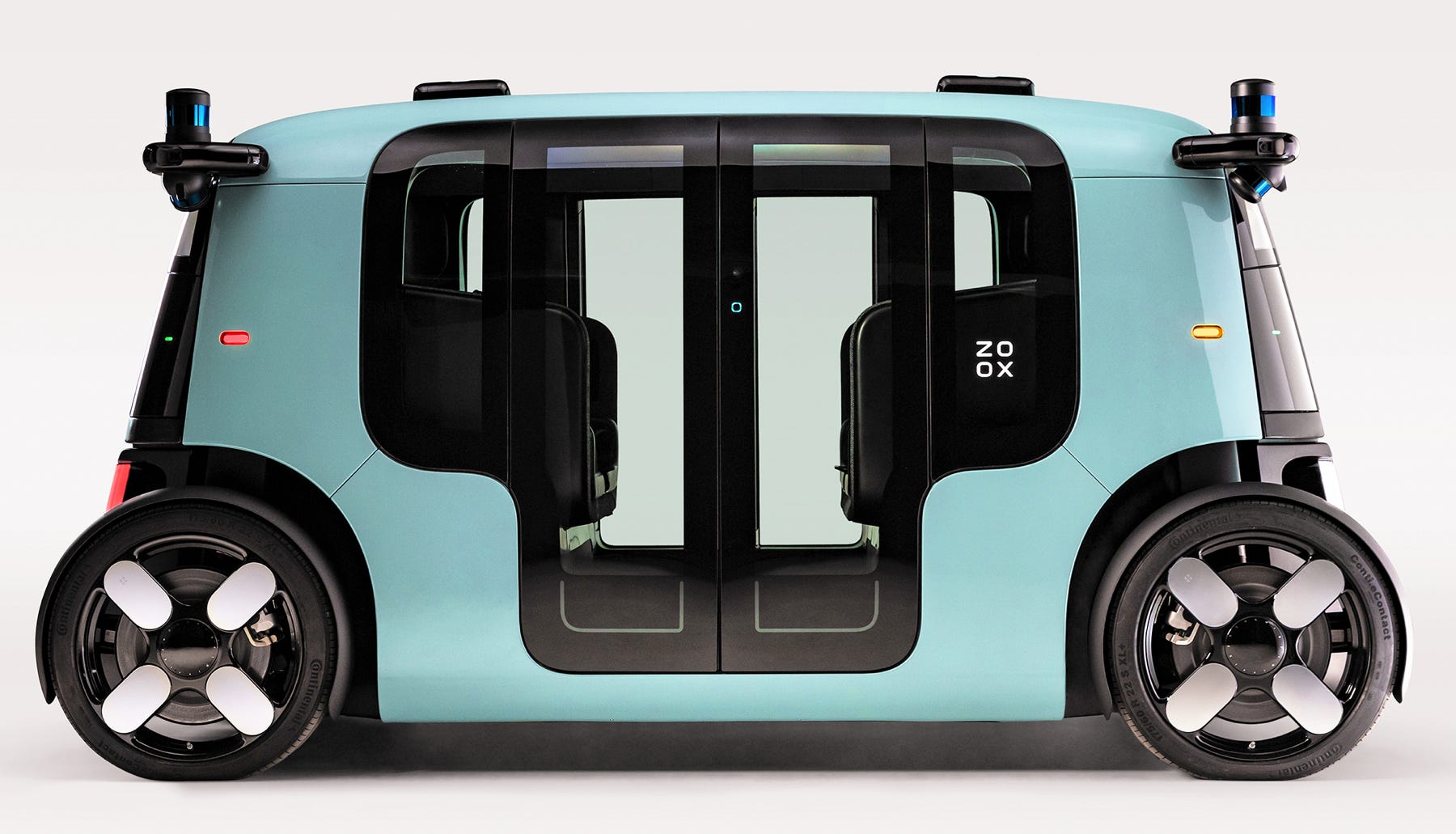
‘Zoox Reveals First Look at Autonomous, Purpose-Built Robotaxi’
Amazon subsidiary Zoox has unveiled what its first self-driving robotaxi will look like (the company was acquired in June 2020, for a reported $1.2bn).
At 3.63m long, the vehicle has one of the smallest footprints in the automotive industry. The vehicle features a four-seat, face-to-face symmetrical seating configuration that eliminates the steering wheel and bench seating seen in conventional car designs. The vehicle also features a 133 kWh battery, one of the largest available in electric vehicles today, allowing it to operate for up to 16 continuous hours on a single charge [and 75 MPH top speed. [...]
The vehicle design has more than 100 safety innovations not featured in conventional cars, including a novel airbag system for bidirectional vehicles and carriage seating that envelops passengers, which is equal to five-star crash safety protections for all four seats. The vehicles utilize a unique sensor architecture of cameras, radar, and LIDAR to obtain an unrivaled 270-degree field of view on all four corners of the vehicle, eliminating typical blind spots and allowing the vehicle to consistently track objects next to and behind it, including pedestrians, bicyclists, and other road users. (Source)
After looking at it for a bit, I kind of like it. I generally think these pseudo-futuristic, bubble-cars that are everywhere as “concepts” at auto shows are abominations, but in this case, it’s so clearly not a car that it works.
To my brain, this falls in a category somewhere with tramways and cable cars, and I like that they didn’t try to fully hide the robotic nature — they made it cute, but not overly cute, and the wheels and corner sensors are the HAL9000 spice to balance out the rounded roofline and pastel color…
*Colossus has entered the chat*
Today, we launch Colossus. Our goal is to become the destination to learn about business building and investing. [...] Our focus is to do just two things extraordinarily well: (1) produce the best conversations in the world, and (2) build tools to make learning from these conversations easier and more effective.
Patrick O’Shaugnessy writes about the genesis of the idea:
During the summer of COVID, I met an executive at HBO who told me, in the nicest way possible, that I was foolish for not building more around the podcast. The next day I posted a job description for a partner. I reviewed all 700 applications and hired Damian Brychcy to be the CEO of the new business.
Right now the core features of the site are the search and transcripts:
Starting today, we are releasing ultra-fast search capability across most of the 200+ Invest Like the Best and Founder's Field Guide episodes (with the rest to be completed soon) replete with full transcripts, show notes, artwork to bring the episodes to life, and links to all books, articles, audio, video, or products mentioned in the episode.
You can slice and dice things by topics, such as find only episodes about public market investing or private equity or crypto or whatever, or search for a specific thing and find out everywhere it has been mentioned (ie. “Barry Diller”).
But their roadmap has new podcasts with new hosts — I guess even someone as productive as Patrick can’t scale past a certain point…
Check it out: Colossus
LILAK M&A Rumbles
For those who have watched Liberty Latin America’s stock melt for the past 5 years, here’s one more reason to… watch and hope that something finally happens?
Liberty Latin America Ltd., the regional operator backed by billionaire John Malone, is considering an acquisition of Telefonica SA’s businesses in Colombia and Ecuador, people with knowledge of the matter said.
The telecommunications companies have held talks over a potential deal, the people said, asking not to be identified discussing confidential information.
Telefonica Colombia reported 558 million euros ($678 million) of operating income before depreciation and amortization last year, while the Ecuador unit generated 193 million euros, according to company filings. Deliberations are ongoing, and there’s no certainty they will result in a transaction, the people said.
Liberty Latin America has been expanding through acquisitions, agreeing last year to spend nearly $2 billion for AT&T Inc.’s operations in Puerto Rico and the U.S. Virgin Islands. In July, it reached a deal to purchase Telefonica’s Costa Rican unit for about $500 million including debt. (Source)
Interview: Frank Slootman, ❄️ Snowflake CEO
Here’s a quote from the interview that tells you a little about how Slootman sees things:
"I'm uber-paranoid... I see problems everywhere. I used to say in my meetings, while we're sitting here laughing and having fun and telling jokes, the competition is planning to assassinate us — right now! We live in a state of constant war. Business is a modern for of warfare, and thankfully people don't get killed, but businesses do.”
I also liked this:
People ask me, “tell me what your playbook is,” and I’m like: Forget playbooks.
The moment you start fixating on playbooks, you become a prisoner of your own experience, ok? You have to fight it, because human nature being what it is, we always want to rely on what we know.
But I’m not going to rely on what I know, I’m going to be like a 5-year-old who’s never seen the situation before, think through, what is the right way to think about it.
In medicine, a doctor will spend 95% of their energy diagnosing what is wrong with you. Once they’ve figured out, eliminated all the other possibilities, it’s very simple what is the protocol for treatment. So it’s 95% diagnosis, 5% treatment.
In business, it’s the opposite. We rush to conclusions, we spend 5% on diagnosis and 95% on the solution. Here’s the problem: If you’re wrong on the diagnosis, the solution won’t work.
I spend way more time trying to think through what the problem is…
On culture:
Get the wrong people off the bus, get the right people on the bus. And then it’s a matter of reinforcement every second of the day, every interaction, every engagement, every situation. You reinforce, reinforce, reinforce.
Culture is not a poster on the wall.
Culture is the willingness to prosecute any deviation of culture, and show everybody that you’re not accepting, you’re calling it out, for everybody to see.
That’s how culture gets built. Just declaring high-minded principles does nothing.
He tells story about turning around businesses earlier in his career, including Data Domain. The guy certainly is enthusiastic and forceful. His thoughts about tempo/velocity and how crucial it is to hire well are spot on. Good stuff.
Interview: Harley Finkelstein, Shopify COO
Tim Ferriss has a good interview with this one-man flywheel:
Interesting, he went to the same University, in the same program that I went to. We overlapped by one year. I’ve possibly met him, though I don’t remember ¯\_(ツ)_/¯
I like what he says about having to re-qualify for your job each year, and that at a fast-growing company like Shopfy, this means a lot of personal growth, to at least keep pace with the company, if not to ideally outrun it a bit. If you fall behind, it’s not just about you; you’re hurting the company, and all the people who depend on it (employees, customers, shareholders), so the stakes are high.
This echos closely what Daniel Ek of Spotify said on his recent interview with Tim (he mentioned something about having had something like 8 different jobs since the company was founded, because things change so much, and so even if the title stays the same, what he’s doing is differnet).
h/t @Komrade_Kapital
‘Jeff Bezos and Amazon execs have discussed launching a rival to Shopify’
Speaking of Shopify (I promise I’ll get better at segues someday):
Bezos and his top lieutenants have considered launching the service under the Amazon Web Services cloud unit and having Yunyan Wang, the technical advisor to retail CEO Jeff Wilke, run the business, one of the people said. (Source)
Obviously it would be very hard for Amazon to compete directly with Shopify, since they aren’t a neutral platform vendor and will always compete with other retailers.
But who knows, it’s a big market and they may be able to come at it from an interesting angle and provide different trade-offs to customers.
There’s a good chance that nothing will come of it — I’m sure Amazon is constantly floating all kinds of ideas of things they could do — but it’s an intriguing thought.
MacKenzie Scott has Given $4.2bn in the Past 4 Months
Flexing some of that $60bn net worth in a very compassionate way:
I asked a team of advisors to help me accelerate my 2020 giving through immediate support to people suffering the economic effects of the crisis. They took a data-driven approach to identifying organizations with strong leadership teams and results, with special attention to those operating in communities facing high projected food insecurity, high measures of racial inequity, high local poverty rates, and low access to philanthropic capital.
The result over the last four months has been $4,158,500,000 in gifts to 384 organizations across all 50 states, Puerto Rico, and Washington D.C.
Some are filling basic needs: food banks, emergency relief funds, and support services for those most vulnerable. Others are addressing long-term systemic inequities that have been deepened by the crisis: debt relief, employment training, credit and financial services for under-resourced communities, education for historically marginalized and underserved people, civil rights advocacy groups, and legal defense funds that take on institutional discrimination. (Source)
Science & Technology
Twitter Moving Timelines to AWS
As UnHedgedChatter put it so well: “Bezos found a way to monetize Twitter.” (HA!)
[Twitter] has selected AWS to provide global cloud infrastructure to deliver Twitter timelines. Under the multi-year deal, Twitter will leverage AWS’s proven infrastructure and portfolio of services to support delivery of millions of daily Tweets.
This expansion onto AWS marks the first time that Twitter is leveraging the public cloud to scale their real-time service. Twitter will rely on the breadth and depth of AWS, including capabilities in compute, containers, storage, and security, to reliably deliver the real-time service with the lowest latency, while continuing to develop and deploy new features to improve how people use Twitter. [...]
Twitter and AWS will create an architecture that extends Twitter’s on-premises infrastructure to enable them to seamlessly run and scale the real-time service globally, increase its reliability using AWS’s fault-tolerant infrastructure, and rapidly move new features into production around the world.
“New features”? “rapidly”? At Twitter? Ha! I’ll believe it when I see it.
The company has been using AWS for some things for a long time:
The new agreement builds on the companies’ more than decade-long collaboration, where AWS continues to provide Twitter with storage, compute, database, and content delivery services to support its distribution of images, videos and ad content. (Source)
Apple: Intel was Breakfast, Qualcomm is Lunch
Who’s for dinner? I guess that’ll probably be AMD, if Apple stops using third-party GPUs at some point (my money would be that they’ll keep using them in Mac Pros and iMac Pros but not in laptops and most iMacs)…
Back to lunch, though: Last year, Apple bought Intel’s 5G modem business for $1bn (after Intel failed to get good traction against Qualcomm), and clearly they didn’t want it just to put in a cardboard box in the crawl space in Cupertino:
Johny Srouji, Apple’s senior vice president of hardware technologies, made the disclosure in a town hall meeting with Apple employees [...]
“This year, we kicked off the development of our first internal cellular modem which will enable another key strategic transition,” he said. “Long-term strategic investments like these are a critical part of enabling our products and making sure we have a rich pipeline of innovative technologies for our future.” [...]
Srouji did not say when the cellular modem would be ready to ship in products, but a 2019 patent agreement between Apple and Qualcomm includes a six-year licensing pact. Qualcomm charges license fees to phone makers based on wireless patents it owns, regardless of whether they use its chips or not. (Source)
Not clear how fast they can have a competitive modem, but looking at how their silicon team has been doing lately, if I was at Qualcomm’s modem division, I’d be worried about losing that big customer eventually…
Interview: ‘Mule’ on Semiconductors & Hiking the Appalachian Trail (Podcast)
Somehow I missed it when it first came out, but ‘Mule’ (@FoolAllTheTime on Twitter, also check out his Substack) did an interview on the Value Hive Podcast:
It’s really good, and covers a lot of ground in a pretty easy-to-understand-way for non-total-nerds like me.
CPUs, GPUs, FPGAs, ASICS, DRAM, INTC, AMD, NVDA, TSMC, ASML, LRCX, IPHI… it's a good mix of acronyms.
And good luck to Mule on hiking the "gnarliest" part of the Appalachian Trail!
Update: Apparently he’s hiking the Continental Divide Trail. I must’ve misheard… oops
‘FDA Authorizes Ellume COVID-19 Home Test’
FDA grants Emergency Use Authorization for Ellume COVID-19 Home Test for non-prescription home use in symptomatic and asymptomatic individuals
96% accuracy, with an overall sensitivity of 95% (positive percent agreement) and specificity of 97% (negative percent agreement) when compared to an emergency use-authorized RT-PCR laboratory test.
In individuals presenting with COVID-19 symptoms, the Ellume COVID-19 Home Test demonstrated a sensitivity of 96% and specificity of 100%, and in asymptomatic individuals, the test demonstrated a sensitivity of 91% and specificity of 96%.
Ellume is ramping up manufacture, with production on track for over 100,000 tests per day in January 2021 (Source)
A little late, and a little expensive at $30 per use, but a good start. Hopefully a lot more, at lower costs, coming so more lives can be saved while vaccines are ramping up and rolling out.
Google’s Year in Search 2020

The Arts & History

The Rise and Fall of the… Simpsons
Really cool visualization of the IMDB ratings of each season, and each episode. Glad I grew up watching reruns of that green period and stopped watching in the early yellow.
Source. h/t Info.Read.Know
A Bunch of Things You Probably Didn’t Know about Paul McCartney
A probably deeper-than-you-need dive into the life and works of Paul McCartney by Ian Leslie at the Ruffian (have to admit, I knew nothing about him before this):
If you want a good one, check out #42 about Penny Lane, as you listen to the song. It won’t sound the same to you afterwards.
h/t Jordan Schneider
Amadeus (1984): Hour-Long ‘Making of’ Documentary
If you can’t watch the whole thing, the last 10 minutes include some great stuff about the making of that memorable requiem-composing scene. Here’s the link to the timestamp.
h/t @ColdCawfee