


Please try to keep an open mind—not only to let new ideas in, but also to let the old ideas out!
—Larry Gonick, Cartoon History of the Universe III

🎬🎥🍿🇫🇷👽💥 Hey Hollywood, I hear you're back, making real event films.
I’ve got one for you.
Edge of Tomorrow is one of the most fun sci-fi films of the past 20 years. Unfortunately, it wasn't a big commercial success. The vague title and marketing probably didn't help, and it came out right in the middle of the superhero/franchise boom.
But its reputation has grown over time, and I think that if it came out today and was well marketed, it would probably make at least 75% as much as Top Gun: Maverick.
So here’s my idea: Do the prequel!

The hook is built into the first film. We never see what happened to Rita at Verdun, and that’s a great storytelling opportunity that sidesteps most of the pitfalls of a sequel (you have to do bigger stakes than the first film, but we already saved the world and beat the Omega, so where do we go from there?).

It doesn’t matter that Tom Cruise isn’t there. I want to meet her squad. Get some great actors playing some well-written characters, and this could be an Aliens-type space marines ride. (How I wish James Cameron would make this instead of Avatar 7 or whatever)
And now that the first film has explored the “learning to deal with the loop”, the prequel could move through that much faster and focus on the adventures/problem-solving side of it
I even made the poster for ya.
🤷♂️🤷♀️ Great quote by friend-of-the-show Rohit Krishnan (💚 🥃):
The fact is though that even though we don’t know much about the right ways to make decisions or the right things to do for success, and yet we live in wondrous civilisation. We have whole cities and medicines and semiconductors and a dizzying array of choices for anything our hearts desire. How?
He then quotes Alfred North Whitehead:
“Civilization advances by extending the number of important operations which we can perform without thinking of them.”
I wish I knew that quote before writing Workbench #4, AI Is Becoming a Compiler for Intelligence. It’s such a perfect fit. I went back and added it in. Why not? Digital is not paper. It can evolve.
💚 🥃 The paid subscription includes the full feed, every podcast, Zoom Q&As with me, and access to the private Discord clubhouse, where a core group of us hang out and discuss the interesting stuff we find:
🏦 💰 Business & Investing 💳 💴
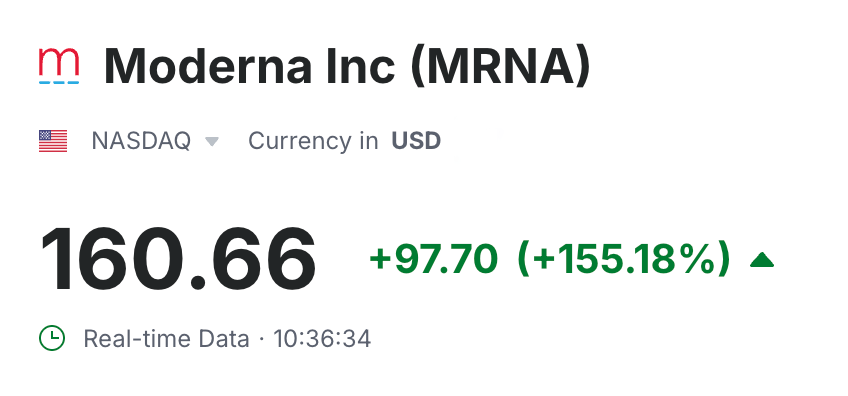
💉 Moderna’s Personalized Cancer Vaccine (Phase 3) 👩🔬🧫🧬
That’s the kind of news I like to wake up to. And I hope we’ll have many more mornings like this as scientists make more breakthroughs on things like cancer, Alzheimer’s, and… let’s cure the common cold while we’re at it.
“Today’s results represent a landmark moment for adjuvant melanoma treatment. This is the first Phase 3 study to show that intismeran, a treatment designed based on the unique mutational ‘fingerprint' of a patient's own tumor, given in combination with pembrolizumab can reduce the risk of recurrence or death in patients with completely resected stage IIB-IV melanoma compared to KEYTRUDA alone,” said Professor Georgina Long, the study’s principal investigator and medical director of Melanoma Institute Australia, Chair of Melanoma Medical Oncology and Translational Research at the University of Sydney. “Intismeran in combination with pembrolizumab has the potential to establish a new treatment paradigm in the adjuvant melanoma setting, helping patients remain cancer-free for longer.”
This isn’t a vaccine that prevents you from getting melanoma in the first place.
These patients already had high-risk stage IIB–IV melanoma that had been surgically removed. The goal was to kill microscopic leftover cancer cells from staging an eventual comeback.
Each patient’s vaccine is personalized to their own cancer and given with Keytruda, an existing anti-PD-1 monoclonal antibody.
tumor sample → sequence tumor → computationally identify neoantigens → manufacture bespoke mRNA → vaccinate patient → train T cells to recognize that cancer
We don’t yet know exactly how large the benefit is because Moderna and Merck haven’t released the detailed Phase 3 numbers yet, but what has me most excited is what this validates: the basic idea actually works at Phase 3 scale. If the approach generalizes, this could become a platform for treating other cancers, not just melanoma. 🙌
This is the first positive Phase 3 trial ever for an individualized neoantigen therapy and for an mRNA-based cancer therapy.


Science FTW!
🌐 Will we ever have enough compute?

It almost sounds like a dumb question.
The first answer that immediately comes to mind is: no, we can always use more compute. We can always find more things to do. Chips keep getting better year after year. We still find new ways of improving them after all these years.
But is it a dumb question?
What’s the endgame here? How much of world GDP can be dedicated to compute?
The larger compute becomes as a fraction of the economy, the more “compute investing” starts to look like macro investing. We already went from looking at memory bandwidth and CUDA changelogs and number of cores per GPU to thinking about financing costs, grid infrastructure, and global geopolitics. If this keeps going, more and more of the economy gets pulled into what we have to worry about for the compute stack.
At what point do things break? Is it because a trend has been going on for some decades that it’ll keep going on?
Algae don’t take over the universe, even though if you graph out their exponential growth in some pond, that’s where the line goes.
At some point, something becomes binding. The algae run out of nutrients, light, space, whatever. What’s the equivalent for compute? Power? Capital? Chips? Land? Or do we just keep solving one bottleneck after another until the real constraint is simply that another dollar of compute isn’t worth another dollar anymore?
But when does that happen? In five years, in fifty years, in five hundred years?
When do we reach a steady state where the basic network is built and most investment goes toward maintaining and upgrading the existing stock rather than expanding it exponentially? Kind of like, I dunno, railroads.
I remember that in Isaac Asimov’s Foundation, there’s a planet called Trantor that is basically just one giant city covering the whole planet’s surface. Star Wars has something similar with Coruscant. Is that where we’re headed? Mars next? 😅
¯\_(ツ)_/¯
Maybe that’s one thing to watch out for. So far, every time we improve one constraint, another bottleneck shows up somewhere farther out (like whack-a-mole). Chips, memory, networking, power, grids, capital, whatever. As long as the bottleneck keeps moving rather than disappearing, that seems like evidence that we’re still a long way from “enough compute.”
The interesting moment may be when that stops happening. When we solve a bottleneck and, instead of immediately discovering the next shortage, capacity waits for demand.
✈️ 💾 Google Wins $10m Auction for Spirit Airlines Business Data from Bankruptcy
This reminds me of stockpiles of patents being bought from the carcass of fallen giants a few years ago. Google was a big buyer at the time:
2011: Nortel — Google tried to buy ~6,000 patents but lost the auction
2011: IBM — Google bought ~2,000 patents from them (if there’s one thing IBM is good at making, it’s patents! Too bad it doesn’t turn them into good products)
2012: Motorola Mobility — They bought the entire company for $12.5bn, and at the time a big part of the reported appeal was the ~17,000 patents and ~7,500 pending patents
2012: Kodak — Google was part of a consortium that bought ~1,100 imaging patents
Most of these purchases were defensive, just to make sure you don't get attacked in court, or that you have a mutually assured destruction type of situation with your competitors.
The gold rush for data is more offensive in nature, trying to gain an edge.
Now:
Google LLC won a bankruptcy auction for a trove of deindentified business data, software code, and operations records from collapsed low-cost carrier Spirit Aviation Holdings Inc., saying it plans to use the assets to improve its artificial intelligence.
The tech giant’s $10 million bid includes a vast repository of the defunct airline’s data, including 100 million emails, 500 million Microsoft Teams chats and collaboration records, plus information related to revenue, aircraft operations, employee productivity, and audits and fraud, according to an Aug. 14 notice in the US Bankruptcy Court for the Southern District of New York. [...]
The cache includes data related to marketing campaigns, human resources, strategy, and project management. Also included is pricing from 7.2 billion competitor flights, an estimated 7.5 billion passenger transaction records going back to 2008, and pricing curve data
Google’s purchase also includes about 30 million lines of code, development metadata, and software models and algorithms. The purchase also includes more than 175,000 employee records dating back to 1986.
The data will be anonymized so the personal info of customers is scrubbed:
Google’s purchase doesn’t include personal data and privileged materials like Spirit’s 97.5 million passenger profiles or an estimated 50.2 million records related to the Free Spirit loyalty program data, according to court records.
The data will also go through a process to ensure that it can’t be associated with particular customers, according to the court filing.
Spirit didn’t accumulate 100 million emails, 500 million Teams chats, billions of transaction and pricing records, and 30 million lines of code because it thought they’d someday be valuable to an AI lab. It’s just a byproduct of doing business.
Until recently, there weren’t many buyers on the planet who could do much with a pile like this. But as I wrote about, better AI models can extract more value from the same old data.
This is a gigantic record of how a real company actually operated: how people worked, how decisions were made, how pricing changed, how projects succeeded or failed, how fraud got caught, how software evolved, etc. All this stuff is great for pre-training and RL!
Stuff that was ‘corporate exhaust’ can now have salvage value. 📁🗄️→💰
It may seem like $10 million is nothing because Google is spending hundreds of billions on CapEx. But the point is that the same dataset can be worth radically different amounts depending on who owns it and what they can do with it.
Spirit couldn't extract much more value from these records (obviously). Google may be able to improve products used at enormous scale. Even if the improvement is small, it doesn't take much for $10 million to look cheap.
Not every company's old data is gold. But I suspect we'll see a lot more attempts to figure out which ones are.
Bankruptcies make this visible because everything gets picked over and assigned a price. But I wouldn't be surprised if living companies realize that some of the operational data they've been accumulating for years is an asset they can license or sell.
Every lab has been generating new data, creating synthetic data, and getting access to large private datasets. AI may now be creating an entirely new market for data that was considered to be mostly worthless to anyone but the company itself (and maybe direct competitors).
🔁 Déjà vu: When Old Compute and Data Get Better With Age
From the full feed 🔒: And Just Like That, Tokenmaxxing Is Out 🚮 — don’t get me wrong. Using a lot of tokens productively is great. Targeting absolute numbers of tokens as a metric was always dumb.
🧪🔬 Science & Technology 🧬 🔭
💻 Helium: My New Primary Browser 🔐
I have long been a browser nerd. Ever since I first got Netscape somehow (on floppy disks or some FTP site, I can’t remember), I was hooked. These beautiful apps were my portal into everything I loved. I kept trying every new one in case it was better than what I was using.
I’ve used Netscape, Internet Explorer, Konqueror, Firebird before it was renamed Firefox, Opera, Safari, OmniWeb, Camino, Chrome, Brave, Orion, Vivaldi, and probably a few more I forget.
Some I just tested for a few days, others I ran for years.
But recently, when I saw that my friend Mykhailo was using Helium, I knew I had to try it. I trust his taste in technology more than pretty much anyone else’s.
And I wasn’t disappointed! Here’s the 101:
It’s built on Chromium, the open-source browser project that Chrome is based on. This means Chrome extensions work.
It’s open source and stripped down. It’s trying to avoid cramming a million features into the browser. So it’s more or less a de-bloated and de-Googled Chrome. No nagging sidebars and random AI features built in.
It’s privacy-first. It doesn’t collect your browsing data, it tries to make it harder for websites to fingerprint you, and it comes with ad and tracker blocking by default.
Oh, it’s free, of course.
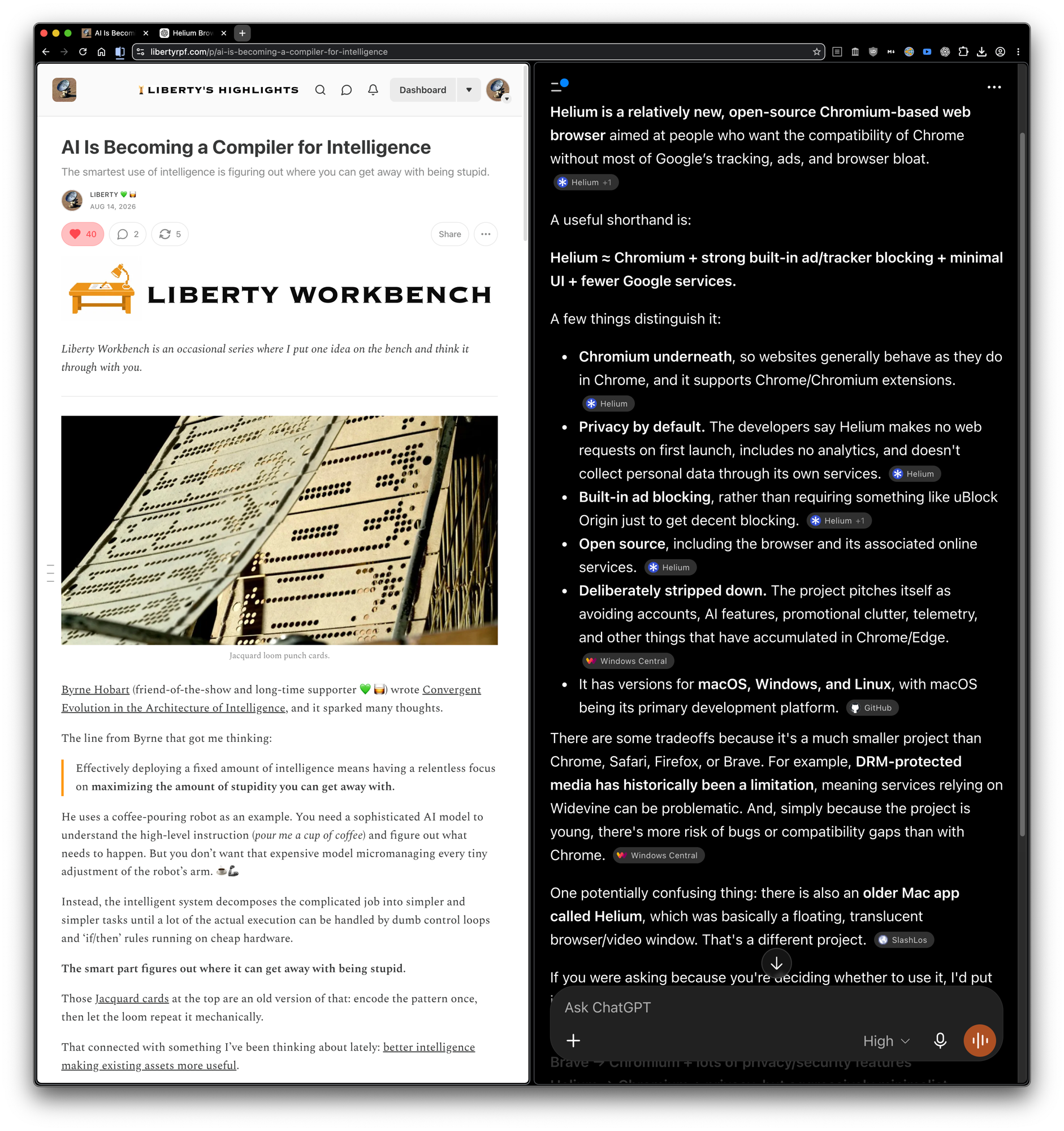
The screenshot above shows the split view, which Chrome also has but I didn’t know about until I saw the feature in Helium. You can basically have two tabs side by side in a single window. I know, I know, you can get almost the same effect by putting two browser windows next to each other. But I find this better organizationally because everything stays inside the same browser window, and it doesn’t mess up the way my windows are arranged on my desktop.
Helium is still in beta, doesn’t have a mobile version (though it has MacOS + Windows + Linux on the desktop) or account sync yet, and doesn’t support Widevine DRM (so some DRM-protected streaming services may not work).
One risk with smaller browsers is delayed security updates.
So far, Helium seems reasonably good on that front. It has been shipping new releases frequently and generally tracking Chromium pretty closely.
If you're a browser nerd like me, or just feel like your current browser has gotten kind of bloated (statistically, it’s probably Chrome), give Helium a try.
🔌⚡The Gigawatt Queue: Revealed Demand vs Paper Demand

When supply is tight, it can become hard to know what demand really is. Customers start panic-buying and double-ordering from multiple suppliers, hoping that one of them will be able to deliver.
This is probably happening with memory and SSDs to a certain extent, and there’s also a similar dynamic when it comes to the power grid.
Let’s look at Exelon. In May, it was showing 18 GW of “high probability” data-center load (as of Q4 2025), plus another ~43 GW of future potential additions.
By Q2 2026, those two buckets had fallen to ~11 GW and ~25 GW.
Wait, demand fell? People cancelled data centers?
Not exactly.
Basically, Exelon made the option more expensive. 💰
It started making developers put more real money to keep their place in the queue. Through what it calls ‘Transmission Security Agreements’, developers can be required to post collateral and make other financial commitments. If the project disappears or uses much less power than promised, the developer can be on the hook.
When grid connections take years, there’s a pretty big incentive to reserve a spot in the queue for 200MW or 500MW or whatever, especially if the cost is low. But when the price of the option goes up, you find out who really meant it.
🔐🤖 Mythos: 60 Hours to Kill a Post-Quantum Cryptographic Candidate
Anthropic’s Mythos just did something pretty cool: it found a weakness not in the code implementing a cryptographic algorithm, but in the math of the algorithm itself.
HAWK was a candidate for a new post-quantum digital-signature standard and had already survived two years of review by expert cryptographers.
Anthropic published Mythos’s attack. The next day, the HAWK team withdrew it from the NIST competition because fixing the weakness would basically kill the advantages that made HAWK attractive in the first place.
What’s cool/scary is how fast it happened. Mythos spent about 60 hours working on HAWK and found a shortcut that dramatically reduced its effective security. For the smallest version, an attack previously estimated to require around 2^64 work fell to about 2^38.
60 hours of Mythos may be an expensive API bill for you and me. But for a nation-state or a large criminal enterprise, it’s not that much money. Right now Mythos access is limited, but more Mythos-class models are coming and will become more widely available.
Mythos also found a new attack on AES, probably the most scrutinized encryption algorithm in the world.
Thankfully, it did not break AES, because so much of the internet’s encrypted traffic uses it (including a huge fraction of HTTPS connections).
Mythos attacked a deliberately weakened 7-round version of AES-128, which normally uses 10 rounds. But it still improved the best previous attack by something like 200-800×.
This obviously doesn’t mean Mythos is about to break full AES.
And to put even that in perspective, the 7-round attack is still completely impractical: Anthropic estimates it would cost hundreds of millions of dollars to execute. 💰💰💰
But what happens when someone lets Mythos loose for 6 months on AES? Or Mythos v6 or v6.5 when it comes out someday?
From the full feed 🔒: Micron and Meta: The Slower Memory Was 3.45× Faster — this may become especially important for long-context and high-concurrency AI inference.
🎨 🎭 The Arts & History 👩🎨 🎥
🎸 The Guitar as an Evolved Artifact
I found this video because my son, who has been learning piano, picks up my guitar once in a while too and is learning a few songs. He asked me where the guitar came from and how it became what it is today.
What I like about this is seeing how the guitar slowly became the guitar. Nobody sat down and designed the whole thing at once; people kept changing bits of it over generations. It’s very cool to hear the different instruments along the way and learn why various features evolved the way they did.



Helium was my primary browser for a couple months but it crashed every time there was an update. Back to Chrome now, but I enjoyed it enough to give it another try once it is out of beta.
plug for librewolf, for those willing to trust someone else taking a stab at prioritizing browser security , with min frictions.
all firefox plugins still work, and so far have been able to find tweaks if there is really is a 'must have' new feature.