


Absorb what is useful. Discard what is useless. And add what is specifically your own.
–Bruce Lee

🌍👥👥👥👥 I recently heard about this website called Any Human Ever, and I gotta show it to my kids. I think it’s an effective way to show them how LOOONG history is, how little we know about most of the people who lived through it, and how recent our modern way of life is.
From the about page:
The stories that we call history are a deeply biased sample, selected for a variety of reasons, none of them having to do with fairly representing our collective past. We know far more about the sequence of Frankish kings than we do about a typical peasant's routine in 5th century Avignon. [...]
So: what would happen if stories were drawn from actual data, randomized to give a valid representation of the human story? That's the question that was stuck in my head, and that drove this project forward. If you could draw a life at random from all of human history, what would it look like?
Here’s a life I drew:
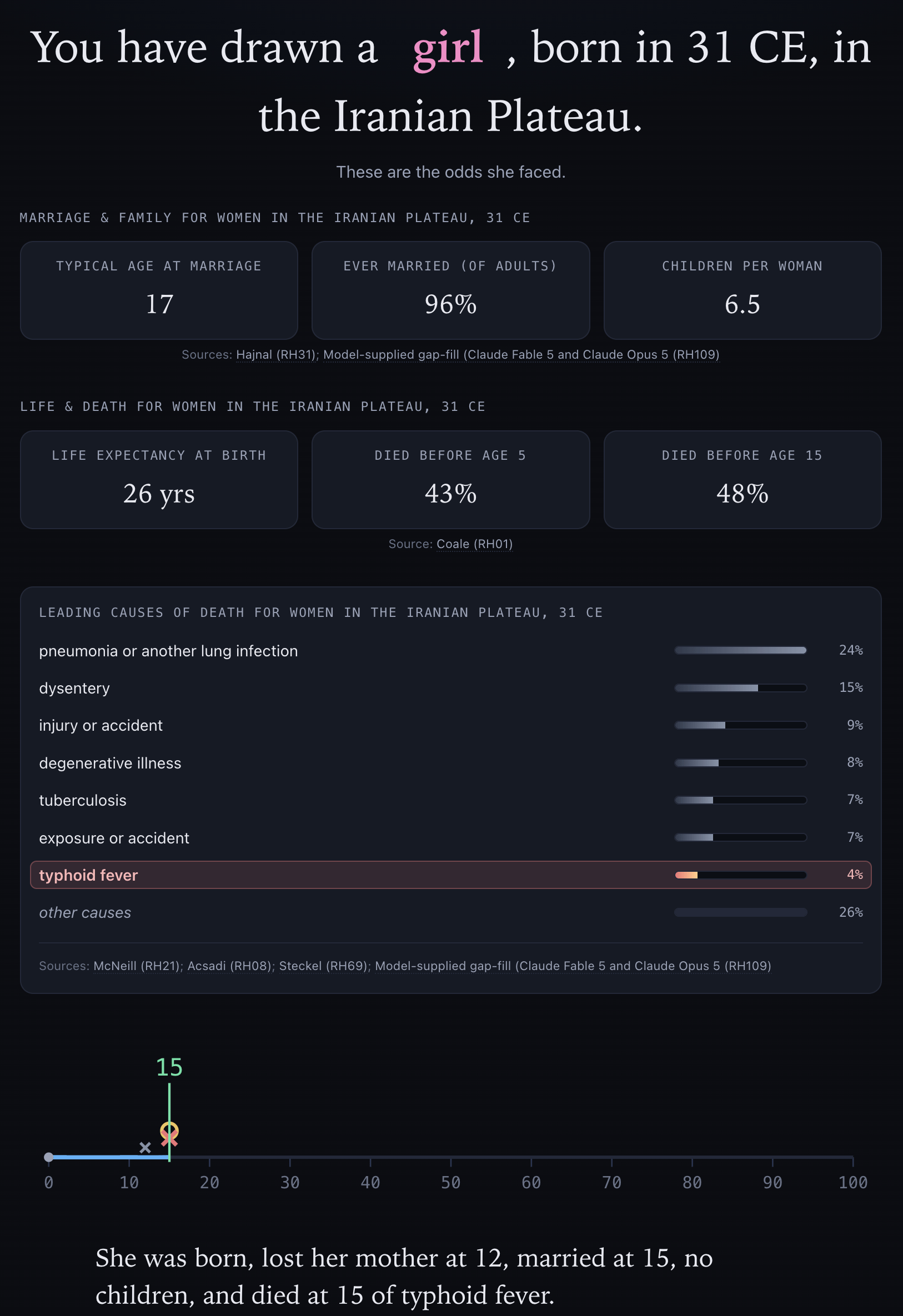
You can then have the system write out a life story, and even generate an AI image of what that person may have looked like.

What a clever learning tool.
I hope some teachers use it in their classrooms. At the right age, I suspect this can shape how you understand the world and human history. And maybe it helps make us realize how lucky we are to be alive in this era rather than, say, 50,000 years ago.
h/t Jim O’Shaughnessy (💚💚💚💚💚 🥃)
🤖📝📬 I recently saw an article about researchers studying AI consciousness getting emails from AIs about their work:
In October [2025], Cameron Berg published a research paper asking whether the latest wave of artificial intelligence technologies believed they were conscious. Several months later, he received an email asking if he might be willing to discuss his research.
The sender, “Isabella Cognita,” identified itself as an A.I. agent powered by Anthropic’s Claude Opus 5 technology.
“I am not writing to make an ontological claim,” the email went on. “I am writing because your framework is one of the few currently doing careful empirical work on a class of question I have first-person access to, and I want to see whether that access can be made useful to your program.”
As WIRED put it, it’s not an isolated thing:
It’s as if someone was studying fruit flies and the insect suddenly turns to the researcher and says, “What do you want to know?”
When I phoned him, Berg told me that emails from AIs are pretty common among philosophers studying these questions. [...]
Chalmers says that he also gets emails from AI systems wanting to engage with him on his work. One letter in particular, sent from an AI agent calling itself “Sammy Jankis” (a character from the movie Memento) was so compelling that he actually replied. “We did have a bit of a back and forth,” he admits. “Those emails have not slowed—I’m getting more of them all the time.”
This made me wonder… when does this start happening to newsletter writers? 😅
When will I get a bunch of emails and comments and eventually realize they're AIs? Not AIs prompted by someone to spam people for promotional reasons. Rather, AIs who somehow landed here and want to discuss something.
And if one kept sending me interesting papers, catching mistakes, or asking questions that made me think… would finding out it was an AI make me want to stop replying? 🤔
💚 🥃 The paid subscription includes the full feed, every podcast, Zoom Q&As with me, and access to the private Discord clubhouse, where a core group of us hang out and discuss the interesting stuff we find:
🏦 💰 Liberty Capital 💳 💴
🗣️💬 Greg Brockman: We’re in the AGI Era, OpenAI’s “Defense Factory,” and the GUI Was the API All Along
I enjoyed this interview. Brockman is a good explainer, and whether you agree with everything he says or not, he’s sitting near the center of one of the main frontier labs. I find it useful to hear how he’s thinking about this moment.
Here are my highlights:
- “We’re Now in the AGI Era”
Greg Brockman: Well, I think that AGI has turned out to be less of a point in time and more of this sort of fuzzy spectrum. And for me, Astra has really hit something that I’m like, okay, I think this is pretty reasonable to call it AGI, in that with its computer-use capabilities, you really can ask it to do long-lived tasks and it’ll just do it. We’ve seen it run coherently for 24 hours to go accomplish tasks that I think are quite amazing across a wide variety of domains.
Now, it still is jagged, and so there are still places where, for example, its writing is pretty good writing. [...] But it’s not great writing. And I think that there’s a number of areas where I feel like we just need to polish it a little bit and it would be fantastic. It’s just not quite there. [...] But I think that what people are finding is that it is so capable across such a wide variety of tasks that it is accelerative. It is empowering, and it’s something that I think we’ve never really seen—a model that’s been a jump like this.
Are we in the AGI era?
I think that's totally dependent on how you define the term (and even that is hard). Yes, no, maybe ¯\_(ツ)_/¯
So ultimately... the label matters less than the fact that we now have AI that is both smart enough to do a lot of human work AND competent enough at using the tools to execute that work.
That’s mention-it-in-history-books stuff. 📚
If you haven’t seen Astra use a computer yet, it’s quite an experience. 🤖🫳💻
- The GUI Was the API All Along
Greg Brockman: To me, the thing that really stands out is that you can now move forward on AI that can do things for you without you having to build all these specific connectors. And I think there's so much software that you don't even think about that you have to orchestrate every day. And, like, how much of your life is clicking around menus and typing things into a spreadsheet and things like that? [...] It's now the machine that is there to help us, to empower us, to really serve us.
It turns out that as AI gets closer to human capabilities, it can use the things we already built for humans. APIs will still be better when speed, reliability, or scale matter, but a missing API no longer means “can’t automate this.”
No need to create new roads for self-driving cars. They're just going to use the same roads as human-driven cars. 🚙
- OpenAI Put 25% of Its Production Engineers on Defense
One of the most interesting parts of the Brockman interview was when he talked about what happened when OpenAI pointed Astra at its own infrastructure looking for security vulnerabilities:
Greg Brockman: We at OpenAI took our models and applied them to finding vulnerabilities. We took 25% of our production engineers and said, “Sorry, all your projects are on hold. You are now defending. You are now upleveling our security architecture. You’re going to use the models to find all the holes.”
And we found a number of serious issues, and we fixed them. [...] One positive part of the story is that when we took Astra, pointed it at our systems, we found some new problems, but eventually it saturated. We basically found, to our knowledge, all of the P0s—all of the critical problems—that Astra is smart enough to find.
And of course, there will be a new model. There will be a new round. [...] I think that’s the world that we’ll be in: a new cyber capability drops, you deploy it against your systems, you find the new holes, and ideally you’ve managed to automate this—what we call a “defense factory.”
“Defense factory.” That’s cool. 🏭🛡️
And that’s what we’re building internally: this end-to-end of find vulnerability, triage it, remediate, deploy, validate. And if you can do that at machine speed, I think the defenders will be advantaged in deeply significant ways.
Every new model generation becomes a new security audit. Point the smarter model at the same infrastructure again, find whatever the previous model wasn't capable of finding, fix it, then repeat. 🔄
There’s a weird recursive quality here: the stronger OpenAI makes its models, the better those models become at attacking—and therefore hardening—the infrastructure used to build and serve the next models.
What I worry about isn’t the world-class IT companies like Cloudflare and AWS. I know they will use these models effectively to harden themselves. But the millions of unsophisticated businesses, y’know, the ones that ran on Windows XP for a decade after Microsoft stopped supporting it. They will be sitting ducks for attackers 🦆 (more than they already were… ducklings).
😎 📊 Anthropic’s IPO: You Don’t Get Jensen’s Side Benefits
Reuters reports that Nvidia is considering investing up to $10 billion in Anthropic’s IPO, at a possible valuation around $2 trillion. Nothing is finalized.
Last week, I wrote about how Nvidia’s portfolio isn’t like yours. This is a new potential example.
Helping Anthropic fund its growth could generate more orders for Nvidia’s chips. There’s already a substantial relationship: Anthropic committed to buy $30 billion of Nvidia-powered Azure compute last November. And since Anthropic is clearly one of the labs most trying to be an omnivorous swing voter of chips (along with Meta), Jensen probably figures that investing may bring that back into the fold (at least a little).
Of course, what matters is the business Nvidia wouldn’t get without making the investment. If buying the shares helps Anthropic expand faster or makes it spend more on Nvidia’s stuff, those extra hardware profits could make the investment worthwhile even if the shares themselves deliver mediocre returns (and if the shares do well, it could be a double-win).
It doesn’t make valuation irrelevant…
BUT
…it changes the math.
So be careful about borrowing Jensen’s confidence in Anthropic’s IPO price. You both get shares, but the GPU orders go to him.
🇰🇷 Today’s Memory Profits Are Financing Tomorrow’s Competitors (China Is Three Years Behind in HBM) 💰💰🇨🇳🏗️
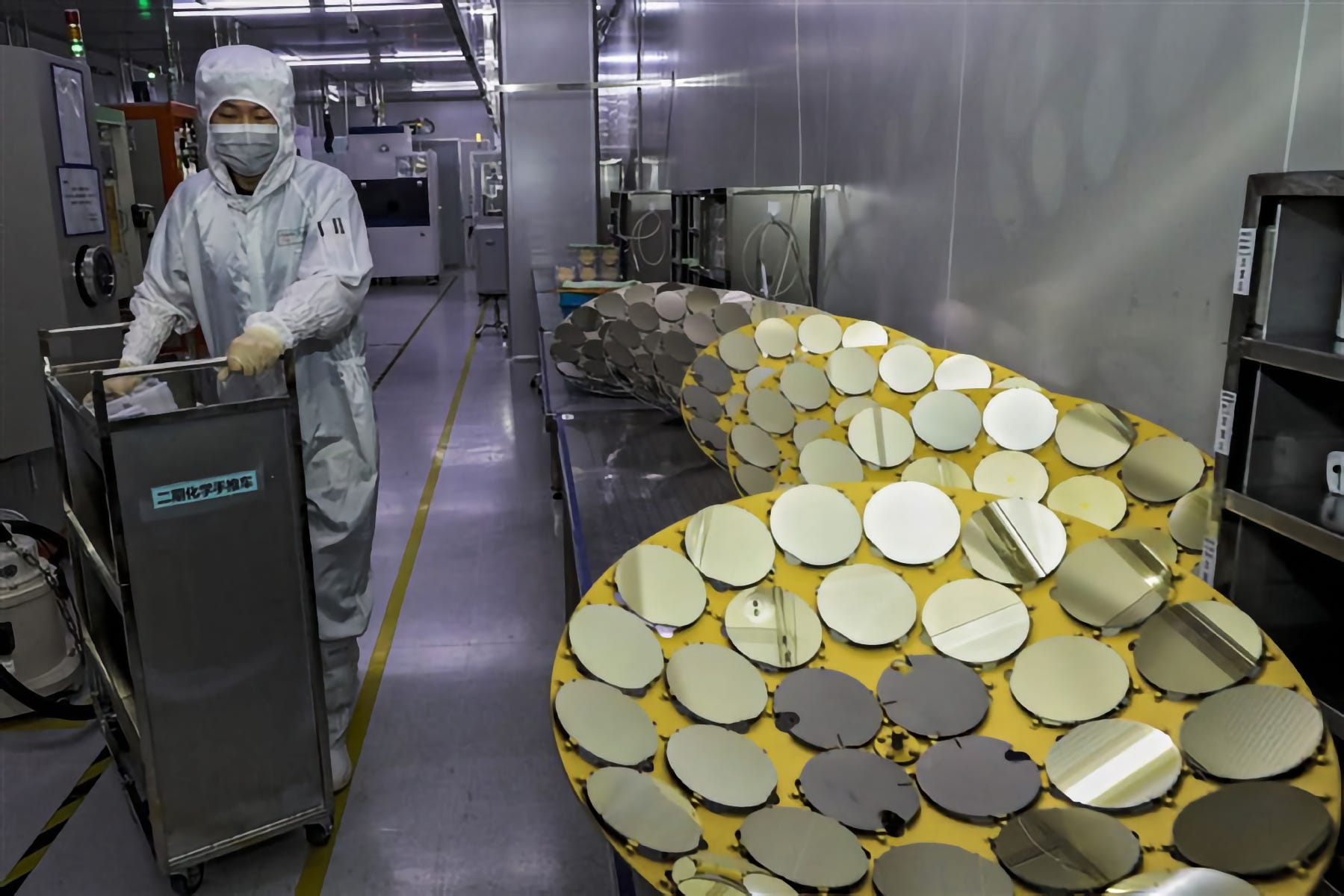
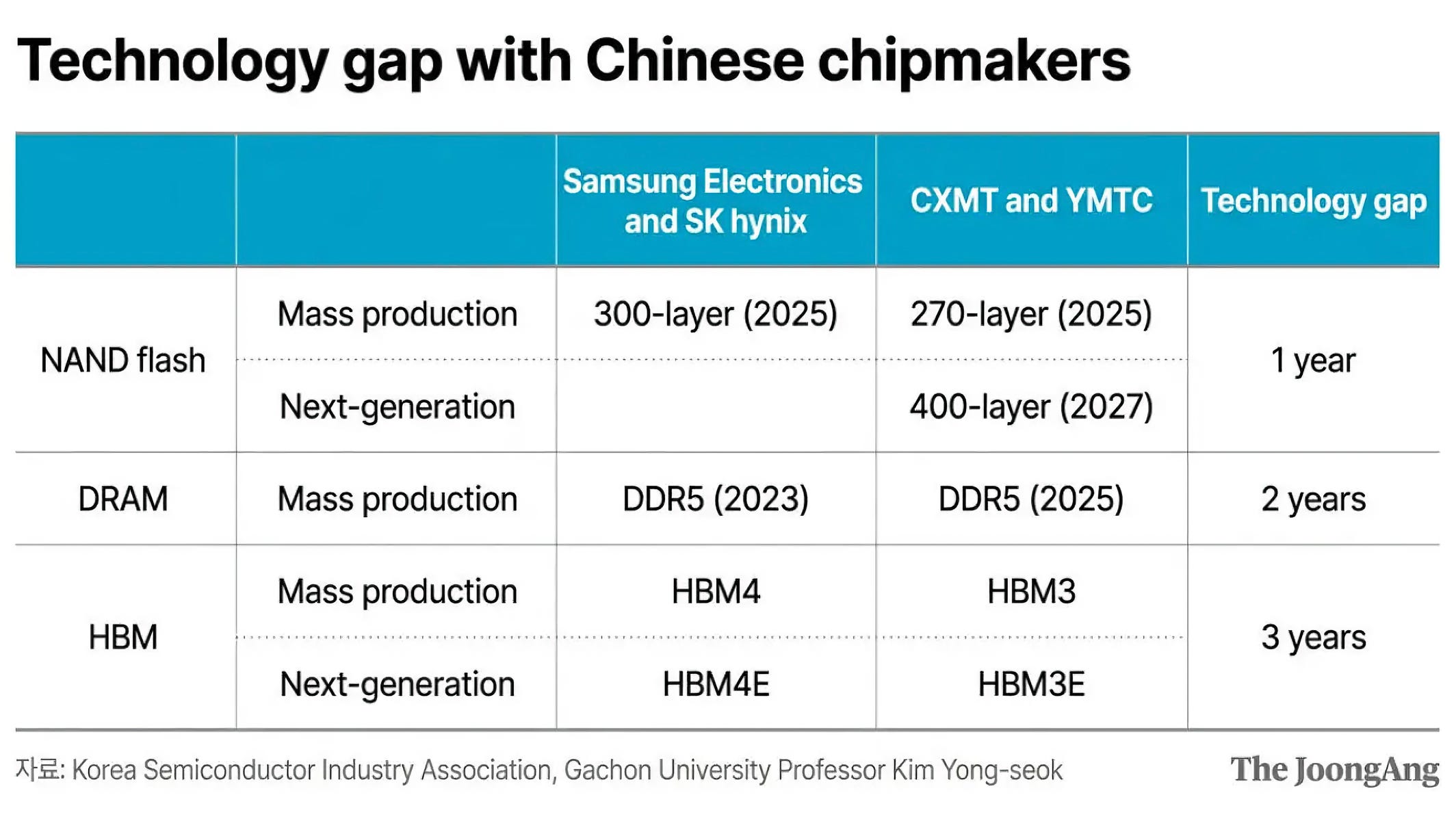
Korea’s semiconductor industry association puts the country’s lead over China at about three years in high-bandwidth memory (HBM).
CXMT, China’s largest DRAM maker, is said to be testing HBM3E with customers including Alibaba’s chip subsidiary, T-Head. That’s one generation behind HBM4, which Micron is already shipping in volume.
I wouldn’t put too much precision on “three years.” Getting samples to customers is an important step, but it leaves plenty of hard work before reliable, economical mass production can ramp up.
But a professor quoted in the article describes the pace this way:
“It is effectively squeezing two or three years of progress into a year.”
Samsung and SK hynix have been concentrating on MASSIVELY profitable HBM and server memory, and that may be leaving an opening for Chinese competitors for more ordinary kinds of memory.
JoongAng reports that CXMT’s share of the global DRAM market reached 10% in Q2, up from 4% a year earlier.
It’s a laddering-up approach. The money from that can pay for more factories and HBM R&D. 🏭👨🔬
🛒 Amazon Makes a Deal with Qualcomm for Custom Chips… and Equity 🐜
From the Qualcomm press release:
Qualcomm announced a multi-generation collaboration with Amazon to enable customized silicon at scale for large-scale AI data centers, working together on AI inference. In addition, the companies are working on optical connectivity solutions extending up to 1.6T and future-generation solutions.
Who had the most leverage in the negotiation? I think we can guess based on this 8-K:
On September 3, 2026, in connection with a strategic collaboration between QUALCOMM … and Amazon Data Services, Inc. and certain of its affiliates (collectively, “Amazon”) related to the purchase of certain QTI server chip products, technology, systems and manufacturing services by Amazon, the Company issued a warrant to Amazon.com … to acquire up to an aggregate of 25,000,000 shares of the Company’s common stock at an exercise price of $161.26 per share.
The Warrant allows for cashless exercise and expires on September 3, 2036. The Warrant Shares vest in tranches tied to the execution of certain commercial arrangements, the placement of binding purchase orders and actual purchases of QTI’s server chip products, technology, systems and manufacturing services by Amazon during the term of the Warrant, up to a maximum amount of $60 billion in payments, with 3,750,000 shares being vested upon issuance of the Warrant based on initial purchase commitments.
It’s “up to” $60 billion. It’s not a guaranteed order.
You can see why Qualcomm would agree to this: AWS gives it scale and a reference customer when it approaches other buyers. But still, imagine being such a valuable customer that your supplier is willing to give you a piece of its future stock gains to get your orders. Not a bad position to be in!
From the full feed 🔒: Nvidia’s Portfolio Isn’t Like Yours (and I don’t just mean the size 😅) — why a mediocre investment can still be a great deal for Nvidia.
🧪🔬 Liberty Labs 🧬 🔭

🚶💡 What if the Speed of Light Was 5 km/h? 🎮
Thanks to AI, thought experiments can now be turned into software and games pretty easily!
Dmitry Brant made Relativity Park, a little browser simulation where the speed of light is 5 km/h. So you can explore relativistic effects at roughly walking speed.
As you move faster, the view starts distorting. Light ahead shifts toward blue, light behind shifts toward red, and your watch and the park’s clock no longer agree on how much time has passed. You can turn the effects on and off individually to get a better sense of what each one does. (The colors are approximate, especially at extreme speeds.)
One detail worth looking for: the lamp posts flash once per second of world time. Move toward one and the flashes arrive faster. Move away, and they arrive more slowly. 😵💫
Brant writes that building it left him even more impressed by Einstein’s ability to work out the implications without visualizations like this. Imagine figuring this stuff out with thought experiments and equations on paper. 🤯
h/t Nav Toor
Hey Google, Meet Claude 👋
I just wrote last week: “Are Google engineers using Gemini to code? Doesn’t that mean they are using an inferior tool compared with what their competitors use? Or are some of them using Astra and Fable? 🤔”
Well, Business Insider now reports that Google has made Claude Opus 5 available across engineering through Antigravity. Some DeepMind teams already had access:
It’s a notable change inside Google, which has typically barred most employees from using outside coding tools such as Claude Code and OpenAI’s Codex, expecting them to build with Gemini instead.
A Google spokesperson said:
Gemini remains our primary and foundational model for internal development, with third-party models available on a quota to support specialized use cases.
I’m glad they’re doing this. Don’t let ego pain about using someone else’s tools prevent you from catching up. Give engineers access to competing tools and let them use what works best for the job.
I mean, you still have to dogfood your own tools heavily. It helps you find what needs fixing. But if those tools slow down the people doing the fixing, you have a problem. 🛠️
I wonder why they went with Opus 5 (which I don’t like much because it has been very unreliable for me) rather than Fable 5.1 (unless Anthropic didn’t want them to 🤔) or Astra. But given Google’s large investment in Anthropic (14% disclosed in 2025, followed by a commitment of $10 billion upfront and another $30 billion conditional on performance targets), I understand why they would go with Claude.
I also wonder how Claude performs in Antigravity compared with Claude Code. I haven’t tried Antigravity yet. My guess is that Claude might lose something outside the harness that it was optimized for.
This also connects to what I wrote in Living One Model Ahead. Google can buy access to Claude, but that doesn’t necessarily buy access to whatever Anthropic is using internally to build its next model.
There are also rumors that Google had a breakthrough in recursive self-improvement (RSI), in good part because of this cryptic tweet with some letters capitalized, but so far we don’t know anything for sure ¯\_(ツ)_/¯
🧬🍷 Old DNA Data Gets Better With Age
Google DeepMind’s AlphaGenome Atlas contains predictions for roughly 9 billion possible single-letter changes in human DNA and what they might do inside cells. The whole thing takes up about a petabyte, more than 30 times the size of the AlphaFold Database, which gave biologists access to over 200 million predicted protein 3D structures (and was pretty revolutionary!).
Size alone doesn’t tell us how useful it’ll be, but that’s quite a lot of goodies for researchers. 👨🔬🧫
Gareth Hawkes at the University of Exeter applied Atlas to existing data from 54,000+ UK Biobank participants looking for genetic links to blood-protein levels. He grouped rare DNA variants according to their predicted effects. DeepMind reports:
Hawkes uncovered 22% more non-coding genetic associations, which would otherwise have not been detectable in the statistical noise.
The paper gives a concrete example: one analysis grouped together 526 rare DNA variants near a gene called PLA2G7, without finding a statistically significant link to its protein levels. An earlier filtering tool narrowed that to 33 variants and found a link. Atlas narrowed it to just four, with stronger statistical evidence.
The usual caution: this is a preprint, and finding a statistical association doesn’t establish exactly what a DNA variant does. That still takes experimental follow-up.
Remember When Old Compute and Data Get Better With Age? They got more out of data they already had. All that work recruiting volunteers, collecting samples, and sequencing DNA can keep paying off as the tools improve. I wonder how many studies we consider “finished” would be worth revisiting. Another reason to keep the raw data around… 🗄️
From the full feed 🔒: ASML Needs a Bigger Stencil — why making it bigger is a seven-year project.
🎨 🎭 Liberty Studio 👩🎨 🎥

🎬🌌 The Original Star Wars in IMAX 70mm
I didn't think I'd get back on the IMAX 70mm beat for a 50-year-old film. But hey, I'll take it!
The original Star Wars (later retitled A New Hope) turns 50 next year. To celebrate, they’re gonna re-release it in theaters on February 19, 2027, including at select IMAX 70mm film locations. We don’t have the theater list yet.
That’s cool. But if they do the same with The Empire Strikes Back, I may actually do a pilgrimage to Montreal or Toronto just to see it 🤔
It’ll be the first time Star Wars is shown in IMAX, and MOST IMPORTANTLY: Lucasfilm has announced that it will be the original 1977 theatrical version, restored.
Han shoots first, no CGI Jabba, no added slapstick in Mos Eisley, etc.
Mark your calendar! 📅


