


I asked Miles after the gig, “Miles, what am I supposed to be doing up there?”
He said, “When they play fast, you play slow. When they play slow, you play fast.”
—Buster Williams, recalling advice from Miles Davis
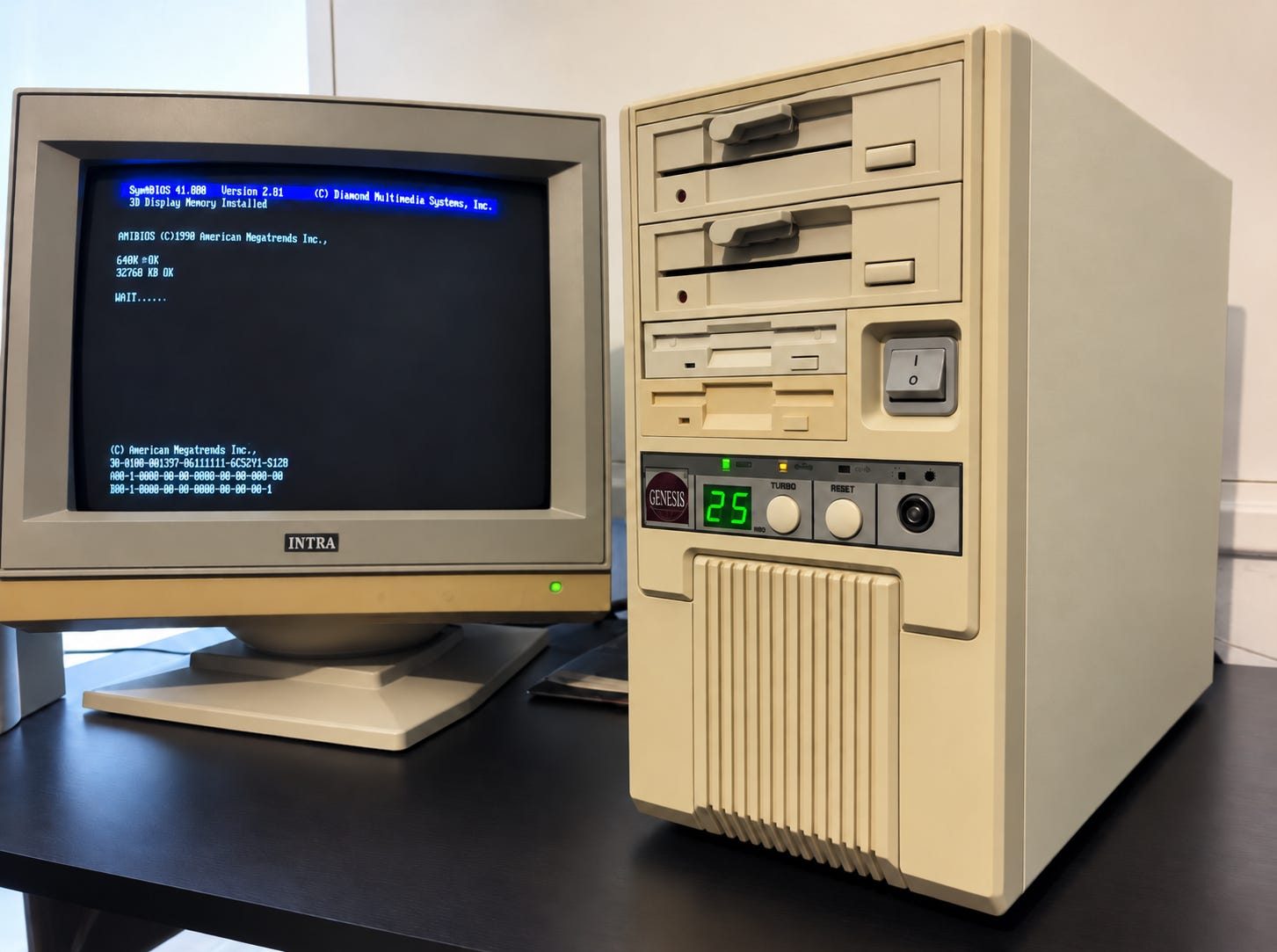
💾🖥️🚀 the first real computer I used was my dad’s 386 DX/25 MHz. It had 8 megs of RAM and the optional 387 floating-point coprocessor. It was just powerful enough to play Doom at something like 10 frames per second in low-detail mode.
The photo above is not the actual one from my childhood, but it’s pretty close.
I recently upgraded my desktop to a Mac Studio M5 Max with 64 gigs of RAM.
It got me thinking about how much more powerful computers have become in my lifetime. I asked GPT-6 to help me get a ballpark figure. Of course, this is a very rough comparison: old and new hardware aren’t really apples to apples, and I’m ignoring other bottlenecks like storage, memory bandwidth, and networking.
At first it was only comparing CPU to CPU, but a big share of modern compute lives in the GPU and AI accelerators, so I decided to include those too.
1. CPU: ~30,000× faster
386DX-25: ~8.5 million instructions/second
M5 Max (18 CPU cores): ~280 billion integer operations/second
280,000,000,000 ÷ 8,500,000 = ~33,000×
Approximation: historical MIPS and modern integer benchmarks aren’t directly equivalent.
2. GPU: ~25 million× faster
386DX-25 + 387 coprocessor: ~800,000 floating-point operations/second
M5 Max GPU (40 cores): ~20 trillion FP32 operations/second
20,000,000,000,000 ÷ 800,000 = 25,000,000×
Approximation: the historical 387 and modern GPU figures use different floating-point workloads and precisions.
3. AI accelerators: ~100 million× faster
Estimated M5 Max peak low-precision throughput:
GPU neural accelerators: ~119 trillion INT8 operations/second
Neural Engine (16 cores): ~61 trillion INT8 operations/second
Combined: ~180 trillion operations/second
Estimated 386DX-25 throughput for comparable integer arithmetic:
25 million clock cycles/second, approximately 20–30 cycles per multiply-accumulate, and 2 arithmetic operations per multiply-accumulate.
25,000,000 ÷ (20–30) × 2 = ~1.7–2.5 million operations/second
Using approximately 2 million operations/second:
180,000,000,000,000 ÷ 2,000,000 = 90,000,000×
Rounded: ~100 million 386s.
This is the most speculative comparison. The GPU and Neural Engine throughput figures are estimates, and the calculation assumes they can sustain peak performance simultaneously.
But this is only because my dad got the optional 387 floating point unit. Without it, the M5 Max is closer to 1 billion times faster 🤯
4. RAM: 8,192× more
386DX-25: 8 MB
M5 Max: 64 GB (65,536 MB)
65,536 ÷ 8 = 8,192×
Bottom line
The M5 Max has roughly 30,000 times the CPU throughput, 25 million times the floating-point throughput, and maybe 100 million times the specialized low-precision compute throughput of that old 386 DX/25.
These are theoretical, workload-dependent comparisons, not directly interchangeable benchmarks. The CPU, GPU, and AI figures shouldn’t be added together.
Pretty incredible! And these numbers are so large that they're almost impossible to visualize. Just for fun, I asked for an image of what that may look like. 😅

💚 🥃 To keep this steamboat alive and afloat, I need supporters. Like you! 🚢
The paid subscription includes the full feed, every podcast, Zoom Q&As with me, and access to the private Discord clubhouse, where a core group of us hang out and discuss the interesting stuff we find:
🏦 💰 Business & Investing 💳 💴

🔐🤖 What If AI Breaks Cryptography? (The Dog That Didn’t Bark 🐕)
Things are very unpredictable right now. Who had on their bingo card that so many of the top open math problems would have their proposed solutions released all on the same day:
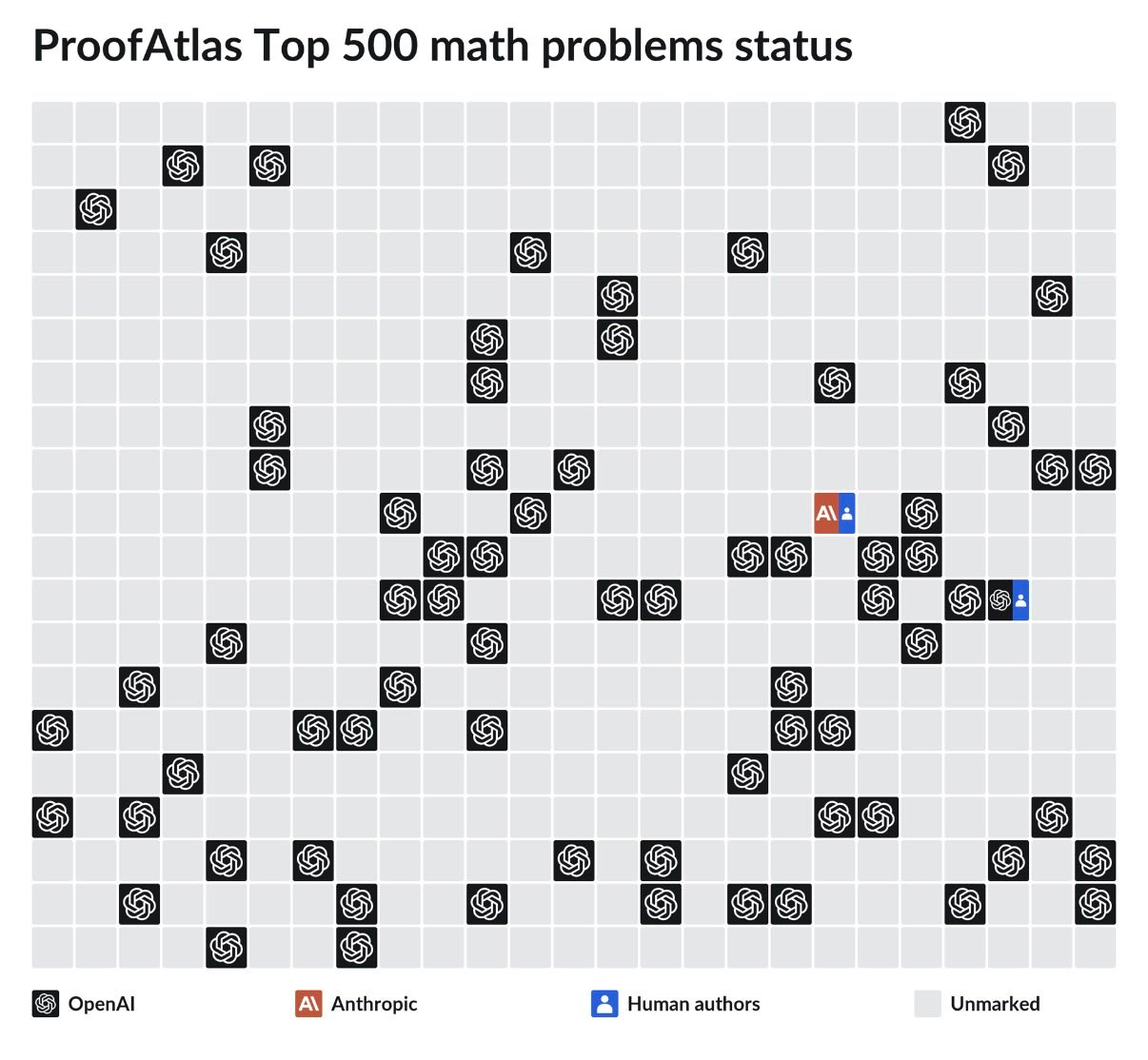
If even most of these proofs hold up, how long until most of the top problems are solved? Then how long until the next batch of even more difficult problems are posed by AI rather than by human mathematicians? 🤔
Also worth noting that OpenAI withdrew three manuscripts following a mathematical error and revised 14 others…
BUT
…people outside of OpenAI have been improving and simplifying some of the proofs! Open source, distributed, crowd-source high-level mathematics is now possible for a much wider group of people — even non-mathematicians! — thanks to these tools!
Douglas Colkitt and contributors have already sharpened one of OpenAI’s integer-multiplication results. The improvement is conditional on OpenAI’s original framework and still needs independent review.
Sela Navot used publicly available AI models to extend OpenAI’s matrix-multiplication proof from complex numbers to arbitrary fields, then checked the extension using Lean, a mathematical proof checker.
And all this math isn’t just esoteric ‘angels dancing on the head of a pin’ type stuff. Many of these breakthroughs can have practical applications. Ole Lehmann compiled a speculative list of what some of these mathematical advances might eventually help make possible (the road from proof to application can be long and difficult):
here’s what OpenAI’s math breakthroughs could eventually help make possible in the real world:
Vlasov–Maxwell → stronger foundations for fusion research, whose ultimate prize is virtually limitless clean energy to power civilization
Calderón’s Problem → portable body scanners using electrical signals, making medical imaging cheaper and easier to access
Maximum-Cardinality Matching → faster searches for compatible kidney swaps across large donor pools, helping hospitals coordinate lifesaving transplants
Inverse Elasticity Problem → scans that map tissue stiffness, helping doctors locate suspicious growths inside the body
Mumford–Shah Conjecture → better tools for spotting tissue changes in brain scans, helping doctors identify signs of disease
Bose–Einstein Condensation → stronger foundations for quantum sensors that could help vehicles navigate without GPS
Simple Stochastic Games → better safety checks for self-driving cars and robots before dangerous mistakes reach the real world
Matrix Multiplication → cheaper AI and bigger scientific simulations using the same computers
Edit Distance → faster DNA comparisons, helping researchers study genetic changes linked to disease
The k-Server Problem → robots that waste less movement and energy, making warehouses more efficient and goods cheaper to move
a reminder that math is the foundation of science.
so accelerating mathematical discovery could compress centuries of scientific progress into years.
But as Sherlock Holmes so eloquently taught us, sometimes it’s the dog that doesn’t bark that is interesting.
As several people have pointed out, cryptography is a subfield that’s extremely conspicuous by its absence from OpenAI’s list of 376 papers! But my sources tell me that the AI companies have now started, gingerly and discreetly, investigating whether their latest internal models can break important cryptographic protocols and primitives. If they can, then it would certainly be nice to get ahead of things before the rest of the world figures out the same.
It’s a bit like in the late 1930s when fission physicists were publishing freely, and then all of a sudden they stopped. The silence itself was a signal. In 1942, Soviet physicist Georgy Flerov noticed the missing papers and wrote to Stalin, arguing that the silence itself was evidence of secret research.
Vitalik Buterin also seems worried:

On July 28, 2026, Anthropic published research showing that Claude Mythos Preview had found a substantially faster mathematical attack against HAWK, a proposed post-quantum digital-signature scheme. HAWK hadn't been deployed, so no real-world systems were compromised. Digital signatures help verify that transactions, messages, or software updates are authentic. They’re different from encryption, which keeps information secret. But the model had found a weakness in the cryptography itself, not a bug in the software implementing it. By finding this early, Anthropic helped make crypto safer.
The nightmare scenario is discovering a comparable weakness AFTER an algorithm has been deployed widely. One AI lab might find the mathematical shortcut, but replacing vulnerable cryptography across banks, browsers, operating systems, cloud services, and countless other systems could take years. If attackers could exploit the weakness, they could do a lot of damage. 💣💥
We don't know how far the labs' private cryptographic research has gotten since then.
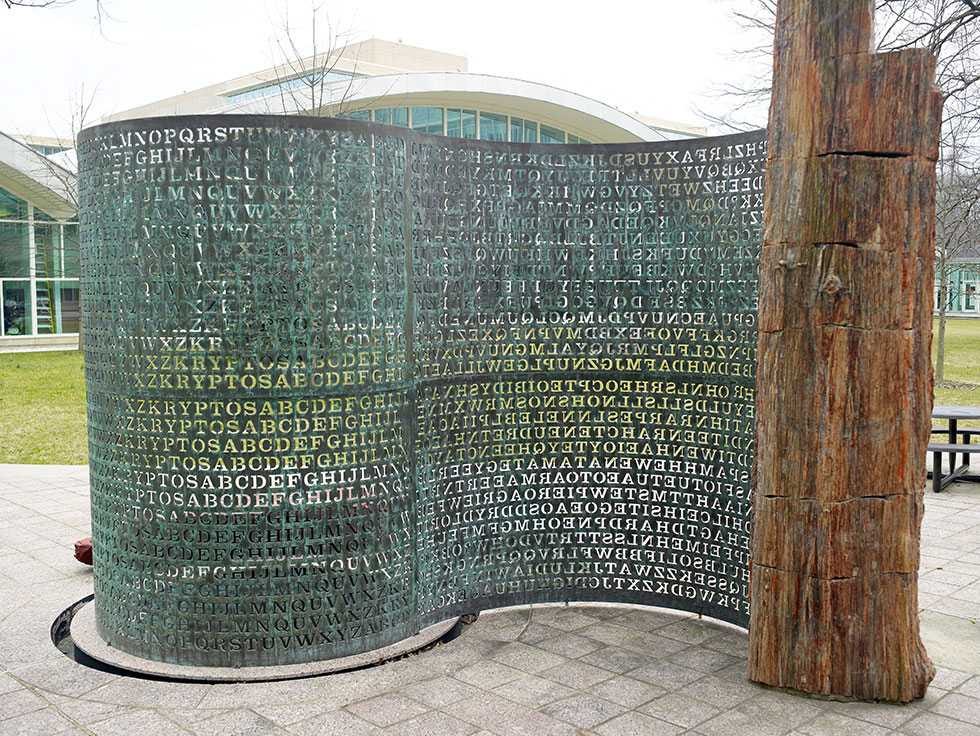
It’s not much of a stretch to imagine that three-letter agencies are asking AI labs to investigate sensitive cryptographic problems privately. Whether anyone has actually asked a lab to keep a major breakthrough secret, I have no idea. 🤐
There’s a strange reversal of incentives here. Earlier I was celebrating how AI is opening up advanced mathematics, with people sharing and improving each other’s proofs on GitHub. But if someone discovers a practical way to break widely used cryptography, publishing the discovery could give attackers a head start before anyone has time to defend against it.
Keeping it secret isn’t exactly a great solution either. If an intelligence agency discovered a practical weakness in widely used cryptography, it might be more valuable to keep secret than to fix. Meanwhile, the companies and people depending on that cryptography would face a risk they didn’t even know about, and would ultimately bear much of the cost of replacing it. You could warn affected organizations privately first, but who do you tell when the same algorithm is used all over the world? 🤔
Weaknesses in the cryptographic stack can be fixed if you see them coming. As computing power has increased, algorithms have been adapted to use longer keys to make brute-force attacks harder, and more secure algorithms have replaced those where shortcuts and flaws have been discovered. And in anticipation of powerful quantum computers, we've been developing post-quantum algorithms.
But that assumes we get enough warning.
It’s kind of a Sneakers situation.

What could bad actors do if AI discovered a practical weakness in an algorithm used everywhere? If digital signatures were broken, they might be able to forge transactions or software updates. If encryption or key exchange were broken, they might be able to read confidential communications, potentially including some that were intercepted years ago and saved for later (aka harvest now, decrypt later). Criminal enterprises and intelligence agencies would do all kinds of IP theft, blackmail, etc. (more than they’re already doing, I mean).
Now, I’m not saying that I have any idea if the crypto stack will break anytime soon, but it has me worried. Modern cryptography depends on some mathematical problems being too difficult to solve in any practical amount of time. What happens if AI finds shortcuts nobody anticipated? ¯\_(ツ)_/¯
