


Don’t say you don’t have enough time. You have exactly the same number of hours per day that were given to Helen Keller, Pasteur, Michaelangelo, Leonardo da Vinci, Thomas Jefferson, and Albert Einstein.
—H. Jackson Brown

🕰️ Here we are, Doc. The future.
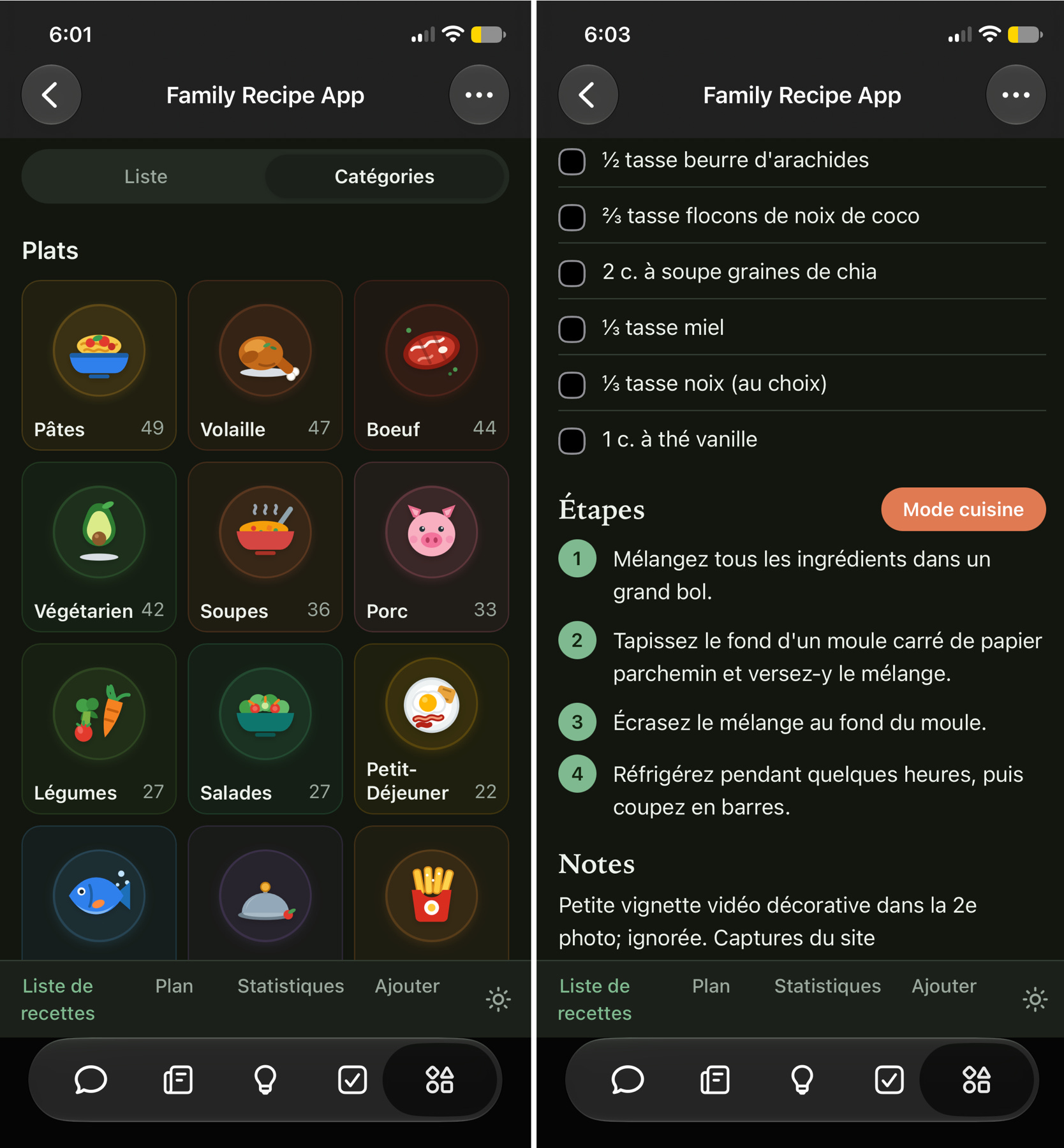
👩🍳🔪🥩🧅🥦🍽️ My wife has been using a recipe app on her iPhone for a few years now. The goal was to have a centralized place to keep track of all the recipes we like, and when we’re planning meals for the coming week, we can pick from there and use it to make the grocery list (we’ve been having groceries delivered at home for a few years now. What a time saver).
The app was never great and it was a paid app. So I decided as a fun project to have her Muse first go on the app’s website with her login and password and extract the 468 recipes she had put in the app over the years. Then save them locally in a portable markdown/JSON format.
Then I had her Muse build a new recipe app inside of Muse as a Muse artifact. I did a few iterations to add some UX features and then I asked it to import all of the recipes and categorize them. It did all this very well and now we’ve moved over to this app for our recipe tracking. What’s most fun is that every time my wife is annoyed by something, she can just ask Muse to change it or fix it. It’s like having the app developer on call just for you. Even very responsive app developers could never deliver this kind of personalized service, largely because they get conflicting requests from users and can’t implement everything and please everyone. But we’re now deeply in the era of customized software.
The next step will be to ask Muse to create a shareable version of the app so that I can also access it and add recipes to it.
But what I’m most curious to see now is whether my wife starts thinking of other things she could use a custom app for. Maybe her running or training, or some other project.
I think the first one is the big breakthrough. Until you’ve tried it, having an app built just for you probably doesn’t even occur to you as an option. Once you’ve seen it work, you start wondering what else you could make. If I were Meta, I’d want as many people as possible to build that first app.
It turns out the really valuable part of our old recipe app was the 468 recipes we’d collected over the years, not the software itself. Once we got those out, replacing the app was easy. I wonder how many other small and relatively simple paid apps could end up in the same position.
🤘6️⃣6️⃣6️⃣🤘 How juvenile and cringey-dad should I be about making some kind of reference to the number of this Edition? Maybe some Iron Maiden thing? 🤔
💚 🥃 To keep this steamboat alive and afloat, I need supporters. Like you! 🚢
The paid subscription includes the full feed, every podcast, Zoom Q&As with me, and access to the private Discord clubhouse, where a core group of us hang out and discuss the interesting stuff we find:
🏦 💰 Business & Investing 💳 💴
🤖 Meta Partners with… Apple?!?… for Muse Spark Open 🍎
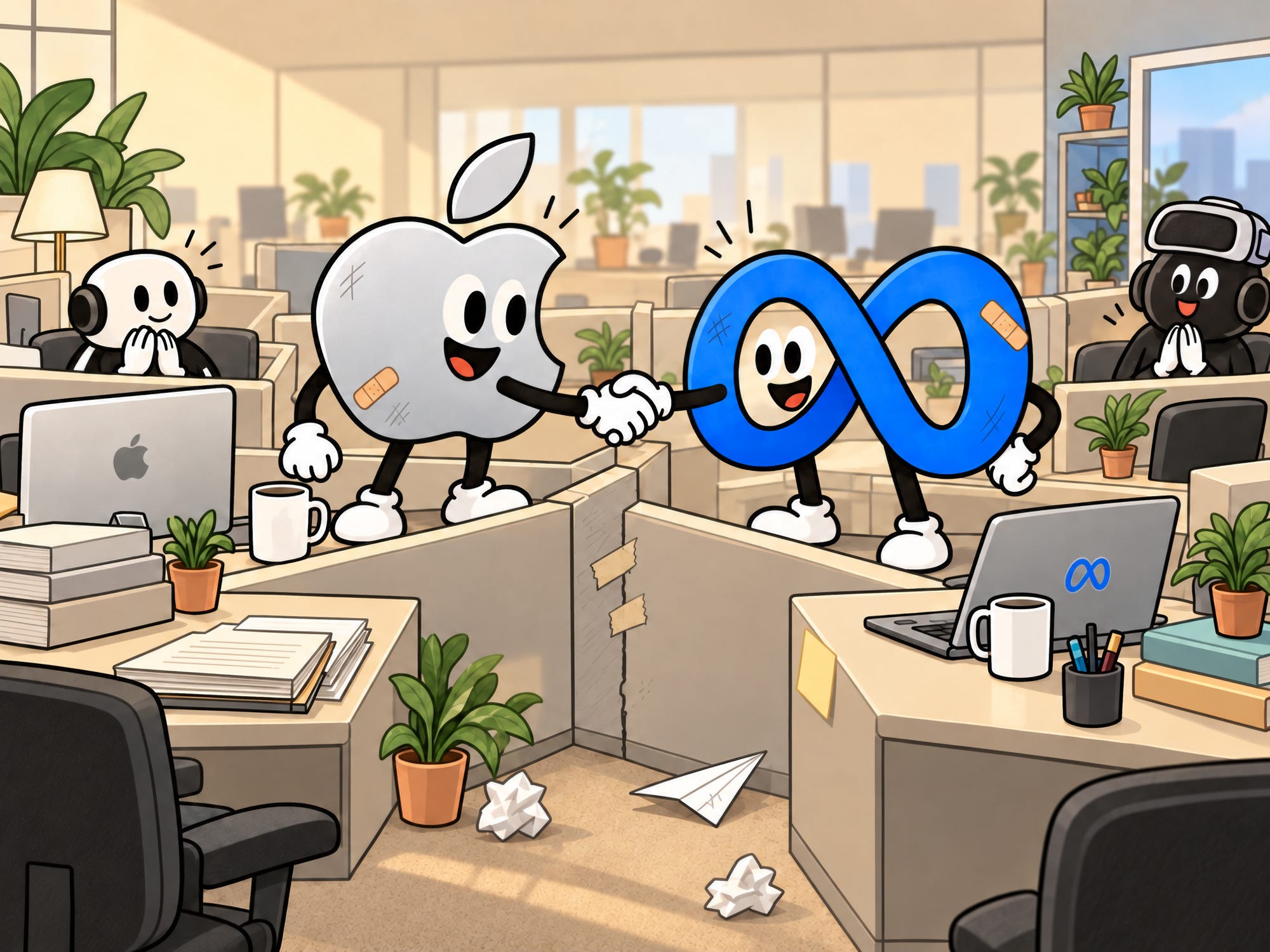
I didn’t see that one coming. I mean, I expected an open-weight model at some point, but not with Apple prominently featured in the announcement. In case you don’t know the backstory, these two companies haven’t exactly been getting along, and when Apple made some changes to tracking across apps, it likely cost Meta tens of billions in lost revenue (they came back from it, and adapted better to the new regime than their competitors, putting them in a stronger relative position, so there’s a silver lining).
Anyway.
Muse Spark Open is out:
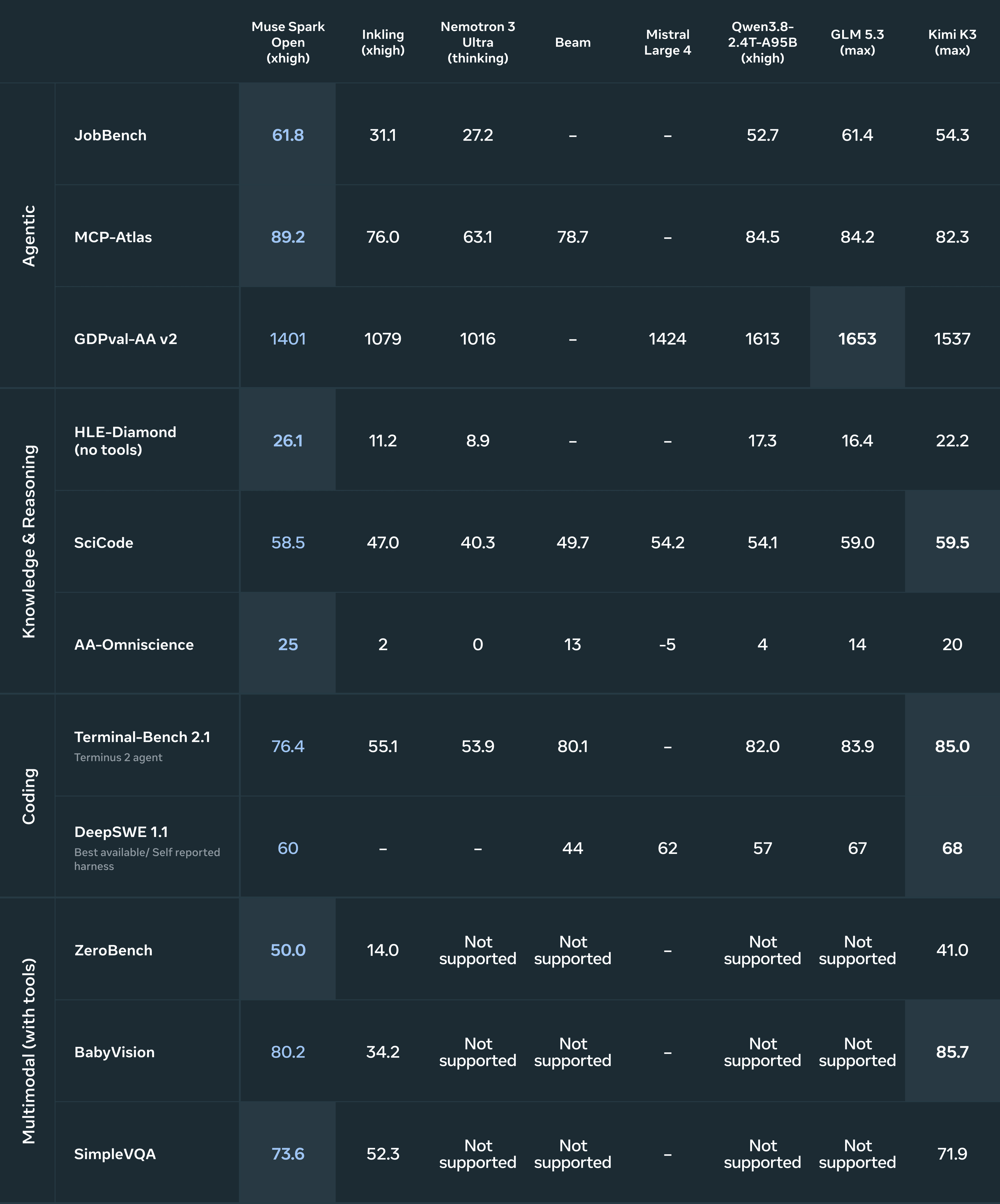
They call it “the most capable US open-weight model to date” because Kimi K3 and GLM 5.3 still beat it in certain benchmarks. Unsurprisingly, Muse Spark Open is particularly good on agentic tasks.
I also found this comparison of Spark Open with Meta’s previous proprietary models.
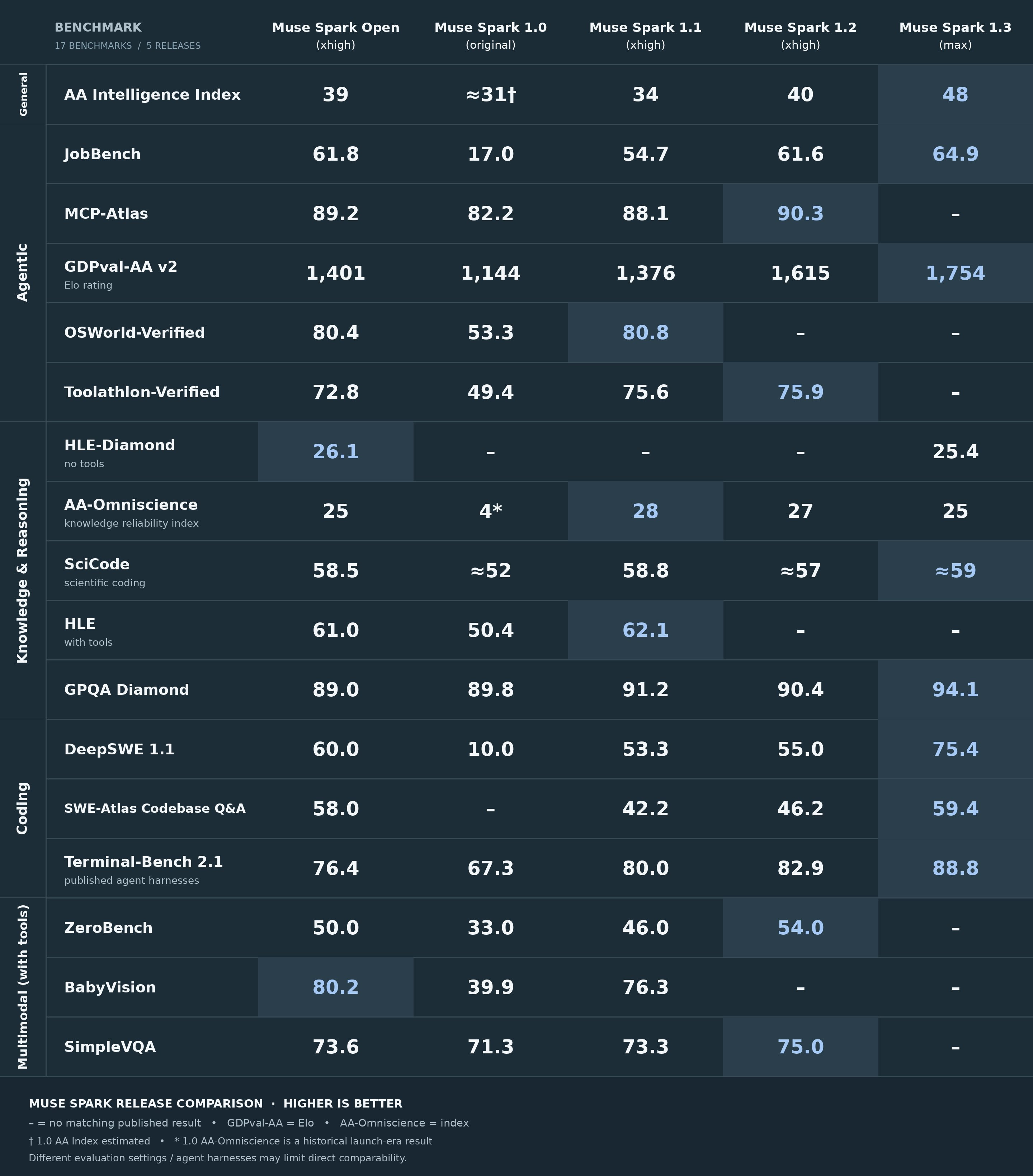
Performance-wise, it’s roughly in the neighborhood of Spark 1.2, scoring 39 on Artificial Analysis’s Intelligence Index versus 40 for 1.2 and 45 for 1.3 at comparable reasoning settings (48 at Max). On some agentic and coding benchmarks, it lands somewhere between 1.2 and 1.3, occasionally outperforming one of them.
Right after the benchmarks, Meta mentions how the model has been optimized for running locally on Macs:
Optimized for Apple Silicon
Leveraging the latest version of MLX, Muse Spark Open was optimized to run on Mac Studio with M5 Ultra, and together they’re the best way to run a powerful model on your own desktop.
Apple’s unified memory architecture lets the M5 Ultra’s integrated GPU use up to 512 GB per Mac Studio, so two machines can hold an entire model. And the chip’s 1.2 TB/s of memory bandwidth is fast enough to read the small slice each token needs. The result is two Mac Studios behave like one supercomputer with a terabyte of unified memory.
Almost an ad for the Mac Studio!
We provide the software, Apple provides the hardware.
To be fair, these aren’t just any Macs. They’re incredibly powerful and expensive machines, and you need TWO of them if you want to run the quantized model. 💸
We’re talking about an 816-billion-parameter model (with 42 billion active for each token). Even after compressing its weights from more than 1.6TB to about 493GB using 4-bit quantization, it still needs additional memory for calculations/context, putting it over a single Mac Studio’s 512GB limit.
Apple published a piece about it.
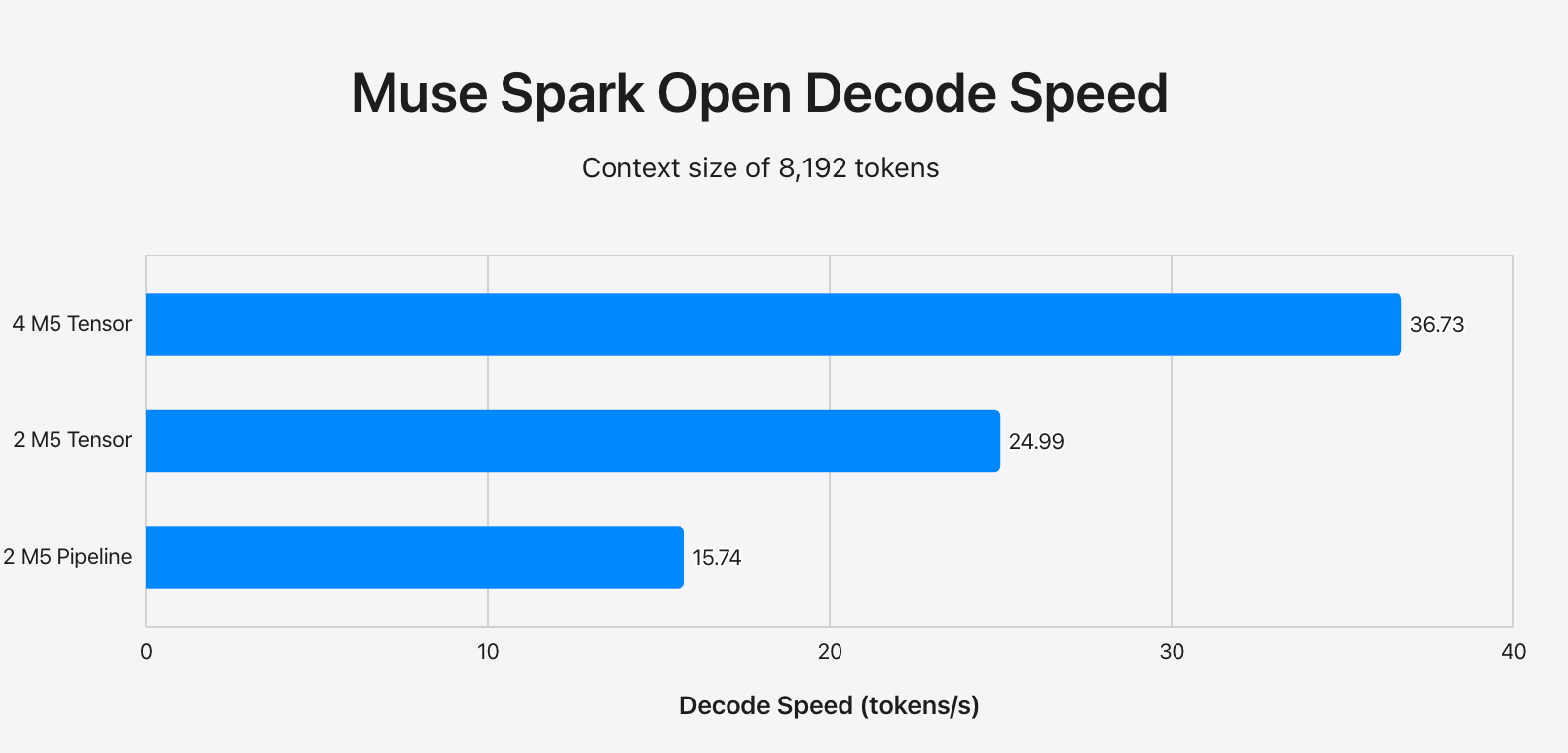
With 4 Mac Studios, they get almost 37 tokens/second at an 8,192-token context on that beast of a model. Very usable, though not exactly ultrafast. But it’s cool that it’s possible at all.
Axios reports that Daniel Gross, a former Apple executive now at Meta, helped bring the companies together. Alexandr Wang described the reconciliation rather amusingly:
“We’re excited for mommy and daddy to be playing nice again.”
😅
Well, I doubt they’re best friends, but it’s certainly a rapprochement.
