


If you run into an asshole in the morning, you ran into an asshole.
If you run into assholes all day, you're the asshole.
—Raylan Givens, Justified
🐦 Tried Twitter Spaces (their social audio thing) for the first time, if only as a listener... Seems like a bare-bones version of Clubhouse, but I think there's a decent chance that Twitter's distribution will matter more in the end. Right now I'd favor Spaces to win over Clubhouse 60:40.
With Twitter, I’m already in the app all the time, I’m already connected to the people that I want to listen to or talk to, and I’ll notice the notifications when Spaces are created more easily than with CH where the notification fatigue is real, and I often get pinged about rooms that are a wall of names that I don’t recognize, training me to mostly ignore the notifications… and what’s with using just first names in the app? I get it’s cleaner, but some of us aren’t that good at recognizing the faces of every silicon valley VC.
But mostly, Twitter feels comfortable to me. When I was listening to a Space a couple nights ago, I felt like I kind of wanted to create a space at some point soon to give it a try. When I’m in CH, it feels a lot less familiar and like most of “my people” aren’t there, so it’s more intimidating.
In fact, a lot of people that I probably know on Twitter as some weird avatar and pseudonym may be on CH under a different name/avatar and I wouldn’t even recognize them.

Some suggestions to the Twitter product people, though:
In the reaction emojis (you can click these and everybody sees the emoji pop over your avatar for a couple seconds), they need to add a 👍 and a 👎.
It’s so obvious to me that when a speaker asks a question to the audience, that’s the easiest way for people to show agreement or disagreement.
They could also add an easy way for hosts to do audience polls, with some pre-populated 2-clicks polls that just asks stuff like “yes/no” or “strongly like/like/dislike/strongly dislike”, and then display the live results of the vote to everyone at the top, something like that.
🛀 The real question isn’t what you read or who you talk to. It’s what you get out of the experience.
Two people could read the exact same book or have a conversation with the same person:
One will learn a ton, connect ideas with existing knowledge and create new insights, decide to act and make important life-changes (even if just small course-corrections that seem minute today — a few degrees — but that over years lead to a very different destination), and use the experience as a starting point to learn more about 5 different things that were mentioned, or dig deeper into one thing for a long time, etc. You get the idea.
Someone else may go “hey, that’s neat”, close the book, and have it all fade away within days, without any detectable impact on that person’s life or mental processes.
¯\_(ツ)_/¯
🐦 Since Twitter threw the kitchen sink at us this week, product-wise, I'm surprised they didn't include something about fixing direct messages (DMs) and making them a competitive messaging platform that has, y'know, any modern features at all.
I’d settle for search, ability to reply to a specific message (useful for group chats), mark as unread (if you can’t reply now and don’t want to forget later), end-to-end encryption, and the ability to pin certain people/groups.
Hopefully someday...
💪 Ok, here’s a life-pro-tip for you if, like me, you mostly sit at a desk reading stuff all day.
Get some hand grippers (the ‘Captains of Crush’ ones seem to be widely well-regarded) and just squeeze these things as you sit there reading. Over time, move on to progressively harder ones (I have 100, 150, and 200lbs models). If you’re cheap, you can get a tennis ball and squeeze that, but it’s not the same.
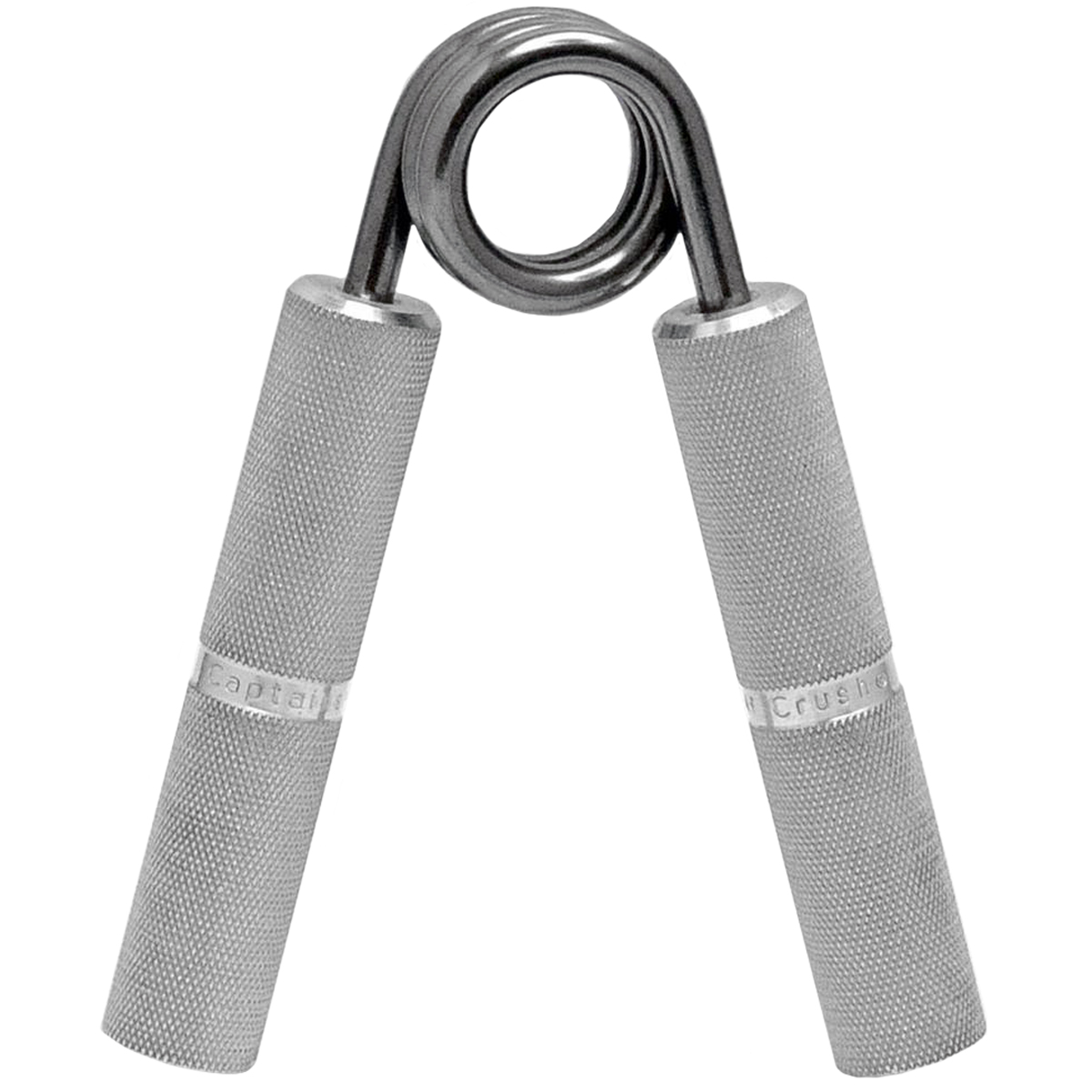
That way, as most of your muscles atrophy, your soul slowly evaporates, and you turn into a mollusk, at least your hands and forearms will be ripped and you’ll be able to open walnuts bare-handed.
Investing & Business
Twitter’s Subscriptions vs Apple & Google
It’s also worth considering how Twitter’s plans may be challenged by in-app purchase rules from Apple and Google — will solo creators really have to give up 30 percent of a $5 per month subscription to the smartphone maker, in addition to whatever Twitter and its payment processor take? (Source)
One more reason why the platform owners, Google and Apple, need to rethink how they manage their platforms. They can’t keep strangling new business models forever.
Will Twitter be forced to end up having payments happen only outside of the mobile app, via a web browser?
Do you load up your account with a larger $ amount and then distribute micro-payments in some pseudo-currency to avoid having to pay fees on each micro-transaction?
Any workaround still creates friction, will reduce spend overall, and means that those on-the-fence and less inclined to spend in the first place will probably just skip it…
Update: I guess this is officially the Twitter Edition… Just before publishing this, Packy McCormick publish a really good look at Twitter/Square and Jack Dorsey in collaboration with Marc Rubinstein.
Elastic Q4
Does *anyone* believe that ESTC will do 28% growth next quarter (as per their guidance) despite their "net expansion rate greater than 130%" and SaaS segment growing almost 80% these days?
The art of sandbagging...
Steve Jobs on Consulting
Interesting 2-minute video of Steve Jobs addressing a college class and giving his opinion of consulting. The insight here isn’t just to dunk on consultant, but to look at how Jobs thought about things.
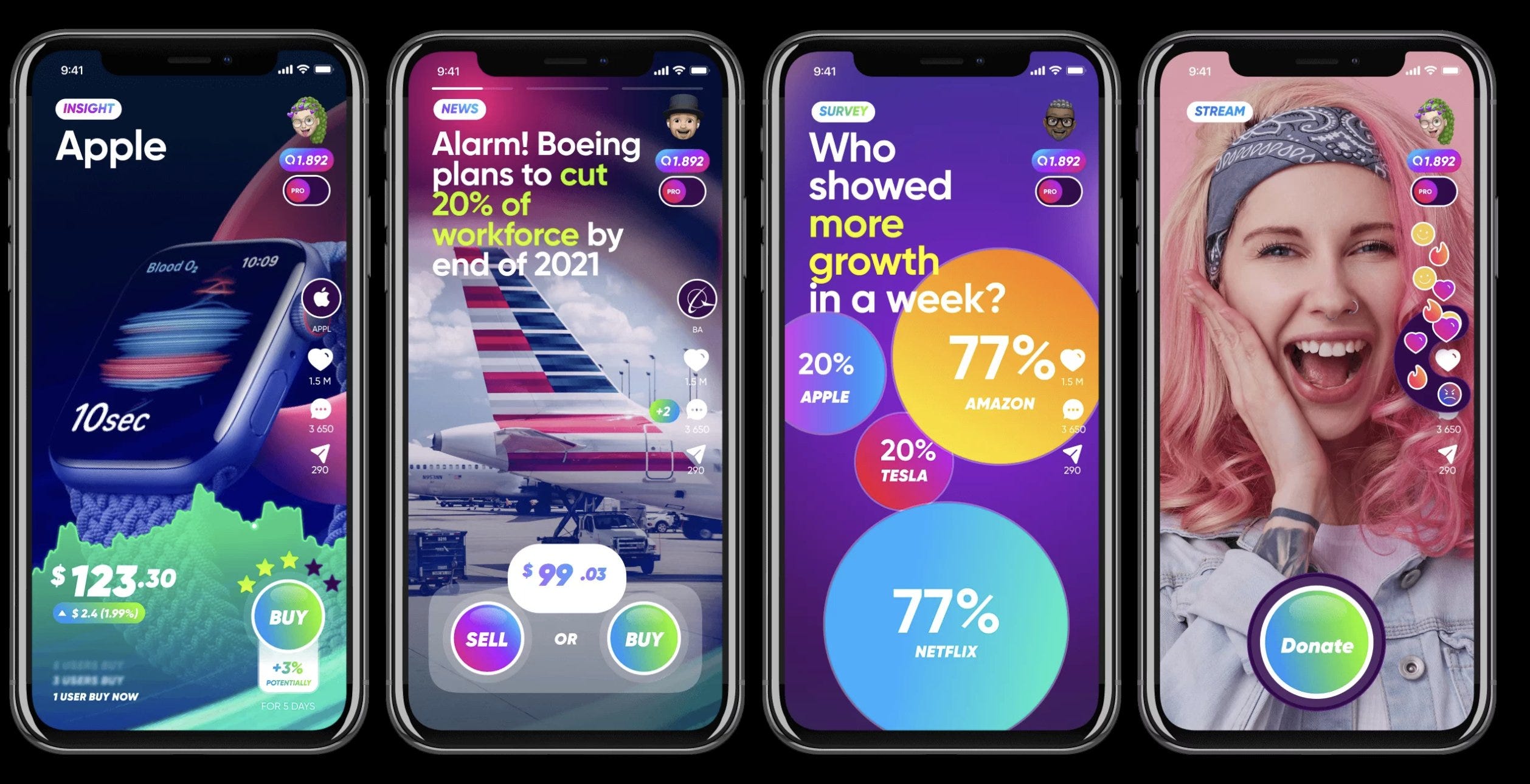
When Robinhood Isn’t Gamified Enough
Subtlety is dead. From the official Qooore website:
Investing is now entertaining, exciting and sexy. Our goal is to get rid of the fear of defeat! We aim to show that everything is possible even without big sums of money and lack of knowledge. We will eliminate all the fears and doubts related to the life, which is desired by so many people.
We take what is ours as easy as swipe. Qooore.
Why three “O”?
Cheap domain name, is my guess.
I think I’ll save myself some clickety-clack on the keyboard and just repeat what I already wrote in the intro of edition #91:
Investing is already very democratic, very accessible. It's not like there's huge barriers to entry anymore, like 40 years ago. You have low-cost or no-cost brokerage, more financial information at your fingertips than you could possible consume in a lifetime, and improving tools to make sense of it all (*cough* Koyfin *cough*).
The problem isn't getting in. It's doing something smart once you're in. Reducing entry friction further, or convincing more people to join manias isn’t going to help with that.
The vast majority of people who aren’t freaks like us Fintwitters, people who won’t spend 20-40 hours a week on this, reading what, to most normal people, are the most boring documents about the most boring companies, until your eyes bleed… These people should index or, if they can somehow find a good money manager that they trust and that will have them, let someone else handle it.
Convincing millions of people that they should invest material amounts of their money in ‘ticker XYZ’ because they spent a couple hours thinking about investing and peer pressure is ramming FOMO down their throat (NYT headline: “Everyone Is Getting Hilariously Rich and You’re Not”) is just speculation and gambling and likely to finish badly for the virgins sitting at the table with the card sharks.
That’s not democratizing investing, that’s recruiting greater fools for your schemes.
Lots of people have something to sell that isn't always aligned with the best interests of who they're selling to… There’s a huge difference between getting someone involved in investing in a way that will benefit them in the long run, and just revving them up for a Hangover-style night in Las Vegas.
Shit, I wasn’t angry when I started typing this.
Interview: Oren Falkowitz, on a Career at NSA, Creating a Security Company, etc
Another good one by Billy Booster, only tangentially related to investing & business, but that’s fine.
Oren is clearly a very thoughtful guy and it’s interesting to hear his perspective on the whole security mess that the world has found itself entangled into in the internet age, especially as an insider to the government apparatus that tries to secure US assets and penetrate the systems of adversaries.
Also a good reminder that the vast majority of breaches start out with a phishing attack where the intruder gets you to load a compromised file or enter your credentials in a fake login page for website X (Gmail, Dropbox, whatever). '
Keep an eye open for that stuff and use best practices (at least turn on two-factor authentication on your accounts and keep your browser and OS up to date with patches).
NFTs in a Nutshell

Science & Technology
‘Five key fallacies have played an outsize role in derailing an effective pandemic response’
Good piece by Zeynep Tufekci:
RISK COMPENSATION
some experts feared that people would respond to something that increased their safety—such as masks, rapid tests, or vaccines—by behaving recklessly. They worried that a heightened sense of safety would lead members of the public to take risks that would not just undermine any gains, but reverse them. [...]
the numbers tell a different story: Even if safety improvements cause a few people to behave recklessly, the benefits overwhelm the ill effects. [...]
RULES IN PLACE OF MECHANISMS AND INTUITIONS
Much of the public messaging focused on offering a series of clear rules to ordinary people, instead of explaining in detail the mechanisms of viral transmission for this pathogen. A focus on explaining transmission mechanisms, and updating our understanding over time, would have helped empower people to make informed calculations about risk in different settings. Instead, both the CDC and the WHO chose to offer fixed guidelines that lent a false sense of precision.
In the United States, the public was initially told that “close contact” meant coming within six feet of an infected individual, for 15 minutes or more. This messaging led to ridiculous gaming of the rules; some establishments moved people around at the 14th minute to avoid passing the threshold. It also led to situations in which people working indoors with others, but just outside the cutoff of six feet, felt that they could take their mask off. None of this made any practical sense. What happened at minute 16? Was seven feet okay? Faux precision isn’t more informative; it’s misleading. [...]
SCOLDING AND SHAMING
Throughout the past year, traditional and social media have been caught up in a cycle of shaming—made worse by being so unscientific and misguided. How dare you go to the beach? newspapers have scolded us for months, despite lacking evidence that this posed any significant threat to public health. [...]
While visible but low-risk activities attract the scolds, other actual risks—in workplaces and crowded households, exacerbated by the lack of testing or paid sick leave—are not as easily accessible to photographers. [...]
HARM REDUCTION
Harm reduction is the recognition that if there is an unmet and yet crucial human need, we cannot simply wish it away; we need to advise people on how to do what they seek to do more safely. [...]
Socializing is not a luxury—kids need to play with one another, and adults need to interact. Your kids can play together outdoors, and outdoor time is the best chance to catch up with your neighbors is not just a sensible message; it’s a way to decrease transmission risks. Some kids will play and some adults will socialize no matter what the scolds say or public-health officials decree, and they’ll do it indoors, out of sight of the scolding. [...]
THE BALANCE BETWEEN KNOWLEDGE AND ACTION
Sometimes, public-health authorities insisted that we did not know enough to act, when the preponderance of evidence already justified precautionary action. Wearing masks, for example, posed few downsides, and held the prospect of mitigating the exponential threat we faced. The wait for certainty hampered our response to airborne transmission, even though there was almost no evidence for—and increasing evidence against—the importance of fomites, or objects that can carry infection.
“Patient Zero” was Originally “Patient O” (the letter)
Investigators placed one man with Kaposi’s sarcoma near the centre of a sociogram representing this cluster and identified him as ‘Patient 0’—a ‘non-Californian AIDS patient’ and a possible ‘carrier’ of an infectious agent (Extended Data Fig. 7). Before publication, Patient ‘O’ was the abbreviation used to indicate that this patient with Kaposi’s sarcoma resided ‘Out(side)-of-California.’ As investigators numbered the cluster cases by date of symptom onset, the letter ‘O’ was misinterpreted as the number ‘0,’ and the non-Californian AIDS patient entered the literature with that title12. Although the authors of the cluster study repeatedly maintained that Patient 0 was probably not the ‘source’ of AIDS for the cluster or the wider US epidemic, many people have subsequently employed the term ‘patient zero’ to denote an original or primary case, and many still believe the story today (Source)
h/t Adam Kucharski
ARK’s “Big Ideas 2021”, Data Center Edition
Always interesting to browse these slides… (doesn’t mean they have a crystal ball or I agree with everything)
I can’t post too many images here, but here’s a few highlights that I found interesting (the future is uncertain, so it’s mostly about how strongly you agree or disagree with any prediction anyway, not a binary “agree/disagree”):
advances in hardware and software have been driving down AI training costs by 37% per year, the size of AI models is growing much faster, 10x per year [...]
We believe that state-of-the-art AI training model costs1 are likely to increase 100-fold, from roughly $1 million today to more than $100 million by 2025
As AI training cost grows from $1 to $100 million per project, specialized processors such as GPUs or TPUs will account for a majority of the incremental growth.
We believe that the combination of ARM and RISC-V will move from 0% market share in 2020 to 71% of the server market by 2030.
I agree that this transition is likely to happen… But from basically nothing to 71% in 10 years would be quite the wave.
A lot depends on how Intel and AMD do during that decade; there’s probably some scenarios where one or both stumble and that accelerates the move away from x86, and some where they come up with some great innovations and catch up on process and are a lot more competitive.
But one of the big benefits of ARM and RISC-V is the decentralized natured of how the IP is used to design chips. Intel and AMD have to please a lot of customers with relatively few SKUs, which there’s all kinds of ARM and RISC-V chips that are and will be designed for more specialized uses, and thus may have better price/performance characteristics vs x86 at those things.
Intel delayed its 10nm processor by four years, allowing its competitors—TSMC and AMD—to lead the market in 2020.
As of 2020, Intel still has not shipped a 10nm server chip. A full generation ahead of Intel, TSMC is mass producing 5nm processors.
One could quibble about how the nm numbers from various fabs aren’t all equivalent and so Intel’s 10nm may be more similar to someone else’s 7nm, but it remains that Intel is behind and losing ground with every passing month.
Apple plans to transition Macs, which are used by one in three developers, from x86 to ARM
Microsoft is doubling down on its efforts to support Windows on ARM processors.
According to ARK’s research, by 2030 most developer PCs could be powered by ARM CPUs, marking the end of the Intel x86 era.
Developers certainly want to work on the same architecture as the servers that they’ll be deploying their code on, and vice versa (they want to develop on what’s most popular in the cloud). So there’s likely going to be a self-reinforcing loop here.
AWS Graviton 2 is cheaper and faster than Intel CPUs, offering 48% higher performance per dollar.
Here Intel is facing a double-headwind. It would be interesting to see a Xeon fabbed on the same process as the Graviton 2 (so probably TSMC’s 7nm..? They probably don’t have access to 5nm yet, as Apple is eating most of that).
But you go to war with the army you have, not with the army you wish you had…
The presentation keeps going for dozens of slides, but this part about the data center is what I wanted to share today.
On Effort
Good piece by Ava at Bookbear Express:
Here’s what I know: if someone’s much better than you at something, they probably try much harder. You probably underestimate how much harder they try. I’m not saying that talent isn’t a meaningful differentiator, because it certainly is, but I think people generally underestimate how effort needs to be poured into talent in order to develop it. So much of getting good at anything is just pure labor: figuring out how to try and then offering up the hours.
That’s so true. It’s the whole “overnight success” after 15 years of trying, right?
people always assume I’m interested in the end result—the wonderful thing they’ve made—when what I’m really interested in is the process. How did you get this way and why? I’m curious about the ugliness of trying, the years and years of wanting and hoping and working. I don’t know why I’m so fascinated by craft.
I’m similar. I love learning about that stuff, whether it be musicians or writers or scientists or technologists or company builders or architects or designers or athletes or whatever.
It’s all the same thing, if you zoom out enough. Who are you? Who can you be? Are you willing to do what it takes to get there? How far do you get?
Donna Tartt once said in an interview that if the writer’s not having fun the reader isn’t either. I think people make the best things when they love the process.
That’s a wise insight. I certainly won’t keep writing this newsletter if I stop having fun doing it, which is why from the start it’s been my goal to be very careful not to inadvertently turn this into a “real” job.
Short Vid on New Features in Blender 2.92
If you’re not in the world of computer graphics and animation, this short video can give you an idea of the kind of tools that are used in the space:
This is the latest version of the free and open-source Blender toolset. More details here.
The Arts & History
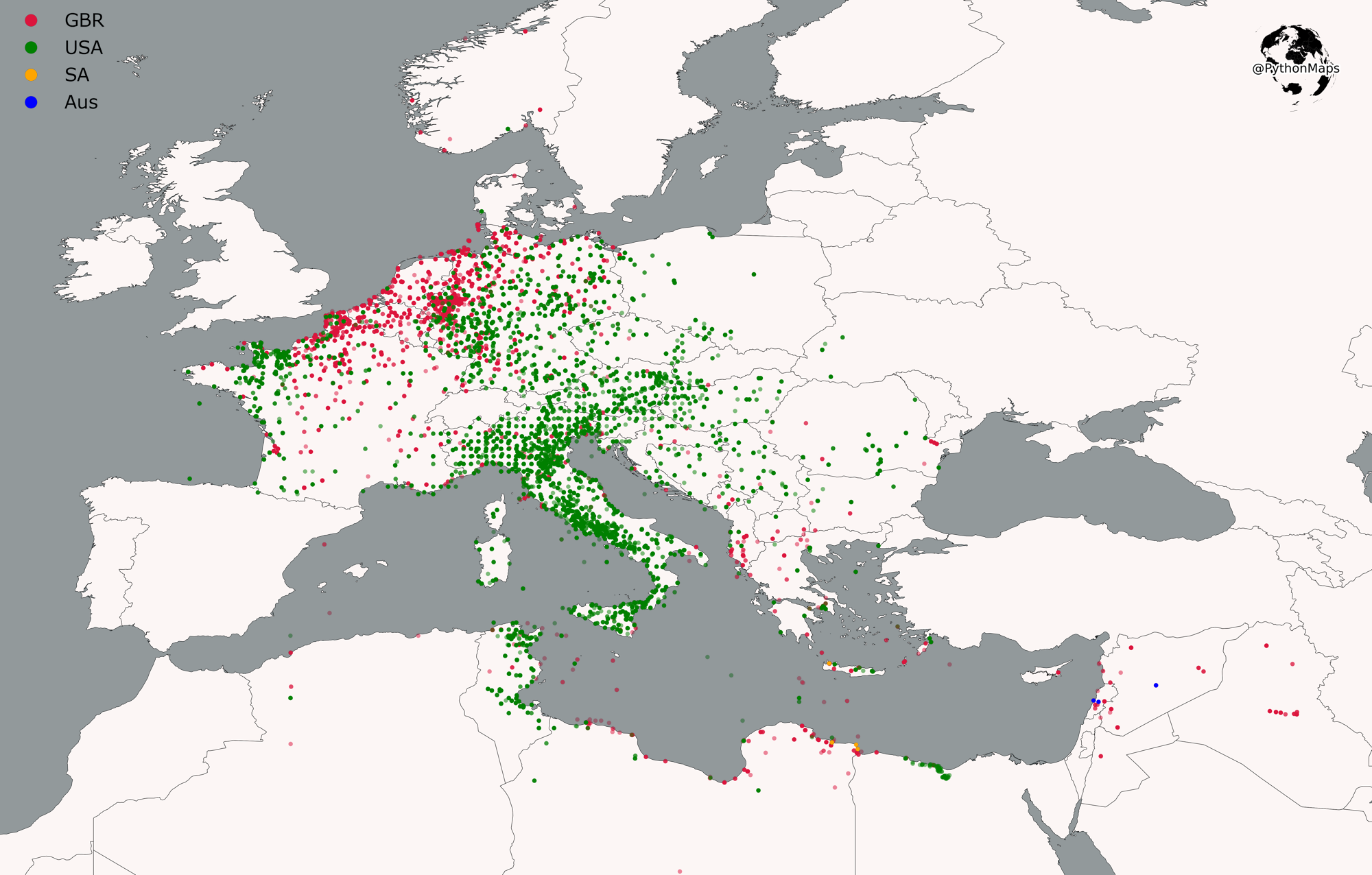
‘Visualising the bombing campaign of the western allies in WW2’
Each point represents a bombing raid led by the allies. The points are coloured according to the army and I've increased the point transparency to so that hostpots really stand out.
The data comes from "Theater History of Operations (THOR) Data: World War II" dataset.
Map was plotted with Python (obvs) using matplotlib, numpy and geopandas.
I wasn’t aware that Italy was bombed so much. It’s one thing to read about it, but it’s another to see it like this.
Source. h/t Eddy Elfenbein
‘How Denis Villeneuve Tells a Story’
Nice video essay on one of my favorite film directors.
Be warned: The video is full of excerpts from all his films, so it contains spoilers. I recommend you only watch if you’ve seen Villeneuve’s films.
Ames Window Optical Illusion
I watched this with my 6yo son, and he really enjoyed it. Probably a good one to watch with kids, but cool even without ‘em.
Just so you guys don't think they would be buying concrete "parking lots." https://www.youtube.com/watch?v=IoZ4IN9_x9o&feature=emb_title