


Everybody’s trying to think through the implications of AI on the economy and every industry. Is there such a thing as ‘good enough’ when it comes to intelligence? And does the answer determine whether we are in a bubble?
Here are some thoughts about whether ‘good enough’ applies to AI and what that would mean.
Let’s start by looking elsewhere to better understand this dynamic:
Consider the GPU market. For gamers, there was never a point when graphics looked “good enough.” They always wanted better lighting, faster framerates, more polygons, and higher resolution.
Then look at the iPhone. It became the most profitable product in history partly because, for consumers, there’s no such thing as “good enough” when it comes to how nice something feels. Even if on paper you can make a list of features, of speeds & feeds, and say that product A and product B are at parity and can accomplish the same tasks, the consumer market also takes into account all kinds of intangibles that the enterprise cares little about.
As long as you can keep improving these intangibles and show your customers that the new version feels better than the old one, they’ll be ready to pay a premium to get the nicest over the runner-up. (yes, upgrade cycles have lengthened, but Apple still did $416 billion in high-margin revenue in the past year!)
📲🧍Consumer AI: when ‘smarter’ becomes harder to feel 🏠
Before we get to the enterprise, let’s start with consumer AI.
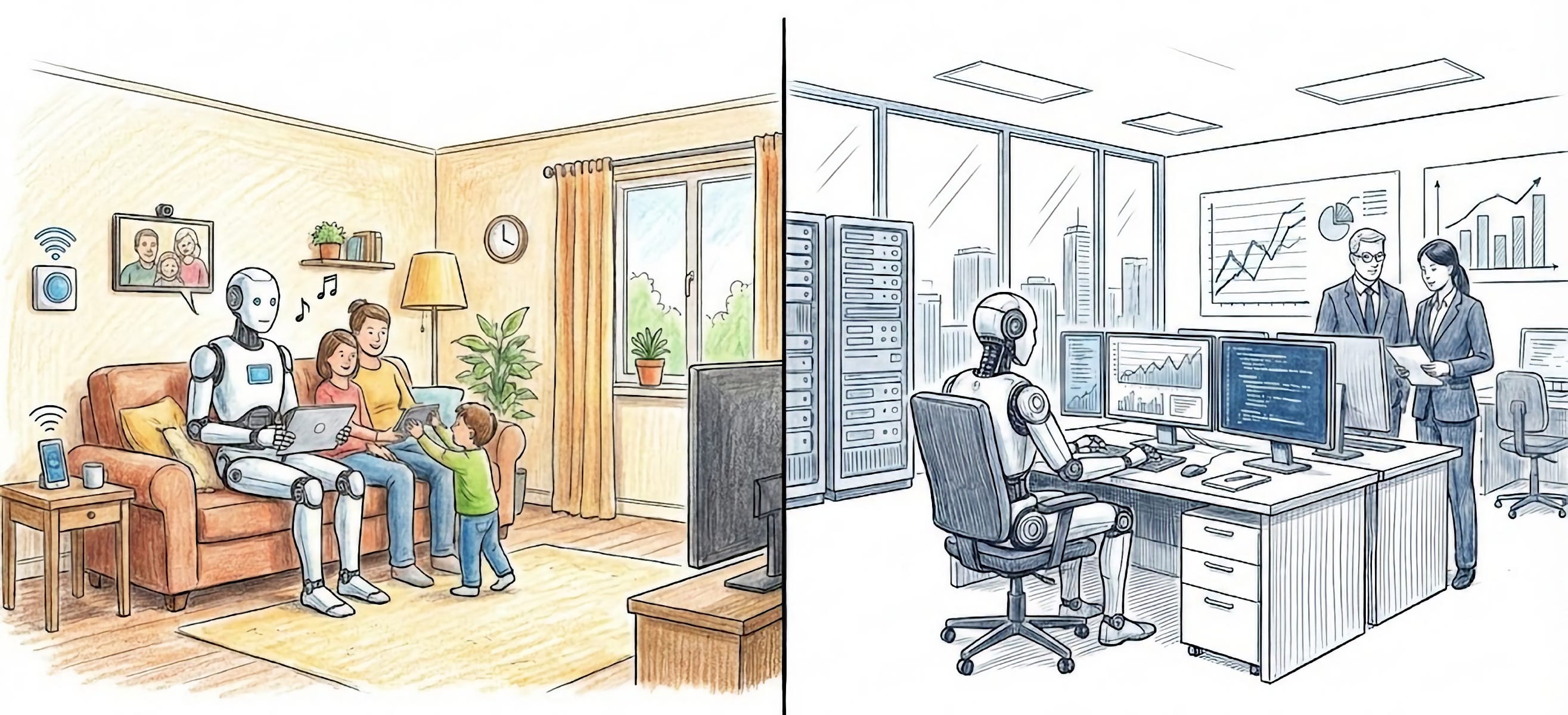
My working theory: the consumer market eventually pivots from ‘raw power’ to ‘user experience/intangibles’ while the enterprise market sticks mostly with cold, calculated, ROI-based, raw efficiency.
What happens when every chatbot is powered by a base model that is incredibly smart? Will the labs still be able to improve their products in ways that normies can tell? Most people are not asking complex questions about astrophysics or quantum mechanics, they want to know how to fix the hot water heater or how to stop killing their houseplants. 🪴
‘Smarter’ becomes harder to feel.
For consumers, intelligence often manifests as personalization and vibe (EQ + Memory + Trust).
If so, OpenAI’s landgrab between the time when they launched ChatGPT and when Google woke up and made Gemini competitive will turn out to have been extremely valuable and fortuitous for them. They’re likely to retain these users even if Google can take the lead on benchmarks because switching costs will increasingly live in habit, muscle memory, history, preferences, and ‘this one just gets me’.
Especially if OpenAI’s product chops (UX, UI, features, app polish) stays ahead of Google, as it currently is.
Google already has gigantic consumer distribution, so maybe we’ll end up with a duopoly in consumer (or maybe Meta can get its act together and get back in the race..?), and the real knife fight will be in the enterprise, where Anthropic is doing particularly well.
But here’s the twist: the ‘good enough’ bar depends on what the AI is doing. If it’s just chat + email drafts, ‘good enough’ might arrive faster than people think. But if we move to agents that are booking flights, moving money, negotiating bills, doing your taxes, ‘good enough’ gets much harder to reach.
You now need trust, reliability, and high confidence that “it didn’t do something insane while I wasn’t looking.”
🖇️🏢💼 Enterprise AI: where there’s never enough intelligence 📊
I’m not worried about coders and the enterprise. They’ll need the latest and greatest because if they don’t have it and their competitors do, they’ll be left behind. And what they do with the models directly leads to revenue being generated, so as long as the ROI is good, they’ll keep upgrading.
Competition forces spend. If AI boosts output, firms can’t opt out. They either adopt or get undercut.
The frontier still matters even if the median is ‘good enough.’ High-value domains disproportionately reward small, marginal, edge improvements: drug discovery, chip design, trading, security, science, complex coding.
Because for a business, is there such a thing as enough intelligence? I don’t think so.
Also: intelligence is a universal input, it applies to almost everything. Code, sales, customer support, logistics, education, finance, engineering, design, HR, research, ops, law, strategy, medicine. That widens the market rather than saturating it.
Quality improvements keep unlocking new use-cases. ‘Good enough for drafts’ becomes ‘good enough to ship’, then ‘good enough to run the workflow,’ ‘good enough to make important decisions autonomously’, then ‘good enough to be trusted.’ Each step expands willingness to pay.
AI is elastic: cheaper intelligence increases consumption. Like bandwidth/compute/storage: as unit costs fall, people do more, not less.
If the CEO could have ten more IQ points, how much is that worth? If most of the employees could have ten more IQ points, or somehow cram three days of work in every single day, what would that be worth?
Is the enterprise going to push adoption of frontier AI models going forward as the consumer world becomes more about the product wrapper around the model engine 🤔
🧭 This first appeared in Edition 605 of Liberty’s Highlights. New here? I made a page for that: Start Here.