


430: Bytedance's Massive Nvidia Order, OpenAI App Store, Amazon Logistics & Ads, Shopify + Flexport, EV vs Hybrids, and the Beatles
"Art is Art because of how it makes us feel"

I like what I like and you like what you like, and art is the place where liking what we like, over and over, is not only allowed but is the essential skill.
How emphatically can you like what you like? How long are you willing to work on something, to ensure that every bit of it gets infused with some trace of your radical preference?
The choosing, the choosing, that's all we've got.
-George Saunders

🖼️🎨🤖📸 If you’ve been on this steamboat for a bit, you know I’ve been having great fun making images with generative AI. Sometimes I share some of what I make on my Reddit account.
Once in a while, I get feedback in the comments that goes something like this:
“You didn’t make this! It’s not yours!”
Whose image is it then? It wouldn’t exist if I hadn’t made it ¯\_(ツ)_/¯
Some of the critics respond that it’s StableDiffusion’s or Midjourney’s image…
So are my photos owned by Nikon?
Binary thinking is dangerous.
It’s not because something isn’t like something else that it’s *nothing*.
Brand new things don’t always have a clean analogy that matches neatly to something from the past.
Some of the people decrying AI-assisted art would have been the same people telling early photographers in the 1800s that they were not real artists because they could make portraits “by pressing a button” rather than by spending days or weeks painstakingly painting someone one brushstroke at a time. Clearly, they weren’t doing the work!
I *don’t* claim to be a painter or a photographer when I make images using AI tools, but it does use a lot of creative muscles. The fact that it’s easier in many ways doesn’t make it worthless.
Art is Art because of how it makes us feel, not because of how difficult it is to make.
Some truly profound masterpieces can be relatively easy to execute while some very intricate and complex pieces are crap… It’s similar to how simple melodies can be great and complex ones can be duds, or how great albums can be recorded in a few days while having fun while terrible ones can be months of grueling work.
What AI allows is an unbundling of the creativity/curation side from the execution side. This has many pros and cons, but it does make creating art more accessible and will unlock a lot of human creativity.
I had a lot of ideas in me that I had no way to get out.

An easy way to tell that skill and creativity are involved is that you can give the same tools to two people, and you will get very different results.
One may make boring crap while the other creates things you could spend all day looking at and thinking about because they make you feel something or fascinate you for unknown reasons.
The world would be ever-so-slightly worse without the images made by the latter.
When you sit down in front of a generative AI, there’s an infinite number of combinations of words and parameters that you can use. An infinite number of images that you can use as seeds, and you can even combine multiple images and styles in ways that have never even been thought of before.
Even running the same prompt twice will give you different results.
Permutations galore.
You can generate hundreds of images and then use your own unique taste to select your favorites, and then iterate some more on these hundreds of additional times. Or find one you like but that isn’t quite right, and then tweak things for a long time until you are satisfied.
It’s a very different process than using a paintbrush, but it’s creative, no doubt about it.
I made the two images above. I’ve been learning more about portraits of all kinds lately.
The woman at the top isn’t based on anyone real. She’s from an AI-painting I made that I then transformed into a photo using AI, and I then used that photo as part of the multi-image seed for this Kubrick-style sci-fi scene. The second one is based on Joan of Arc, though I don’t claim it’s a realistic depiction. It’s a fictionalization of her.
You can like them or not — all art is subjective and personal — but *I* like them.
🏦 💰 Liberty Capital 💳 💴

🇨🇳 ‘ByteDance Has Gobbled Up $1 Billion of Nvidia GPUs for AI This Year’ 💰💰💰
It takes a lot of GPUs to run the algorithms that extract signals from and serve Tiktok videos.
In dollar terms, Bytedance alone has bought as much data-center GPUs this year as the entire country of China bought in 2022:
Chinese publication Jitwei revealed that ByteDance has already ordered around $1 billion worth of Nvidia GPUs in 2023 so far, which amounts to around 100,000 units split between Nvidia's A100 (ordered before the US government told Nvidia to stop selling its top-performing HPC cards to China, back in August 2022) and H800 cards - that last series number corresponding to a Hopper-based custom accelerator Nvidia built to comply with export restrictions — a nerfed cameo of the H100 accelerator.
Nerfed or not, Nvidia's Average Sale Price (ASP) seems to sit at around $10,000 per accelerator. (Source)
This is the first time I’m hearing about the H800.
I’m surprised that they can cripple an H100 enough to stay below the limits since it’s so much faster than the A800… But I suppose that if you restrict the interconnects and memory bandwidth enough, you can stay below the magic threshold. 🤔
If Bytedance is doing that, you can be sure that Tencent and Alibaba and others are doing something similar. The chip restrictions may mean that they have to buy more slower chips to meet their needs, which is kind of a strange second-order effect…
Somewhere, Jensen is smiling 😎 (while wearing a leather jacket and organizing his collection of spatulas…)
🛒 OpenAI is considering an AI Model “App Store” 🤔
[OpenAI] is considering launching a marketplace in which customers could sell AI models they customize for their own needs to other businesses [...]
Creating such an app store also could be a hedge against a future where no AI model dominates. It’s not clear whether OpenAI would charge commissions on those sales or otherwise look to generate revenue from the marketplace.
Such a store would compete with app stores run by some of OpenAI’s customers and technology partners, including Salesforce and Microsoft
This is apparently still at the planning stage and not yet ‘active’. We’ll see…
One potential user of this is Khan Academy:
Another OpenAI customer, education app maker Khan Academy, developed Khanmigo, a version of ChatGPT that acts like a tutor for both teachers and students. The nonprofit, which used data from its test prep and academic support materials to create the AI tutor, developed filters aimed at preventing students from using Khanmigo to cheat and making sure the answers it gives teachers are appropriate for the classroom.
Now Khan Academy is exploring making Khanmigo available through other app stores or web browser plug-ins, CEO Sal Khan said. (Source)
The benefits to OpenAI of having people go through their app to explore third-party models is obvious.
But it’s not entirely clear to me what the benefit would be for customers of going to their app store vs Apple or Google’s app store. And how will these platform owners react? 🤔
They usually don’t allow parallel app stores, with some exceptions like Roblox, and that usually involves some weirdness like not using money directly but instead buying tokens.
🤖📎💼 ‘Large Language Models are a breakthrough technology for individual productivity, but not (yet) for organizations’
Professor Ethan Mollick wrote an interesting piece about how AI is helping individuals inside companies become more productive and better at their jobs, but they mostly keep quiet about it (hidden cyborgs! shadow AI IT!).
He argues that it’s still very difficult to scale AI use at the company level because — while it is very powerful — it doesn’t act like other software that IT is used to dealing with.
AI is probabilistic and fuzzy instead of deterministic and predictable.
Some highlights:
The initial evidence suggests that AI can have huge impacts on individual productivity. Early controlled studies have suggested time savings of anywhere from 20% to 70% for many tasks, with higher quality output than if AI wasn’t used. Yet, the current state of AI primarily helps individuals become more productive, not so much helping organizations as a whole. [...] So, right now, AI doesn’t scale well. But, as a personal productivity tool, when operated by someone in their area of expertise it is pretty amazing.
Why are companies having so much trouble adapting quickly?
All of the usual ways in which organizations try to respond new technologies don’t work well for AI. They are all far too centralized and far too slow. The IT department cannot easily build an in-house AI model, and certainly not one that competes with one of the major LLMs (and also: AI doesn’t work like software). Consultants and system integrators have no special knowledge about how to make AI work for a particular company, or even the best ways to use AI overall.
Prof Mollick then suggests some ways for organizations to better integrate AI. You can read the whole thing here.
For more from Mollick, check out his recent appearance on Infinite Loops! ♾️🔁
📫 Amazon Logistics vs UPS vs FedEx vs USPS 🚚📦📦📦

Over the past decade, the [Amazon] has rapidly expanded its logistics division, going from a market share of less than 1% a decade ago to a substantial 23% in 2022, per data from Pitney Bowes. Currently, Amazon sits just 1% behind UPS, having surpassed FedEx in 2020.
Via Chartr
💰 Amazon Ads — Buying and Selling! 💰
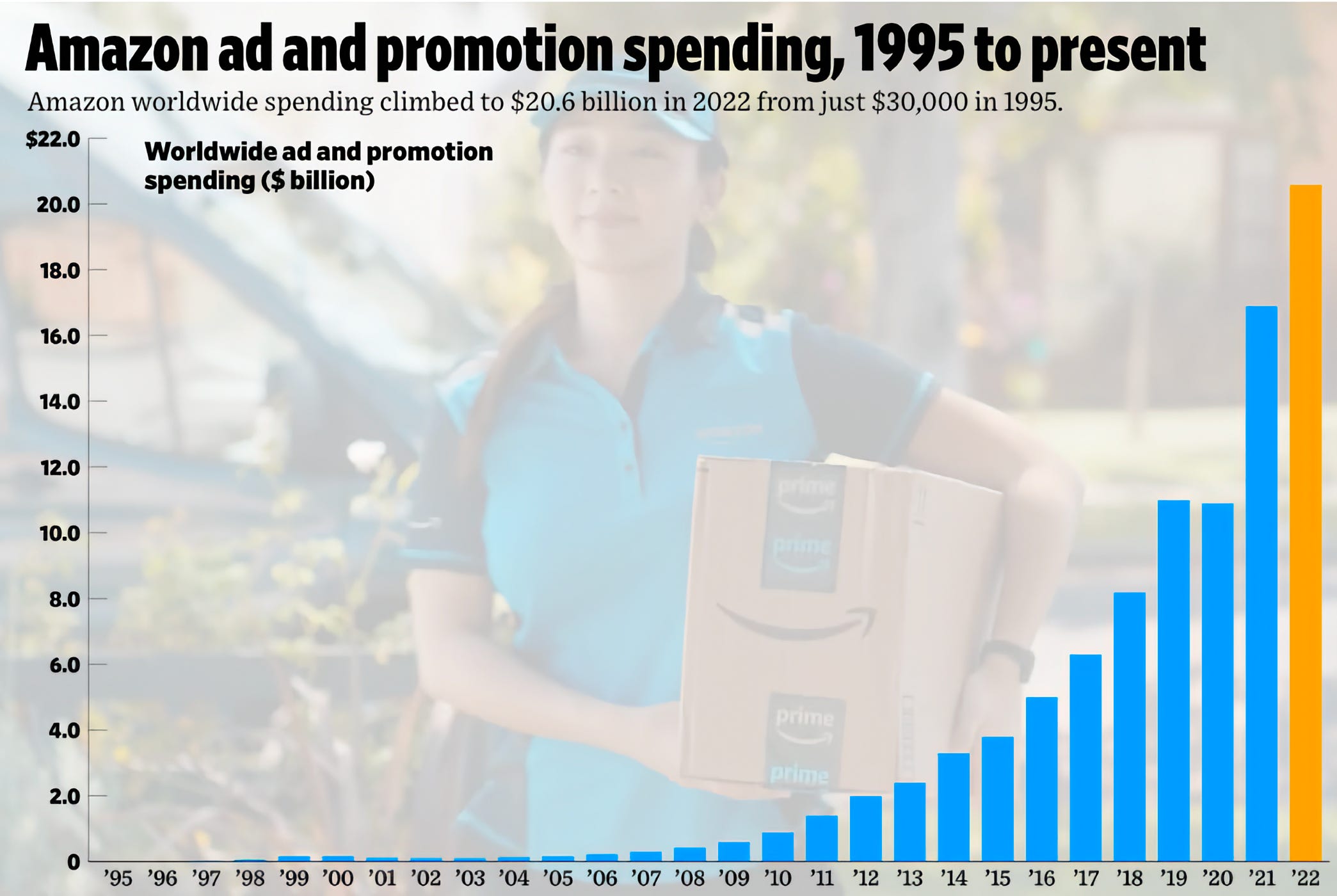
"Advertising is the price you pay for having an unremarkable product or service" - Jeff Bezos, 2009
"We are the biggest advertisers in history" - Amazon, 2022
Amazon spent $20.6 billion in 2022 — making them the biggest advertiser in history.
The craziest part?
Amazon made more money from its own ad network ($38 billion) than they used to break the advertising world record.
The Amazon Ad network also now makes more money than Prime.
h/t The Ad Professor
Shopify 💗 Flexport
The Information has a good piece with some details about Shopify’s sale of its logistics arm to Flexport, and the relationship between the two companies.
The whole thing is rather long and detailed, but here are a few highlights:
last month, Shopify surprised investors and analysts by announcing the sale of most of its logistics business, including Deliverr, to SoftBank-backed Flexport in exchange for a 13% stake in the freight forwarder. The terms of the deal crystallized a loss for Shopify on what it invested in the logistics unit, reflected in the up to $1.5 billion impairment charge the company said it would take against earnings. Yet investors greeted the hasty retreat with enthusiasm, sending the company’s shares up as much as 27% the day of the announcement. [...]
Shopify’s chief operating officer and vice president of product for merchant services, Kaz Nejatian, explained the rapid pivot from expansion to sale by saying an unnamed potential buyer of its logistics business had approached the company in late 2022, leading Shopify to explore a sale.
“When we got approached late last year by someone who wanted to acquire the business, we started asking, ‘Is there anyone else who actually can do it?’” [...]
Going forward, the relationship between Shopify and Flexport will be very similar to Shopify’s arrangements with Stripe and Affirm, which power its payment processing and installment loans for customers, respectively, Nejatian said. Product teams from Shopify and Flexport will talk frequently and work closely together on building products. [...]
As for Shopify, the company is looking to return its focus to its core software products and restore the company to profitability this year. The foray into logistics, Lütke wrote in a published memo to staff announcing the sale and job cuts, was a “side quest.
The thing with side quests is, when they go badly, it’s easy to say you shouldn’t even have tried, but when they go well, you look like a genius for having dared take a detour ¯\_(ツ)_/¯ (aka ‘resulting’)
🧪🔬 Liberty Labs 🧬 🔭
🔌🚘 Plug-in Hybrids vs Fully Electric Vehicles Sales 🔋🔋
Hannah Ritchie took a look at the growth in EV sales, and looked under the hood at where plug-in hybrids are more popular and where full EVs dominate:

Some highlights:
In 2022, electric cars accounted for around 14% of all new cars sold: 10% being battery electric cars, and the remaining 4% as plug-in hybrids.
That means that globally, 72% of new electric cars sold were fully-electric
The region where plug-in hybrids are most popular is Europe:
Europe tops the list. In Greece, two-thirds are hybrids. More than half are in Belgium, Spain, Italy, and Finland.
Other European countries aren’t far behind: Portugal, Denmark, Germany, and Sweden are all above 40%. The average across the European Union is 44%.
The volume of fully electric vehicles is increasing at a faster rate than plug-in hybrids, so their share is decreasing over time.
I see them as a very useful transition technology, but if batteries and EV drivetrains keep getting cheaper and better while internal combustion engines don’t, someday hybrids just won’t make sense anymore.
🍁 The number of lakes in northern Québec is kind of bonkers 🦆

This is a random part of the map, maybe a few hundred square miles in area, but it’s like that all over.
I’ve seen various estimates, but the number of lakes in the Province seems to be in the 500,000+ range.
🎨 🎭 Liberty Studio 👩🎨 🎥
🥰 The Beatles: Two of Us (in the studio) 😁
What a wholesome and enjoyable video!
If it doesn’t put you in a good mood, I don’t know what will.
I started really paying attention to this song after Steve Jobs referenced it during this classic interview with Bill Gates on stage at the D5 conference in 2007. He and Gates were reminiscing about their long career as rivals, and Jobs said something like:
To me, everything is either a Dylan or a Beatles song. I’m reminded of the Beatles line in Two of Us:
You and I have memories

Longer than the road that stretches out ahead
I thought that was a great line, so I listened to the song. It’s a fun ode to friendship and the complicity of true partnership.
The verses and choruses are so different, but the contrast is what makes it so interesting. That classic McCartney melody in the chorus is really beautiful, and the playfulness of the verses makes me smile every time.
So that’s the song, but I had never seen the video above until now. ⬆️
It’s great to see them in studios, their voices harmonizing so well, and all these little moments of joy, with kids running around and goofing off. They’re facing each other as they sing, highlighting the theme of the song.
And McCartney’s beard is so on point! I kinda wish I could grow one like that…
👋
Have been spending a lot of time checking out pictures of Northern Quebec since you tweeted about the lakes :). I think I am due for a Canada trip!
That was an excellent newsletter, TY.
I especially liked the bit about AI art. I've found some AI images that have stopped me mid-scroll because they're so powerful. And yes maybe they're not "real art" in the traditional sense or whatever, but they've made me feel something and that's pretty cool.