


It is not knowledge, but the act of learning, not possession but the act of getting there, which grants the greatest enjoyment.
—Carl Friedrich Gauss

🙌 😇 👿 Here's something that sounds backwards, but I think is true: when you turn someone into a god, you make their achievements LESS impressive.
Michael Jordan as a basketball god?
Of course he dominated. That’s what gods do. It’s expected.
But Michael Jordan as a human being who outworked other freakishly talented human beings for fifteen seasons, through injuries and failures and a sport full of people trying to dethrone him? Now THAT is impressive! 🤯
Deification makes greatness feel inevitable. And inevitability isn’t impressive.
Now flip that.
Adolf Hitler and Joseph Stalin are scarier when you keep them human.
Turning them into monsters, demons, or cartoon villains is the comfortable move. It lets you believe that this kind of evil is some alien force. Fundamentally unlike you. But they weren't a separate species. They were people. Stalin wrote romantic poetry as a young man. Hitler loved Mickey Mouse films — Goebbels gave him 18 reels for Christmas — and had a personal copy of Disney's Snow White delivered to his private theater. They had insecurities and families and the same basic cognitive hardware as you and me.
The distance between us and history’s worst isn’t as large as the mythology suggests. If they were human, the inputs are replicable. Which means the outcome might be too.
Humanizing works in both directions at once. It makes achievement more impressive AND makes evil more frightening.
Mythologizing lets you avoid both truths by creating a category break. Which is probably why it’s so popular.
🛞 When’s the last time you checked your car tire pressure?
Forget gas prices for a sec. I just find it very inelegant to waste more energy than necessary on rolling resistance when it takes a minute to fix. The money saved is just a bonus.
There's a whole category of problems like this: trivial to fix but easy to ignore, so most people just... don't.
The dusty coils on the back of your fridge make the compressor work harder. Five minutes with a vacuum once a year. The HVAC air filter you haven't changed since you moved in.
Anyway. I realize this makes me sound like your dad. I'm fine with it. ¯\_(ツ)_/¯
🔎📫💚 🥃 Too few readers of this newsletter are paid supporters, and it’s threatening the existence of the project.
I’m not saying this to be dramatic. I just want to level with you.
Paid support has declined, even as total readership has continued to climb and now approaches 30,000. 📉📈
If you want it to continue, this is the moment. Become a paid supporter 👇
🏦 💰 Liberty Capital 💳 💴
👀🚙🤖 Dmitri Dolgov Explains How Waymo Actually Works
Waymo's careful, methodical approach is aging well.
After more than 15 years of development, it’s now doing about half a million fully autonomous rides a week across 11 U.S. cities. Do you remember the video of the self-driving Prius from 2010? That’s what it looks like when a science project turns into a real business.
Dmitri Dolgov shares a bunch of unusually clear details about how the tech behind the self-driving taxis works, including a few things I hadn’t seen explained before. Here are my highlights:
Waymo’s architecture: foundation model → teachers → students:
Dmitri Dolgov: the way we think about building the Waymo Driver, it starts with a large off-board foundation model. I can imagine building a big model that understands how the physical world works and understands the important properties of what it means to drive, the social aspects of driving, and what it means to be a good driver as opposed to a bad one. That’s the foundation.
Then we specialize it into, let me call it, three main off-board teachers. There are still large, high-capacity off-board models. There’s the Waymo Driver, there is the simulator, and then there’s the critic. [...] if you think about the critic, the job of the critic is to find interesting events and then be opinionated about what's good behavior and what's bad behavior. [...]
Those then get distilled into smaller models that you can run inference on faster. The Waymo Driver becomes the backbone, what’s in the car. The simulator, of course, is what powers our synthetic generative environment that can run on the cloud for training and for evaluation enclosed the system. The critic is the value.
Dolgov also shares a great example of why Waymo uses the full sensor stack, not just cameras: while replaying a situation from logs, he watched the system detect a pedestrian on the other side of a bus even though he couldn’t see anyone on the video, and the sensors couldn’t see through the vehicle.
That’s a little eerie.
Then the pedestrian emerged from behind the bus 🚌🚶♂️
It turned out the car was getting faint reflections from under the bus on peripheral LiDAR, and the model was good enough to interpret that noisy signal as a likely pedestrian.
Driver-assist to full autonomy is not incremental:
John Collison: What do you think that working your way up from the lower levels [of autonomy] versus working your way expanding from existing products like Waymo? What will that convergence look like? Because we’re going to eat it from both sides.
Dmitri Dolgov: I don’t believe we will. [...]
I see it just as fundamentally two different problems. There’s driver-assist systems, and then there is full autonomy. I think it’s deceptive to think of them as incremental on one spectrum of complexity.
…If I think about the hardest parts of building a fully autonomous, rider-only system, they are very different from what you do for a driver-assist system. Of course, some work in this space helps you. I don’t want to say you can’t make the jump, but it is a qualitative jump.
That's a direct rebuttal to Tesla's approach. Tesla bets on cameras-only and on climbing incrementally from driver-assist to full autonomy. Waymo bets on the full sensor stack and on attacking full autonomy directly.
We’ll see who’s right. Maybe both approaches can work, but my guess is that one will reveal itself to be clearly superior.
🤖 Jensen on the CUDA Bet Nobody Wanted, Tapping the Grid's Idle Power, and Nvidia’s Single Biggest Advantage 🚀
I don’t mean to post so many Jensen interviews, but he *is* at the center of the most interesting technological revolution in… maybe ever? While simultaneously being a central figure in the most consequential business story right now, the whole AI ecosystem, from chips to power plants and the ripples going well beyond that.
So it’s hard to look away 🫣
I thought this one was quite good. Lex surprised me again, and gave us a quieter Jensen (he feels more intimate, less ‘on stage’ than usual) explaining how he thinks through problems, where he sees AI going, how he’s scaling up Nvidia’s supply chain, how he organizes the company around himself and evolves it to keep up with innovation, and how he thinks about creating new markets rather than taking share in existing ones.
First, the CUDA bet: how Nvidia had to bet the company on a platform that killed profits for years, with no visible payoff on the horizon. That required a lot of patience from the board. Based on the stock drawdown, many less-patient shareholders just hit the "eject" button. 🪂
In fact, nobody was asking for CUDA. They Trojan-horsed it to gamers who didn’t care and wouldn’t pay anything extra for it, just to get the installed base going and start the flywheel. Talk about long-term thinking.
Jensen: Our single most important property as a company… is the install base of CUDA. [...]
That install base, when you amplify it with the velocity of our execution at the scale that we’re talking about, no company in history had ever built systems of this complexity, period. And then to build it once a year is impossible. And that velocity combined with the install base… From the developer’s perspective, if I support CUDA, tomorrow it’ll be 10 times better. I just have to wait six months on average.
Not only that, if I develop it on CUDA, I reach a few hundred million people, computers. I’m in every cloud, I’m in every computer company, I’m in every single industry, I’m in every single country. [...] And not only that, I trust 100% that NVIDIA is going to keep CUDA around and maintain it and improve it and keep optimizing the libraries for as long as they shall live… You put all that stuff together, [and] if I were a developer today, I would target CUDA first.
But getting there was a long, hard road:
Jensen: We invented this thing called CUDA, and it expanded the aperture of applications that we can accelerate with our accelerator.
The question [was], how do we attract developers to CUDA? Because a computing platform is all about developers… They come to a computing platform because the install base is large. Because a developer, like anybody else, wants to develop software that reaches a lot of people. So, the install base is, in fact, the single most important part of an architecture.
…We were already selling millions and millions of GeForce GPUs a year, and we said, ‘You know, we, we ought to put CUDA on GeForce and put it into every single PC whether customers use it or not, and use it as a starting point of cultivating our install base.’ Meanwhile, we’ll go and attract developers, and we went to universities and wrote books and taught classes and put CUDA everywhere. [...]
the problem was CUDA increased our cost of that GPU, which is a consumer product, so tremendously, it completely consumed all of the company’s gross profit dollars. And so at the time, the company was probably, you know, worth, I don’t know, at the time, eight… Was it like $8 billion or something? Like 6, $7 billion or something like that. After we launched CUDA… our market cap went down to like one and a half billion dollars. […]GeForce would carry the burden of CUDA and none of the gamers would appreciate it and none of the gamers would pay for it. You know, they only pay certain price and it doesn’t matter what your cost is. We increased our cost by 50%… And we were a 35% gross margin company, and so it was a… It was quite a difficult decision to make. [...]
The other one I want to share with you is Jensen’s suggestion for how to get more power for data centers in the US via demand-response:
Q: What are your hopes for how to solve the energy problem?
Jensen: Our power grid is designed for the worst case condition with some margin. Well, 99% of the time we’re nowhere near the worst case condition because the worst case condition is a few days in the winter, a few days in the summer, and extreme weather. Most of the time we’re nowhere near the worst case condition and we’re probably running around, call it 60% of peak.
And so 99% of the time, our power grid has excess power, and they’re just sitting idle, but they have to be there sitting idle because just in case, when the time comes, hospitals have to be powered and, you know, infrastructure has to be powered and airports have to run and so on and so forth. And so the question that I have is whether we could go and help them understand and create contractual agreements and design computer architecture systems, data centers, such that when they need the maximum power for infrastructure in society, that the data centers would get less.
But that’s in a very rare instance anyways. And during that time, we either have a backup generator for that little part of it, or we just have our computers shift the workload somewhere else, or we have the computers just run slower.
We could degrade our performance, reduce our power consumption and provide for a slightly longer latency response when somebody asks for an answer. And so I think that that way of using computers, of building data centers, instead of expecting 100% uptime—and these contracts that are really, really quite rigorous, it’s putting a lot of pressure on the grid to be able to… I just wanna use their excess. It’s just sitting there.
That feels pretty elegant to me. Use idle capacity through systems engineering so that you can demand-respond the few times when you may not have power by shifting workloads around or having on-site backup/batteries. 🔋
Google is already doing this at ~1 GW scale with several U.S. utilities, but I’m surprised it’s not being done more already. It seems a lot easier than building more capacity.
🍁 A Decade of Falling Behind: Canada's Quietly Terrible Economic Record 📊🦫
Some pretty bleak numbers from Canada’s 2014-2024 decade:
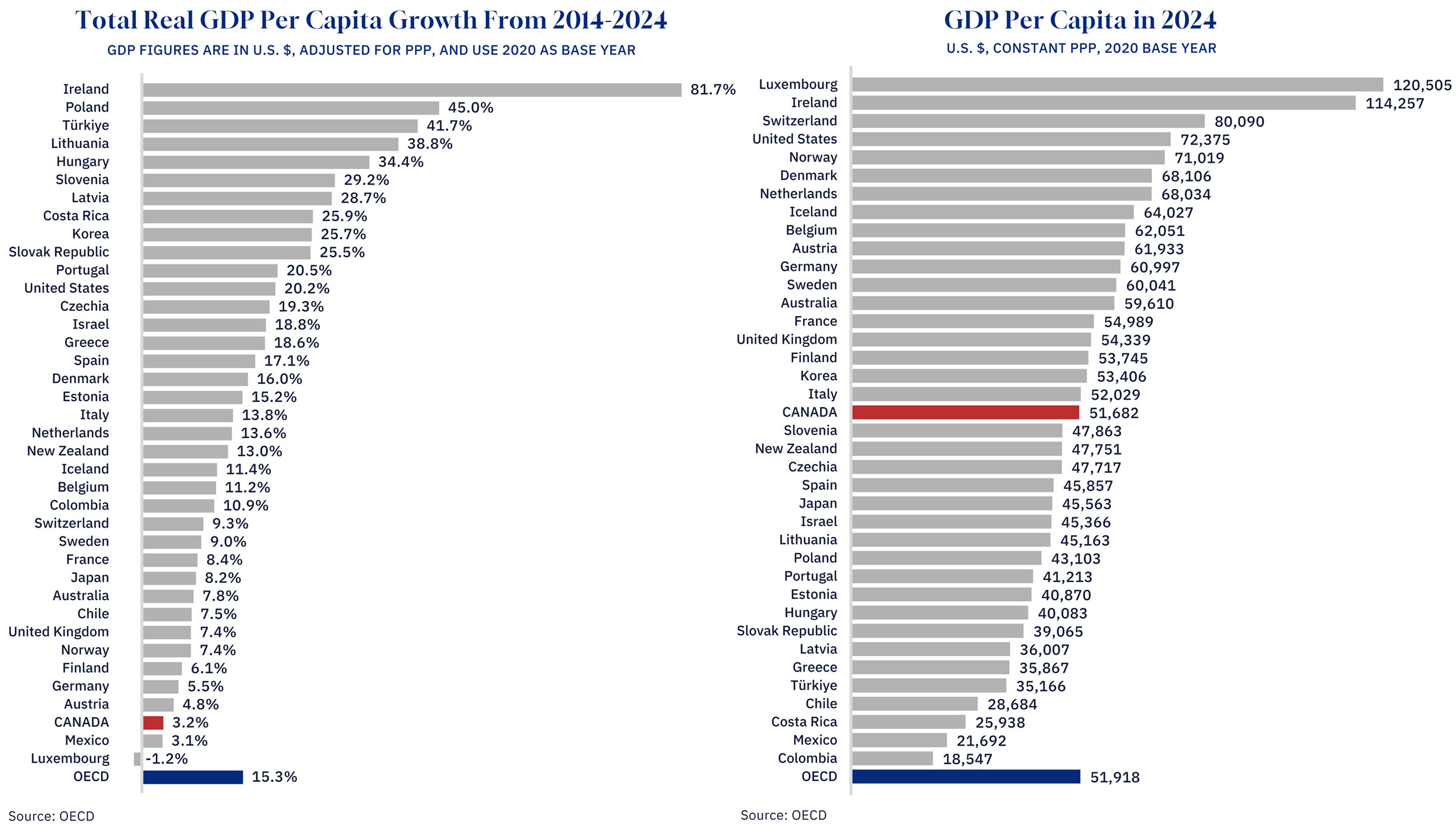
From 2014 to 2024, Canada’s real GDP per capita adjusted for purchasing power parity grew by just 3.2 percent in total, an anemic 0.4 percent per year on average, and the third lowest among 38 advanced nations.
Over the same period, the United States posted 20.2 percent total growth (1.9 percent annually), and the OECD average reached 15.3 percent (1.4 percent annually). The measurement shortcomings cannot explain five-to six-fold differences in growth rates.
And the underlying reality may be even worse:
Even Canada’s headline GDP per capita figure, while weak, may overstate our underlying economic health. Total government spending as a share of GDP increased from approximately 38 percent in 2014 to 45 percent in 2024.
The country used to keep up with the U.S. and the rest of the OECD in the previous (2005-2014) decade, but the divergence is yikes:

There are many causes, but one of them appears to be the brain drain to the US:
The analysis estimates that a substantial share of Canadians who would rank among top earners in Canada have emigrated to the United States—roughly 40 percent of potential top 1 percent earners and 30 to 50 percent of the next nine percentiles. Canadian-born individuals in the United States are more educated than native-born Americans, earn substantially more, and cluster disproportionately in top income deciles.
Canada is effectively exporting its inequality to the U.S. The brain drain simultaneously lowers our average income while raising American income, accounting for a significant share of the persistent GDP gap.
But at least, Canadians are happy, right?
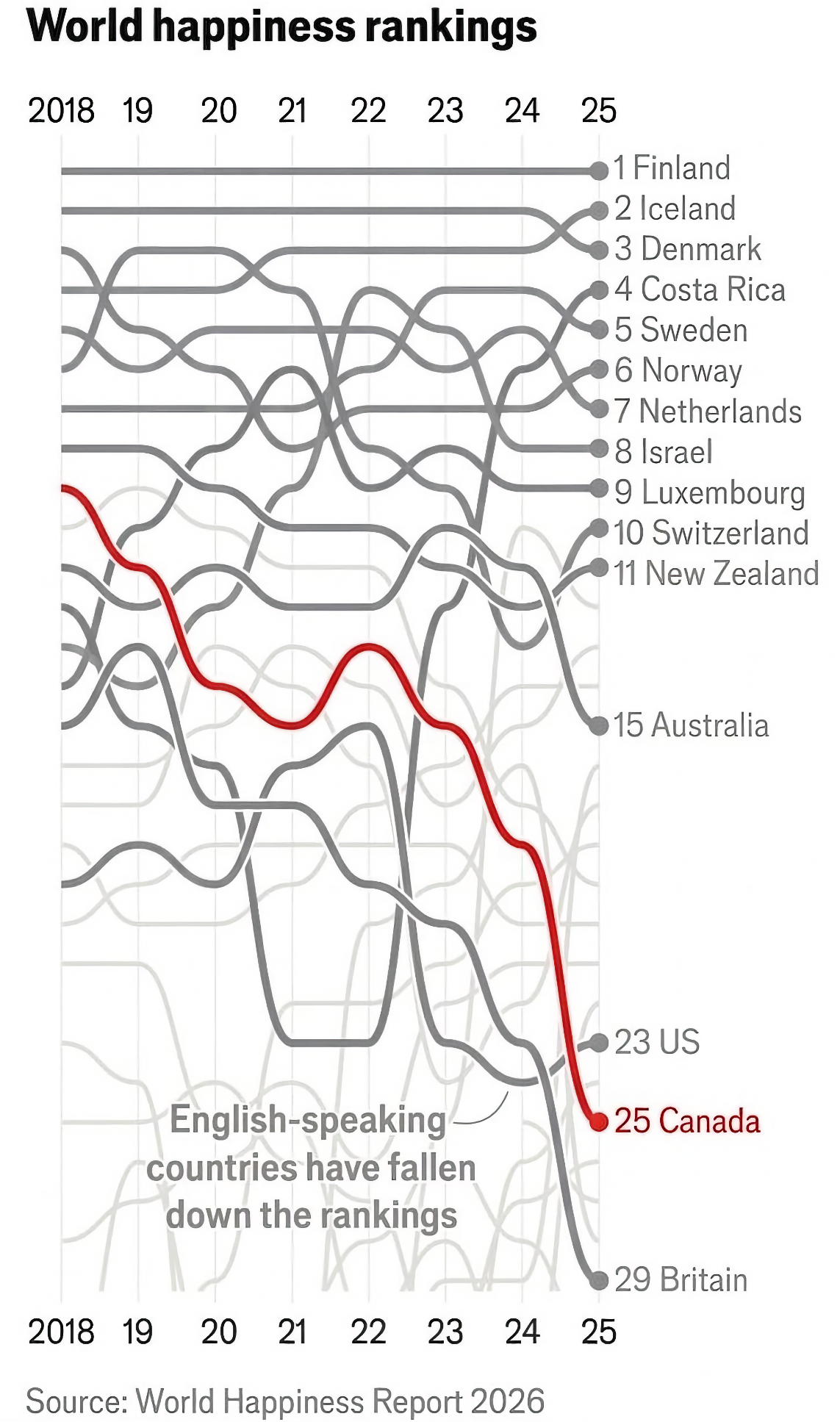
What do you mean “one of the largest declines in happiness in the world” and now ranking below the US?! 😬
I think I’ll do like the Finns and go take a sauna 🤔
🧪🔬 Liberty Labs 🧬 🔭
🛰️ The Soviet Military Space Station With a Secret Cannon on It

In 1974, the Soviet Union put a cannon in orbit. Not metaphorically — an actual 23mm autocannon, the Rikhter R-23, bolted to the hull of Salyut 3. Officially described as a “civilian research station” (imagine me making air quotes here), it was actually part of the classified Almaz military program. The stated rationale was self-defense against American anti-satellite systems and inspection spacecraft.
How do we know it exists? It was revealed on the Russian military show, Voennaya Priemka, back in 2015.
The engineering constraints were absurd.
The gun was fixed to the hull with no turret — the only way to aim it was to rotate the entire space station. Recoil was considered potentially catastrophic for a crewed vessel, so engineers synchronized the cannon's firing with the station's thrusters to counteract it, and sent the cosmonauts home before pulling the trigger.
In January 1975, with the crew back on Earth, ground controllers fired it by remote. A few short bursts, targets at ranges between 500 and 3,000 meters. Then Salyut 3 was deorbited and burned up in the atmosphere, taking the world’s only known space cannon with it (how many don’t we know about, though?).
(This perfectly captures the logic of the Cold War. You go to space, one of the great civilizational achievements, and the question rapidly becomes: okay, but how do we arm it?)
h/t VisionaryVoid
🛜 The US is Banning Foreign Consumer Routers (Most are Chinese) 📶
There’s a pretty good chance that the wifi you’re getting at home is coming from a Chinese-made router. Reuters says China controls at least 60% of the U.S. market for home routers. That’s a lot, and I wouldn’t be surprised if that number is conservative.
The FCC is trying to do something about that:
routers produced in foreign countries, regardless of nationality of the producer, pose… unacceptable risks to the United States: ‘(1) introducing a supply chain vulnerability that could disrupt the U.S. economy, critical infrastructure, and national defense; and (2) establishing a severe cybersecurity risk that could be leveraged to immediately and severely disrupt U.S. critical infrastructure and directly harm U.S. persons.’
Companies that make routers outside the US can seek an evaluation and potentially receive an exemption from the DoD/DHS, but it’s not yet clear how permissive or restrictive that process will be in practice.
This ban only applies to new models, not existing ones, so it will roll out over time as the lineup refreshes… which makes me wonder if some vendors will keep selling existing models longer than they would otherwise have — after all, most consumers won’t notice much difference between wifi routers 🤔
Bottom line: The US is not just targeting one company. It’s implicitly admitting that the modern consumer-router supply chain is so strategically sensitive yet so dependent on foreign manufacturing that it now views the whole category as suspect.
🦞 Anthropic Is Building the Domesticated Version of OpenClaw 🛠️
Anthropic is moving fast to make Claude Code and Claude Cowork feel more agentic, and the direction of travel is pretty clear: more autonomy, more persistence, more ability to act across tools and apps, and less of the old “chatbot in a box” feeling. First came Dispatch, which lets you hand Claude a task from your phone and keep one continuous conversation going between mobile and desktop.
Now they’ve added computer use inside Claude Cowork and Claude Code, so when Claude doesn’t have the right connector, it can fall back to using your actual computer the human way: cursor, clicks, files, browser, dev tools.
That's starting to look very OpenClaw-ish 🤔
Anthropic would obviously frame it in a more polished and safety-conscious way — connectors first, explicit permission prompts, prompt-injection safeguards, some sensitive apps blocked by default, and still just in ‘research preview’. But the trajectory is the same: give the model a goal, let it operate the machine directly.
The big difference, at least for now, is that OpenClaw still feels more like the Wild West (🤠) maximalist version of this idea, while Anthropic is building the cleaner, more consumerized, please stay inside the guardrails version.
For now, this research preview is Mac only, and for Pro and Max subscribers. I’ve heard reports that it doesn’t quite work yet on many use cases, so it’s probably not ready for prime time, but I expect it to improve fast.
🎨 🎭 Liberty Studio 👩🎨 🎥

👨🚀 My Thoughts on Project Hail Mary 🪨🪐🦠
My non-spoiler review: get IMAX tickets and bring people you love. This is what cinema is for.
🚨SOME SPOILERS BELOW🚨
I saw this film yesterday with two friends. I highly recommend IMAX, this is a visual feast. The cinematographer is Greig Fraser, and once again, he does great work (he did Dune Part 1 & 2, The Batman, Rogue One, Zero Dark Thirty, etc).
Adapting this book was always going to be hard. A lot of thinking it through science that happens in Grace’s head, a very strange non-humanoid alien friendship is central to the plot, many scenes happen in zero G, etc.
I don’t want to compare it to the book, because it’s such a different medium. If I grade it as a film, it delivers something about as good as could have been hoped for. And we still have the book. (Still reading it with my boys — we're five chapters in 📙)
I love what Greig Fraser did with the light. Because the ship is a centrifuge that is spinning most of the time, there are constantly moving lights and shadows across the actors. There are also many very impressionistic scenes where the light takes over most of the frame and colors (pinks, greens, yellows) wash over everything. It’s beautiful. Lots of weird camera angles to remind us that in space, there’s no up.
In an interview with directors Chris Miller and Phil Lord, they mention that Fraser is “not a perfectionist, he’s an imperfectionist. Always looking for messy shots.” I love that.
They also mention in that interview that they built a full-scale, 360-degree set for the ship. They made it in such a way that the sections could be rotated so that they can use it for both the scenes where the centrifuge is in action, and when he’s floating in the other orientation in microgravity. This allowed more improvisation and angles discovered in the moment than if they only had partial sets with pre-planned shots.
The buddy cop structure works surprisingly well, and the humor mostly landed for me. Gosling is likable, and Rocky is this generation’s Yoda (I mean the puppet, not the wisdom). The directors also did the Spider-Verse films, so I’m not surprised they have a good feel for comedic timing and dialogue.
Eva Stratt is one of my favorites in the book. Almost every line she has is a scene stealer. Sandra Hüller's performance is good, but on screen Stratt loses maybe 30% of what makes her so compelling in the novel. Maybe some things just can't be conveyed by a real person the way they work on the page 🤔
Fun trivia: I mentioned in the past how good the audiobook version of PHM is. Well, in the film, they use text-to-voice software for Rocky’s voice, and there’s a scene where they’re trying a bunch of different voices. One of the voices they try is Ray Porter, the narrator of the English audiobook. And apparently, Gosling ad-libbed a Meryl Streep joke on set, which is how she ended up recording a few lines for a voice too.
I hope this makes a billion dollars and wins a bunch of prizes and helps bring back the appetite for these big, ambitious non-franchise/superhero films with large practical sets and a sense of adventure. 💰
Interestingly, Quebec ranks fifth in the world if taken separately from the rest of Canada in the Happiness rankings
I heartily agree with the Project Hail Mary movie recommendation having also seen it yesterday. I also highly recommend the book which has so many extra interesting points to explore that had to be flooded over to fit it into a 2 hour film, especially if you have a reasonable level of scientific literacy.
***SPOILERS FOLLOW*** I don't have IMAX near me and watched it in on the normal big screen in English with Spanish subtitles (and fortunately Rocky's dialogue was always translated to audible English because finding a method of translation for Ryland Grace using his laptop was part of the plot). I loved the book and had hoped for a good movie and want disappointed. I thought the visualisation of Rocky's sense of echo location to visualise through sound was really well handled. I had forgotten some parts of the plot in the intervening years but felt it was extremely well adapted and told the story really well and captured most of the buddy movie feel. The final scene in the biodome was different to my memory of the book but worked quite well to briefly explain Ryland's life after the encounter and leave the viewer with something to imagine about how it might continue.