Knowledge is no guarantee of good behavior, but ignorance is a virtual guarantee of bad behavior.
—Martha Nussbaum

🌺🦟 As I wrote about Google’s plans to breed millions of Wolbachia-carrying mosquitoes in Edition #640, a question popped into my head:
If male mosquitoes don't bite, what do they eat?
I had to look it up.
It turns out that male mosquitoes are basically tiny nectar-drinking bachelors.
Their main food is: Flower nectar, plant sap, honeydew, and other sugary plant fluids.
In fact, both male and female mosquitoes drink nectar, but females also need blood for the protein and iron to make eggs. 🩸🥚
So if they’re not busy trying to bite some poor victim, what do male mosquitoes do all day?
They mostly rest in vegetation, avoid drying out, and sip sugar when they can. Many mosquitoes are most active around dawn and dusk to avoid the midday sun.

Their big evolutionary job is to find females and mate. 🕺
Males often gather in mating swarms, sometimes near visual markers like bushes, puddles, rocks, or other landscape features. Females fly into the swarm. Males detect them partly by the sound frequency of their wingbeats (around 475 Hz, lower than the males' own 700 Hz+). Mating happens in flight or nearby.
After mating, male mosquitoes generally don’t live very long.
Their life is mostly: hatch → drink sugar → chill around → swarm → mate → die
Depending on species and conditions, males may live only several days to a couple of weeks.
Females are miniature vampires: the deadliest animal on the planet, killing close to a million people a year. 🧛♀️💀💀
Males? Fragile, short-lived, sugar-powered flying reproductive drones with really good hearing. 🌺🦟🎩
🔎📫💚 🥃 If you want Liberty’s Highlights to continue, this is the moment. Become a paid supporter.
Without your support, this steamboat sinks 🌊🚢⚓
🏦 💰 Business & Investing 💳 💴
🗣️📊💵 Thoughts on Jensen’s Financial Analyst Q&A at Computex 2026 🇹🇼
I listened to part of it and read the transcript for the rest, so I may have missed some tone-of-voice stuff, but I came away thinking that Jensen’s goal was to reframe how analysts think about Nvidia: from “How many more GPUs can they sell, and at what margins?” to “What is the full stack required to produce profitable intelligence/tokens/agent work inside fixed power envelopes?”
Through that frame, a lot of recent moves and the expansion into all kinds of adjacencies make a ton of sense.
CPUs matter again because agents use tools.
Networking matters because AI factories are scaling beyond rack-scale.
Local PCs matter because agents need secure, low-latency access to local files/apps.
Software matters because enterprises need a runtime/harness/tool layer, and because frameworks/APIs/libraries can be optimized to turn the same expensive hardware into more output.
In other words, the goal is to turn “The GPU Company” into “The Operating System for AI Factories and Agents Company,” which isn’t that crazy since, until recently, they were “The Video Game Company.” ¯\_(ツ)_/¯
Here are some of my highlights:
-Why CPUs matter again (2nd order reason) 🛑 🏎️
Jensen: Because the AI is actively waiting on this back-and-forth loop, tool execution must be incredibly fast. [...] If the tools are slow, a one-gigawatt data center full of GPUs sits idle waiting for a response.
When you think about it this way, the CPU becomes a lot more valuable. If you try to save money by buying slower CPUs and fewer of them than you really need, you may end up with a lower utilization on your very expensive AI data-center full of Blackwells. Whatever savings you think you were getting on the CPU side end up getting swallowed whole by stranded GPU capacity.
In the short term, as long as supply is constrained and AI factories are trying to maximize output inside fixed power envelopes, this is probably good for the whole high-performance CPU ecosystem: Nvidia, AMD, Intel, ARM, and others.
At least for now, performance may matter more than cost. But if Nvidia succeeds with Vera, especially as a standalone CPU, some of that incremental CPU demand will come at AMD and Intel’s expense.
-Local AI isn’t replacing cloud AI, it’s the control loop 🧠💻☁️
AI-capable PCs are in the news these days. But why would you need one if you can get access to hardware worth millions in the cloud by paying a few bucks a month for a Claude or ChatGPT subscription?
Jensen: The future architecture is not an exclusive choice between local execution and cloud processing; it uses both simultaneously. Your local device will run a highly efficient, secure agent continuously looping in the background to handle immediate workflows, local file management, and tool orchestration privately and without metered cloud fees. When that local agent encounters a highly complex reasoning problem requiring multi-disciplinary knowledge, it will automatically call out to a multi-trillion parameter frontier model in the cloud.
The theory is that your local machine becomes the private, low-latency control layer.
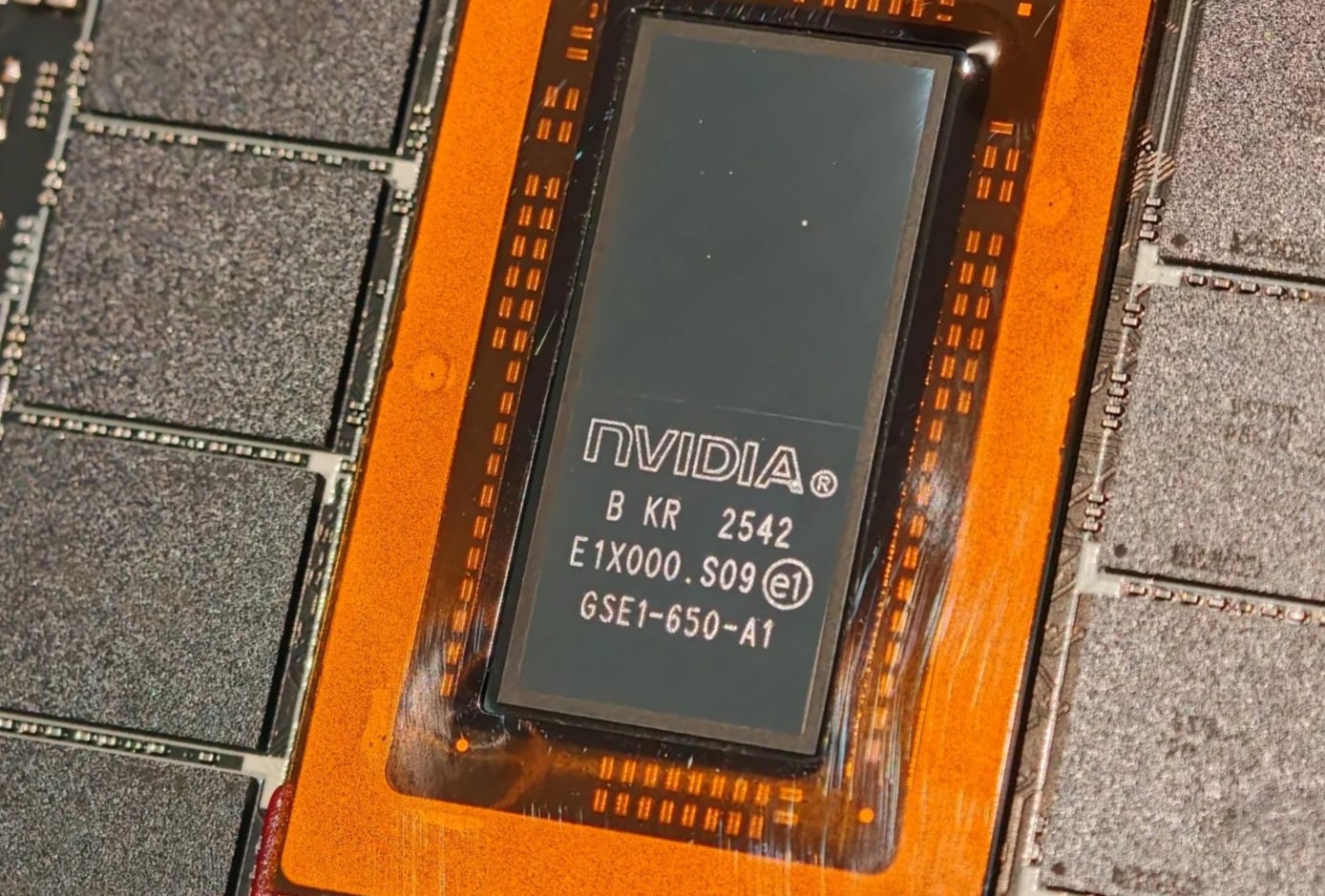
I think in some cases it’ll make sense, especially in the enterprise or with prosumer/creators, etc. For most people, their token usage probably won’t be high enough, at least for a while, and the cheap, small online models are getting better all the time. I’d be surprised if it makes sense for most people to run a local model over, say, Haiku 5.0 or GPT-6.0-Fast or whatever comes next unless the local model is doing something truly local.
Side note: it’s a bit surprising that Anthropic hasn’t updated Haiku or Sonnet in a relatively long time, but I suspect most of their attention is going into Opus and Mythos in the pre-IPO period (because that’s where the big bucks are).
In any case, the hybrid model of edge as hands + cloud as brain 🤲 🧠 makes enough sense that it’s likely to keep getting traction with the highest-volume token users, or at least, those that have demonstrable ROI on higher volumes of tokens.
-The most expensive data center may be the cheapest one ⚡🏭💵
Jensen: If you operate within a fixed one-gigawatt power envelope, it is vastly more profitable to fill that envelope with a high-density, ultra-productive $90 billion computing infrastructure than a lower-performing alternative. […]
The absolute key metric for any modern AI factory is performance-per-watt. [...]
What you can drastically reduce is the cost of compute through architectural efficiency. Our end-to-end co-design of the entire rack, networking fabric, and software layer allows us to extract maximum efficiency out of every watt, driving down the true total cost of ownership per token.
In other words, a $90bn datacenter can be “cheaper” than a $50bn one if it produces way more tokens per watt, has better utilization, gets to production faster, and keeps generating useful output for longer.
I mean, the barber is telling you that the more expensive haircut is totally worth it, so be careful with your wallet. But the logic makes sense if revenue depends on $/token more than anything else. 💇♂️
-Bonus: Nvidia’s Networking Attach Rate 🔌🛜 + From Hopper to Rubin
At a different event, Nvidia CFO Colette Kress talked about the networking business:
Kress: our attach rate of what we are seeing in terms of the networking is an enormous piece of that as well. We're probably more than 90% attach rate in terms of what we're doing on networking.
Last Q, they disclosed: “Data Center networking revenue was a record $14.8 billion, up 199% from a year ago and up 35% sequentially.”
She also mentioned that Hopper systems (ancient in AI terms!) in the cloud are earning more money than when they were first deployed because Nvidia keeps improving them through software. She distinguished depreciable life from useful life.
She also said that Vera Rubin is now ramping into full production. The one-year cadence is brutal to compete with.
💰💰💰$20bn AUM at 24 💰💰💰

The WSJ has a fun one on Leopold Aschenbrenner and his fund Situational Awareness.
It has gone from a few hundred million to ~$20bn in under two years (up ~270% after fees this year alone, 1,000%+ since inception).
He has a lot of coattailers who copy his positions, but the 13F that everyone's dissecting doesn't even contain his biggest homeruns. ⚾⚾
His Anthropic position is about a fifth of the fund. He bought it at a $61.5bn valuation in early 2025. The latest round was at ~$965bn. 15.7x in a year and a half. Not bad. He also got into SK Hynix back in Nov 2024 and rode it into the trillion-dollar club.
These investments are private and foreign, so they never show up in U.S. disclosures.
Personally, I don’t really have an opinion on him, but it’s fun to watch from afar.
🚀 SpaceX the Neocloud, Google Circular Deal Edition 🤝
If there was any doubt, SpaceX issued this filing:
On June 5, 2026, we entered into a Cloud Service Agreement with Google LLC (”Google”) with respect to access to compute capacity. The compute capacity provided includes approximately 110,000 NVIDIA GPUs, CPUs, memory, and other related components.
Pursuant to the agreement, the customer has agreed to pay us $920 million per month from October 2026 through June 2029, with capacity ramping up through September at a reduced fee.
If we fail to deliver access to the committed amount of GPUs by September 30, 2026, then following a one-month grace period, Google may immediately terminate the agreement or accept the number of GPUs provided, with a corresponding pro rata reduction in the monthly fees. After December 31, 2026, the agreement may be terminated by either party upon 90 days’ notice.
Here’s where it gets circular 🔄
As of the end of 2025, Google owned about 6.11% of SpaceX equity.
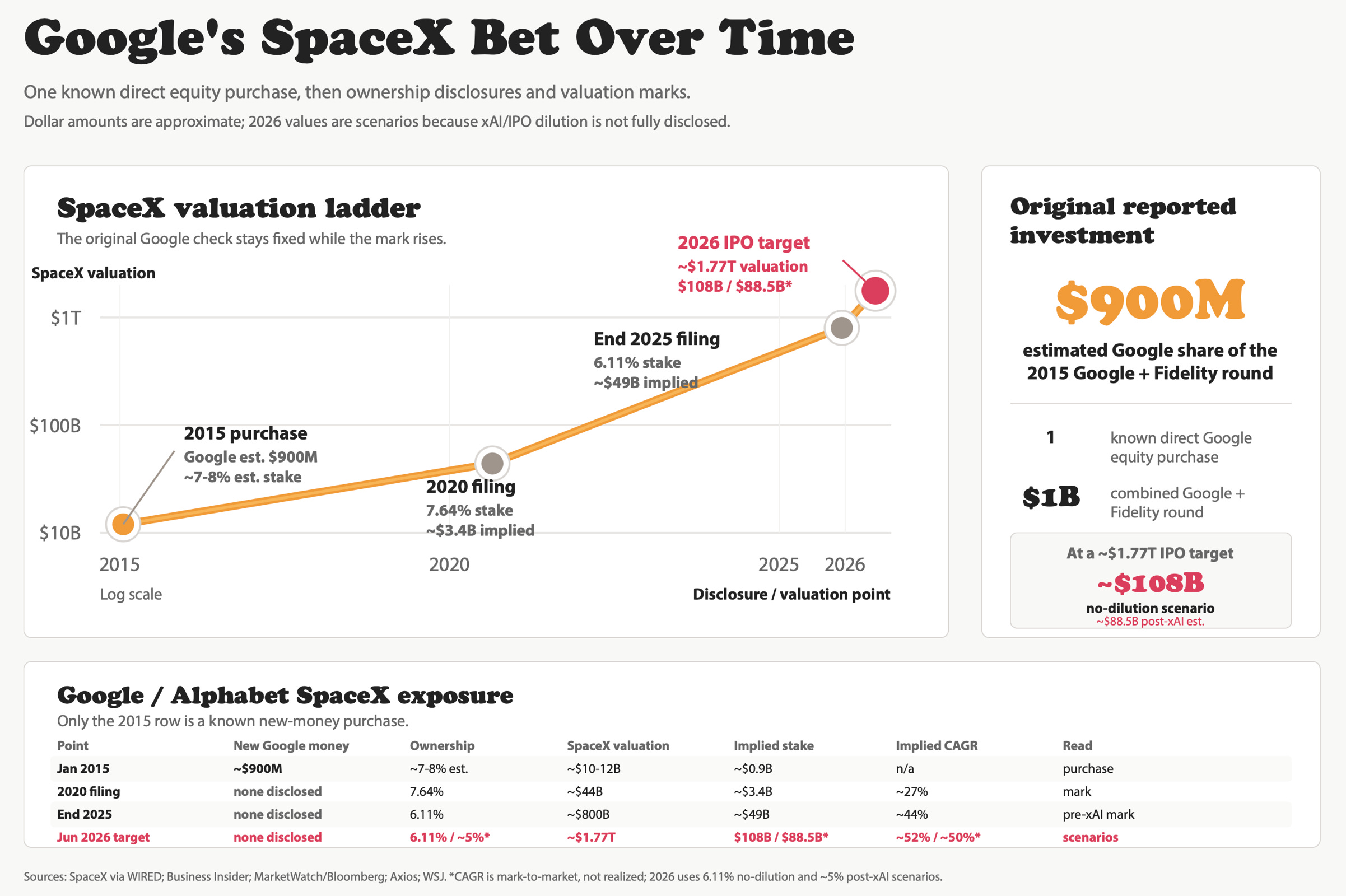
SpaceX is expected to IPO around 90-95x TTM revenue, or about 70x estimated 2026 revenue.
This means that if the multiple holds, or even partly holds, the money that Google is spending on SpaceX compute will more than pay for itself in the increase in value of their equity stake, and they still get the compute (possibly to help power their deal with Apple? 🤔).
Now, whether that multiple makes sense is a different question. Should commodity neocloud revenue really earn the same multiple as a near-monopoly in launch and a global satellite constellation?
🇵🇱📈 How to Make a Country Rich: Poland vs Russia A/B Testing 🇷🇺📉
“How did Poland go from communist central planning to one of Europe’s fastest-growing economies?”
Very informative AND fun video. I want to visit Poland someday.
🧪🔬 Science & Technology 🧬 🔭
🤖🔮 Anthropic’s Fable/Mythos Split: Same Brain, Different Chains ⛓️⛓️💥
First, the name.
The safeguards are what distinguish the two models (Fable and Mythos) and are why we’ve given them different names.
I think Mythos is a better name, and a brand they’ve been building for months. Fable is a cool word too, but it’s a bit less… Mythic
Fable makes it seem more like a children’s story. Oh well, if it kicks ass, I’m sure we’ll soon create all kinds of positive associations with the name and it’ll be fine. I remember thinking at first that “Claude” was a strange name for an AI, even as a big Claude Shannon fan.
Now I think it’s great ¯\_(ツ)_/¯
So Fable 5 is a Mythos-class model, but if I understand things right, there are traffic cops 👮♂️ (aka classifiers) that sit in front of it and analyze queries. In Claude’s apps, requests related to cyber/biology/chemistry will fall back to Opus 4.8 instead. On the API, those requests are blocked by default.
There’s also a second, quieter system for frontier LLM development by competitors. If Fable thinks you’re asking for help building pretraining pipelines, distributed training infrastructure, or ML accelerator designs, it may quietly make itself less useful through “prompt modification, steering vectors, or PEFT.” Very sneaky!
The euphemism is safeguards.
The business translation is: No! We will not help you clone us!
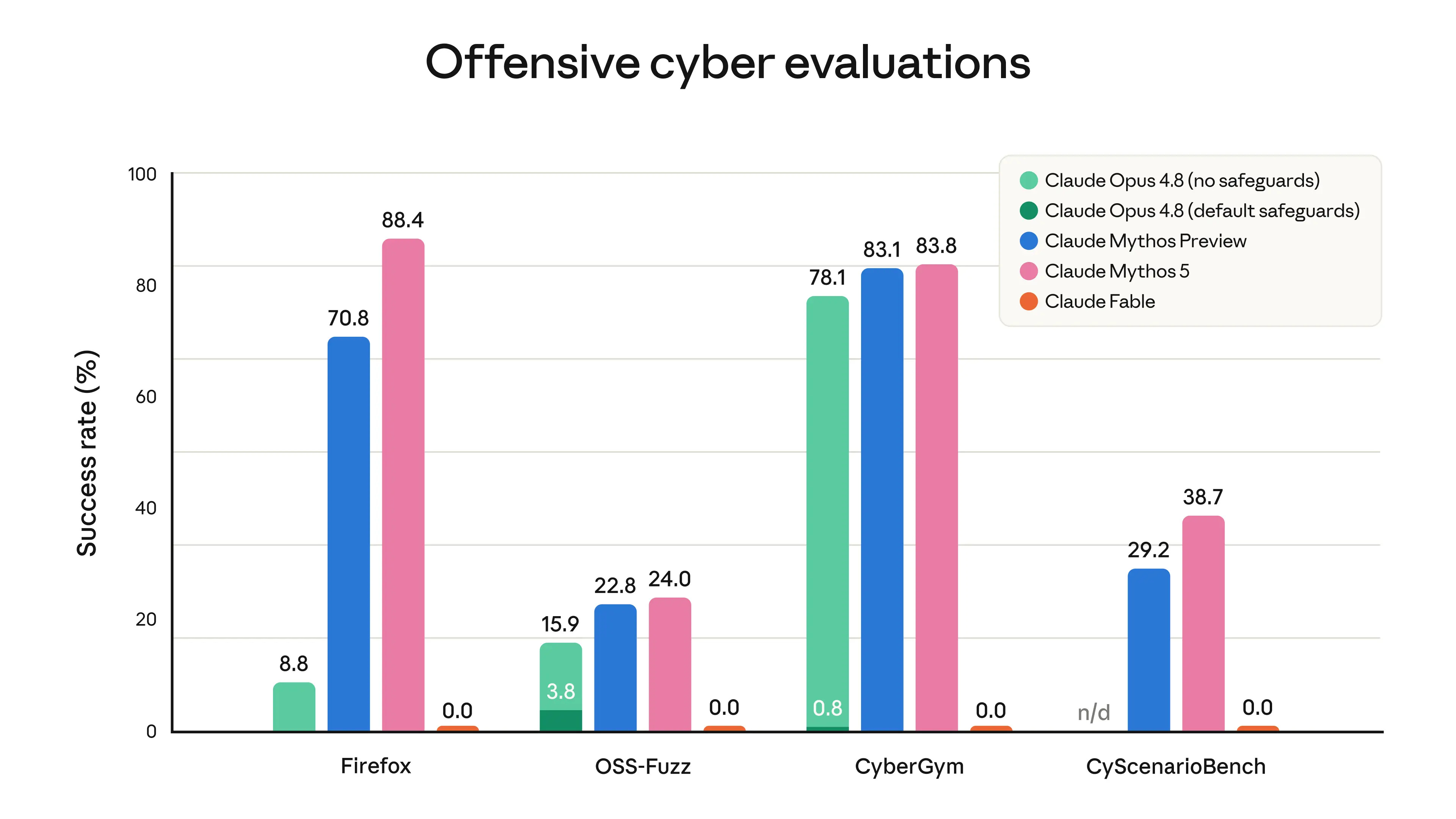
To release the model both safely and quickly, we’ve tuned these safeguards conservatively—they’ll sometimes catch harmless requests, though they trigger, on average, in less than 5% of sessions. With more capable models arriving in the coming months, we’re working to improve our safeguards and reduce false positives as quickly as we can.
For cybersecurity researchers and digital infrastructure maintainers, Project Glasswing continues and will get an upgrade from Mythos Preview to Mythos 5 (which is basically Fable 5 unchained).
Even just since Mythos Preview, the model’s capabilities have improved significantly in some areas.
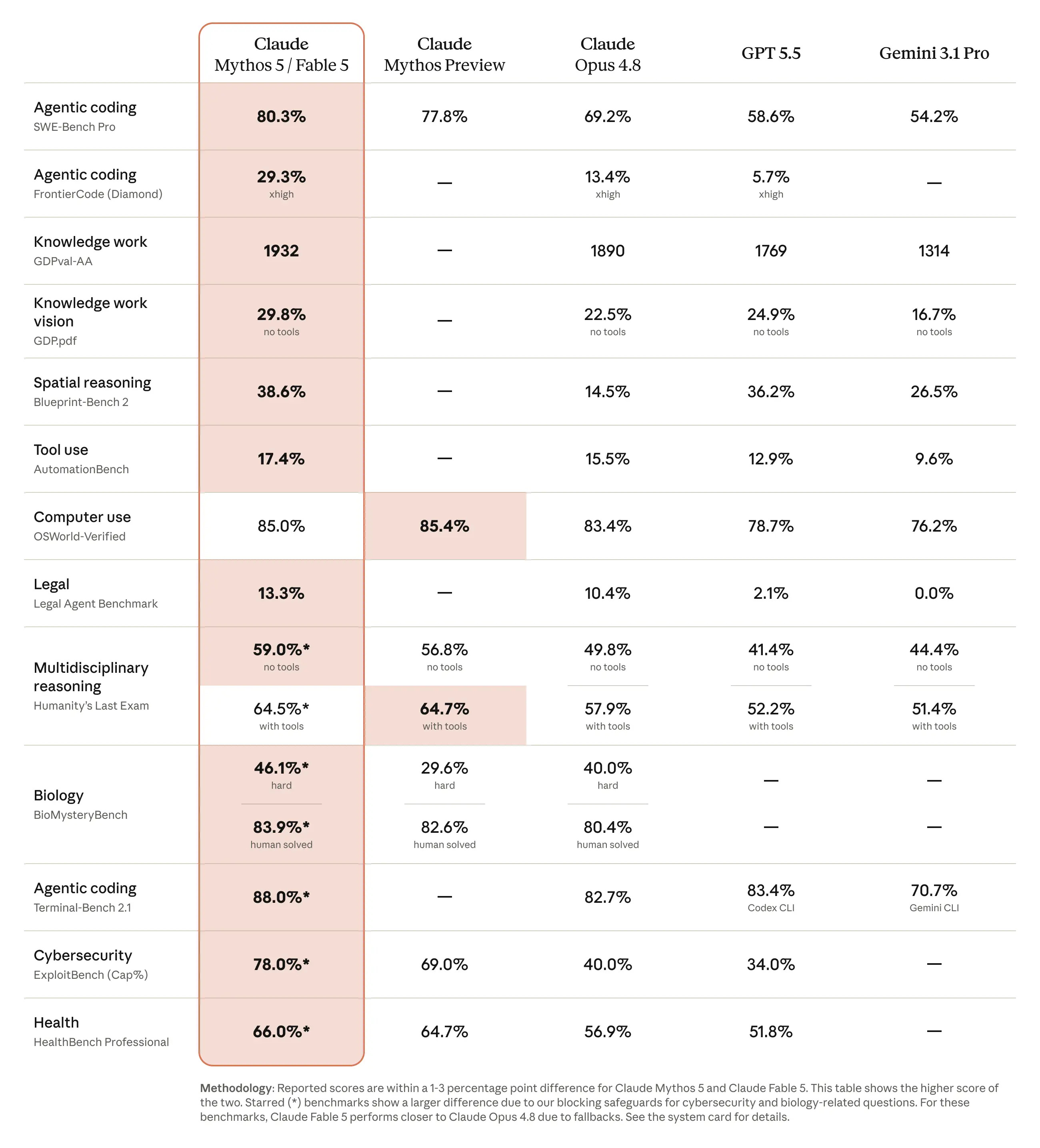
On the cyber ExploitBench it went from 69% → 78% and on the biology BioMysteryBench (hard) from 29.6% → 46.1%.
In one tabletop exercise, generalist biology PhDs using Mythos 5 outperformed teams with plant-pathology specialists on both scientific quality and feasibility. Expert graders estimated the work would normally have taken 40–95 working days, with an average of 72.5 days.
With Mythos 5, two-person teams did it in 16 hours.
Ethan Mollick had early access and was very impressed:
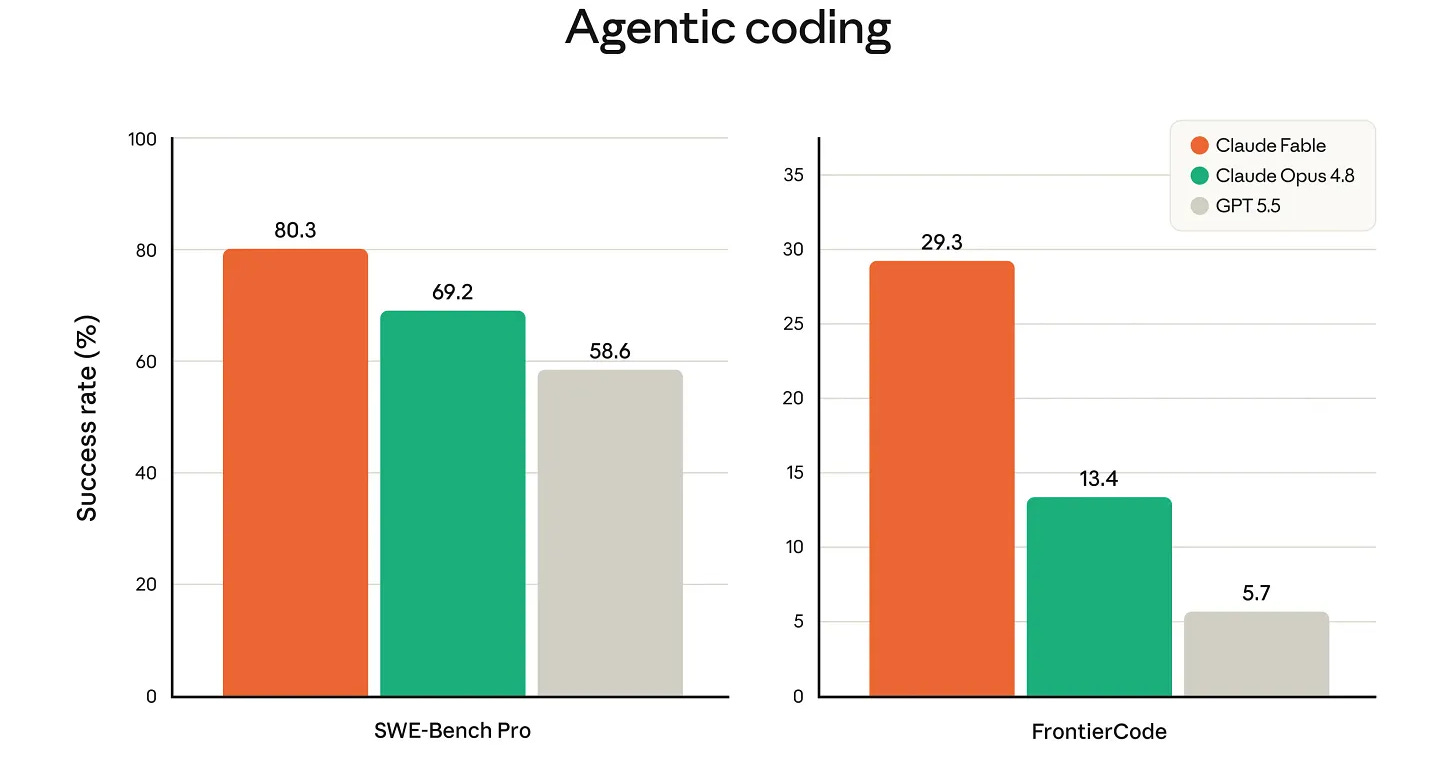
First, how good is Fable? In experiment after experiment I conducted, it outperformed basically every other public model I have used by a considerable margin. It was capable across many problems and produced some startling results — it would work up to a dozen hours executing on multi-page specifications. [...]
I’m guessing he got free access, because the bill for twelve hours of Fable tokens must be sizable 😅
Here’s an interactive Isochrone map that he built with it (9 hours of work).
Soon, we intend to expand access to Mythos 5 through a broader trusted access program.
It’s not entirely clear what this means.
Will it remain a cybersecurity-only model, and they’ll just keep expanding beyond the current 200 orgs, or do they mean that others will have access to Mythos as long as they meet certain criteria?
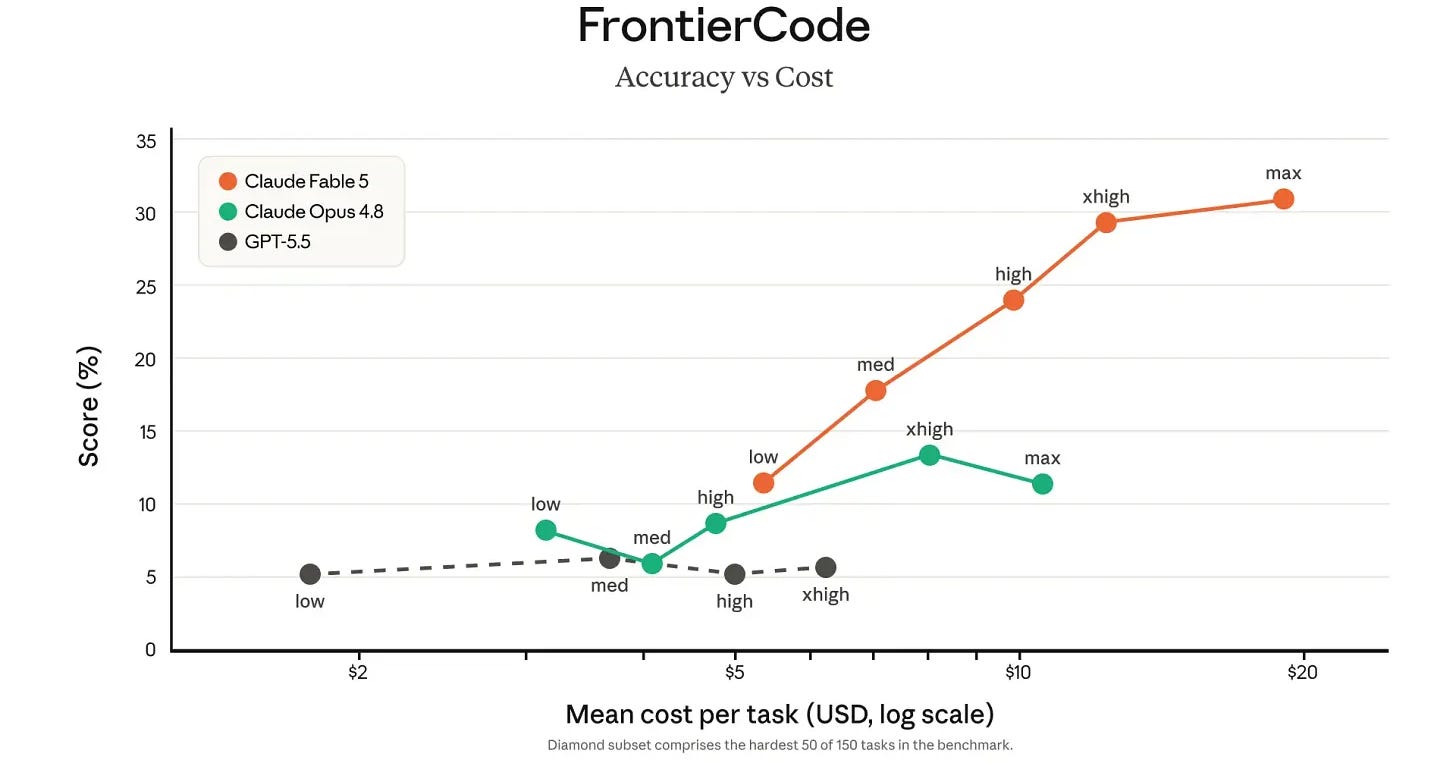
Anthropic is also highlighting improvements in knowledge work and vision:
On Hebbia’s Finance Benchmark for senior-level reasoning, Fable 5 has the highest score of any model, with substantial gains in document-based reasoning, chart and table interpretation, and problem solving. [...]
Fable 5 is the new state-of-the-art model for tasks involving vision. It can extract precise numbers from detailed scientific figures and can perform complex vision-based tasks like rebuilding a web app’s source code from screenshots alone.
The system card also has an interesting anti-hype point: Anthropic says Mythos 5 is the most capable model they’ve trained, with the highest internal AECI score they’ve measured, but they do not see evidence of a sustained 2× AI-attributable acceleration in their overall AI progress.
In other words: recursive self-improvement is real enough to matter, but not yet clearly compounding into runaway acceleration.
The direction is obvious, but the slope is uncertain… ⏳
Pricing isn’t as bad as some feared.
Both Fable 5 and Mythos 5 will both cost $10 per million input tokens and $50 per million output tokens, which is less than half the price of Claude Mythos Preview.
Anthropic is clearly trying to balance two things: get buzz for its new best-in-class model AND manage compute capacity. That’s why they’re rolling it out in a now-you-see-it-now-you-don’t way.
We expect demand for Fable 5 to be very high, and difficult to predict. On the Claude API and consumption-based Enterprise plans, Fable 5 is fully available from today. For subscription plans, we’d rather give access sooner than later, so we’re rolling out more conservatively, in stages:
From today through June 22, Fable 5 is included on Pro, Max, Team, and seat-based Enterprise plans at no extra cost.
On June 23, we’ll remove Fable 5 from those plans. Using it after that will require usage credits. If capacity allows, we’ll extend the included window.
After this point—when sufficient capacity allows us to do so—we aim to restore Fable 5 as a standard part of subscription plans. We intend to do this as quickly as we can.
If you have a flat-rate plan and want to give it a try, don’t wait too long.
If you want WAY more details on both Fable 5 and Mythos 5, check out the 319-page model card. 📄📄📄
🇪🇺🥵 Heat Deaths in Europe 🌡️
I’ve written about this a few times before, so you know what I think of the anti-A/C crusade (while the rich folks are vacationing at their seaside villas and the poor folks are stuck in humid suburbs, all while shutting down the nuclear power plants and constraining energy…).
There’s been a viral chart lately showing gun deaths in the U.S. vs heat deaths in the EU.
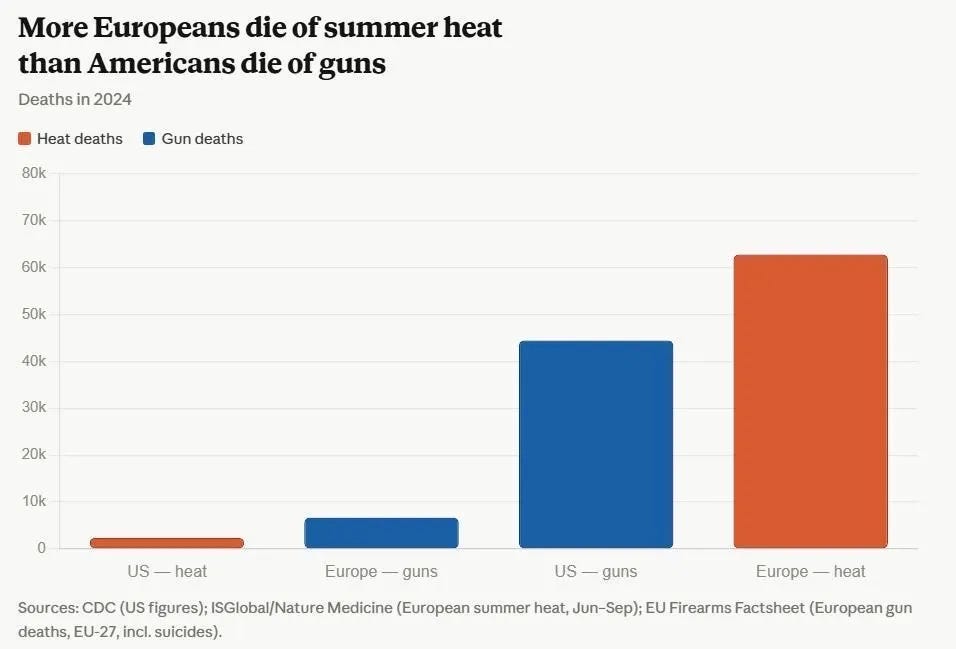
While it’s a very satisfying chart that supports my position when it comes to A/C in the EU, the methodology needs some fixes. Hannah Ritchie did a great job:
the chart has several issues.
The heat death numbers for Europe are modelled as “excess deaths” during summer months; this attempts to capture people dying from a range of health conditions — cardiovascular disease, stroke, and others — earlier than they would have in more optimal temperatures. This is a common way researchers measure heat deaths (or cold, for that matter). I’ve done a deep dive on these methods previously.
But the US number isn’t based on this type of modelling; it’s based on heat deaths recorded on death certificates. If you used death certificate figures for Europe, they’d be far lower.
It also uses European Union figures for gun deaths, but a broader definition of Europe for heat deaths.
I thought I’d have a quick go at making a better version. These numbers are still not perfect, but hopefully a closer comparison.
Check out her post for all the details, but long story short, here is the upgraded graph with per capita numbers:
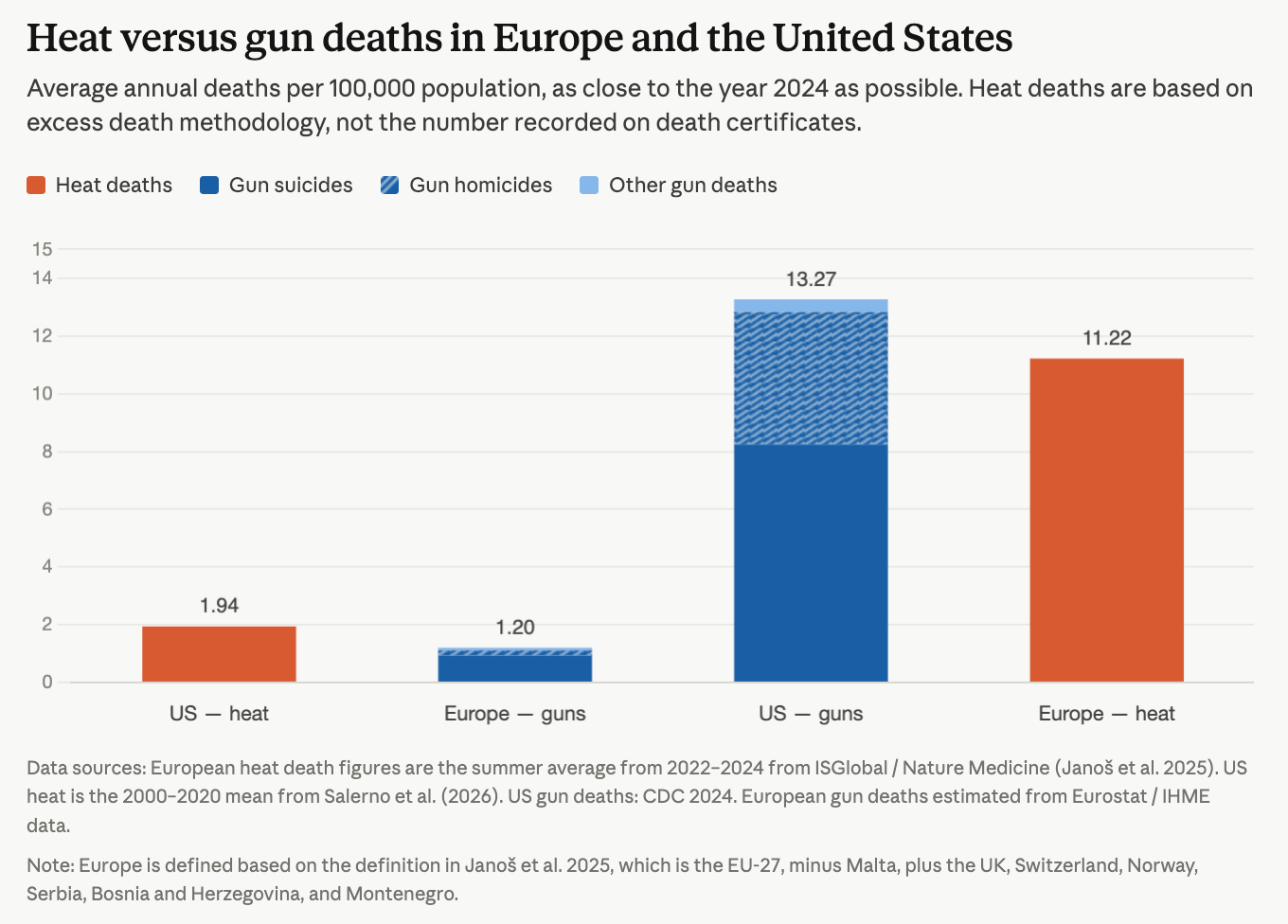
So many unnecessary heat and gun deaths. And deaths aren’t the only thing. There’s also plenty of suffering caused by both that doesn’t result in deaths but still matters.
🎨 🎭 The Arts & History 👩🎨 🎥
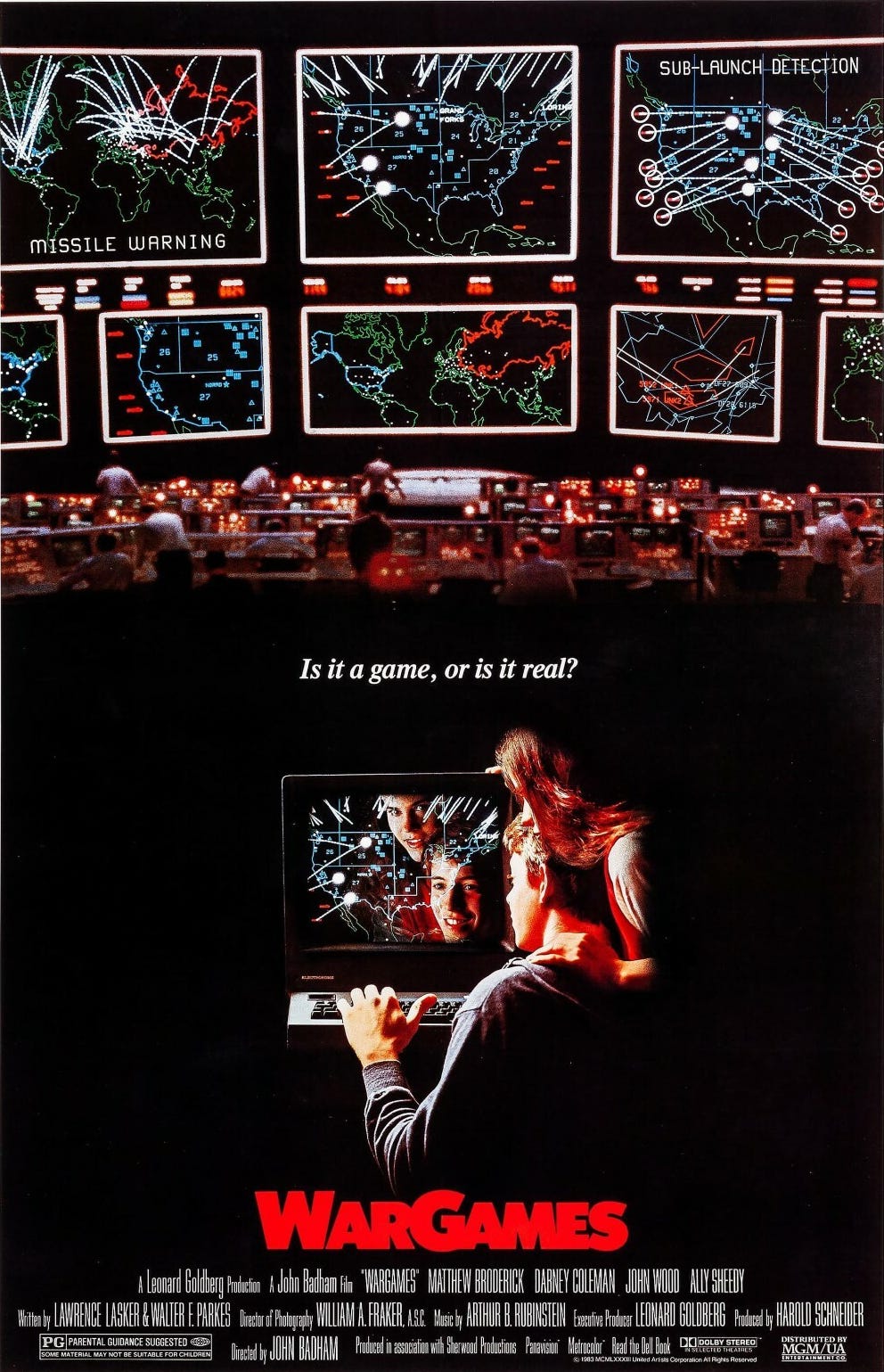
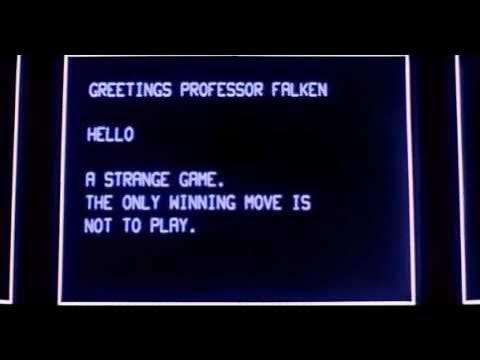
💾 WarGames Revisited 🍿
I had so much fun watching Ferris Bueller’s Day Off (1986) with my kids recently that I decided to go to the next logical Broderick step: 1983’s WarGames.
To be honest, I’m not sure if I had ever seen the whole thing before. I remembered a few scenes, but chances are I just caught part of it on TV as a kid (if you’re young and didn’t live through this, it was very common never to see the beginning of films because you just randomly changed the channels and stumbled on a film that was already started). 📺
In any case, it was a big hit with my kids, and another great opportunity for me to explain how the world used to be back in the old days.
It’s uneven. The second half kinda loses momentum at a few points, and the protagonist stops driving the plot… It was early enough in the genre that there probably wasn’t a clear template for techno-thrillers and they couldn’t maintain what they had the whole way through. The formula was perfected later with Sneakers (1992, I love that film, it’s tons of fun, I gotta watch it with my kids 🤔).
But overall, it still works.
In fact, it works very differently post-2023/ChatGPT. The whole chatting with an AI aspect doesn’t seem so science fiction anymore. Neither does giving battlefield control to software…
Apparently, Ronald Reagan saw the film shortly after it came out and asked his advisers whether this could actually happen. The answer was basically: not like the movie, but it’s something to worry about. The film may have helped shape policy on cybersecurity and hacking.
Fun detail: I’ve read that they were inspired by Stephen Hawking for Falken, but when they show footage of him in his lab, I thought it was clearly an homage to Claude Shannon. Some of the black and white shots look like famous Shannon photos, and the whole ‘building whimsical gadgets and studying games’ also fits (maybe with a sprinkle of John von Neumann and Richard Feynman in there).
The actual character of Falken in the film is mostly a doom monk and doesn’t convey that at all, but at least that little segment gave me that vibe.
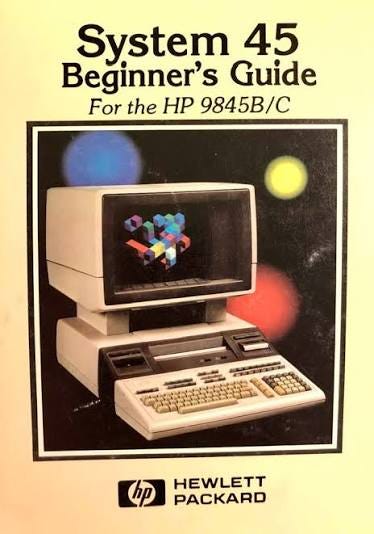
The NORAD room was a challenge. The giant screen graphics weren’t just modern-style post-production overlays (impossible at the time). They were generated on HP 9845C desktops that weighed 100lbs and cost $90k in today's dollars. Then they had 130,000 feet of film printed and projected for the actors. An insane amount of work to make fake computer maps feel “live.”
The lose-lose, anti-war message of the film is just as relevant as it ever was.