


Authentic happiness derives from raising the bar for yourself, not rating yourself against others.
–Martin Seligman

🧰🪛 I want to tell you about my new screwdriver.
If you’re a real handyman-type person, this will seem very basic, but if you’re like me, someone who has never been inclined toward manual labor but has slowly been learning to be more of a Dad™ over time, you may appreciate this one.
A bit of context first: When I moved in with my then-GF-now-wife into a shitty 500sq-ft apartment with paper-thin walls in the Vanier neighborhood of Ottawa back in 2009 (where centipedes came out at night and the SWAT team busted our neighbor), I didn’t have much. We needed to fix and assemble stuff around the apartment, so I got the cheapest little IKEA plastic toolbox and set of screwdrivers, and I’ve kind of been using these ever since.
When it comes to things like computers or music or kitchen stuff, I care about good tools, but when it comes to actual tools, they’ve remained in my blind spot for a long time. I suspect we all have categories where we've tolerated garbage tools for years without noticing 🤔 (what’s your blind spot?)
Well, I’ve seen the light thanks to this screwdriver!
I don’t remember what the final straw was, but I decided I wanted a decent set of screwdrivers and did some research. I landed on this 15-in-1 Klein, and man does it feel nice.
The rubberized handle feels great and is non-slip. The various bits fit snugly and won’t ever fall out by accident. The metal is machined precisely and seems very durable. The ratchet clicks satisfyingly, and the bit-storage compartment has this latching mechanism that is just perfect.
So many things around us are mediocre. It’s easy to forget how satisfying quality craftsmanship and design can be.
It makes me realize how shitty what I’ve been using was.
If you also have a bunch of random hand-me-down screwdrivers, do yourself a favor and get one. It’s just $25 (less on sale), and the quality-of-life improvement will be worth multiples of that.
The ROI is great on the reduced brain damage of having to deal with bad tools. 🤬
🔎📫💚 🥃 If you want Liberty’s Highlights to continue, this is the moment. Become a paid supporter.
Without your support, this steamboat sinks 🌊🚢⚓
🏦 💰 Liberty Capital 💳 💴

⚙️🔧 Back to the Era of Optimization 👨🔧 (From Your iPhone to the Datacenter)
I grew up as a computer nerd in the era of optimization. Computers were so slow and resources so limited (memory, disk space, bandwidth, etc) that only the cleverest wizard engineers could do the most interesting things.
My nerd heroes were people like John Carmack, squeezing incredible 3D game engines out of CPUs running less than 100MHz and RAM that was measured in megabytes (and before him, a previous generation of heroes was dealing with single-digit MHz and RAM counted in kilobytes.. I’m looking at you, Woz!)
Today, the Slack app takes more RAM and disk space than entire operating systems from that long ago. Many popular desktop apps are built on the Electron framework, which bundles the whole Chrome engine with each app to make it easier to develop and port across platforms, trading the user’s resources for developer convenience.
But now that we’re back to having serious computing resource constraints (of a different kind, but very real), I think we may enter a new era of optimization.
- Apple WWDC optimizations
The fruit company just had its developer conference, and while all the headlines went to AI features and a newly rebuilt Siri that should actually not suck this time, and some attention also went to new parental controls, the part that excited me most was the Snow Leopard-flavored improvements.

OS X Snow Leopard shipped in 2009, back when software came in boxes, and you paid for upgrades to new OS versions.
It was notable because Apple marketed it as a “no new features” release that focused on polish, optimization, and fixing bugs. The reality wasn’t quite that neat, and it had new features, but it became almost legendary because it made so many everyday things better and faster.
This year’s WWDC is a bit similar, with iOS 27 and MacOS 27 getting a deep polish pass rather than a focus on big visible features (other than AI and parental controls).
Some of what they announced to squeeze more performance out of their hardware:
New CPU scheduler that better prioritizes jobs and ensures the right work executes on time.
Improved Wi-Fi ↔ cellular handoff for smoother transitions when leaving Wi-Fi range.
Rebuilt search index. A unified engine now powers Spotlight, Mail, and Photos. New files/photos get indexed almost immediately rather than with a delay. Search may actually work, and this is one of the foundations of the new Siri.
Photos appearing in the camera roll after shooting up to 70% faster.
AirDrop transfers are up to 80% faster.
Files app transfers: up to 50% faster.
App launches up to 30% faster.
Faster network file browsing (including SMB).
WebKit / Safari 27 will include 500+ browser-engine improvements and fixes.
Smoother animations and scrolling in multiple places.
All this stuff makes even older iPhones feel snappier, which is nice. 📱
- AI Memory Optimizations are Coming
In his interview of Ben Bajarin, Ben Thompson (💚 🥃 🎩) said:
look at the memory players, they didn’t build capacity for several years, and now whatever they build is going to take a while to come online, and in the meantime they’ve created astronomical incentives for — you know who’s never worried about memory? The entire technology industry. Do you know what that means? If they’ve never actually optimized for memory in 40 years, do you know how much low-hanging fruit there probably is to optimize for memory, which is going to ultimately be to the detriment of the memory providers?
When you’re spending billions trillions in capex on infrastructure, the returns to optimization are very large. This is one of the very few domains where a 1% performance improvement can be worth more than a billion dollars.
That’s why it’s so powerful when Nvidia optimizes CUDA and extracts more performance from existing hardware. It improves the ROI of its customers, but it also makes it harder for competitors to keep up with both the hardware AND the software cadence.
This UncoverAlpha piece goes into some of the potential memory efficiency techniques that we’re likely to see a lot more of. While it may not be enough to compensate for the explosion in demand from agentic AI, it could certainly slow the growth and keep memory demand more reasonable than it would be without the recent spike in memory costs/gigabyte.
🚀 How Much of SpaceX Does Gwynne Shotwell Own? 🤔
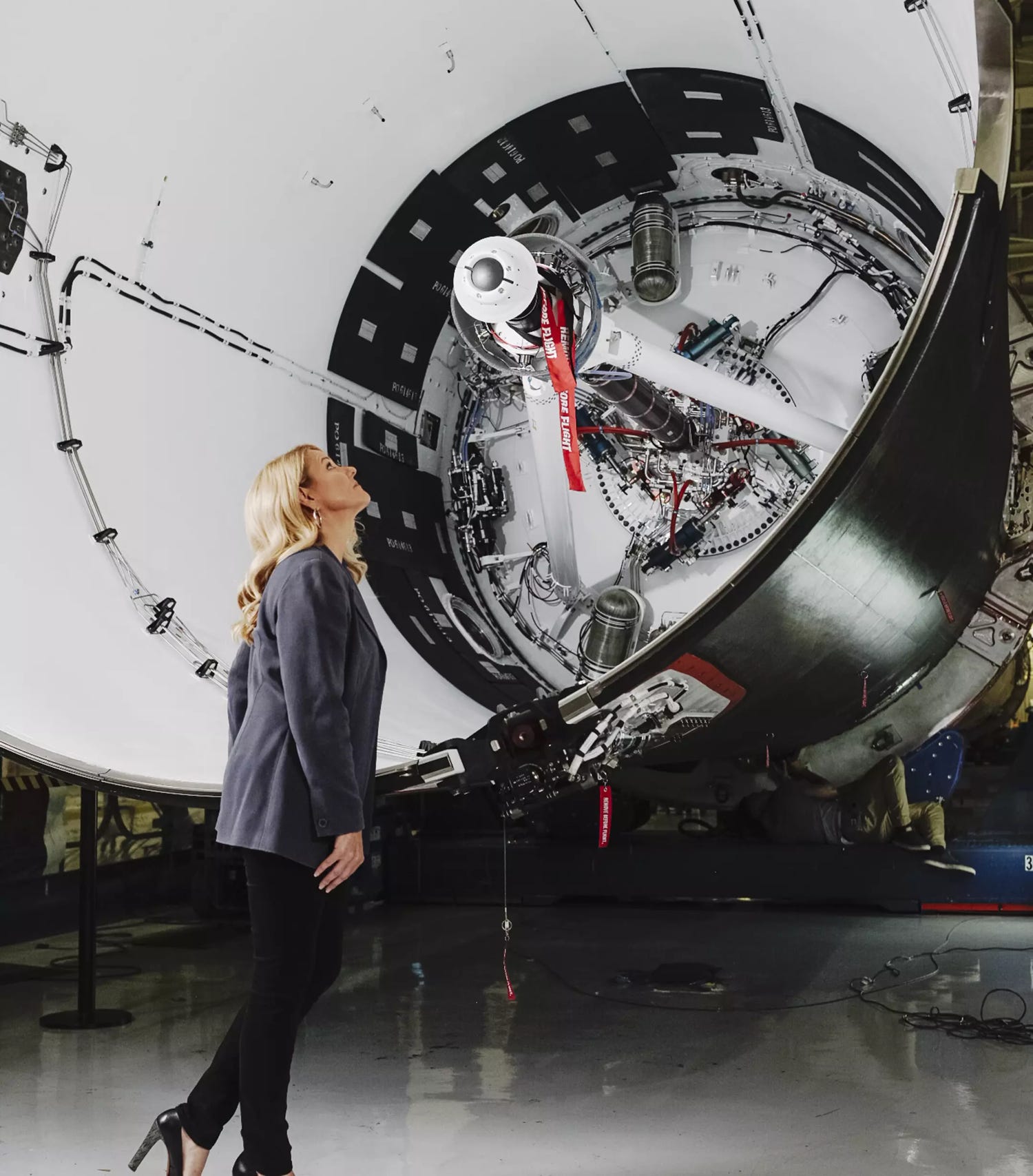
Now that SpaceX is public and going up 20%/day, I wondered how big Shotwell’s stake was.
Before looking it up, my thinking was:
She joined in 2002 (the company was founded in March, she joined in September as employee #11).
She became company president in 2008 after negotiating the ISS resupply deal with NASA.
Ever since, it seems like any profile or book about SpaceX mentions how key she has been to the success of the company, basically being the adult supervision that keeps the trains running on time while Musk mostly focuses on the tech. She executes on the vision, deals with customers, regulators, operations, etc.
She is also widely seen as the “Musk risk” mitigator, which is pretty important since a huge chunk of SpaceX’s business has been with the government.
At the time that I’m writing this, SpaceX’s market cap is 2.8 trillion (213/share). But it’s volatile enough that by the time you’re reading this, it could be up or down 15%…
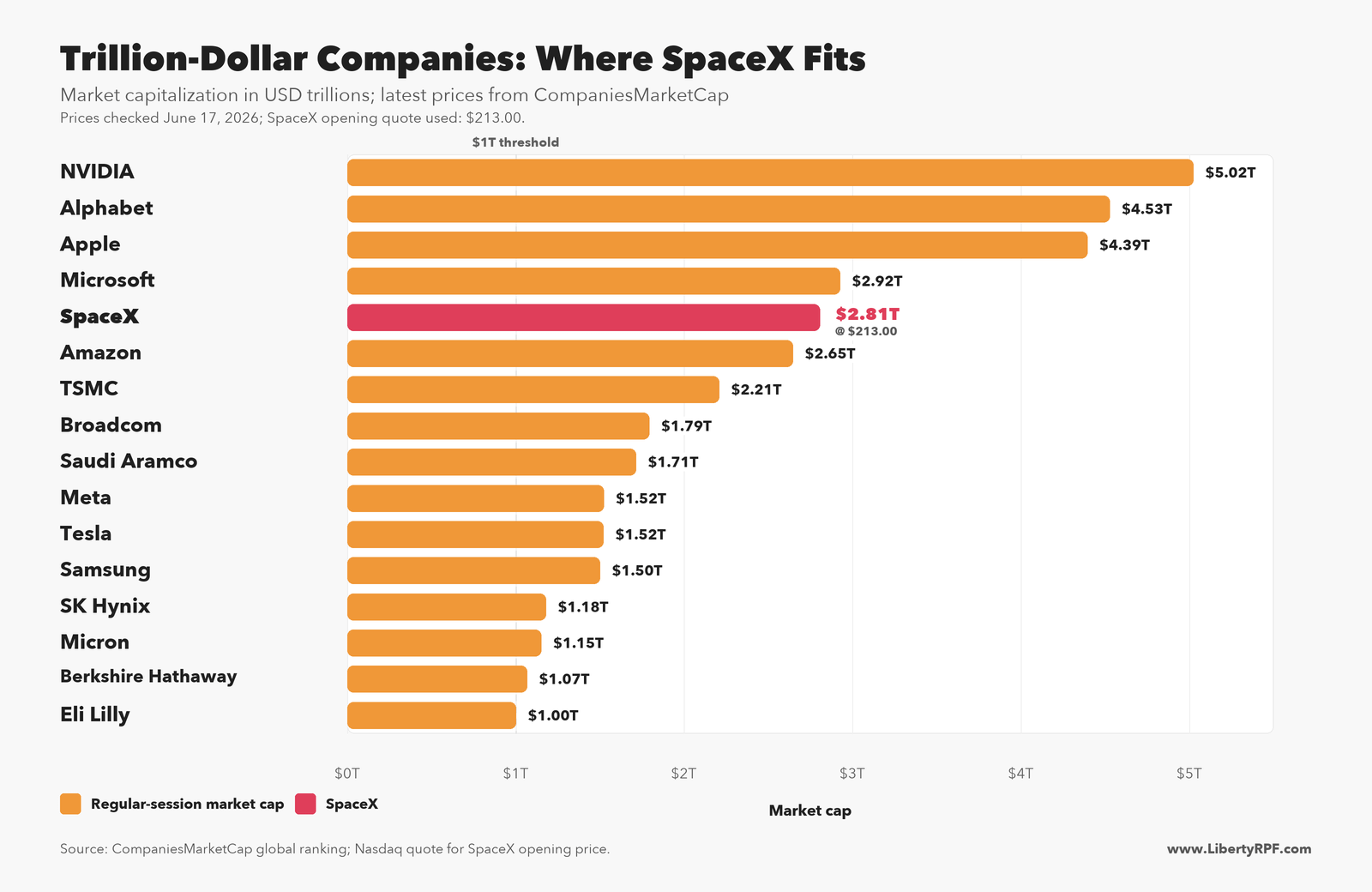
That makes it bigger than Amazon, TSMC, and Meta (and Tesla 😅). Intra-day, it was even bigger than Microsoft at one point 🫡
Elon Musk’s Monday wealth pop was bigger than Warren Buffett’s entire net worth:

It is reported that countless SpaceX employees are now deca and centimillionaires.
So what about Shotwell? My initial guess would be that as such an early employee who rapidly became such a key figure in the company, she probably could have amassed low-single-digit percents of the equity. Maybe 1-3%. Just guessing.
Looking at the filings, the reality is that she owns about 0.098%. (5,759,610 Class A shares, 7,113,550 Class B shares).
That’s still worth $2.75bn at 213/share, which is a crapload of money by any standard.
BUT
I can’t help but feel a little disappointed for Gwynne. She appears to have been instrumental in the company's success and in creating a lot of its value… and she gets a tenth of one percent?
Even the CFO, Bret Johnsen, has ~9.58m shares worth ~$2.04bn at $213/share, or ~0.073% of the equity. He joined SpaceX in 2011, nine years after Gwynne. By then, Falcon 9 had successfully gone to orbit, the Dragon capsule had been tested in orbit and returned, and they had a $1.6bn fixed-price CRS contract for 12 ISS resupply missions with NASA.
Not exactly the same risk profile, and a lot of the eating-glass-and-staring-into-the-abyss phase was done.
Shotwell’s reputation as a negotiator and dealmaker is great, often described as “one of the best in the industry.” As far as I can tell, she may be one of the most important non-founder operators in the modern industrial space, certainly in aerospace.
This makes me wonder why she couldn’t do better than 0.1% 🤔
I mean, it’s hard to feel too bad for someone who made a couple of billion as an employee, but non-founder key people who help build a company from the ground up over decades sometimes end up amassing a lot more equity than that.
🤝 SpaceX Goes for It, Acquires Cursor for $60bn in Stock (What Else is on the Shopping List?) 🛒
I mean, if you have equity trading at that multiple, go for it.
The $60bn in Class A stock that they are paying Cursor with is just 3.4% dilution at IPO price (and may be lower than that at closing, when the amount of stock is determined over a 7-day period. Good timing for SpaceX, closing is before the biggest lockups expire).
Why not buy everything that isn’t nailed down by paying for it with stock or raising cash in the equity market? 💰
That’s probably what I would do if I was Musk. I’d try to lure away AI talent and buy whatever I can get away with (and regulators probably won’t push back, because, well, you know). Turn the richly-valued paper into real assets and scarce advantages.
Why not try to acquire Intel too while at it?
Heck, they could buy Boeing with couch cushion change at this point, but I’m not sure they’d want to. Why not make a run at Anduril and lean further into the defense side? Or maybe Impulse Space as a tuck-in? Or snatch Jim Keller’s Tenstorrent before Qualcomm gets it? Why not add Perplexity to the shopping cart too, I’m sure there’s a lot of talent and usage data there ¯\_(ツ)_/¯
🗣️ Dan Shipper: How Bring Your Own Tokens (BYOT) Might Save SaaS 🤖💾
I found this interview of Dan Shipper by Lenny Rachitsky via my friend MBI (🇧🇩🇺🇸). He highlights a very interesting part of the interview, which I encourage you to check out.
I’ll go with a different idea from the conversation (but there are many other interesting ideas, I recommend listening to the whole thing. Even if you ultimately disagree with some of the claims, I think they’re great starting points to think things through).
The doom case for SaaS goes something like: AI agents eat the interface, software margins get crushed under token costs as everyone bolts an AI assistant onto their product, and a thousand wrappers get commoditized to zero. Shipper thinks that's backwards. His argument flips on one small detail: whose tokens get spent?
Lenny Rachitsky: What I’m hearing is instead of AI being baked into SaaS tools, what you’re predicting here is the SaaS tools will run within Codex or Claude Code?
Dan Shipper: I’m using Proof or really any website, maybe PostHog or whatever, and I’m doing it inside of my agent and the agent has access to the website.
So, it has access to everything that I have access to, and it has access to my whole computer. When I run the agent on that website, I’m using my tokens. I’m not using the vendor’s tokens, I’m not using the app’s tokens.
And so, it puts SaaS back in this place where yeah, you want to make it friendly for an agent and everyone’s got a CLI now, you want to make the HTML really usable. You want to make sure that anything that happens in the CLI shows up for the user immediately, all that kind of stuff.
There are a lot of issues to deal with. But once you do that, you actually don’t really need to think about having an AI surface that’s primarily going to be the thing that users use in the sense that you don’t need to build an agent necessarily into your product.
[…] with Proof, for example, anyone who uses it, I don’t pay for tokens because they bring their AI to Proof.
And so, it changes what you build as a SaaS company and you build it now for both humans and agents to use at the same time, and it changes your margins back to, well, I don’t really have to pay for tokens anymore because the user’s going to bring AI.
That creates a bull case for SaaS apps:
Dan Shipper I think it actually may save their margins, because right now all these companies are rushing to add a agent to their offering and thinking, “Oh, the agent is going to be the main way that people interact with me.” And that cost tokens, obviously.
And I actually think once I have Codex or Cowork as my main work surface, I still want to use SaaS. So, this is another prediction. I would buy SaaS stocks right now. I think the SaaS apocalypse is dumb, and SaaS stocks will be up majorly in the next couple years.
Not investment advice, but I would buy SaaS stocks.
So, I think it saves your margin because now the way that you’re thinking then is not I have to build AI into this, it’s more like I have to make a piece of software that humans and AI want to collaborate on together.
And that’s hard, but once you build it, it’s a lot cheaper than assuming everyone’s spending tokens, and I think it’s a good business.
And part of the reason I’m so bullish on SaaS is A, everybody internally here is, like I said, we have all got agents and we’re all using Codex and whatever, and we still pay for a ton of SaaS and our SaaS spend is up year over year, and we’re not vibe coding every single little thing.
And I think that what agents do is increase the number of users of SaaS, not get rid of it. And so, I think SaaS companies are going to see an insane spike in the amount of demand that they have, because there’s going to be tons of agents using these products at a very high volume.
And like I said, that’s a huge infrastructure challenge. There’s a lot of interesting pricing challenges, but it makes me very bullish on SaaS.
There are two flips going on here.
The first is about cost. If my agent is the one actually operating your app, clicking around on my behalf, the inference runs on my account, not the app’s. They’re back to selling close-to-zero-marginal-cost software instead of reselling tokens at a loss.

The second flip is about demand. Every human now shows up with an agent or three, and agents use software at a volume no human can match, even if you were really good at Track & Field. And agents don’t sleep, they don’t get bored, they don’t get sidetracked on YouTube.
So SaaScos don’t get fewer users. They get a swarm. 🐝🐝🐝🐝
BUT
A swarm of agents using the product at superhuman volume can be scary and forces a rethink.
Just ask GitHub how fun agent traffic is for them. It also breaks the meter most SaaS is sold by: the seat. 🪑
Per-seat pricing assumes a human in the seat, with human patterns and limitations. When your user is a robot, you probably need to change how you charge. Probably a mix of seats + usage + outcomes in different ratios depending on the industry.
Nobody's quite figured it out yet, but I suspect that's where a lot of the value gets won or lost.
🧪🔬 Liberty Labs 🧬 🔭
💸 How Subsidized Are Tokens? 🤔
It’s widely known that flat-rate subscriptions to Claude and ChatGPT offer cheaper tokens than the pay-as-you-go API, at least if you use a lot of tokens (utilization matters! If you pay for a plan and barely use the service, your cost per token could be extremely high).
SemiAnalysis tried to quantify this:
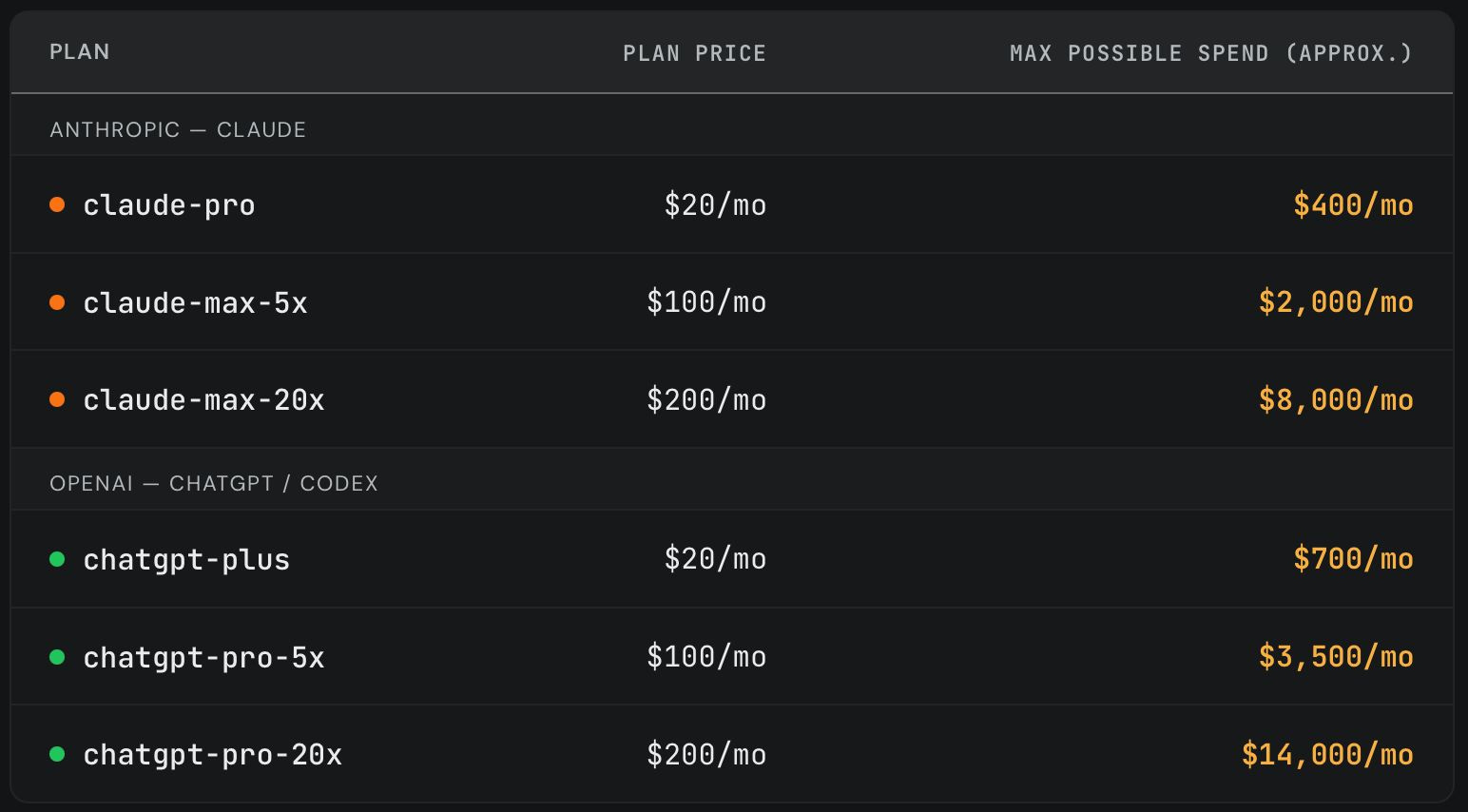
Recently, we purchased one of each Anthropic/OpenAI subscription plan and randomly ran long horizon coding tasks until we exhausted the weekly limit. It's widely believed that a $200/month plan maxes out at ~$2000/month worth of tokens (assuming API pricing). However, we found that the subscriptions are actually far more generous.
See the image above for those numbers 👆
On max usage, SemiAnalysis found a $200 plan can burn ~$14k of tokens at ChatGPT and ~$8k at Claude. A 40–70x subsidy. To be clear, these are API-equivalent prices, not the true underlying compute costs to the labs.
The margin on a subscription plan is a function of the average utilization. If we assume both companies have 75% API gross margins, this results in the following subscription margins.
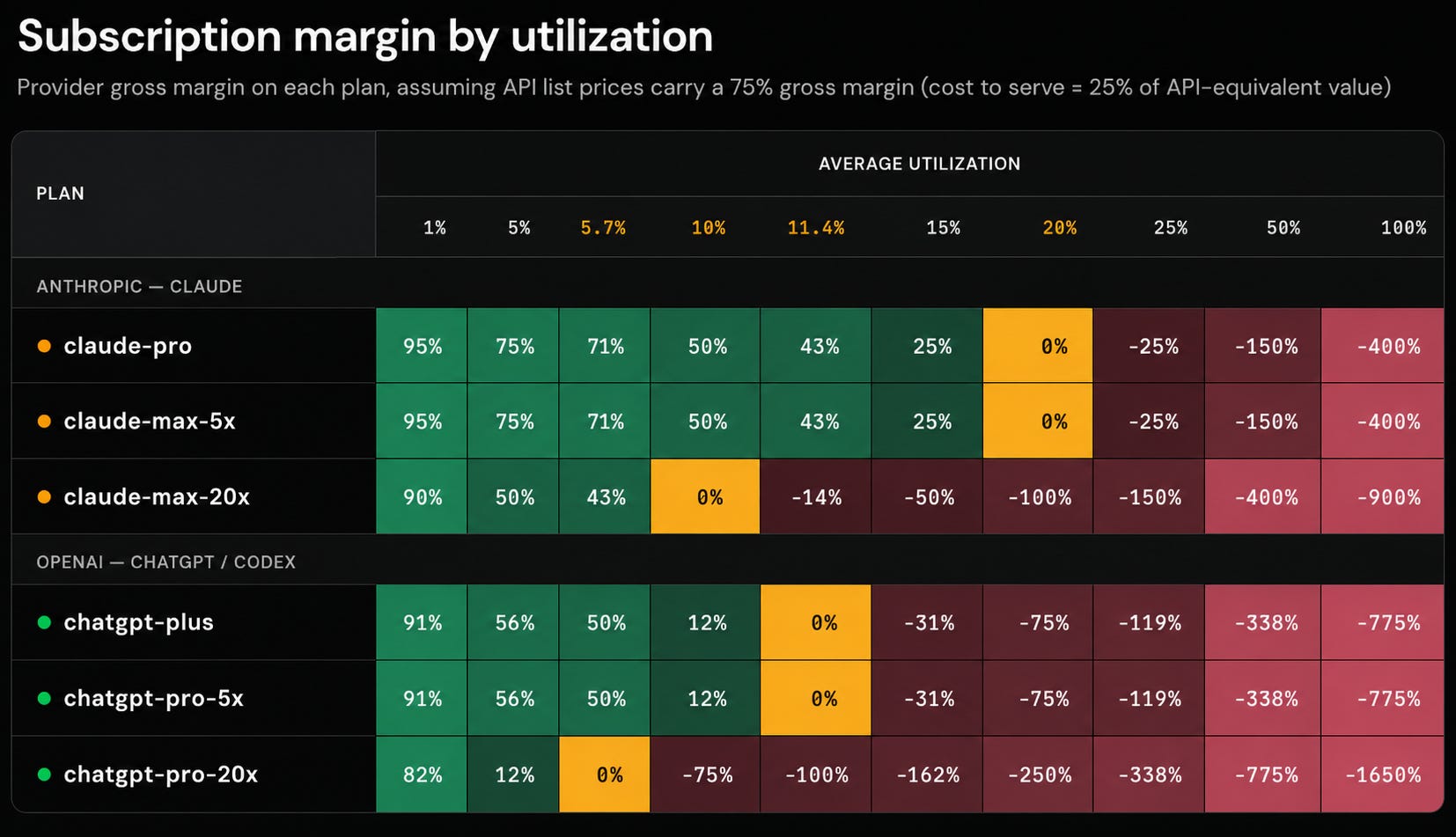
That's the gym-membership model.
The thing is, because we can’t know how many whales there are and how many paying users don’t get anywhere near their weekly usage limit, it’s hard to know what the economics are for the labs.
I suspect that the $200/month tiers attract a lot of whales, because anyone who isn’t a tokenmaxxer wouldn’t even consider such a plan.
Obviously this is way worse than API overall. However, explicitly nerfing subscriptions leads to huge public backlash, and the rapidly falling cost of intelligence means you'll be able to profitably serve Opus 4.8 level models for $20/month in the near future. We therefore think it's far more likely the labs will withhold new features/models from subscription plans. It will be interesting to see if Mythos ends up being API only.
There’s an interesting equilibrium here, where as long as OpenAI keeps subsidizing tokens this way, it’s hard for Anthropic to stop, and vice-versa. Not quite mutually-assured destruction, but as long as they don’t collude to both reduce subsidies at the same time, I suspect they will continue for a bit longer (though as I wrote, the all-you-can-eat buffet era of AI is slowly ending).
The thing that has the most chance of ending these subsidies is for one of the AI labs to get far enough ahead of the other that it can become less generous, and users won’t switch because they need this better/differentiated AI.
☀️💨 Solar + Wind > Natural Gas
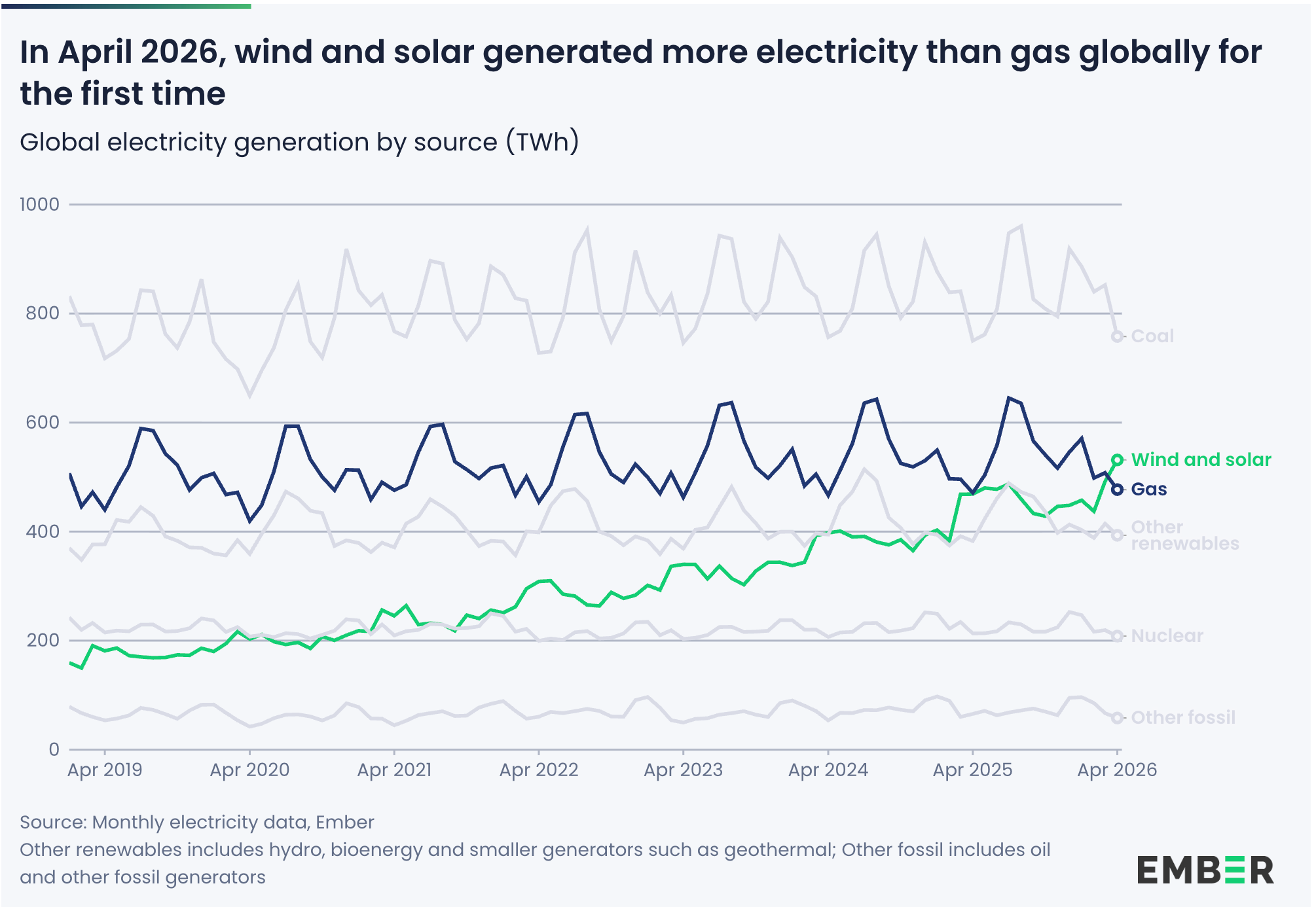
Wind and solar generated more electricity than gas globally for the first month ever in April 2026, according to data analysed by global energy think tank Ember. Together, wind and solar generated 22% of global electricity in April 2026, compared with 20% from gas. [...]
Wind and solar produced a record 531 TWh of electricity in April 2026, 54 TWh more than gas generation at 477 TWh. Five years ago, in April 2021, gas generation stood at a similar level (476 TWh), but was nearly double the combined generation from wind and solar (245 TWh).
Of course, not all kWhs are created equal. It’s better to have a dispatchable source than an intermittent one, but credit where credit is due, wind and solar have come a long way and are now coming for coal’s crown. 👑
In absolute numbers, China leads, but in relative numbers, the UK, Chile, and Australia are doing great:
Globally, output is estimated to have grown 13% year-on-year, with gains across major markets including China (+14%), EU (+13%), the UK (+35%), the US (+8%), Australia (+17%), Chile (+24%) and Brazil (+4%).
Now if only we were in the alternate timeline where we didn’t stop building nuclear decades ago and the top line wasn’t coal… Oh well, you have to work with the reality as it exists and not as you wish it did.
🐕 OpenAI the Underdog: Rate Limit Resets and Lower Prices (Maybe)
I got this in my Codex:
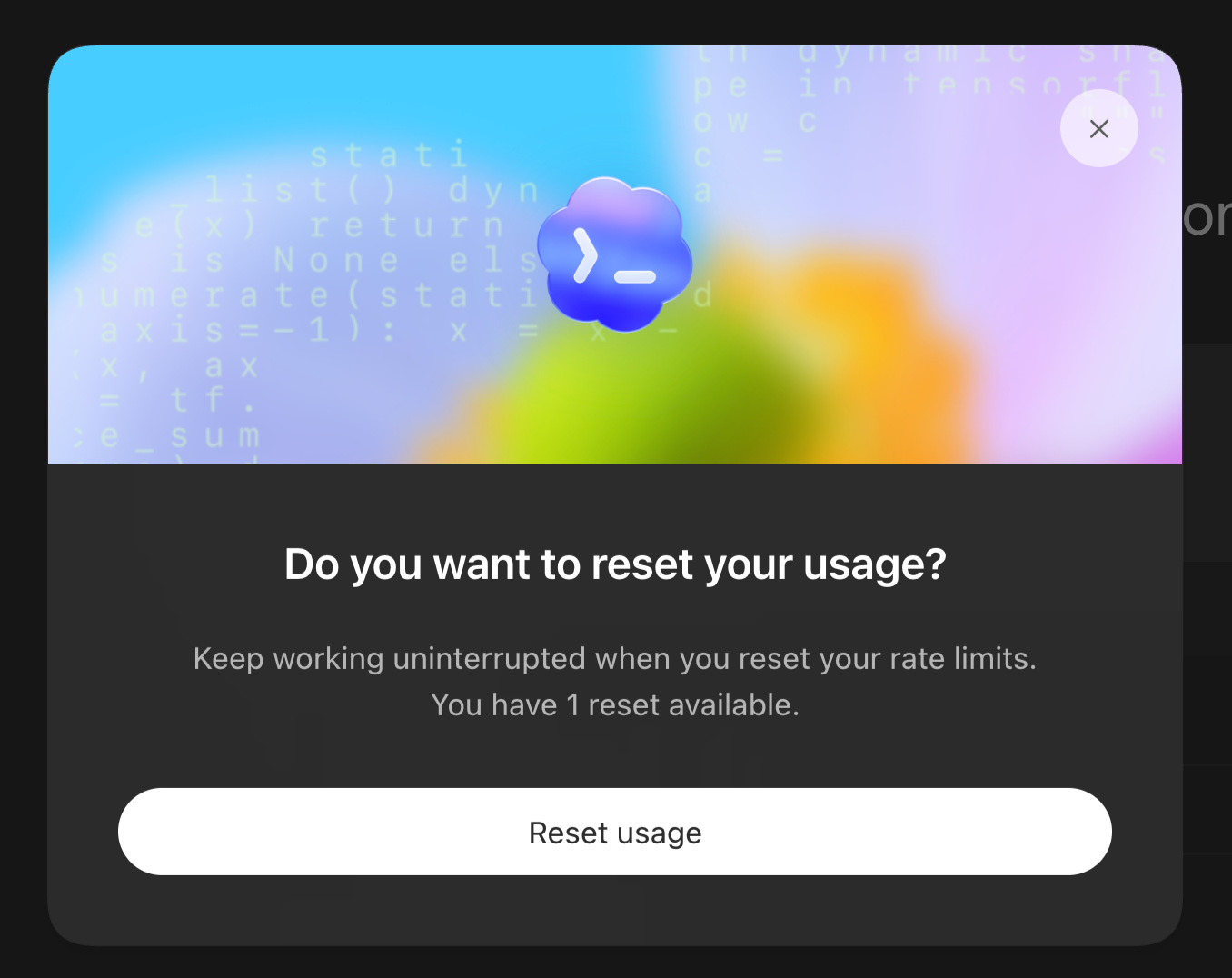
It’s a clever UX mechanic, because there must be so many users who are constantly frustrated by time-based session usage limits (which have historically been a lot tighter on Claude, though they’ve improved that since their xAI-Colossus GPU deal).
Sometimes you just want to work NOW while in the flow, but don’t want to go into pay-as-you-go token mode (where tokens are a lot more expensive than the flat-rate ones, see above for more details on that).
Having the ability to trigger a reset is very user-friendly, and I hope it’ll be copied by Anthropic.
Not only that, but they’re also using old-school PayPal/Dropbox viral marketing tactics with it:

Another old-school tactic that OpenAI may pull to compete with Anthropic: Price cuts.
The WSJ reports:
[OpenAI] is weighing significant cuts to what it charges for tokens, the unit of measurement artificial-intelligence firms use to bill for their products, according to people familiar with the matter. The move would be in anticipation of similar cuts the company expects at Anthropic, the people said.
They probably wouldn’t get into a price war right before IPO if they could avoid it, but clearly they have lost some momentum (they used to report revenue and user milestones like clockwork, and I haven’t seen much lately, even before they entered the IPO quiet period after filing in early June).
🎨 🎭 Liberty Studio 👩🎨 🎥
🥁 Dave Grohl on Nirvana and Foo Fighters: Band Life, Losing Friends, Rebuilding 🎤🎸
This documentary, cobbled together from dozens of interviews given by Grohl over the years, is worth watching if you have any interest in those bands and in the people behind the ‘rock stars’ created by the media.
And if you like this and want more Grohl, you may also want to check out the documentary he directed about the legendary studio Sound City. I really enjoyed it and learned a lot.
“Grohl was inspired to create the documentary after he purchased several items from the studio, including the Neve 8028 analog mixing console, when it stopped operating as a commercial studio in 2011.”
That Neve console is so cool! And note that Sound City went back into operations in 2017, relaunched by Sandy Skeeter, the daughter of co-founder Tom Skeeter, and producer/music executive Olivier Chastan.
The whole thing is available for free, so here you go:
The part where you see Rage Against the Machine record their first album live in the studio is pretty epic, and so many artists appear, including Paul McCartney.
seems there is a huge spectral dispersion of SaaSco types; some agents will hammer, and others where billions of transactions are rather insignificant for days\weeks (noise or slow trends).