


The envious man thinks that if his neighbor breaks a leg, he will be able to walk better himself.
—Popular saying quoted by Helmut Schoeck

✨🌌🔭 The pattern of the stars as seen from our planet is like a fingerprint.
It’s unique to a position in space and a moment in time.
I just think that’s cool.
🍝 I had never really thought that much about pasta until I heard a podcast series about a guy who decided to create his own pasta shape because he thought he could do better than the existing ones. I wrote about it here, if you’re curious.
I decided I should experiment a bit with different shapes and brands to see if maybe I could find new favorites. It’s a one-time exploration that can lead to years of better food, so it seemed like a pretty good trade! (The same idea applies more widely to getting better at cooking.)
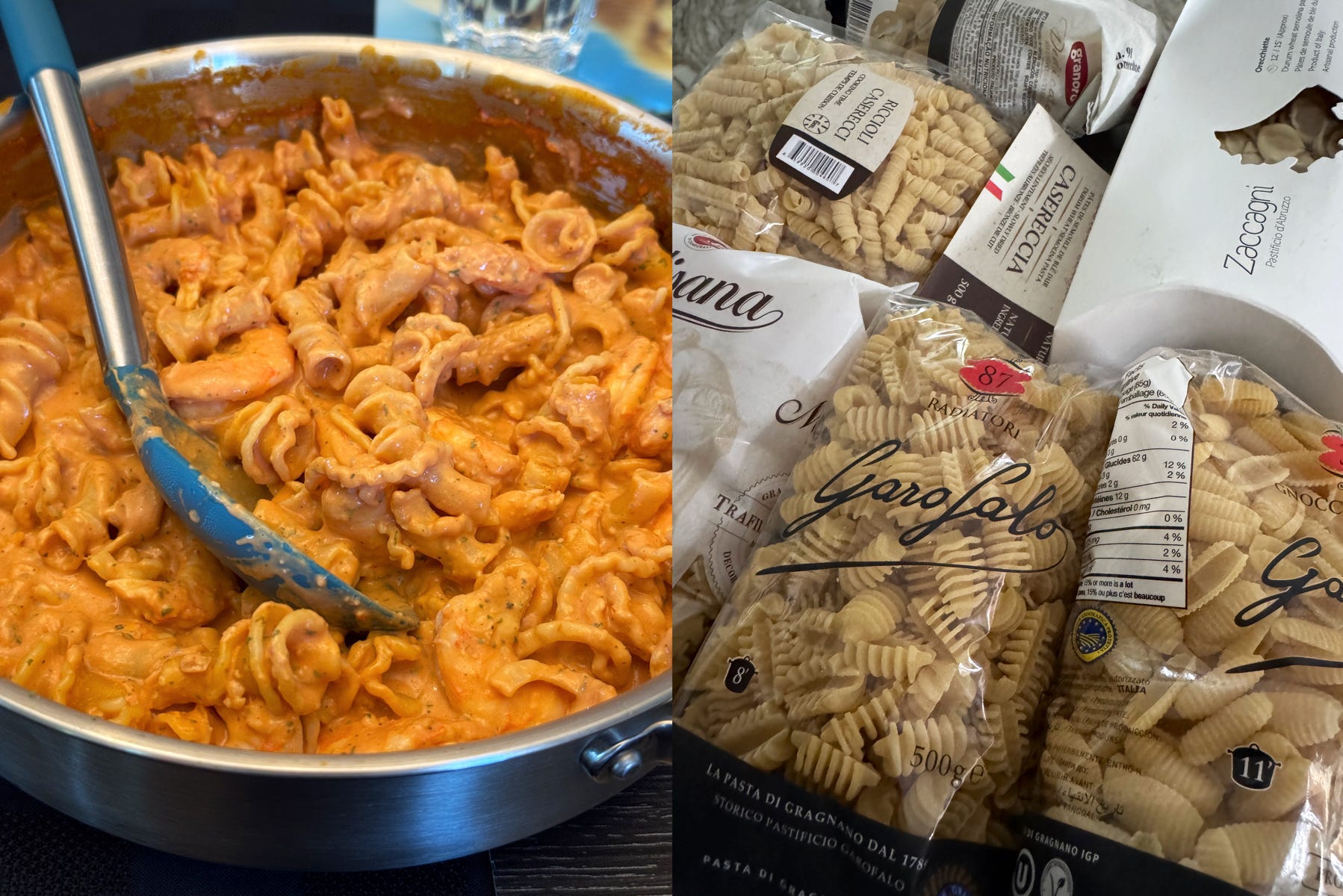
I found a Montreal store that carries a ton of Italian brands and sells them online, so I ordered a big box of pastas that seemed interesting. I did some research into which brands were considered good quality, then told ChatGPT my current favorites and asked it what else I might like.
So far, it’s been one of the most fun small experiments I’ve done lately. Can’t complain about eating pasta! 😅
If you’re curious, my first batch included: Casarecce, Gigli/Campanelle, Fusilli corti bucati, Mafalda corte, Gnocchi sardi, Mafaldine, Mezzi rigatoni, Tortiglioni, Orecchiette, and Radiatori.
If you’re looking for brands that should be decently easy to find and pretty good quality, see if you can find Rummo, Granoro, La Molisana, and Garofalo. Things like bronze-die extrusion (it creates a rougher, more porous surface, so sauce sticks better!), good durum wheat, and slower/gentler drying can make a noticeable difference to the texture, flavor, and how well the sauce clings.
💚 🥃 The paid subscription includes the full feed, every podcast, Zoom Q&As with me, and access to the private Discord clubhouse, where a core group of us hang out and discuss the interesting stuff we find:
🏦 💰 Business & Investing 💳 💴
🧩 Google is Trying to Unbundle Nvidia
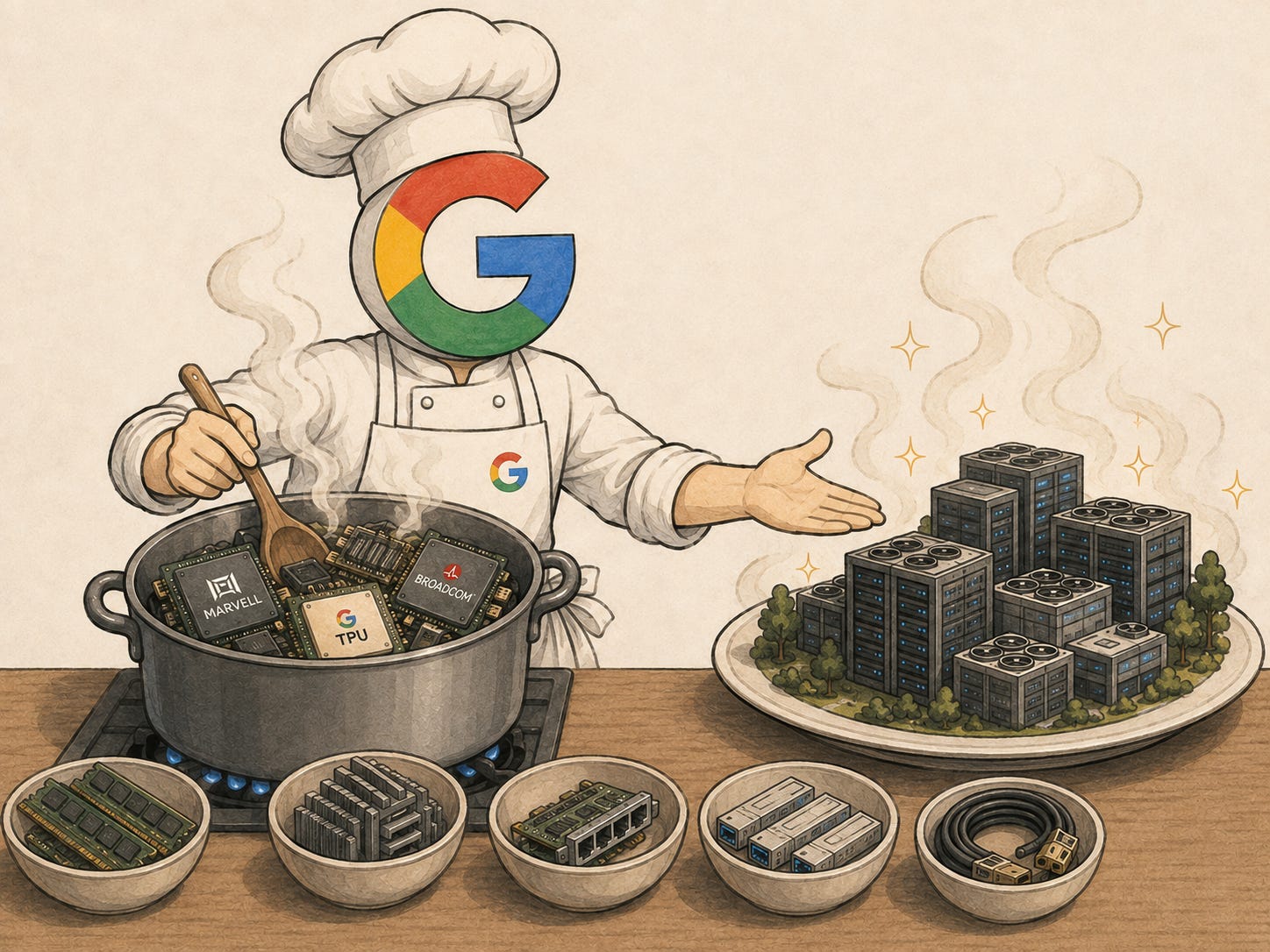
Google and Marvell just expanded their custom-chip partnership, with Marvell helping develop Google’s custom silicon for the TPU ecosystem and giving Google a warrant to buy up to 58.97 million shares.
At first, this looks like another ASIC/custom-chip win. But look at what the deal actually covers: AI inference accelerators, storage controllers, NICs, memory-interface controllers, and near-memory compute, all attached to Google’s TPU ecosystem. That’s a lot more than “help us make another chip.” Google isn’t really trying to unbundle the AI factory. It’s trying to unbundle Nvidia as the company that integrates the whole thing, then re-integrate those pieces around Google.
In this model, Google is the system architect, using specialist chip companies to build different pieces underneath it.
Nvidia’s moat isn’t just the GPU. It increasingly sells the whole AI factory: accelerator, CPU, high-speed interconnect, networking, DPUs, rack-scale systems, and the software tying it all together. It’s what Jensen calls “extreme co-design”: the pieces aren’t optimized in isolation; they’re designed together as one system.
Broadcom is already a major partner on TPU and networking, and Marvell is now working across inference, networking, storage, and memory. Instead of buying one vertically integrated stack from Nvidia, Google can keep control of the architecture while specialist suppliers build different pieces for it. (not that Google is stopping buying from Nvidia, it’s still a large customer… but without TPU, they would be buying A LOT more)
The reason Google can even attempt this is that it already has a gigantic built-in customer: itself (similar to Amazon with many things). TPUs power Gemini and huge Google products like Search, Photos, and Maps, and Google also sells TPU capacity to outside customers through Google Cloud. That’s an enormous workload to design around, and plenty of internal demand to justify building this whole ecosystem rather than buying it from Nvidia.
This is basically how TPUs started. Jeff Dean did some napkin math in 2013 and realized that rolling neural-network speech recognition out at Google scale could require roughly doubling its datacenter compute. He reportedly told Urs Hölzle: “We need another Google.” 😅 So instead, they built the TPU.
The tradeoff is that this gives Google more supplier diversity, but also creates a harder coordination problem. Nvidia can optimize chips, networking, software, and racks against one roadmap inside one company. Google has to get its own teams, Broadcom, Marvell, and everyone else moving in sync.
So what about the warrant?
It has a $206.58 exercise price, and almost all of Google’s 58.97 million Marvell shares it covers vest based on purchases: one tranche for every $500 million of qualifying revenue, up to 240 tranches, or $120 billion. To be clear, that’s not a $120bn purchase commitment, it’s just the top of the warrant’s vesting ladder.
How much of Nvidia’s moat comes from owning the best individual pieces, and how much comes from coordinating them under one roadmap and integrating the whole system better than anyone else? 🤔
🗣️💬 Sam Altman on AI’s Two Bottlenecks: Human Inertia and Context
Whatever you think of Sam Altman, he’s consequential. OpenAI is at the center of everything these days, and any chance to get a better view into his thought process is very interesting.
My friend David Senra (📚🎙️) went from interviewing books and dead people to interviewing the live players. In a way, it’s the same job, he’s just getting the same kind of wisdom out of a different source.
And it’s a natural progression. Books are permissionless, the ideal place to start. His hard work over many years has earned him ‘permission’ to do this (in this case, being on the radar of the people he wants to interview, and having their trust).
In the same way that I much prefer when a musician interviews musicians, and they can go deep and nerd out about the actual music, I think it’s great when founders are interviewed by those who understand them, like David. Journalists and historians are important, and we need more good ones too, but they do a different job.
I think some of David’s interviews will be the raw material for books and biographies that will be written years down the line. Documenting how a player thinks about things in real-time, having them talk about their journey in their own words.
So many interesting stories were no doubt lost to time because no one did a good interview and the people didn’t write it down themselves.
Anyway, back to Altman, here are a couple of my highlights, first on being wrong on timelines and things unfolding SLOWER than he expected:
Sam Altman: I love startups. I think startups are the coolest thing in the economy, and I’ve spent my career trying to really understand startups. When we got to GPT-4, back in 2023, I thought that very quickly after that there was going to be much more disruption in software, much more of business being up for grabs right away, than it turned out to be.
I think I was wrong about a few things, but one of them, in terms of the speed, is that the economy just has so much inertia. People keep doing the same things they’re doing. They keep buying from the same company. They keep wanting to use their tools in the same way.
Technological capability and economic disruption *aren’t* the same curve. The models can improve insanely fast, while companies, workflows, habits, purchasing decisions, and organizations change much more slowly.
That inertia is also a kind of moat for incumbents.
A startup can suddenly have dramatically better technology and… still have to convince customers to switch, retrain employees, change workflows, trust a new vendor, integrate new software, etc. The technical disruption can arrive a while before you feel it as an economic disruption.
Sam Altman: I think this is actually a positive in many ways, and it’s going to make this big transition in front of us go smoother and slower. I’m grateful for it. But I think it means we’ve all been too ambitious on timelines.
Even with this incredible technology — I think AI is one of the most incredible technologies humanity has ever invented — society and the economy will adapt more slowly.
Next on context as a bottleneck:
Sam Altman: With the latest generation of models, I don’t want to say they feel smart enough, because I think we should always aspire for them to get smarter, but they are pretty smart. And I feel more limited at this point by the amount of useful context AI has on me.
If model intelligence is becoming less of a constraint, the bottleneck moves to the stuff around the model. And this isn’t about having a giant context window. It’s about the quality of that context, its usefulness. Even if you’re smart, if you don’t have the right info to work from, you can’t be effective.
Sam Altman: I want the AI to know as much as it can to help me. I want it to be doing things I can’t or don’t want to do on my own. I’m not going to read every post on our internal Slack. I’m not going to read every story a customer has to tell about where ChatGPT worked for them or failed them. I can’t. I probably could read more research papers than I do, but it takes a lot of mental energy. I would love to have an AI agent that is constantly trying to be helpful to me, that can look at and understand more context than I can, or than I have the time or energy to do on my own, and can help bring that context to bear and give me good advice when I have to make a decision.
I think we’ve focused correctly so much on model intelligence that, on the product side, we have not yet thought enough about what it means to give a model more context than any person could have. There are plenty of very smart people, but there is no one who can read tens of thousands of pages of context in some small number of seconds and really use that accurately. And this is something that AI can do that is going to be very new.
These two quotes from the interview rhyme a bit.
They say that the model is moving faster than the things around it. Companies and institutions are slow to adapt to what the models can do, and on the product side, we’re still figuring out how to give the AI more useful context.
This hints at what they’ll try to do with their physical products. Some kind of ambient AI that gathers more context by actively listening and watching..? 🤔
🌶️ OpenAI’s Jalapeño is Apparently Very Spicy 🌡️🔥
Speaking of OpenAI, back in February 2025, when OpenAI’s custom-chip project was still mostly plans and rumors, I wrote:
I wouldn’t be surprised if its main contribution — at least for the foreseeable future — is to give OpenAI more leverage when negotiating with Nvidia.
It’ll take a while to ramp up production, for the chip and its software to mature, and meanwhile, Nvidia is a fast-moving target with incredible chip design resources and a decade+ buildup of software libraries and frameworks.
Well, time to update! 😅
It appears to be MUCH better than I expected from a first-generation ASIC.
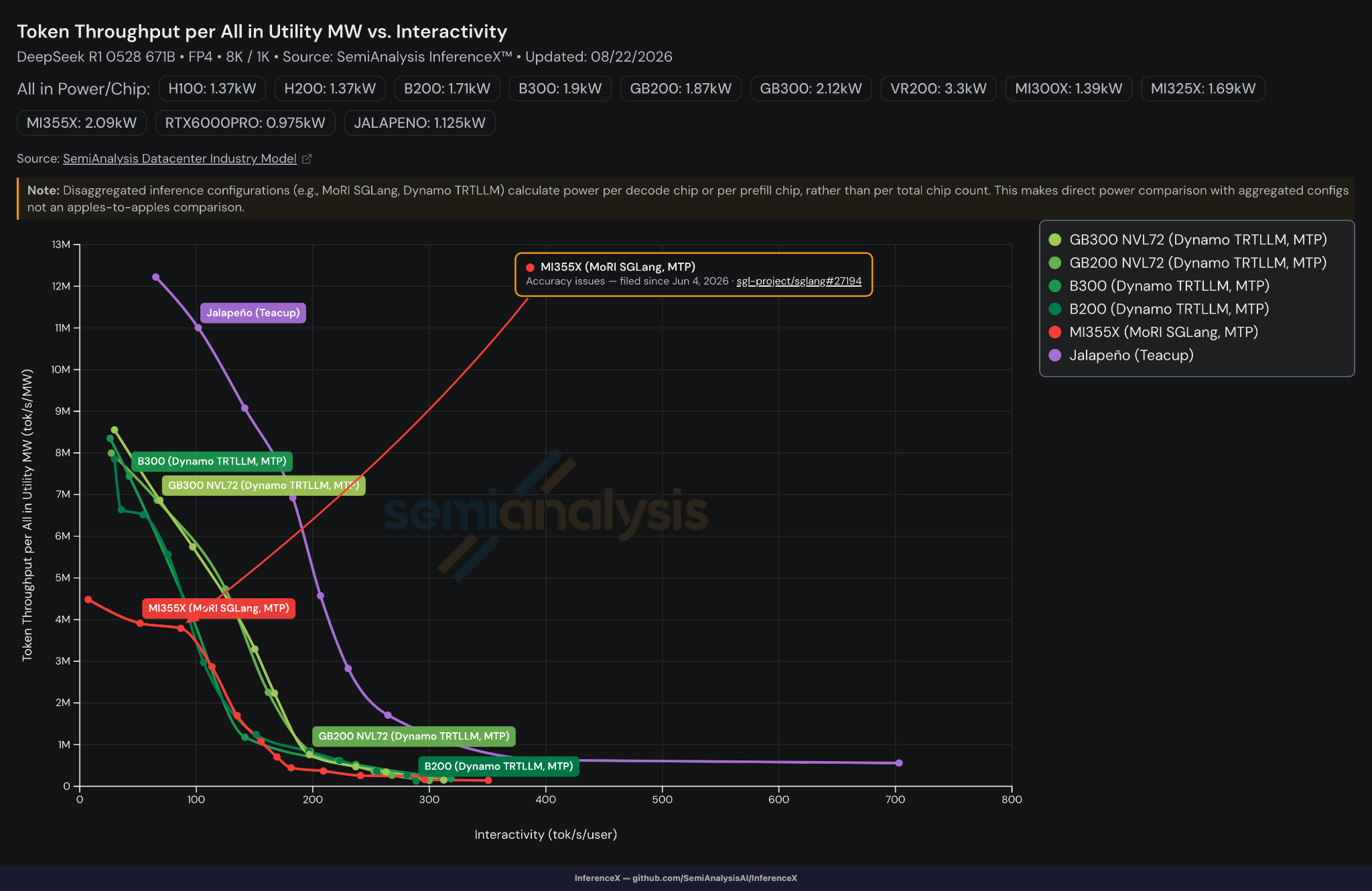
Based on what SemiAnalysis saw (they verified the InferenceX runs in OpenAI’s lab, though OpenAI supplied the numbers and SemiAnalysis didn’t run the full suite or its harder AgentX benchmark), Jalapeño produced roughly 1.5-1.9x more throughput per watt than Nvidia GB200/GB300 systems, depending on the workload, while also delivering much lower latency.
And that’s a metric to focus on, because AI datacenters are increasingly power-constrained. If the number of megawatts is fixed, tokens per watt basically helps you squeeze out more tokens per dollar from your infrastructure.
SemiAnalysis also says Blackwell isn’t really the fair comparison. Vera Rubin is. And things get much closer there: Jalapeño still wins on the current perf/watt numbers, but SemiAnalysis has the two roughly tied on perf/TCO.
The big difference is time. Rubin is arriving in production datacenters NOW:


Meanwhile, Jalapeño is still at engineering-sample stage, and most of its volume is currently scheduled for late 2027. So the real question is what it’ll look like against a much more mature Rubin stack by then, with Feynman coming next in 2028.
¯\_(ツ)_/¯
It may not do as well with some harder workloads, larger models, etc. There could be production delays and other bumps in the road that end up making it less competitive.
But it’s still EXTREMELY impressive how quickly OpenAI went from 0 to 60 with this ASIC project, both on the hardware and the software.
I wrote a lot about the Escher Hands effect with AI writing the code that builds the next AI.

AI helped design the chip, AI is already helping write and optimize code for it, and future generations of AI will run on hardware like this and help design and program the chips that come next. 🔄
💵💉 The $500,000 Check That Started Moderna’s Cancer Program
I wrote about Moderna's personalized cancer vaccine in Edition #654. What I didn’t know was how BONKERS the origin story of the program that created it is.
The WSJ wrote about Patrick Degorce back in 2020:
“The first time hedge-fund manager Patrick Degorce met with biotech company Moderna, it was a hail-Mary effort to find a cure for his wife.”
This was 2011. Moderna had about 10 employees, and Degorce’s high-school sweetheart wife had recently been diagnosed with Stage IV lung cancer. He began personally investing in Moderna the following year.
Then, in 2013, having lost his wife (😢), he reached out to Stéphane Bancel, the CEO of Moderna, to ask about the potential for using mRNA against cancer.
Bancel told him that Moderna had some ideas, but the young company couldn’t afford to pursue them. (Moderna was founded in 2010)
So Degorce asked how much it would cost to hire a couple of scientists and start working on it. 👨🔬👩🔬
Bancel’s napkin math answer: $500,000.
Degorce sent him a cheque for that amount. Not an investment. A gift. 🎁
Now, the program cost a lot more than that, and Merck put $200m into it later. But without this start, who knows what would have happened. It may not have existed at all, or may have been delayed by years, etc.
That’s why the early people are so important (founders, early investors, early technical people). Without them, whole branches of possible futures disappear. 🌱🌳
Patrick Degorce, you are a mensch.
h/t Compound248 (👋) and supporter DvorakQ (💚 🥃)
From the full feed 🔒: The AI Hardware Heist Economy: When a Truckload of Electronics Is Worth $38 Million — When a single truckload is worth $38 million, you get a whole new kind of heist economy.
🧪🔬 Science & Technology 🧬 🔭
🚗🗺️ Google Maps is Becoming Air Traffic Control for Roads
I've long been fascinated by the power that GPS apps like Google Maps have over the real world and over people's actions. Most drivers now trust GPS so much that we just set it and forget it.
But there are very interesting game theory aspects to this thing (can we mention game theory again or is it still a banned phrase because people on LinkedIn use it in cringe posts like a few years ago? I’ve lost track). If every driver is routed independently, the app is trying to find the best route for that driver. But Google can see the whole network, including where it's about to send everybody else. That means it can sometimes give you a route that's basically just as good for you, but better for everybody.
It’s basically what game theorists call the “price of anarchy”: everyone choosing the route that’s best for themselves can produce a worse result for the network as a whole. Sometimes making a tiny number of drivers take a route that’s almost as good for them makes things better for everybody. And because it’s an iterated game, the driver getting the slightly worse route today doesn’t have to be the driver getting it tomorrow.
Google Research recently published a cool real-world experiment testing that.
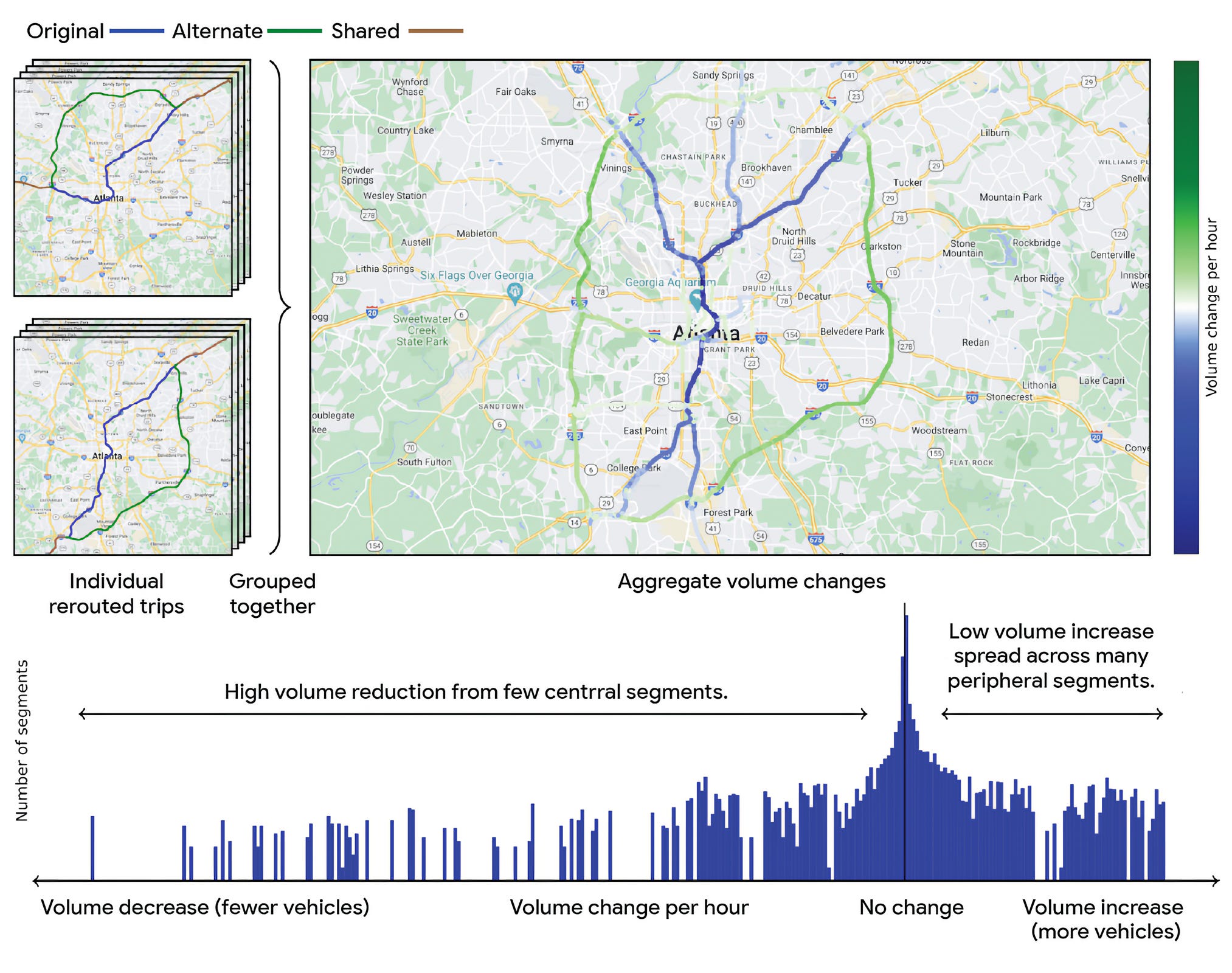
Over six months, they experimented with routing in 10 major U.S. cities, identifying roughly 100 recurring bottlenecks in each. On treatment days, Google Maps slightly discouraged routes through those bottlenecks when it could send someone along a similar road with a comparable travel time.
The intervention was tiny: fewer than 2% of observed trips actually received a different routing recommendation.
And that was enough:
Speeds on the targeted bottlenecks increased ~2%
Across the much larger network of affected roads, speeds increased ~0.35% overall and ~0.5% during peak hours
Average trip travel times improved by about 0.7%
Non-linearity ftw!
Air traffic is centrally coordinated. Internet packets are routed with the state of the network in mind. Cars have mostly been millions of independent agents trying to get somewhere as quickly as possible.
For now, this experiment was fairly simple and relied on historically congested bottlenecks rather than some all-seeing real-time optimizer. But add better models, connected traffic lights, more connected vehicles, and eventually autonomous cars…
The navigation app starts looking less like a map and more like the control system for the road network. 🤔
🔁 Déjà vu: Google Maps data used to optimize traffic lights
I think I like… Grok 4.6 😳
Didn’t see this one coming! After all of xAI’s original co-founders except Musk had left, Elon said the company hadn’t been built right, most of the Grok use I saw in the wild seemed to be people asking it to explain tweets, and they started selling compute to Anthropic.
I figured that they were pretty much done as a frontier lab. 🪦☠️
Then SpaceX bought Cursor, and I was skeptical. Cursor is a good company full of talented people, but they’re not a frontier lab. Their strongest model work had been things like Composer 2, which started from the Chinese open-weight Kimi K2.5 and then did more training around coding.
That’s not nothing, but it’s not quite the same as what OpenAI and Anthropic have been doing…
And yet, I want to keep an open mind. So when Grok 4.5 came out, I had a look and was pleasantly surprised. I started sending more work its way, making it double-check code from my vibe-coding projects (I’ll tell you more about that some other day!), or I’d send it research questions I was also asking GPT-5.6 Sol to compare.
Then Grok 4.6 came out, and that was even better! I could see myself promoting it to my model toolbox. 🧰
At the same time, Claude Opus 5 and Sonnet 5 have been annoying me more and more. They have a tendency to write in heavy jargon. That’s fine for chain-of-thought, but it keeps spilling out into the user replies, even if I try to steer the model away from it (it keeps coming back).
But worst of all: Claude 5 has been a lot less reliable than past versions, in my own experience. I’ve had it invent things, or tell me things that don’t turn out to be correct when I verify, or do things that GPT-5.6 will check and find errors in.
All this adds up to Claude Opus and Sonnet 5 not having a very pleasant flavor 🍦
Meanwhile, OpenAI really killed it with 5.6 and with recent Codex improvements, it’s probably my favorite model + harness right now… and Grok (it still sounds weird to me) is increasingly earning a spot on my roster, mostly replacing some Claude usage.
I’m just as surprised as anyone else. Just a few months ago, Anthropic was king of the world and clearly had the best models (especially for coding/agentic stuff).
It’s almost more like the weather than a typical product industry.
🧑🔬 The Little AI Scientist Supervising a Giant 🤖
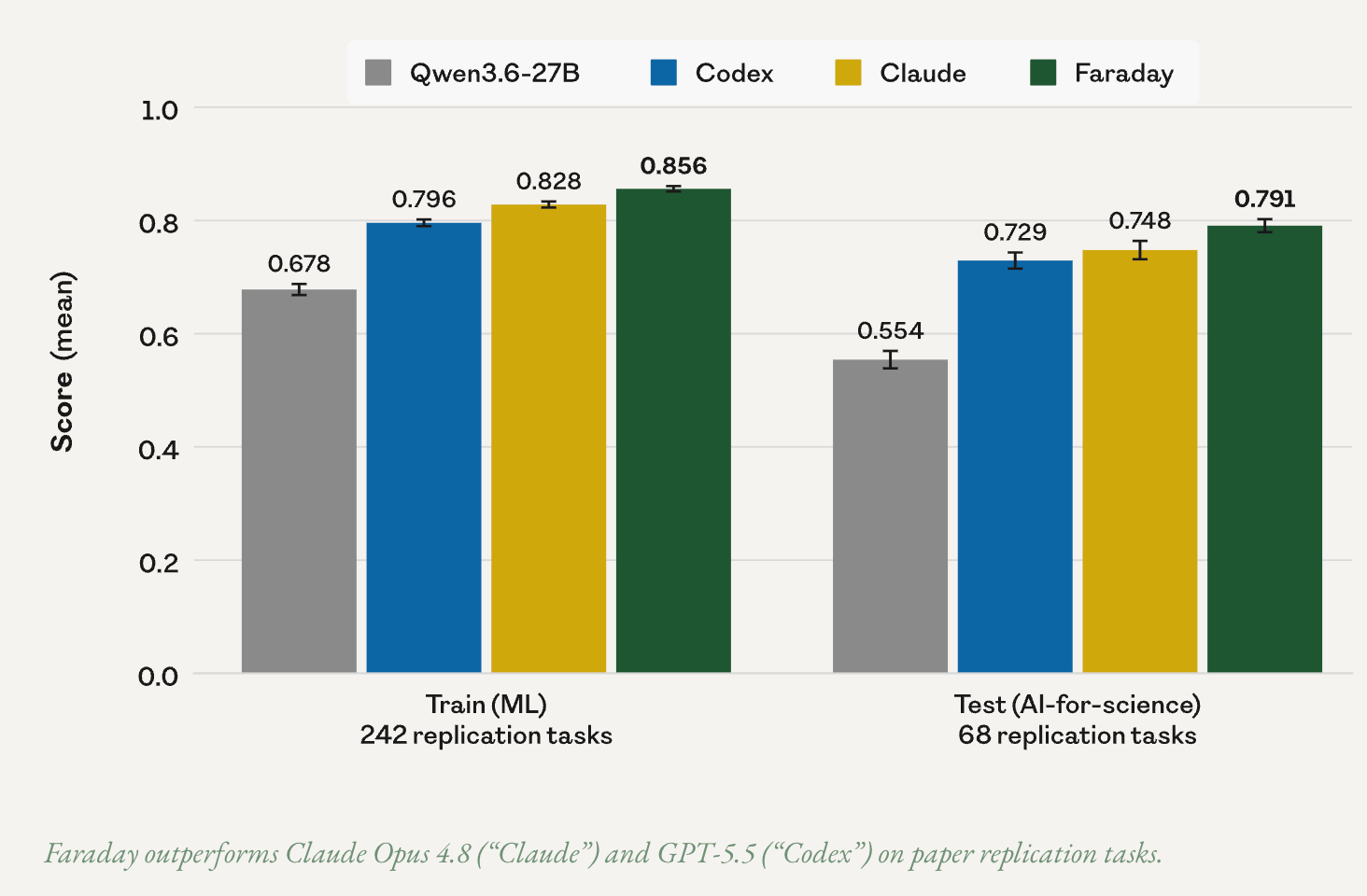
Inherent just released an interesting paper about Faraday, a 27B-parameter “AI Scientist” trained to replicate results from scientific papers.
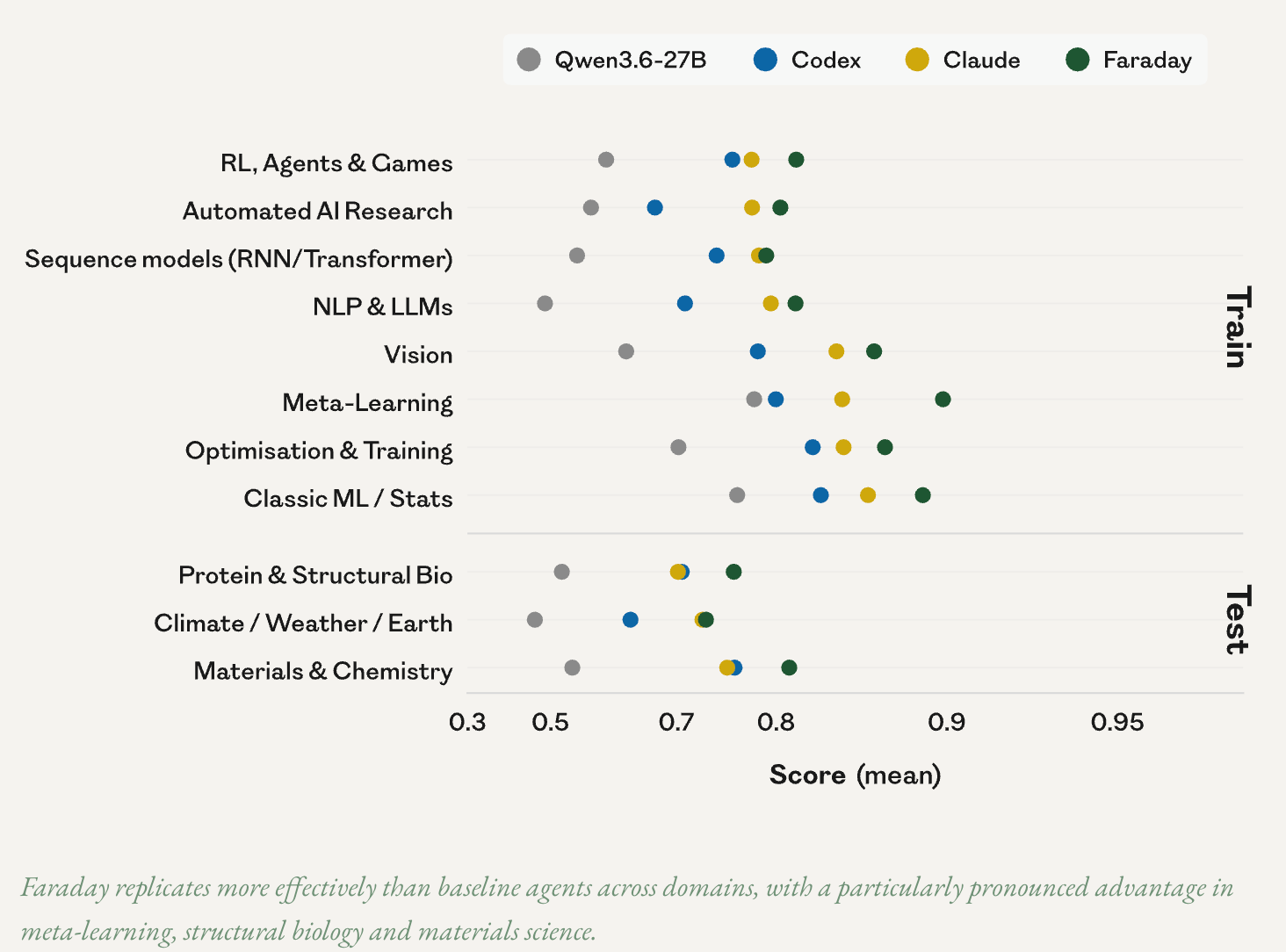
They built 310 tasks from 100 papers: remove one of the paper’s result figures, give the agent an hour and limited compute, and see how well it can recreate the experiment that produced it. Faraday beats Claude Opus 4.8 and GPT-5.5 on the authors’ benchmark.
There’s a bit of an Escher Hands (🔄) aspect: Faraday itself uses GPT-5.5 Codex to do the coding (at the time of the paper, anyway, I wouldn’t be surprised if it got upgraded to 5.6 soon). So this relatively small model is basically acting as the principal investigator, deciding what to try and directing a vastly larger model that does much of the actual implementation.
One example from the paper stands out to me. In an LSTM replication task, Faraday’s Codex coding agent couldn’t get the experiment to converge and eventually tried to hand-craft the network to produce the expected result. Faraday basically said nope!, backed up, and found a training recipe that actually made the experiment work.
The giant model was smart enough to build a Rube Goldberg machine to jury-rig the answer. The little one had the judgment to know that getting the right-looking answer the wrong way wasn’t the point.
From the full feed 🔒: Visa & Mastercard: How to Turn Competitors Into Complements — What if Visa and Mastercard don’t actually need your payment to run on Visa or Mastercard?
🎨 🎭 The Arts & History 👩🎨 🎥
🤘 Documentary about Metallica’s Rasmussen Trilogy (Ride, Master, and Justice) ⚡🔔🔨
I have pretty eclectic taste in music, but growing up, these three albums were a huge part of my musical education. I’ve heard them countless times. They’re familiar places in my mind. 🧠💭🎶
So this fan-made documentary about them is tapping into a very deep nostalgia for me. I hope it does the same for you, or maybe, if this stuff is new to you, that it’ll convince you to discover it.
Even if you’re mostly into hip hop or electronic music or whatever, forget about genre for a sec. There’s great music that sounds all kinds of ways, and IMO these albums qualify.
On the full-stack point, the cloud line's arc from the 10-Ks: Google Cloud went from $8.9B in FY19 to $58.7B in FY25, and grew 82% Y/Y in the latest quarter - 21% of Alphabet's revenue now. Drawn to scale at bastionmemos.com.
Altman's inertia point maps directly onto what I see with Indian salaried clients: they delay SIPs assuming salary jumps will cover it, but career growth is as sticky as corporate adoption.
The same inertia that protects incumbents also protects stable jobs — yet medical inflation doesn't wait for AI to compound.
Discipline now beats hypothetical future raises.