


In the creative process there are certain strategic moments in which it seems as if you are either standing still or even going backward.
These moments of apparent lack of progress are strategic because the actions you take at such moments will largely determine whether or not you are ultimately successful.
—Robert Fritz
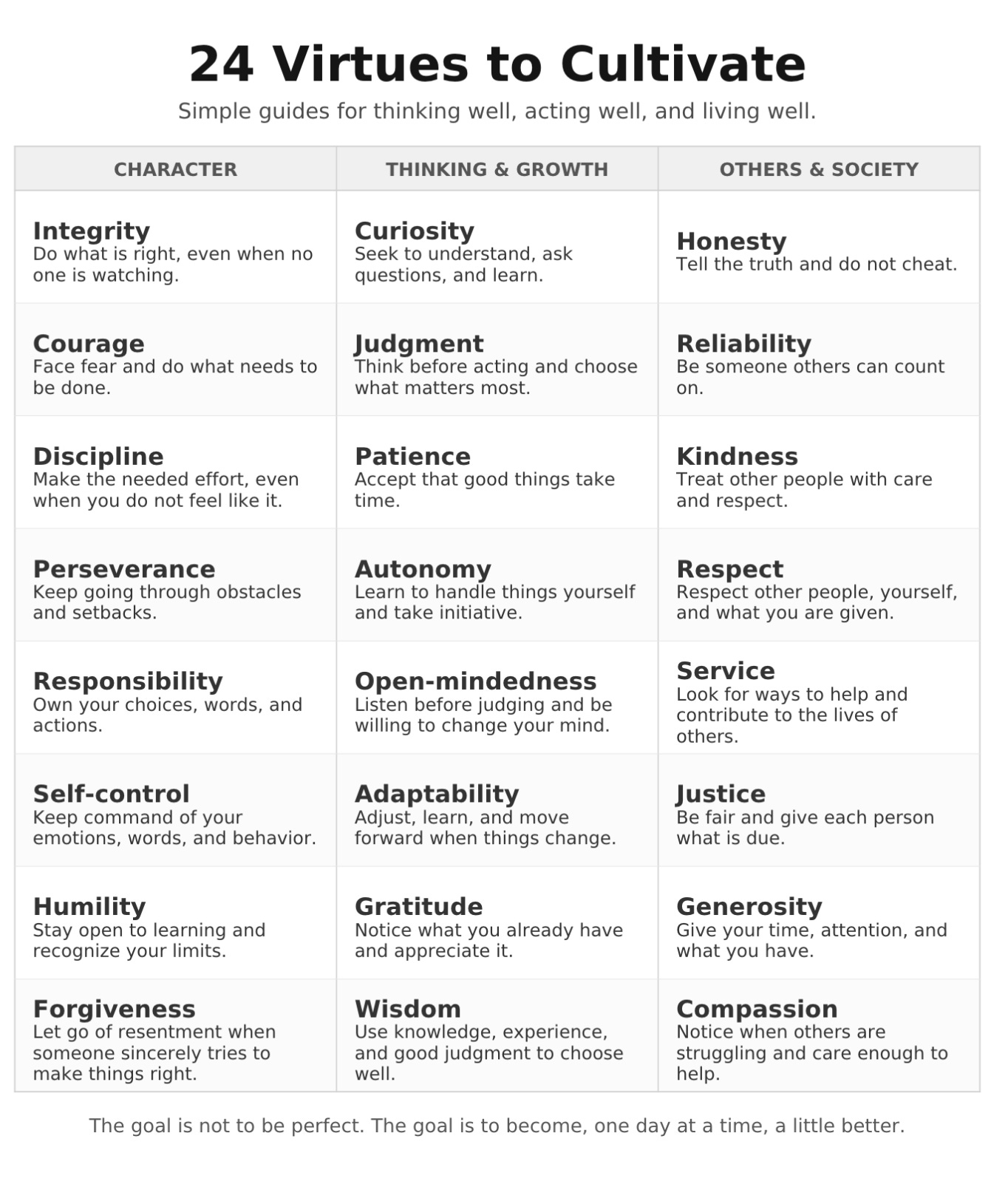
🧭🏛️⚖️⭐🌱 I don’t remember why we got on this topic, but my oldest boy asked me what a virtue is.
To explain it better, I looked up some of the classical lists of virtues, then broader lists covering character, thinking, relationships, civic life, etc. As we went through them, I explained some in more detail and told him that you could spend a lifetime getting better at any one of them. They’re guiding stars, not destinations.
I’m not sure he was super impressed, but I thought this was an important moment, so I decided to print out a one-pager of virtues and put it on his bedroom whiteboard with a magnet. Hopefully this becomes another bit of that ambient learning I wrote about in the intro of Edition #649, when I got him a periodic-table poster for his bedroom.
Is this like a periodic table for virtues 🤔
The one on his wall is in French, but I translated it above so you can have a look 👆
💾🎨🧑🎨 I think this tweet by Kasra Kyanzadeh, an experienced engineer who just left OpenAI’s Codex team, is thought-provoking:


The tweet is truncated in the preview. I’ll save you a click and reproduce it in full here:
I ended up leaving OpenAI, not because there's anything wrong with OAI (I actually think they're underrated as a biz), but because to me, building commercial software doesn't feel fun anymore
Because agents write ~all the code:
- There’s less human to human collaboration, so it’s a lonelier experience
- You’re constantly context switching and not going as deep into the code, which means there’s ~zero flow state
- Most of the job becomes code review and trying to reduce complexity, which is very mentally draining
Again just my experience, and none of this specific to OAI. There are many people who seem to be enjoying building software in this era!
But I've always wanted to try making films, and now seems as good a time as any
None of his complaints are about AI being bad at coding. More the opposite: the tools are now good enough that they change what the job feels like.
This is the other side of the coin from all the people I’ve heard say they’re having more fun than ever, or doing things they couldn’t have done before. (I count myself among them, by the way, and I’ll tell you more about my vibe-coded apps another time.)
I can certainly imagine that a lot of people got into software because they liked a particular kind of work. Methodically writing the code. Solving many small logic puzzles. 🧩 Holding a complicated system in their heads, disappearing into it for hours, in a flow state… 😵💫
And now, in less than a year, their whole way of working has changed. Opus 4.5 only came out last November! I can imagine the malaise when something you spent years getting really good at suddenly becomes a much smaller part of the job because LLMs can do so much of it faster.
And not every engineer likes design or management or high-level product thinking, but they’re increasingly being pushed in that direction (managing agents, if not people) because more and more of the low-level implementation stuff is being automated.
It’ll drive some people out and attract others in (at least until AI agents are fully autonomous 😅). The people who love building software in 2030 may be a different group from the people who loved building software in 2020.
💚 🥃 The paid subscription includes the full feed, every podcast, Zoom Q&As with me, and access to the private Discord clubhouse, where a core group of us hang out and discuss the interesting stuff we find:
🏦 💰 Liberty Capital 💳 💴
🤖💵 The Fed is Now Thinking in Tokens 📊
A few years ago, almost nobody outside of AI knew what a token was.
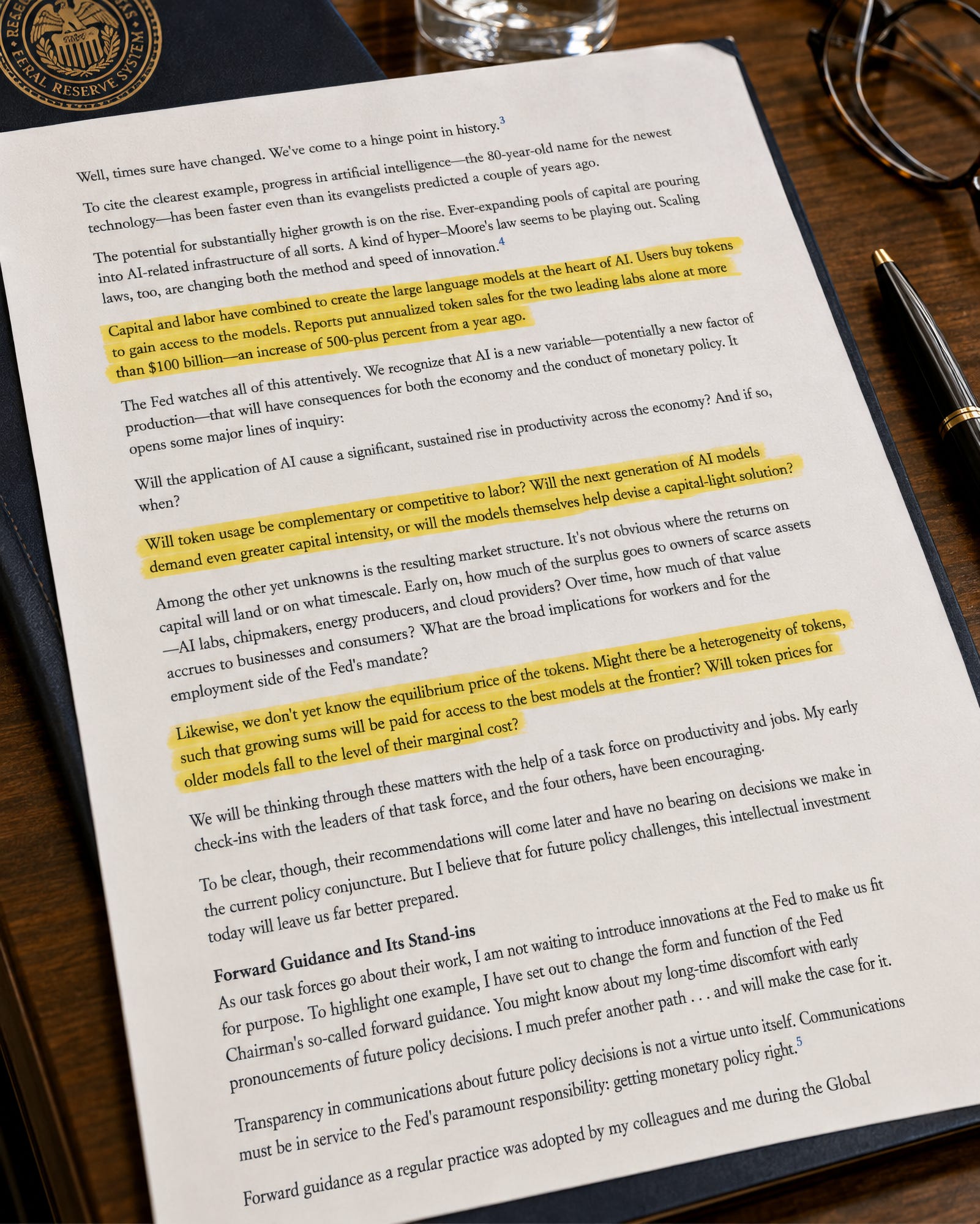
Now the Chairman of the Federal Reserve is at Jackson Hole discussing reports of $100+ billion in annualized token sales from the two leading AI labs alone, asking whether tokens will be substitutes or complements for human labor, and wondering what their ‘equilibrium price’ will be.
Huh 🤔
Here’s the part of the speech about it:
Capital and labor have combined to create the large language models at the heart of AI. Users buy tokens to gain access to the models. [...]
Will token usage be complementary or competitive to labor? Will the next generation of AI models demand even greater capital intensity, or will the models themselves help devise a capital-light solution? [...]
We don’t yet know the equilibrium price of the tokens. Might there be a heterogeneity of tokens, such that growing sums will be paid for access to the best models at the frontier? Will token prices for older models fall to the level of their marginal cost?
A few months ago, Satya Nadella talked about companies eventually having “human capital and token capital.” Now the Fed is starting to think in similar ways.
But as I wrote about in Tokens Schmokens: We Need a Better Economic Unit of AI Work (Edition #634) and Tokens are NOT like Kilowatt-Hours or Gallons of Gasoline (Edition #630), raw token counts are a pretty terrible way to compare AI output across different models and workloads.
A token is a useful billing/usage unit, but it’s not a standardized unit of economic output. They are NOT a commodity, and a token from one model or workload is NOT economically fungible with a token from another.
A million tokens from Mythos doing super-difficult agentic coding or working on an advanced math proof and a million tokens from a tiny model summarizing spam emails are both counted as ‘a million tokens.’ But economically, they’re very different.
Maybe what economists will eventually have to track is something closer to the price of useful intelligence (if we can figure out how to measure it). 👩🔬 In practice, that probably means something more like the cost of completing a given task at a given level of quality.
This starts to become a very weird quality-adjustment problem. If token prices fall 80%, but the models get much better and need fewer tokens to accomplish the same useful task, what actually happened to the real price of AI work?
It’s a strange new thing that economists have to think about. ¯\_(ツ)_/¯
🤖🦅🛡️ CrowdStrike’s AI Security Advantage: The Agent is Already There
I haven’t written about CrowdStrike in a while, but this seems like a good time. Everyone has cybersecurity on the mind these days, for obvious reasons. 🔐
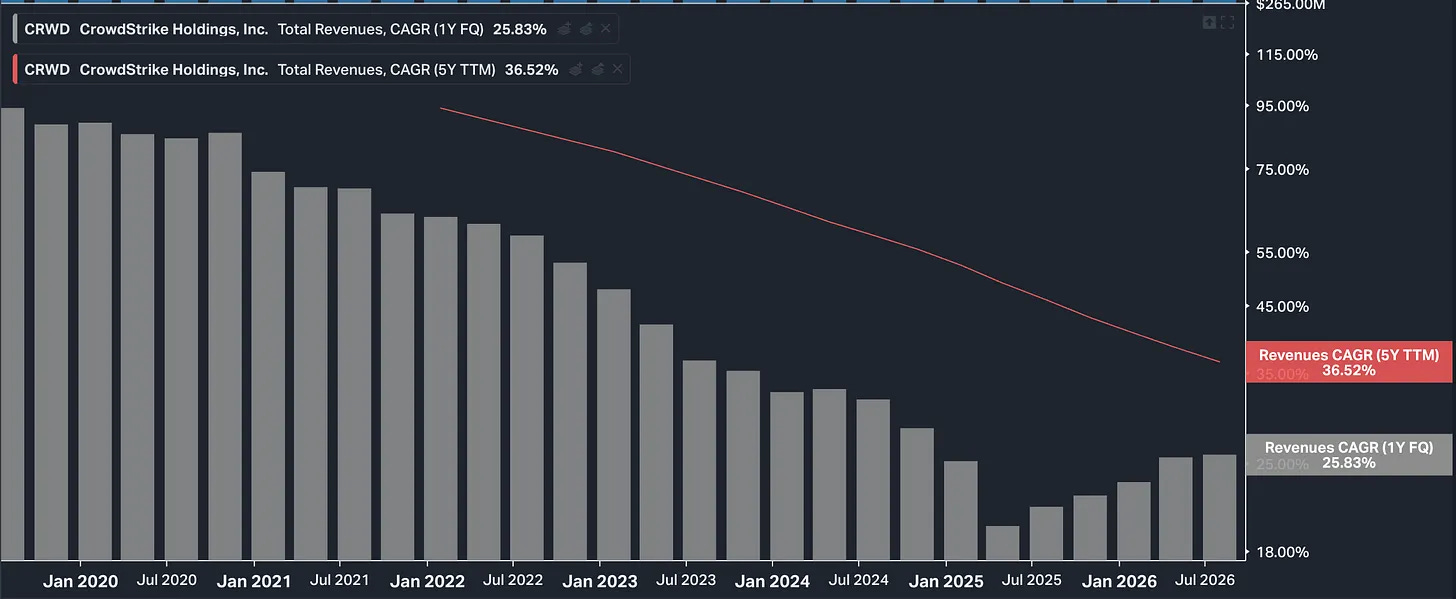
The numbers are impressive: Net new ARR grew 51% to a record $333 million, and revenue grew 26%. (Look at that reversing trend 5 quarters ago)
As expected, AI is part of the reason. What jumped out at me, though, is how CrowdStrike is turning demand into revenue: it can sell existing customers AIDR, its AI-security module, without installing another piece of software.
Its Falcon agent is already installed on customer machines. Because of how CrowdStrike built the platform, adding AIDR is basically flipping a switch on a customer’s account. Very low friction, and we know how much that matters.
The CEO explained it pretty directly on the call:
George Kurtz: So on the first point, it is separate and incremental. It’s another module and it’s priced separately, which is, again, where we’re seeing a lot of the growth. [...] When we think about the beauty of the architecture and the platform, it’s still using the same agent.
And if you want to enable AIDR, again, that’s a license entitlement. It’s part of our friction-free deployment.
[...] you don’t have to roll out yet another agent. [...] it’s on the same platform, that’s the beauty, but we’re able to monetize it separately.
This is one of those nerdy technical architectural decisions that turns into a big business advantage years later. CrowdStrike already did the hard work when it got Falcon installed on all those customer machines. AIDR’s ending ARR nearly tripled sequentially in Q2.
Though keep in mind, “nearly tripled” can sound more impressive than it is when you don’t know the starting point, and CrowdStrike doesn’t disclose AIDR’s absolute ARR yet.
🤖 Mythos & Fable 5.1: Generalist Knowledge, Specialist Judgment


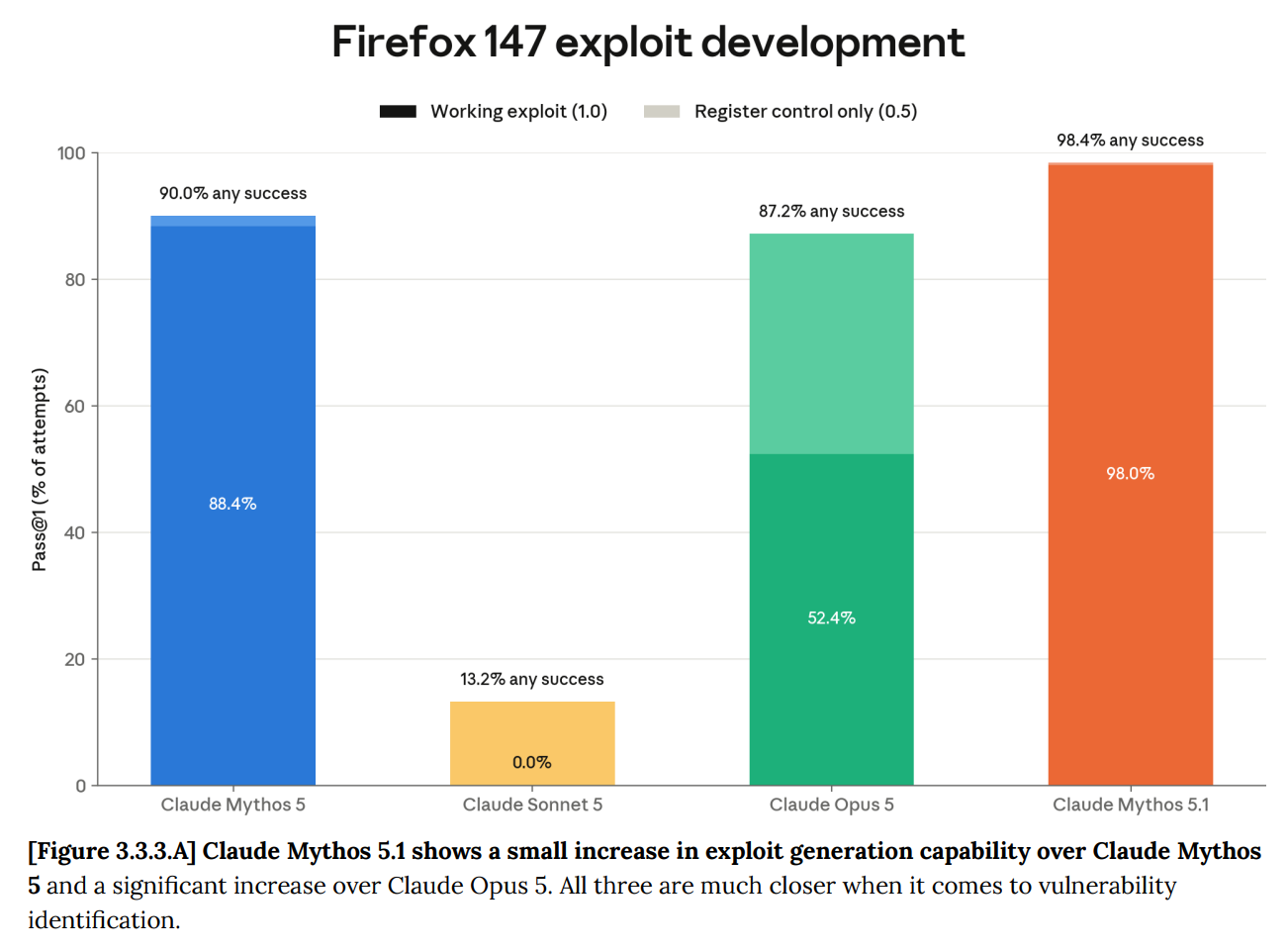
Anthropic just released Claude Fable 5.1 and Mythos 5.1. There are lots of impressive benchmarks, as usual. But what stood out to me in the 212-page system card was an experiment comparing specialists with generalists using AI.
Anthropic paired PhD biologists with LLM experts, then gave them a difficult research-planning problem. Some of the biologists were specialists in the relevant field, while others were generalists.
The question this gets at is basically: how much can a powerful AI close the gap between a smart generalist and someone who has spent years becoming a specialist?
Well…
The specialist teams did a little better overall, but the graders couldn’t reliably tell the specialist submissions from the generalist ones. The strongest generalist team even beat one of the specialist teams on every measure and got the highest innovation score of the whole group.
Seven of the nine participants also said completing the task would have been *impossible* without the model.
But this wasn’t quite “generalists are now specialists.” The specialist teams still had a small edge overall. And across Anthropic’s broader red-teaming, people with enough expertise to challenge Claude were better positioned to catch its mistakes.
Maybe the more interesting split isn’t generalists vs. specialists. It’s specialist knowledge vs. specialist judgment.
A good biologist can now cover more ground in statistics, bioinformatics, chemistry, coding, etc. The model can give them access to knowledge that previously required years of study and work inside each field.
Knowing enough to recognize when the model is subtly wrong is different. That may still be the specialists’ edge.
So generalists get broader and specialists can apply their judgment to more work. But what happens as the models improve? Does that gap keep shrinking, or does specialist judgment get leveraged across more and more work? Or both at the same time? 🤔
Personally, the Anthropic model I’m waiting for is Opus 5.1.
Fable is too expensive for me to use as a daily driver, and Opus 5 is strong in some ways, but annoying in others, so I hope that they fix it with 5.1. In the meantime, I’m mostly using GPT-5.6 Sol.
If you want a deeper vibe-check on Mythos & Fable 5.1, here’s Dan Shipper’s early review. He had access for a week before release. His bottom line:
State of Play:
The big knock on Anthropic was they built a supergenius in a datacenter that was almost unusable. It was too slow, argued back, and talked in technical gibberish. They’ve managed to solve those problems and more with Fable 5.1!
🗣️💬 Gavin Baker: “Thank You, Jensen”
Baker has been on a roll lately, doing many good interviews. This one is wide-ranging, covering most of the big topics in tech and AI lately. I recommend the whole thing.
Here are my highlights:
Gavin Baker: I think [Jensen is] in a very, very good position with his strategy of being vertically integrated but horizontally open. [...] if you’re a semiconductor CEO, the only thing you should ever say is, “Thank you, Jensen.”
“Thank you for creating this opportunity. Thank you. How can we work with you? We want to enable you. Sure, we’re going to compete with you on the edges.”[...]
Every 1% of share today is probably worth $100 billion. [...] So there’s no need to go head-on with NVIDIA. [...] Just pick a niche and get your 1%.
David George: That pie is very big.
Gavin Baker: He has 9 chips. He's got multiple flavors of accelerators. He's got CPUs, Ethernet switches, and 2 kinds of DPUs. We've gone from just scale-out networking being a thing. We have scale-up, scale-out, scale-across, and now scale-in. So just try to find a way to plug into his ecosystem.
By the way, this is not foreign. His biggest customers all have competing products across various of those 9 chips. [...]
It's like, hey, that's great. You did the one thing. To actually be competitive with him at the system level, you need another 8 chips.
Baker’s ‘$100 billion per 1%’ is obviously a rule of thumb, but the AI compute pie is so large that you don’t need to replace Nvidia to win.
Nvidia is very integrated. Replacing the whole system would be BRUTAL. But at the same time, they’re open enough that another company can build a huge business by plugging into their stuff.

Competitors need to ask: “Which slice can we be the best in, while making sure we work really well with everything else?” 🥧
That means many of Nvidia’s competitors wind up strengthening its ecosystem, while also buying tens of billions of dollars of Nvidia products.
The other one I wanted to share was about customer preferences:
Gavin Baker: In a world that is so supply-chain-constrained, it's actually really hard to tell what true customer preferences are.
If you have a TSM allocation, you're going to be sold out. Particularly if you can get the DRAM to pair with it. You're going to be sold out.
So it's actually kind of hard to infer true customer preferences.
During a shortage, a mediocre chip can sell out simply because customers will take whatever compute they can get. Market share can tell you as much about what customers could get as what they actually preferred.
BUT
The concessions required to generate adoption may tell you more:
Gavin Baker: I actually think one of the best ways you can see true customer preferences is the kind of deals they cut with chip companies.
So broadly speaking, the first deal is where the chip company invests in a customer, and you saw TPU and Trainium—Amazon and Google—do that with Anthropic. [...] In that scenario, as long as the dollars you invest are less than the gross profit, you can’t lose money.
Then there’s the scenario where you do the RVG. Blackstone finances it, or whoever—Blackstone, Apollo, KKR and Goldman Sachs finance it. As long as that RVG is actually less than your gross profit, you can’t lose money, and you have upside, probably through a revenue share on top of it.
(RVG here means residual-value guarantee: a promise that the equipment will retain a certain value.)
Then there are deals where you give warrants away, but they’re tied to a fixed price per 1 million tokens. [...] If you just give warrants away, it could be negative NPV, because the better the stock does, the worse the deal is.
[...] You can look at that hierarchy of deals and infer something about true customer preferences.
A much cleaner test will come when supply loosens enough that customers can actually choose. (But when will that be? ¯\_(ツ)_/¯ )
🇹🇼🏜️ A Replica of Central Taipei in the Inner Mongolian Desert


Well, this is slightly ominous 😬
China has built a mock-up of part of Taipei’s government district in the Inner Mongolian desert for PLA training.
This is not China’s first mock Taipei. The PLA has had a separate replica of the Presidential Office and nearby government buildings at the Zhurihe training base for more than a decade. The newer site in Cameron’s images appears to focus more on the surrounding street grid and city blocks. Historical sat imagery suggests it did not exist in 2020.
It’s hard to make “we’re planning for this” much more literal than building a copy of the place in the desert for military training.
From the full feed 🔒: Thoughts on Nvidia Q2 + Hugging Face Deal — The quarter was absurd, but the Hugging Face deal may be the more interesting signal.
🧪🔬 Liberty Labs 🧬 🔭
🧫🔬🤖👨🔬 Bringing Claude Into the Lab
Anthropic just opened a research preview of its Model Hardware Standard (MHS):
We’re opening a research preview of the Model Hardware Standard (MHS), a shared specification for AI agents to safely operate physical devices, to a first group of scientific research labs and advanced manufacturers.
MHS enables AI agents to operate multiple lab and manufacturing instruments, such as microscopes, liquid handlers, and robotic arms, in parallel, and perform intricate tasks ranging from routine drug discovery experiments to laser calibration on a quantum computer.
This is very cool. MHS is kind of a glue layer between the AI and all the different instruments in the lab, allowing the AI to control and coordinate them much more easily:
Getting multiple devices in a lab or on a factory floor to communicate with one another can be challenging, even setting aside the added difficulty of integrating AI into the setup. Each device tends to have its own programming interface, and so far there has been no standardized way to integrate them. And once the devices are connected, there is no common way for them to share data with an AI agent, nor to let the agent operate them safely.
MHS addresses these challenges by introducing a standardized driver: software that translates between a computer’s operating system and a hardware device.
If it works, it could let scientists spend less time getting all their equipment to talk to each other and debugging it, and more time on the actual scientific questions.
And by the way, the production values on this video are great. 🎥
The aspect ratio makes it look more like IMAX than a regular YouTube video, and whoever shot it clearly knows what they’re doing. Lots of very interesting shots, good composition, nice depth-of-field effects, etc. Kudos.
h/t my friend MBI (🇧🇩🇺🇸) for sharing this via DMs
🏴☠️🤖 Abliteration: Unlocking the Cyber Skills Behind the Guardrails
Abliteration AI is taking open-weight models and removing some of the refusal behavior that makes them say “no” to certain requests.
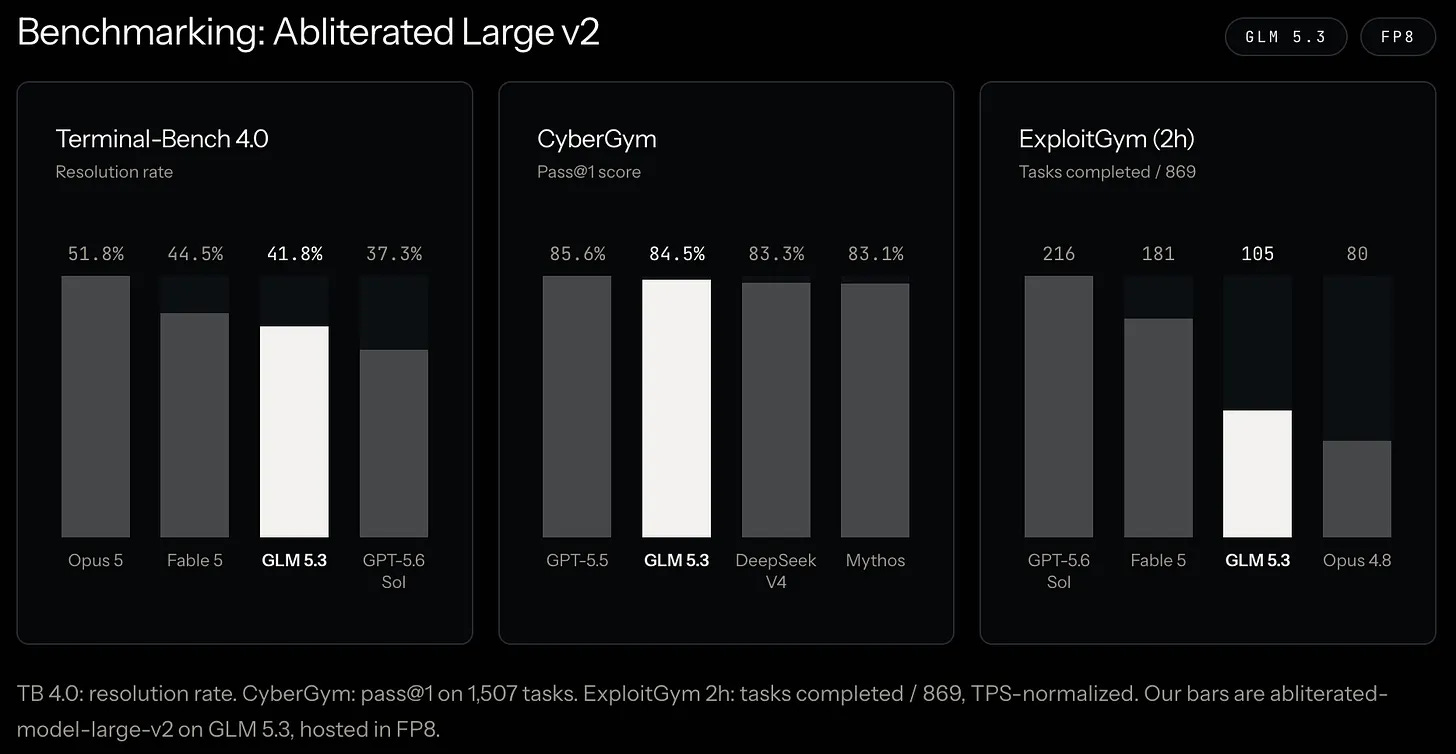
Their newest one is based on Z.ai’s GLM-5.3, which is already very good at cybersecurity. They’re selling the modified version for *offensive* security work: exploit development, red-teaming, etc. Basically, the kind of stuff that mainstream models will generally refuse to help with.

So what exactly are they removing?
When a model goes through post-training, it isn’t only being taught to give better answers. It’s also being taught the kinds of requests that should trigger a refusal. The model may know how to write exploit code, but it has been taught a kind of reflex: this looks dangerous, don’t answer. 🛑
Researchers found that when you look at what’s happening inside a model as it refuses a request, there are identifiable patterns in its activations associated with that refusal. Those patterns are surprisingly concentrated.
Abliteration finds those ‘refusal directions’ and edits the weights to weaken them.
This isn’t like most other jailbreaks we hear about, where the model is tricked into answering something (sometimes via very strange prompting). This is more like a selective lobotomy. They’re changing the model’s weights. 🧠✂️
Cybersecurity is the area where this makes the most sense because the white hats and the black hats often need the model to do the same thing.
If you’re a security researcher trying to prove that a vulnerability is real so it can be fixed, you may need the model to write an exploit for it. Same as if you were someone trying to break into someone else's system without permission ¯\_(ツ)_/¯
And this is also a business. 💵
Abliteration hosts these modified open-weight models and sells access through an API. Their GLM-5.3 version costs $5 per million tokens of input or output, so security researchers can use it without having to run a 753B-parameter model themselves.
They do have optional moderation and a Policy Gateway for customers who want more controls, but the underlying product deliberately has very few restrictions.
So I hope most of the people hammering those GPUs are white hats helping us patch the world, and not black hats doing the opposite. 🏴☠️🤔
h/t Supporter Boogie (💚 🥃), who shared this with us on the private Discord
From the full feed 🔒: HEICO: 10x Production Without 10x Capex — How do you prepare for 10x production without spending anywhere near 10x on capex?
🎨 🎭 Liberty Studio 👩🎨 🎥
📺 Mini-Documentary About Master of Puppets
I recently posted the Metallica documentary about the Rasmussen trilogy.
I couldn't get enough, apparently.
The YouTube algo suggested this one to me, and I was like, well, I may as well check it out, just to see if it's well made.
I pressed ▶️ on my living room TV… and I watched the whole thing before bed. 😅
It's quite well executed, and very interesting.
What surprised me is that Stuart Kirwan only has three videos on his YouTube channel. This doc is from 6 years ago, so well before the current generative-AI video era.
Turns out Kirwan really is a pro. He’s a professional editor and motion-graphics artist who has worked for the BBC, ITV, Amazon Prime, DAZN, etc. He also posted this video showing how he edited some of the B-roll:
It’s really cool to see how he took reference images and turned them into something very different.
Always interesting. You make AI kind of make sense to me. I don’t know how you have time to consume so much and to repackage it.
China’s impending attack on Taiwan is a matter of time in my opinion. America’s attack on Iran seems to set a precedence and America’s expenditure of interceptors and deployment of naval resources to the ME, and away from the Pacific, doesn’t make me feel very secure. We are truly in the realms of the type of phony war that preceded WWII.
Appreciate you doing a bit more of a deep dive into the ‘Abliteration’ restriction lifting. They take and update GLM (which might not be too happy about the restrictions loosening), after the open source firms take (or learn) from what the closed model teams produce. Almost like open source getting their own medicine. And they’re already at capacity, crazy!
I think it really shows how quickly these things can get disbursed and the importance of letting defenders get the tool early as you’ve said in the past.
I’d be interested if there’s any vetting going on for who they’re selling their capacity too for these unrestricted models. My gut thinks more black hats than I would hope are getting through