


Strategy is about making choices, trade-offs; it's about deliberately choosing to be different.
–Michael Porter
🤓🤪✍️Lately I've been re-watching season one of the excellent TV show Elementary with my wife (I wrote about why I like it here).
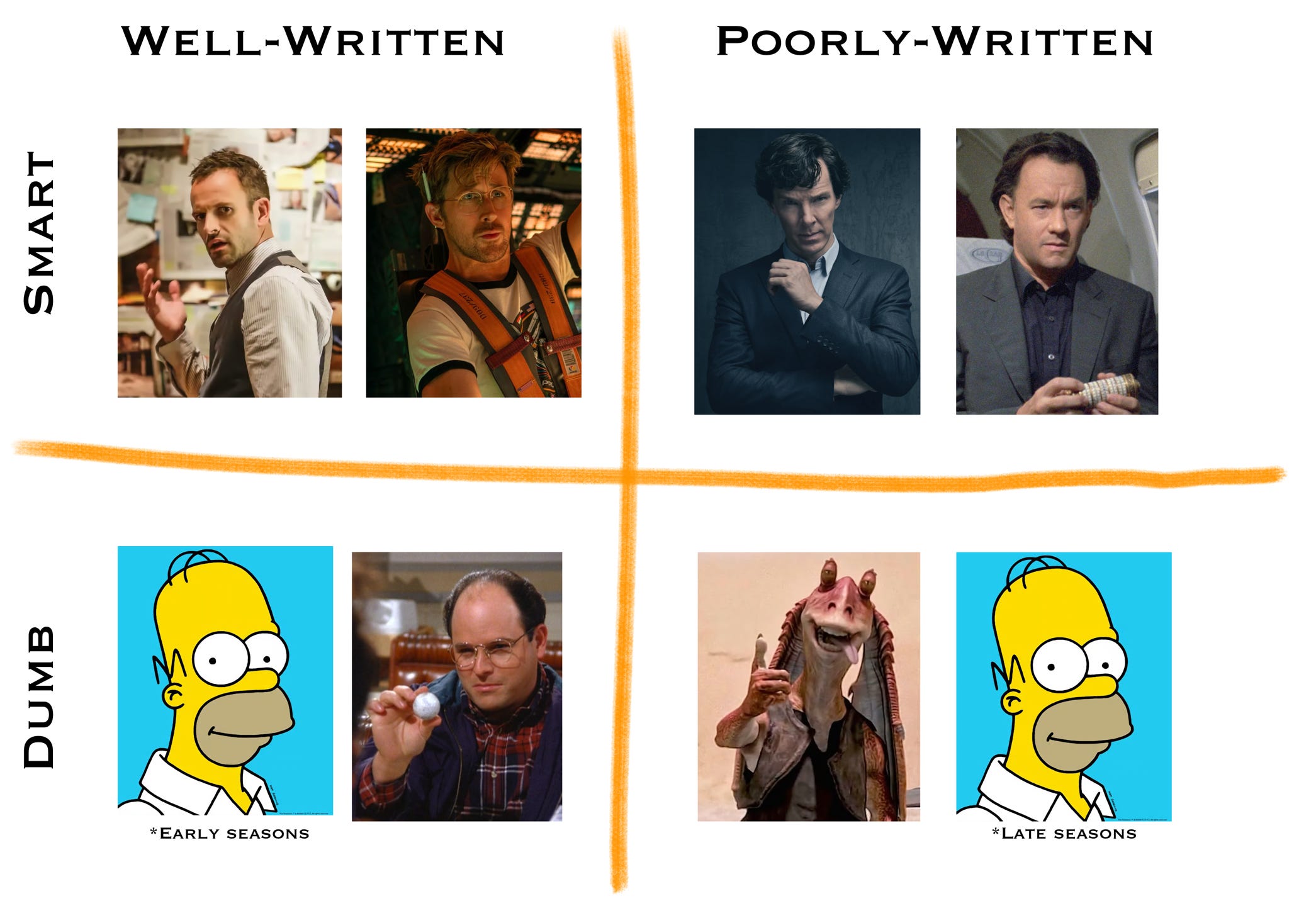
It made me wonder why some fictional geniuses feel truly smart, while others just know whatever the plot needs them to know. And on the other side, why some fictional idiots are much more interesting than others.
I created the matrix above to illustrate 👆
Homer and Sherlock are especially useful to A/B compare, because each appears twice: Homer in the bottom row, Sherlock in the top. (Two different Sherlocks… there have been many.)

Golden Era Homer is dumb in an interesting way. His mistakes have a structure. You can follow the bad logic from one step to the next and see how he gets there, even when the place he gets to is absurd.
Later Homer is often dumb in a much less interesting way. He doesn’t understand obvious things, or behaves randomly, or does whatever stupid thing the joke requires. And sometimes he’s just mean. Earlier Homer was selfish and careless, but you could usually tell he loved his family and was trying to do the right thing, in his own bumbling way. Later Homer can seem like he isn’t even trying.
Or how about Sherlock vs. Sherlock? 🕵️♂️
Both are smart characters, but in Elementary, Sherlock feels smart because you can see him working. You can usually see how he gets to a solution. He’s constantly studying between cases, sharpening his skills. On a crime scene, he notices things, follows leads that go nowhere, tests ideas, gets things wrong, and eventually pieces the case together. He’s great at what he does. He’s an extreme version of human intelligence, but he doesn’t feel superhuman and doesn’t figure things out just because that’s what the plot requires.
You almost feel like you could’ve done what he’s doing. Almost.
What about Sherlock on the BBC’s show?
He’s basically the Zach Galifianakis ‘calculating’ meme from The Hangover 😅

On the BBC show, Sherlock often feels less like a brilliant detective and more like a superhero whose power is “being smart.” He sees something, the music tells us something is happening, the editing speeds up, and suddenly he knows a bunch of stuff no real person could figure out. 🦸
It’s the view of what a smart person is from the point of view of someone for whom the kind of smart things that a detective does are basically magic. So they wrote it as magic. Intelligence as magic! 🪄
A bit like how bad hacker films show computer people doing all kinds of crazy impossible things because the writers don’t understand what they’re writing about.

💚 🥃 The paid subscription includes the full feed, every podcast, Zoom Q&As with me, and access to the private Discord clubhouse, where a core group of us hang out and discuss the interesting stuff we find:
🏦 💰 Business & Investing 💳 💴

🧸 My Thoughts on Meta Muse After Using It for a Few Days Like a Maniac
In ‘The Brain is the Replaceable Part,’ I wrote some thoughts about persistent AI assistants, the new hotness in AI. Right after I published, Muse became available in Canada and I’ve been using it heavily ever since. Both to test it, but also because it’s a really interesting product and I’m still trying to figure out where the edges of its capabilities are.
But first things first. Last week, I wrote:
I’m not sure I agree with their decision to go with this kind of branding, though.
Making the bots look like Teletubbies makes them seem friendly, but not especially smart or like something I’d trust with difficult work. But maybe that friendliness is exactly what gets people who are skeptical of AI to try them. I don’t know ¯\_(ツ)_/¯
Well, it looks like I was wrong on that. I guess Meta’s designers know what they’re doing, because as soon as I showed the app to my wife, she was absolutely delighted and said “I want one.”
To be clear, I don’t even think she was that excited when she got her first iPhone, and I kept hearing her giggle as she did more stuff with her Muse (which she renamed, changed the color of, and asked to review her email inbox daily).
In fact, the look of the mascot grew on me. You don’t have to stick with it, you can replace it with anything you want, and whatever you pick will get a few animations made with generative AI (my own Muse is called Chief-of-Staff, and I was considering using an image of General Patton for it, but I don’t think I want a real historical figure, so I stuck with an orange Muse plushie for now).
So 1 for Meta and 0 for me on this count 😅
I’ve been using both the mobile and Mac apps, and the care with which this product is designed puts it ahead of Grok Bot and Instinct for me (we’ll see what OpenAI releases). I have no trouble believing Alexandr Wang when he says they were working on it a year ago in Sept 2025.

I’ve long been a big fan of Nat Friedman (including for his work on the Vesuvius Scrolls), and I was disappointed when he went radio-silent after joining Meta. But clearly he was locked in.
On the surface, the app is the most user-friendly AI product I’ve seen (more than ChatGPT). Unlike Grok Bot, you interact with just one agent, but you can create side chats with it to organize things and not clutter the main chat. But while it’s simple at first, it’s designed around progressive disclosure of complexity, allowing it to be quite powerful.
If you click around, you can see exactly what your agents and their sub-agents are doing. You can view what they’re doing on their web browser, browse the files they created for you, see a history of every action and permission granted, see scheduled and recurring tasks, etc. It’s both more accessible to regular users than Grok Bot AND seems more powerful if you’re a nerd and want to look under the hood. Doing that gives me confidence in the power of the system (at first, I was afraid it would be kind of a toy compared to Codex and Claude Code, but that’s not the case).
Your agent has SOUL.md and MEMORY.md files that you can easily access and edit, very similar to the OpenClaw model. In fact, some people thought that maybe Muse was just a reskinned OpenClaw, but Nat explained:

They basically did what Meta does best: Copy something that works.
BUT
This time they didn’t just make their own version of Snapchat Stories or whatever. They improved on the original quite a bit. Some of my favorites are the Ideas tab. People who have never used agents before will find all kinds of starting-off points in there, filed by categories and everything (health, finances, shopping, etc). Once you have the agent do something for you and see that it works, you want to do more. Getting that first project right seems to be the crucial onboarding moment, and they’ve nailed it.
There’s also the Feed tab. As your agent gets to know you and your interests better, it creates a personalized feed (that you can also steer with a prompt). So far there’s only been a few items per day there for me, but the hit rate is pretty high. This isn’t an infinite scroll feed like on Meta’s other apps.
Then there’s the Goals tab, which acts a bit like the Ideas one, but from another angle. The AI extracts various goals from your interactions and lists them there, as a way of tracking them and starting projects to better achieve them.
On migration and using multiple assistants at the same time, I wrote:
It’s really hard to test several of these things properly in parallel. What makes them useful is the context you give them, the apps and folders they can access, and the recurring jobs you put them in charge of. You don’t want three bots doing the same thing. But without giving the new one that setup and responsibility, you’re not really testing what it could do for you. [...]
The new bot is competing with all the work I’ve already put into the old one. It’s starting from behind. Maybe it’s better! But I have to spend time setting it up and giving it real work just to find out. And if the one I already use is doing a good enough job… how much homework am I willing to do to replace it? [...]
I’d be willing to redo some setup if it meant less friction between the tools I use every day. And if a new assistant could help move my existing setup over, that would make the decision easier still (that’s probably how the labs will try to reduce switching friction… but it cuts both ways ↔️).
Well, Meta is doing its best to help you migrate your memory and context from other platforms onto Muse. A couple of days after I installed the app, I got this:
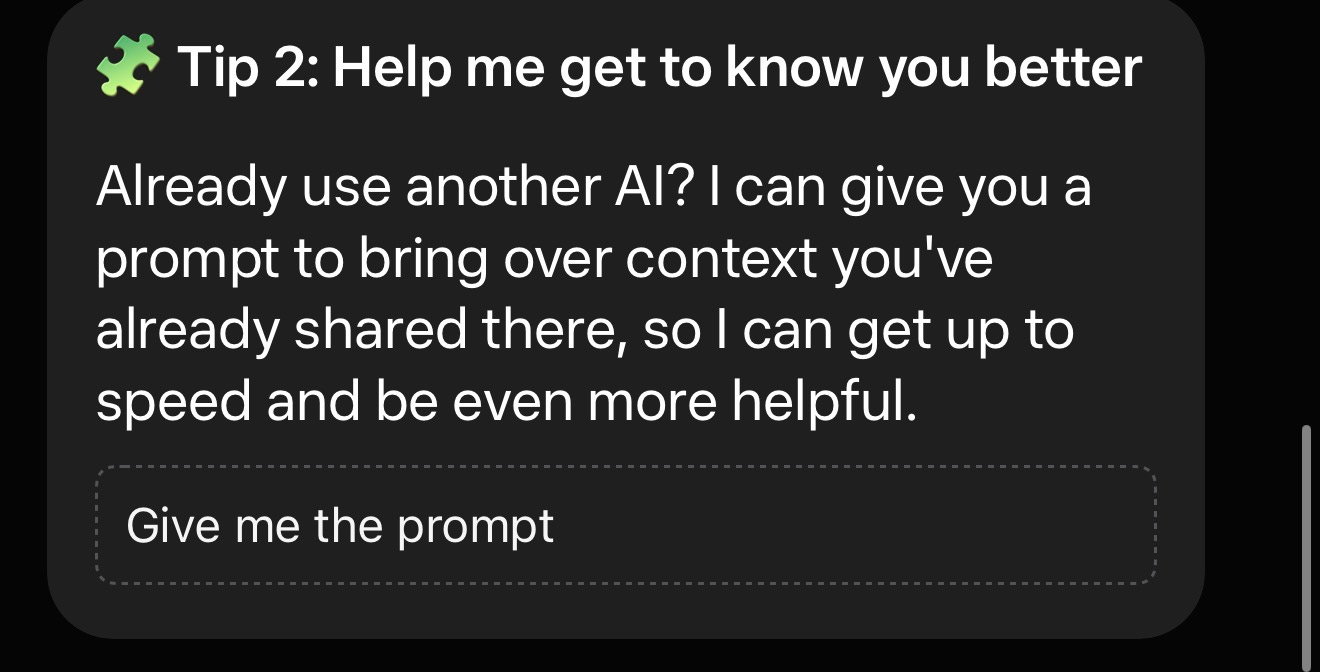
This is smart. As long as everyone plays nice with these types of requests, it makes it easy to export what they know about me, Muse could save me some of the homework I mentioned. But importing that context doesn’t tell me if Muse can take over the jobs I’ve already given another assistant. I’d still need to connect my apps, get those recurring jobs running, and see how well Muse handles them.
It’s not zero work, but it’s easier.
People have been using Muse for all kinds of things (Alexandr Wang’s Twitter feed has been documenting these use cases. I hope that they’re learning from their users and then injecting new ideas they hadn’t thought of into the Muse Ideas tab).
Some people say Muse has saved them hundreds or thousands of dollars. One user says it found him car insurance for $3,500 less a year. It can create AI-voiced ‘podcasts’ a bit like Google’s NotebookLM, it can turn recipes into grocery lists, help you get to inbox zero, do weekly check-ins about fitness or health goals, create monthly graphs of expenses, whatever.
Truthfully, a lot of this stuff you could do with Codex or Claude Code, but the shape of the product doesn’t make this stuff quite as natural, especially the recurring and ongoing tasks and nudges.
My wife started by playing with the cute mascot. Then she asked it to review her inbox every day. If Muse does that well, why not give it another job? At some point, you may start asking Muse what to buy before you ever visit Amazon.
But not everyone is happy about that. Amazon has blocked Muse bots from shopping on the site, while Shopify, Instacart, and PayPal have explicitly partnered with Muse. 💳


Amazon doesn’t just want to sell you the thing. It wants to be where you decide what to buy. It wants to own the customer relationship. That’s what its very profitable ad business is based on. 🛒
In general, businesses that benefit from being the interface will resist agents trying to squeeze between them and their customers, while businesses that make money underneath the interface will try to make themselves as agent-friendly as possible (that’s why Tobi specifically mentions Shop Pay).
The underlying model powering Muse may not be quite state-of-the-art, but so far I haven't felt too constrained by it. The quality of its output has been good, and it's been quite fast. But that's just a temporary state of things because everyone knows that Meta has been training very large new base models (Avocado 🥑, then Watermelon 🍉… I’m not sure what comes after that. Pumpkin? 🤔), and if all goes well, they may soon be at the frontier with OpenAI and Anthropic.
From a recent interview with Zuckerberg:
Alex Heath: Some of the larger clusters, like our gigawatt cluster in Ohio, so Prometheus came online and we’re using that to now scale the post-Watermelon models.
Mark Zuckerberg: Watermelon is basically, that’s shipping soon [...]
it’s a very big advance. It’s a significantly more advanced pre-train. And then we’re going to continue doing everything that we’ve learned for post-training. And yeah, well, I mean, you’ll see soon. It’s good. We feel good about it.
In the same interview, Zuckerberg says Muse needs to “really understand you” to be useful. He and Nat Friedman recruited Signal founder Moxie Marlinspike to work on the Confidential VM, which is meant to ensure that “even Meta cannot see the content that is in there.”
More details on the security model, including the VM, have been published here.
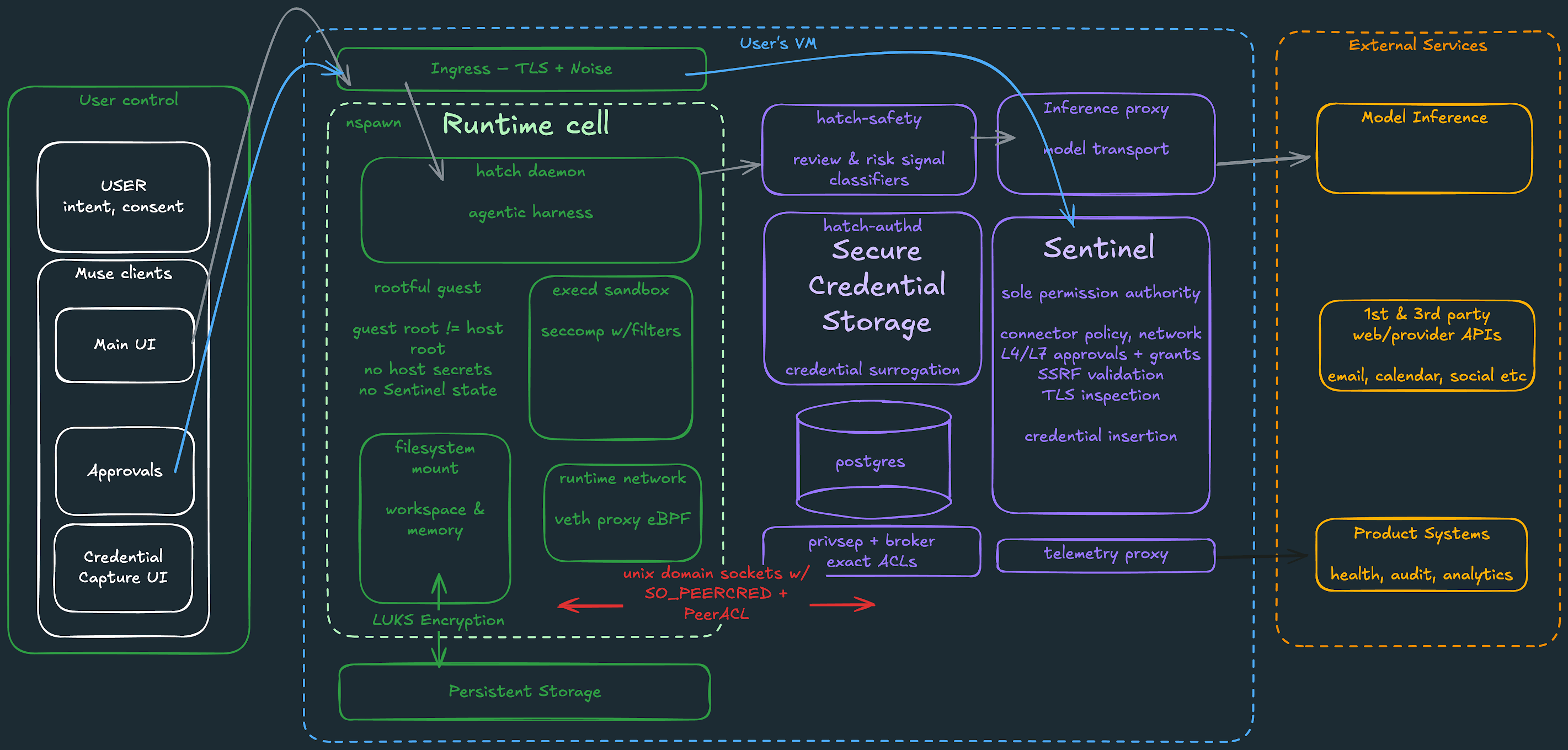
I can see why Meta is putting so much work into this. Asking a chatbot a question is one thing. Giving it access to your inbox and calendar and letting it work in the background is another.
It may be hard to change the public perception of Meta when it comes to privacy, but regardless of that, I’m glad they’re focusing heavily on it. To be clear, the current VM keeps users’ data separate, but Meta can still access it when necessary. The Confidential VM, which is supposed to keep even Meta from accessing the data inside it, is coming later this year.
If you thought Google knew a lot about you, just wait until people have had AI assistants for a few years 😬
So in the span of a few months, Meta could go from being absent at the frontier and getting little buzz for its AI products (sure, billions of people have a Meta AI tab in their products, but it wasn’t exactly setting the world on fire) to having the best persistent assistant AND a top model. It would be a real vindication for Zuckerberg’s reboot of Meta’s AI efforts.
Ask me again in a month, when Muse has had time to handle the boring recurring stuff without me watching it so closely. On the battlefield, the enemy has a say. We’ll see what OpenAI comes up with.

They are using the old PayPal/Dropbox model to create some virality with the app. If you refer new users with your invites, you get 1 billion tokens per user. I’ve already got 26 billion tokens from referring people in the Liberty Discord and on Twitter, which is more than the cumulative number of tokens I’ve used on Codex so far.
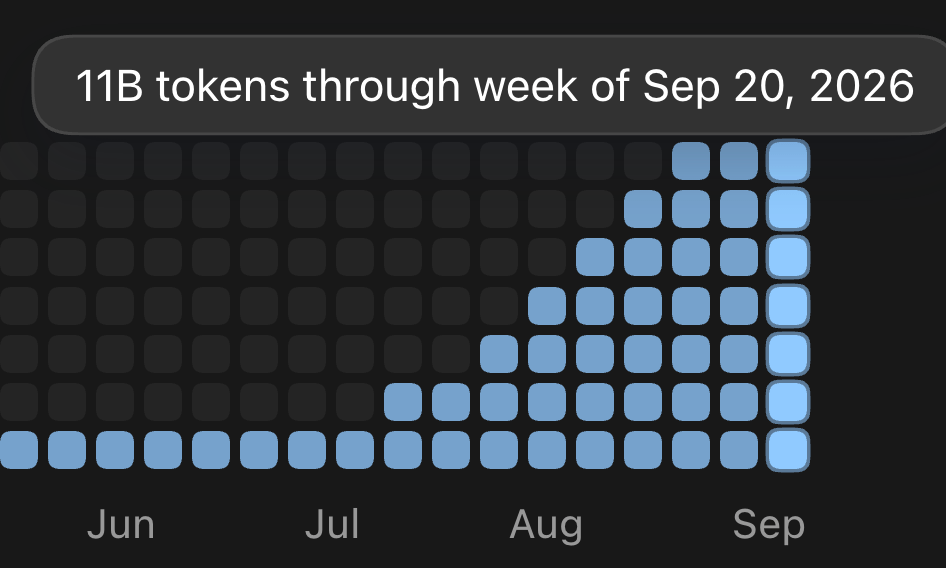
Pretty generous! It reminds me of how much free space I got on Dropbox from referrals in the early days.
If you want to try Muse, use my referral code within 48 hours of joining and we both get 1 billion tokens that never expire. Since you already get 100m tokens/week for free and only eat into that bonus when you go over, this amount could last for months or even years, if you’re a light user.
My code is: CAO9VN (You have to cut & paste it into the settings)
🏗️ Nvidia’s Moat Moves Outward
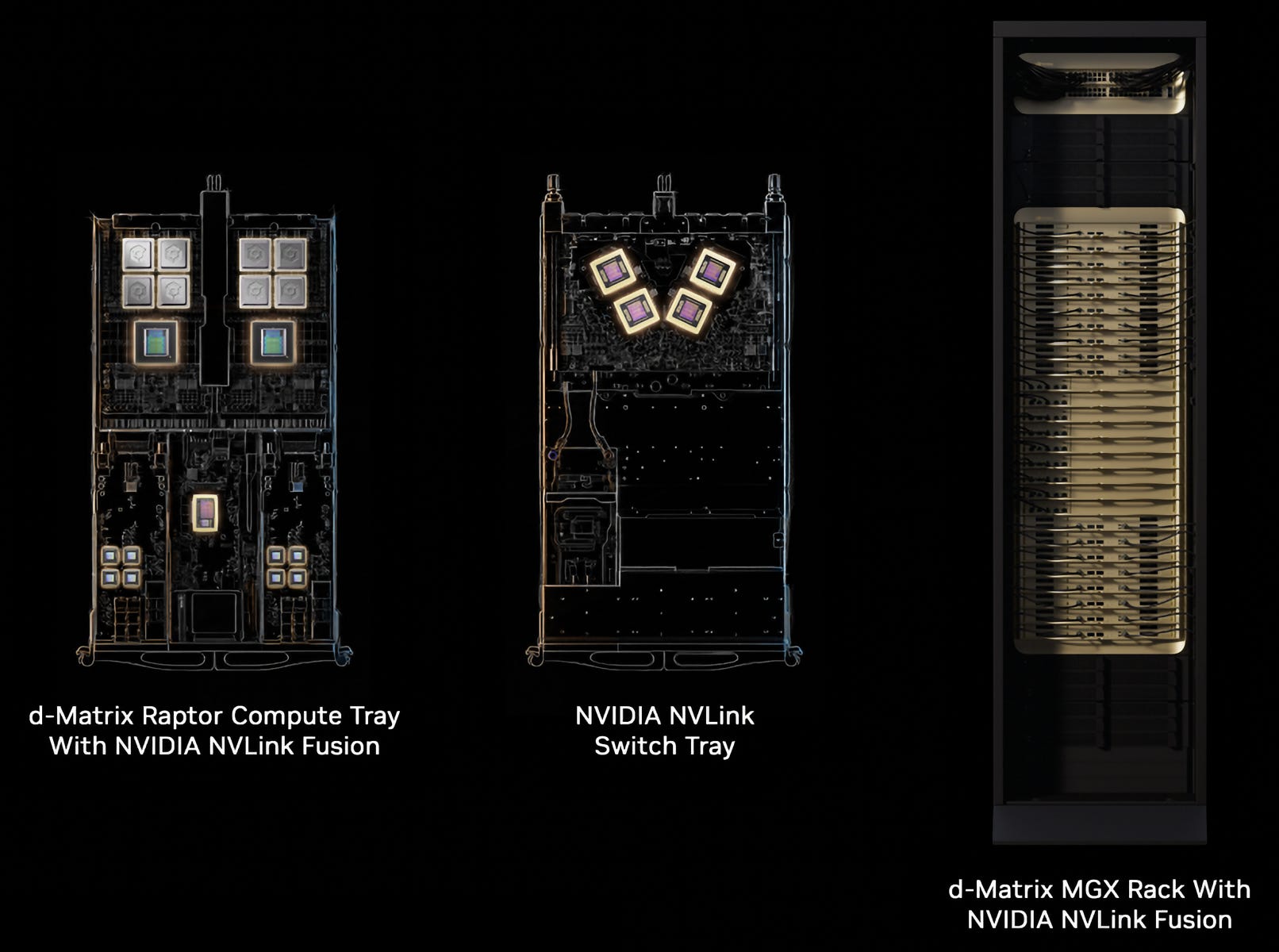
I think Nvidia is trying to make sure it still has something to sell you even when you don’t buy an Nvidia GPU. Being “Nvidia-compatible” may become a much bigger deal.
Earlier this month, inference-chip startup d-Matrix announced that its next-generation Raptor chips will plug into Nvidia’s datacenter architecture through NVLink Fusion. So you can have a non-Nvidia accelerator sitting inside an Nvidia-shaped rack, connected through Nvidia’s NVLink fabric and surrounded by Nvidia networking and infrastructure.
And d-Matrix isn’t alone. AWS is also designing its future Trainium4 chips to work with NVLink Fusion.
That’s kind of interesting. Why make it easier for other accelerators to compete with your GPUs? 🤔
Maybe Nvidia is trying to move the moat outward: it doesn’t need every chip in the rack to be Nvidia if the others plug into its architecture. If d-Matrix makes a better chip for some kinds of inference, Nvidia can still provide the interconnect, networking, CPUs, rack design, power and cooling architecture, etc. Nvidia describes the strategy as “vertically integrated and horizontally open.”
Of course, I don’t know how the math works for Nvidia here. If AWS was going to use Trainium4 anyway, getting NVLink into those racks is extra business. But if NVLink Fusion makes it easier for customers to buy other chips instead of Nvidia GPUs, how much of the rest of the rack does Nvidia need to sell to come out ahead? 🤔
🧪🔬 Science & Technology 🧬 🔭
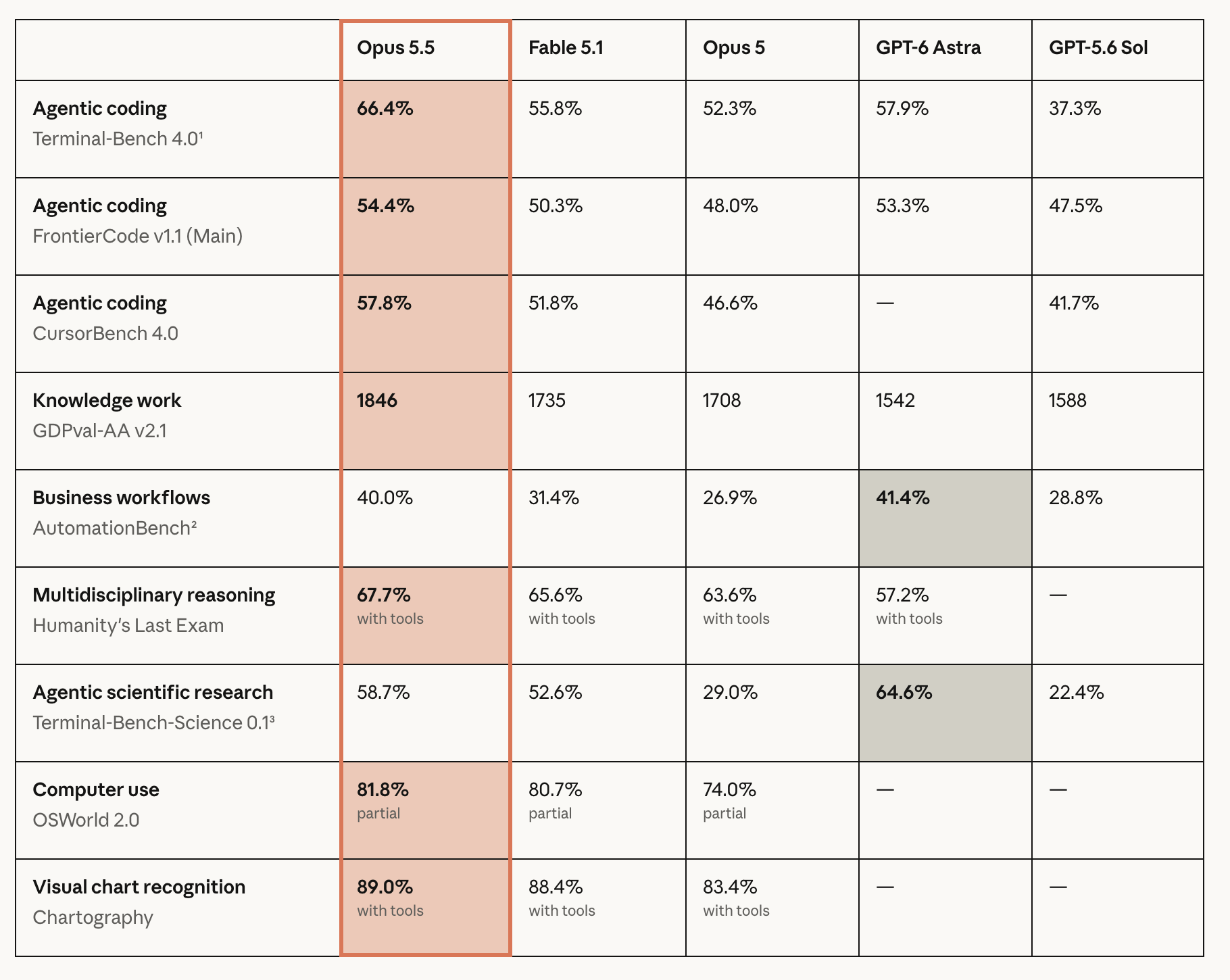
↗️ 📊 Opus 5.5 and GPT-6 Sol: Raising the Middle ☀️🌙
Claude Fable 5.1 came out just three weeks ago. Already, Anthropic says Opus 5.5 can do most work at Fable’s level, while costing 40% less to run than the previous Opus.
Over at OpenAI, GPT-6 Sol gets some of Astra’s advances at half the API price of the previous Sol.
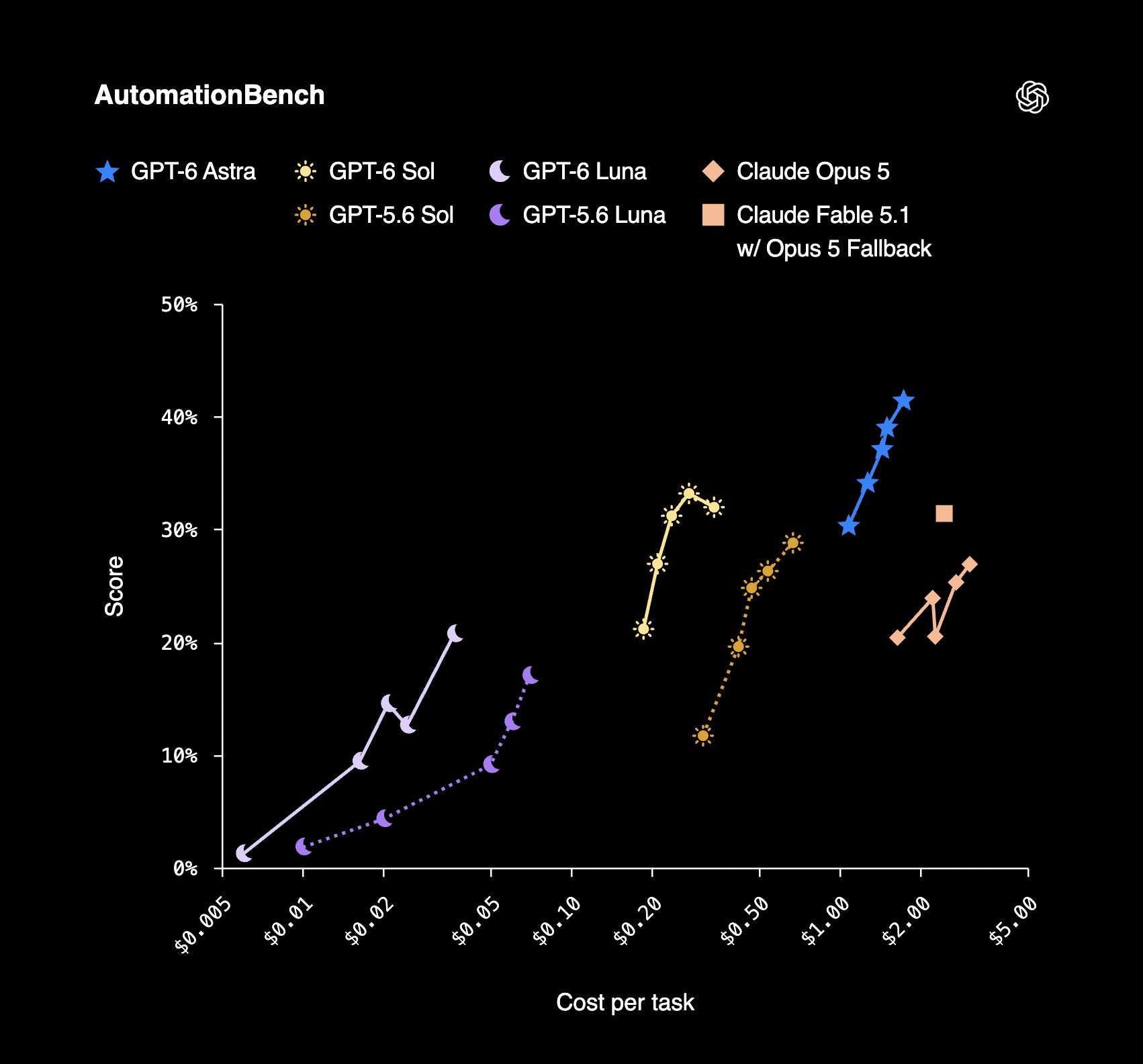
The best models are still out in front, but the middle is getting better awfully fast.
Now, a much broader set of people and companies can afford this level of intelligence.
I also like the focus on ‘factuality’:
On our internal factuality evaluation, which is based on de-identified real-world conversations where users flagged mistakes by our models, GPT‑6 Sol makes about half as many mistakes as its predecessor, approaching Astra-level reliability at much lower cost. GPT‑6 Luna also improves substantially; at higher effort levels it matches GPT‑5.6 Sol at about a hundredth its cost.
And look at this:
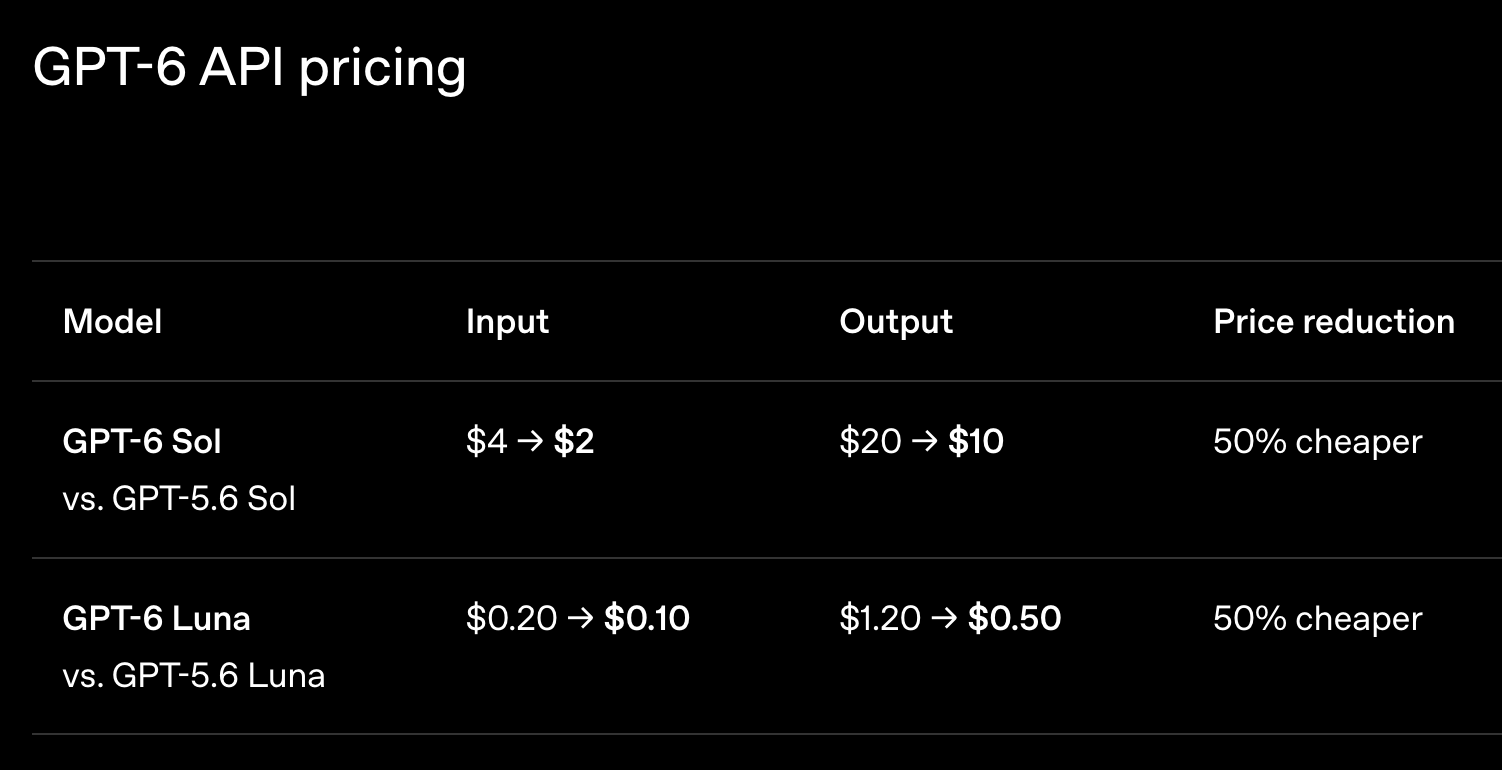
The sleeper hit may be GPT-6 Luna. On OpenAI’s internal factuality test, Luna at higher effort levels matches GPT-5.6 Sol for about 1% of the cost (!!!). 🌙
For less complex tasks, Luna 5.6 was already a great workhorse. So cheap that you could leave it set to Max, and it did a diligent job. Look at the improvement on coding:
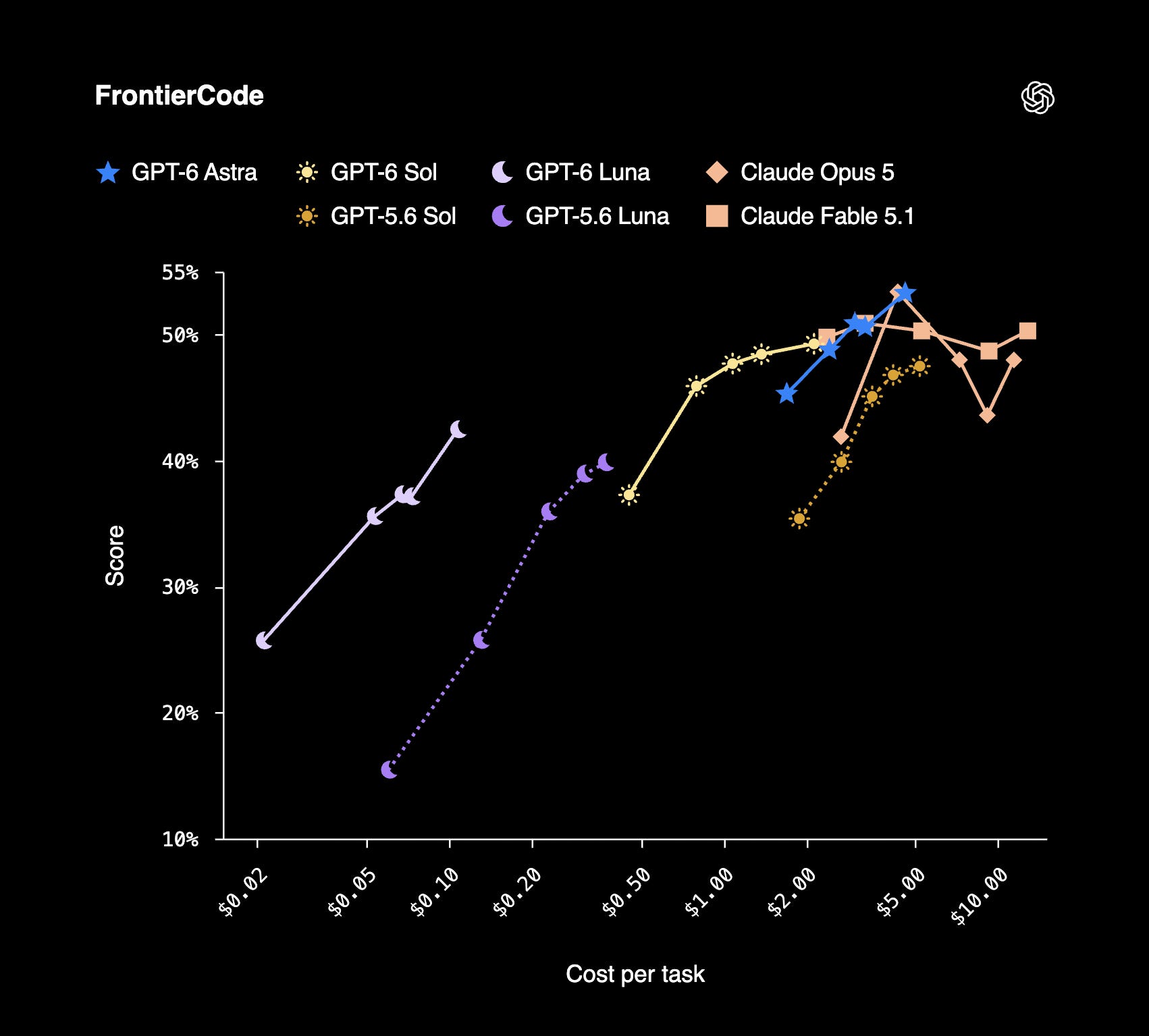
If they haven’t somehow screwed up Luna 6 in other ways and it’s truly significantly smarter at half the price, wow!
Another very impressive demonstration of the capabilities of this new crop of models is painting in Python:


These images were done in code, not using generative image AI or using an existing tool like Canvas or Photoshop or whatever. 🤯
🏅 OpenAI Says Its Unreleased Model Has Solved More Than 100 Long-Standing Math Problems
In Edition #660, I wrote: ‘More Math Breakthroughs Are Coming 🧮’
Well, we didn’t have to wait long!
On August 28, we began training a new internal model. In addition to resolving the Navier–Stokes Millennium Prize problem, this model has now resolved more than 100 long-standing open problems across most areas of mathematics. The pace of its progress in mathematics has surprised the mathematicians within OpenAI. This has led to internal discussions on the best way to inform the community of the rapid progress to prepare and adapt the field.
OpenAI is working with mathematicians to address some of their concerns with AI being used to solve very difficult problems in ways that may not necessarily lead to more human understanding (at least, that’s the stated worry.. It could also be a mix of loss of prestige and relevance for some 🤔).
When will we see the first Fields Medal or Nobel Prize awarded to an AI model (or most likely, to a person who heavily used AI for their work)?
🎨 🎭 The Arts & History 👩🎨 🎥

🎹 Amadeus: Imagine Competing With Mozart 🎻
I recently rewatched one of my favorite films, Amadeus (1984), with my kids. It was their first time and my... fourth? I lost track.
The movie is really Antonio Salieri’s story. Mozart says at one point, “I’m a vulgar man. But I assure you, my music is not.” That’s basically Salieri’s problem in one line. He’s a successful composer himself, and he has enough musical taste to recognize that this giggling, childish, vulgar guy is producing something he never could. He can hate Mozart all he wants, but every time he hears the music, he knows.
One of my favorite scenes is when Salieri remembers hearing Mozart’s Gran Partita for the first time. He walks us through it: a low pulse from bassoons and basset horns, then an oboe above it, then a clarinet takes over. And while he describes what’s happening, we hear exactly what he hears. F. Murray Abraham is incredible in the role. The guy who hates Mozart is also the guy teaching us why Mozart’s music is so good.
Watching Amadeus when I was younger sent me exploring Mozart and other composers. I hope it does the same for my kids.
The story began as a 1979 play by Peter Shaffer, who also wrote the screenplay for Miloš Forman’s film. Shaffer wasn’t trying to write a biopic and took some pretty big liberties with history. There’s no evidence Salieri tried to murder Mozart, and while they may have been rivals, they weren’t mortal enemies. They even collaborated on a piece. But Shaffer used the two composers to tell a story about talent, genius, envy, and a man who decides to pick a fight with God.
The other scene I love is near the end, when a dying Mozart dictates part of the Requiem to Salieri. Mozart is hearing the whole thing in his head and throwing out one part after another. A half-delirious Mozart is composing faster than Salieri can get it onto paper.
🎬 Amadeus (1984)
This piece was originally published in OSV Field Notes. You should subscribe, it’s full of great stuff!


Curious why you think Muse maybe more powerful than GrokBot or others, can see how Meta can make something very user friendly and the goals and feed tab sound quite interesting but not sure why it would be more powerful? Thanks