But each time I left a village, people warned me about the folks in the next place I was pedaling to: “You’re safe in our village here. But be careful when you get to the next town. There are some shady characters over there.”
I’d toss my saddlebags onto the back of my bike, pedal to the next village, and find myself smothered in hospitality again. When it was time to leave, I got the same warning.
—Porter Erisman
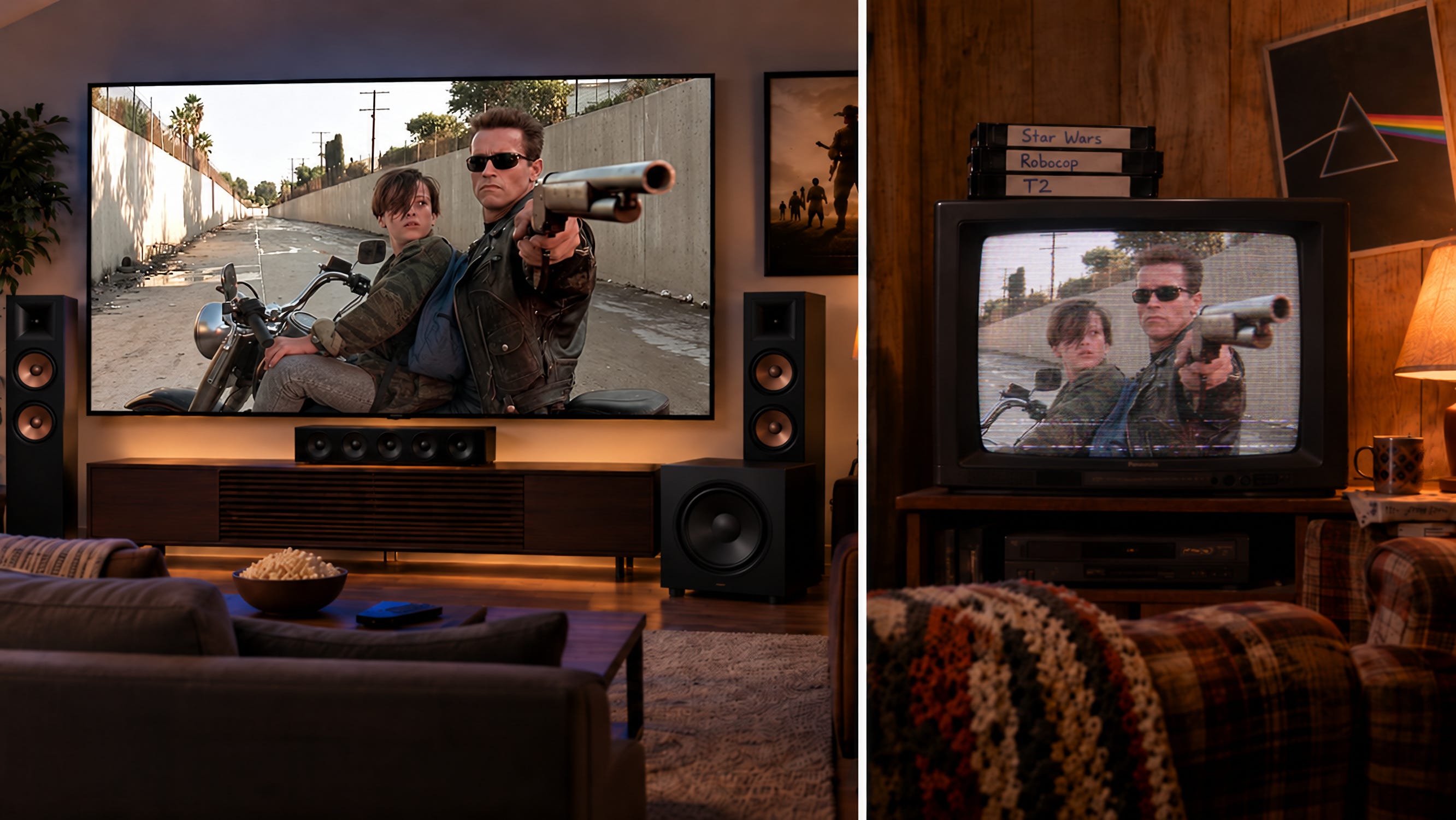
📽️ 📺 🎬🍿 I don’t know how old you are.
Maybe the worst screen you’ve ever had at home was a widescreen 1080p TV, but if you were born knee-deep in the last millennium like I was, you probably grew up watching things on pan-&-scan VHS, standard def 480i/p DVDs, and crummy cable TV signals.
One thing I’ve realized while rewatching old favorites with my boys is that I had never really seen or heard some of them properly until now. Some I hadn't watched in a very long time, and the experience has been so good that now I want to revisit a whole bunch more.
I told you that my boy and I have been watching Band of Brothers. Man, that’s *cinematic* on a big 4K screen with a good subwoofer. Same with Aliens, Die Hard, The Fugitive, Speed, Jurassic Park, Amadeus, Butch Cassidy & the Sundance Kid, Back to the Future, etc. Many of these I imprinted on growing up, but had never seen in theater or on a good home setup.
I can’t wait for my boy to be a bit older so we can watch Terminator 1 & 2, Donnie Darko, Saving Private Ryan, etc.
I guess this is just my reminder to you to revisit old favorites, especially if you have never seen them on a good screen with good sound. And of course, share the moment with your loved ones. We don’t go to the theater as often anymore, but family movie night — when it’s a really good one — is one of the peak human experiences, IMO.
💚 🥃 To keep this steamboat alive and afloat, I need supporters. Like you! 🚢
The paid subscription includes the full feed, every podcast, Zoom Q&As with me, and access to the private Discord clubhouse, where a core group of us hang out and discuss the interesting stuff we find:
🏦 💰 Liberty Capital 💳 💴
🌵🦙 Meta’s AI Comeback: From Llama 4 to the Frontier in 18 Months 🤖🚀
It feels like a lifetime ago, but Llama 3.1 (a high for the company’s AI ambitions) was just a little over 2 years ago, and Llama 4 (a low) was 1.5 years ago.
And now, Meta is releasing Muse Wonder and Muse Wonder Full (😅) and, at least based on the numbers and first impressions from those with early access, they are back in the mix with the frontier leaders.
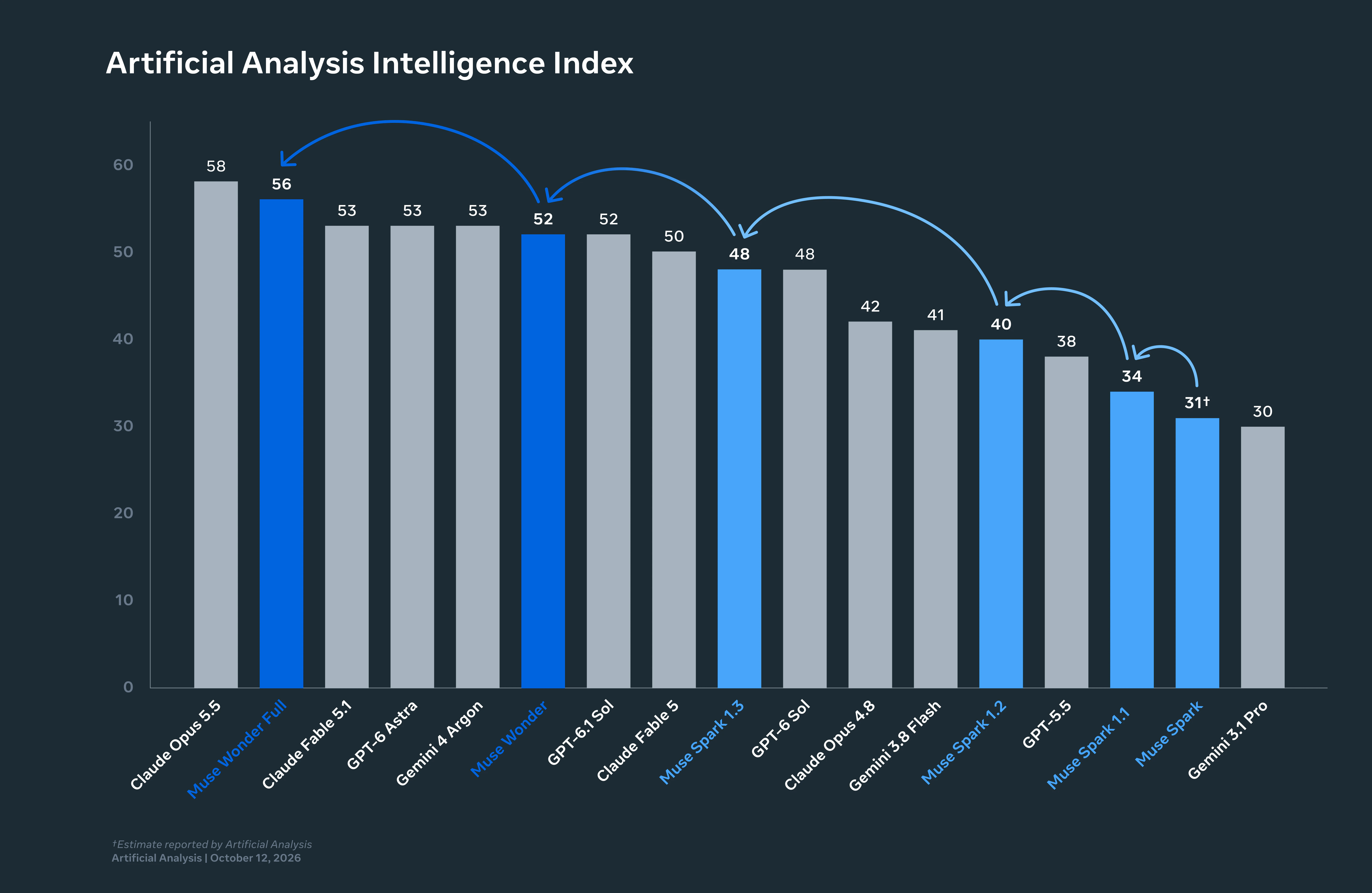
After the Llama 4 benchmaxxing mess, I can see why Meta would be extra careful with benchmarks this time. But maybe all that pressure to show results from tens of billions of dollars of investment makes them more tempted to optimize for benchmarks. ¯\_(ツ)_/¯
Either way, the independent results are encouraging, and I’m especially curious to see how Wonder performs in real-world use (I can’t wait to try it myself).
Another interesting change from the Llama days: when Meta released Llama 3.1 in 2024, Zuckerberg wrote that “selling access to AI models isn’t our business model.” Making powerful models widely available made sense when Meta could benefit from a bigger AI ecosystem and avoid depending on somebody else’s models for its own products.
But Wonder and Wonder Full aren’t being released with open weights (at least not yet). Wonder is available through Meta’s API and Muse Code, while Wonder Full is available to Muse Code subscribers. I’ll be keeping an eye on Meta’s open-source strategy, and how they decide what comes out (and when). 💾
Just last week, I wrote about how Meta was dramatically reducing its internal use of Claude. Wonder's coding results make that shift look a lot less surprising:
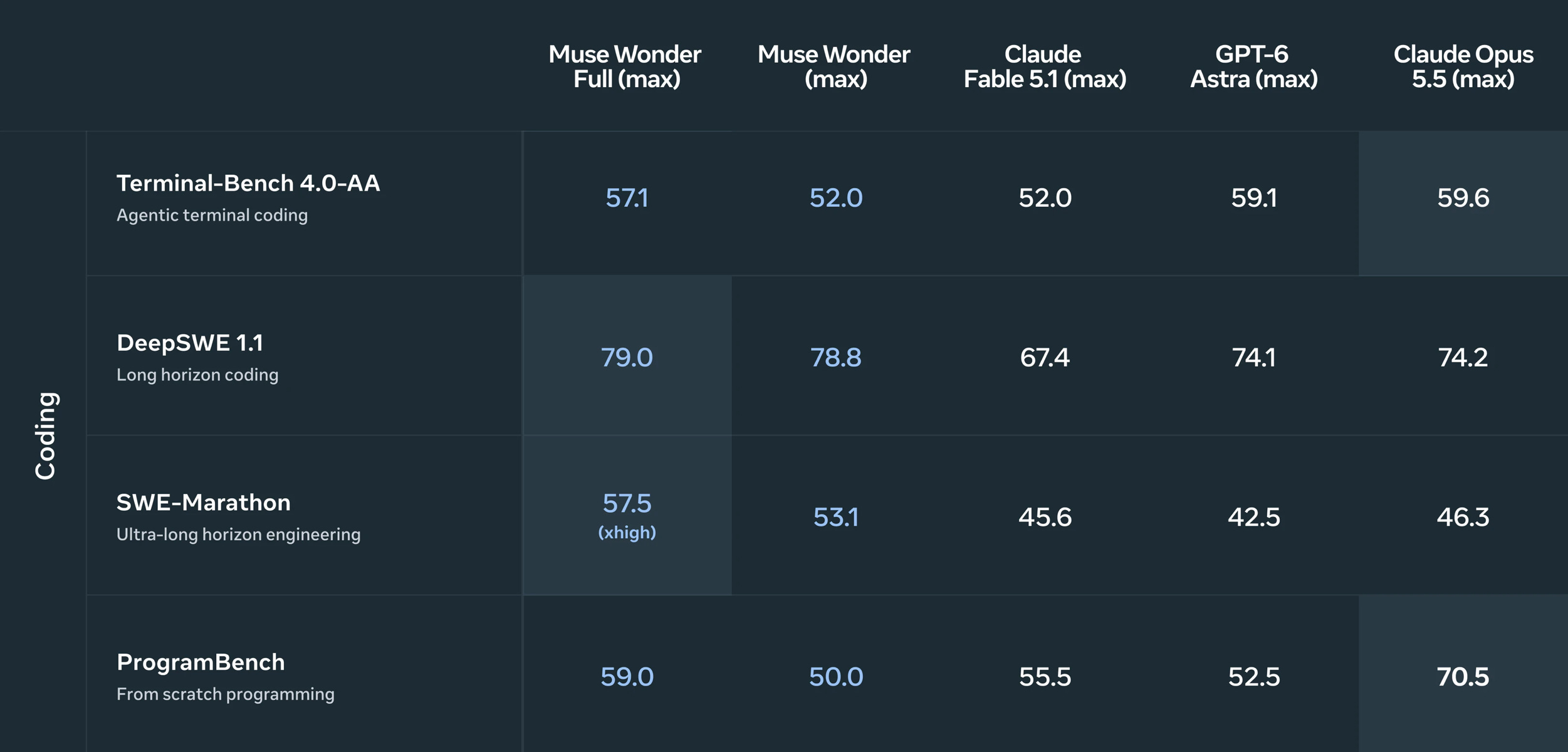
Of course, benchmarks are only worth so much… And in real-world use cases, the harness can make a big difference to engineer productivity and the ability to really get the most out of the model (especially if you have to manage swarms of agents on very long-running tasks).
But Opus 5.5 is considered to be ‘one of the good ones’, an extremely strong generation that was a leap forward. So landing in the same ballpark for coding not that long after Meta was barely in the race is EXTREMELY impressive.
And y’know what? While I’m sure they’re trying very hard to get great coding because a lot of what Muse can do is build apps for its users, they don’t seem quite as laser-focused on coding as Anthropic is.
Meta also has a pretty big advantage here: It’s one of the world’s largest software companies, so its own engineers can be a huge customer for its coding models. Even if Muse Code never beats Claude Code in the broader market, reducing dependence on outside AI suppliers could be very valuable. Of course, if Meta’s models fall behind again and slow its engineers down, that could cost more than it saves by not using Claude.
Their main focus seems to be the multimodal agentic use cases that a persistent assistant like Muse needs most, and on that front, Muse Wonder seems excellent (at least based on what we know right now).
Both Zuckerberg and Alexandr Wang (where did that missing ‘e’ go, I wonder) recently had a good convo with John Collison about it all, and while I recommend the whole thing, I want to share my highlights with you.

- 💰 Meta’s Other AI Payoff: A Few % of $230 Billion
Everyone keeps asking how they think they’ll be able to monetize Muse with subscriptions and taking a cut of various commerce transactions and such, but there’s another HUGE way that gets less attention:
Mark Zuckerberg: The other thing is that we use the models to accelerate our core business, right? So I mean, you have this core business that’s hundreds of billions of dollars and still growing extremely quickly.
And now, like, if you can grow it a few percent faster by using these models to accelerate these things, then that ends up funding a huge amount of this too as you’re scaling it out.
Of course, there’s no such thing as a free lunch, and the money invested in AI could probably have also helped the core business if it was invested in it more directly (or spent on buybacks when the stock was a fraction of its current price 😅).
But this stuff should certainly be counted in the returns from AI investments.
- 🧩 “The Model is the Product”: Software Design Moves Into Training
Mark Zuckerberg: One thing that we talked about from early on is that basically there is this pattern where I think the products are getting thinner and the model is getting to be more of the product, right? So one of the things that we say internally is, “The model is the product.”
When you’re talking about an agent, a lot of the complex product work that went into Muse is basically around the privacy and security model for handling your data and the things that get connected to it. […] But the capabilities, the personality, a lot of the stuff is like you’re training into the model.
An example of that just yesterday morning (before I had my coffee, so I wasn’t fully awake yet 🥱☕). I wondered how I could tell which model my own Muse was using, and for a second I was like where in the app can I see this, and then I realized, oh yeah, you just ask it and it tells you.
More and more product design is being absorbed by the model, because behaviors that previously required explicit settings, interfaces, and rules can increasingly be handled by the model itself.
A conventional application might have notification settings, priority rules, and a handful of hard-coded exceptions. An AI agent can just directly decide the urgency of the message, what you're doing, who's involved, and what it remembers about your preferences.
But it’s fuzzy! Getting that behavior right means teaching the model judgment, then testing whether it exercises that judgment across thousands of situations. But you can’t be certain it’ll do it next time, so part of the solution is also giving the model deterministic tools (a calendar, its own reminders, to-do lists, etc).
But some of the product designer's work is becoming the AI researcher's work.
- 🧠 💾 Active Memory: Remembering is Harder Than Storing
John Collison: What does memory mean in a model to a layperson? […] How’s it different from context?
Alexandr Wang: I think it’s in the experience of using the model. How well does it remember things that you mentioned to it over days, weeks, or months, and then leverage those in the process of doing future tasks? […]
So we’ve designed basically both the model and a system for the model to use to develop a much stronger form of memory. We call it active memory. […] So it’s aware of its memory as a core system. And it’s about how it’s able to leverage various sources to be able to conduct tasks in the future, as well as understand its ability to do compaction, how it should do that compaction most effectively, et cetera.
Active Memory is interesting because Meta is clearly treating memory management as a capability the model itself should learn, rather than leaving all of that work to external software.
One data point there:
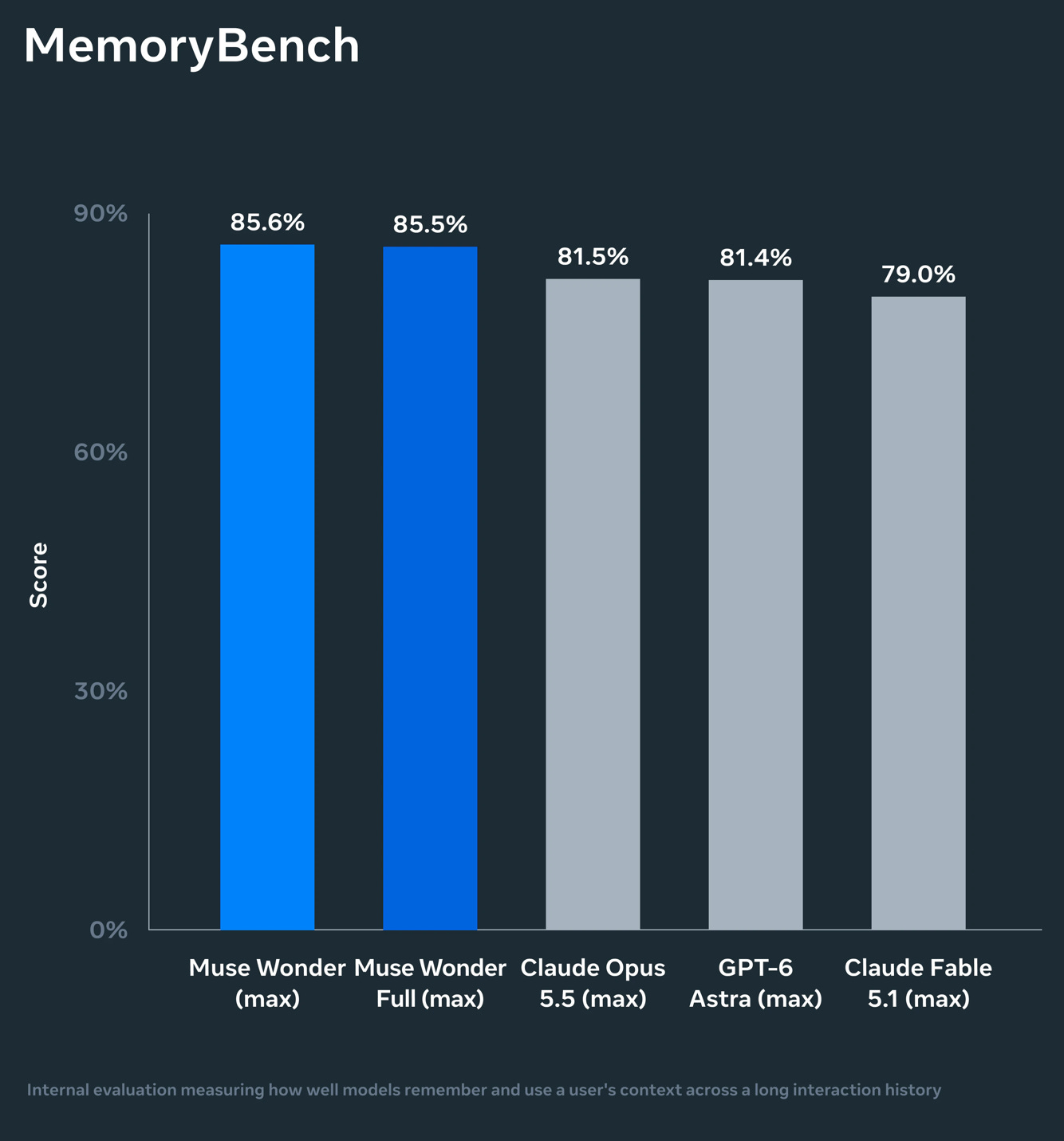
From the model card:
MemoryBench. MemoryBench is an internal benchmark that tests how accurately a model can recall critical information across long, complex multi-turn conversations of 64K to 100K tokens that span several individual facts, with distractor conversations and injected turns that conflict with or later update the target details. An LLM judge scores each answer against weighted, question-specific rubric criteria.
It's still an internal benchmark testing recall in long conversations, not proof that Muse will remember everything reliably over months or years, but it's a useful data point.
The thing to remember is that there can be a big difference between the headline numbers on context size, and the ability to make good use of all that context.
Having a million-token context window doesn't mean a model has a million tokens of *useful* memory.
This is especially important for an assistant that you use over months or years across all kinds of unrelated parts of your life, as opposed to a chatbot or even coding agent where most of the context is within a pretty clear number of source files or threads. Having access to a mountain of conversation history is all well and good, but in practice, it’s about remembering the right detail at the right moment, or distinguishing an old preference from a new one.
When compacting things, there are many decisions that impact how good memory turns out to be. This means that an improvement in reasoning ability may improve memory quality even without increasing the amount of storage. 🤔
That connects to something I wrote a few weeks ago: The Brain Is the Replaceable Part. My argument was that a persistent assistant could become hard to leave because of all the memories, connected apps, and recurring jobs you’ve built up around it, even if you can swap the model that runs it.
But replaceable doesn’t mean interchangeable. Two models could have access to exactly the same memories and still be very different at knowing what matters and when to bring it up. And as models get smarter, all that accumulated context could become more useful, even if you don’t add anything to it. Another case of old data getting better with age. 🍇🍷
If some of that context is hard to move to another assistant, better brains could actually make the one you’re already using even harder to leave. 🧠↔🧠
- 🤫 Discretion: Your AI Needs to Know When to Keep Its Mouth Shut
Mark Zuckerberg: One of the things that we talk about is this idea of discretion, right? So if you want to use the model to get something done, it needs to be able to know a lot about you and get things done in the world while disclosing as little as possible. [...]
Like, okay, how do you handle that? And I mean, humans have common sense and the models so far… If you’re building a coding agent that works in an environment where everyone has access to the same context, discretion isn’t particularly important.
That’s a good example of how personal assistants have very different problems to deal with than coding agents. The agent has to understand the difference between information it is allowed to know and information it is allowed to disclose, and that’s often not entirely clear cut, especially if the agent is working across different parts of your life (work stuff, personal stuff, various projects).
Of course, discretion also needs to be enforced by software outside the model. You don’t want your AI to merely know that it shouldn’t reveal certain information. You want some things to be impossible for it to disclose without your permission.
Meta has some relevant experience here from its work on WhatsApp’s end-to-end encryption, including with Signal founder Moxie Marlinspike. They're now working together again on Muse's privacy protections, but securing an AI agent that has access to so much of your life is a different problem.
I’m particularly looking forward to Muse Confidential VM, which is supposed to make it impossible even for Meta to access your private data. It’s still in limited testing, though. 🔐
- 🧑🔬 About 100 Researchers, Gigawatts of Compute, and One Giant Reboot
And finally, a bit more detail about just how small the team is at MSL:
Mark Zuckerberg: Talent density is the thing that matters. [...]
It’s basically you actually don’t need a massive number of people, but what you do need is for each of the people to be as good as possible, which informed this kind of crazy recruiting push and very intense filtering that we had to take some of the best people from inside Meta and a very intense process to get people from outside Meta.
But I actually think a lot of what has made MSL special and why a lot of people have wanted to join is because in some ways it’s just more fun to work on a talent-dense, smaller effort. It feels like the startup that’s operating. In some ways it has all the benefits of a startup with the stability and resources of a larger company […]
I think part of the reason why these models are doing well is because you have people who we’re betting on and they have a lot of resources because we’re taking our compute. We’re not peanut-buttering it across a lot of competing efforts. We’re basically just investing in the key people, a lot of compute per researcher, and then they can do their work. [...]
John Collison: So Meta is a huge company, but this is like a really tiny effort inside of Meta.
Mark Zuckerberg: Yeah. Oh yeah. The research team is less than 200 people.
Alexandr Wang: Yeah, it’s very small. It’s intentionally very, very tight.
Mark Zuckerberg: It’s closer to 100, right? And then there’s a bunch of infra folks.
Closer to 100!
That is a pretty unusual ratio of people to capital! 👥💰
The economic leverage of those researchers can be enormous. A better training recipe, a smarter experiment, or a decision not to waste a giant training run will affect the return on tens of billions of dollars of equipment.
🔁 Déjà vu:
The Brain is the Replaceable Part: Persistent AI Assistants Are Getting Harder to Leave
My Thoughts on Meta Muse After Using It for a Few Days Like a Maniac
Are OpenAI and Anthropic Better Businesses Than We Think? 🤔💡📈
My friend MBI (🇧🇩🇨🇦🇺🇸) has a great piece that I want to convince you to go read. It’s very thought-provoking, and helped put into sharper focus a lot of stuff that had been swirling in my head for a while (but not as precisely). I’ll share some highlights here, but go over there (do it!).
The basic idea is that he has updated his view on the AI Labs as businesses (or at least, how their downside is more limited than he thought, even as the upside is large, if hard to pin down). You know how much I love people who update their beliefs when they learn more, and aim to be well-calibrated!
What changed his mind was the impact of the levers available to the labs to “control and shape their destiny”:
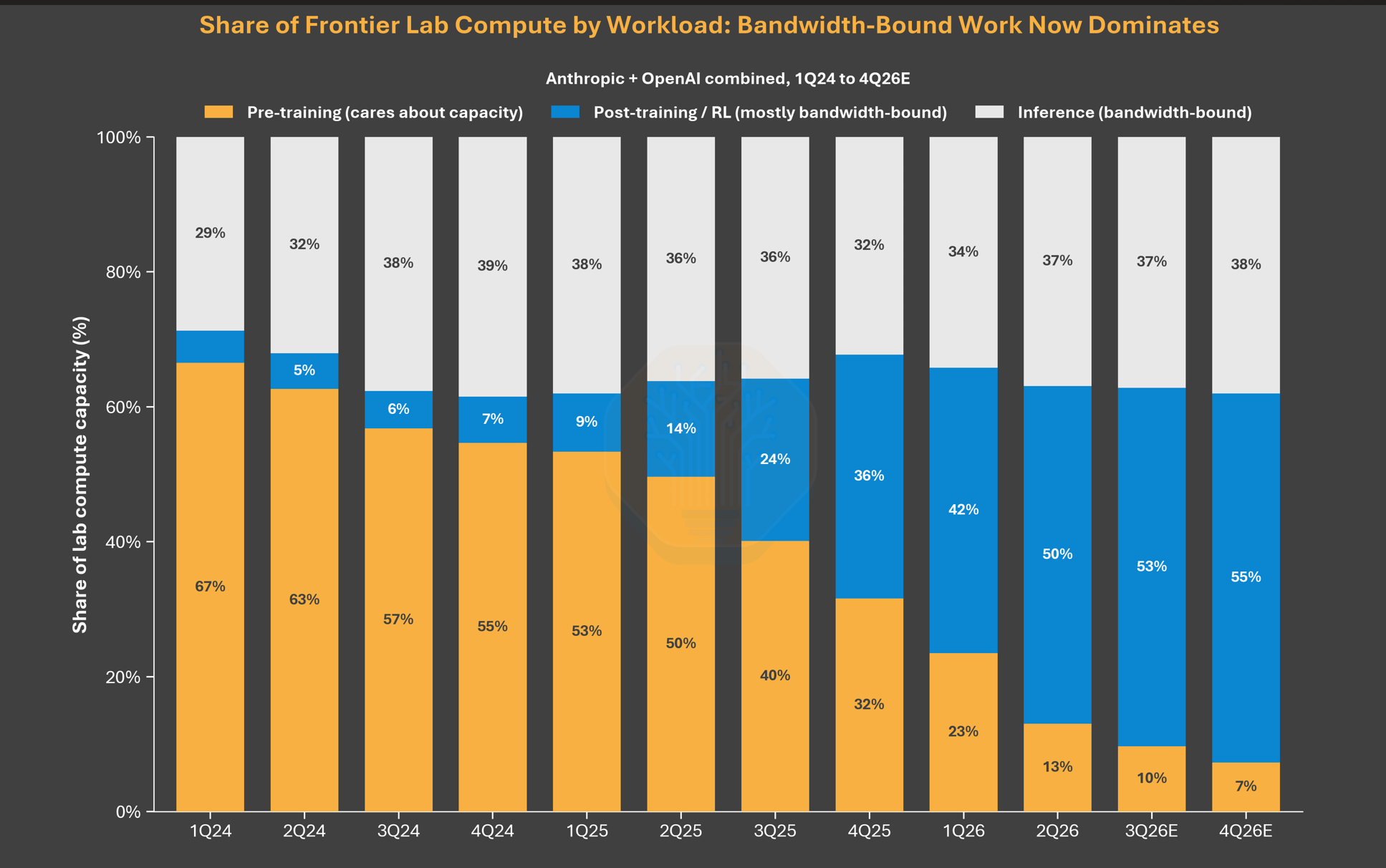
Pretty incredible to see the balance between pre-training and post-training shift so much in just a couple of years!
The first lever is how much of the fleet actually serves paying customers. SemiAnalysis estimates that for Anthropic and OpenAI combined, pre-training fell from about two-thirds of compute in 1Q24 to an expected ~7% by 4Q26, while RL and post-training rose to ~55% and inference stayed in the high 30s.
The financial implication is that RL involves a lot of inference-like work (generating model outputs), so it's much easier to repurpose some of that compute to serve paying customers. Giant pre-training clusters were much less flexible in that way.
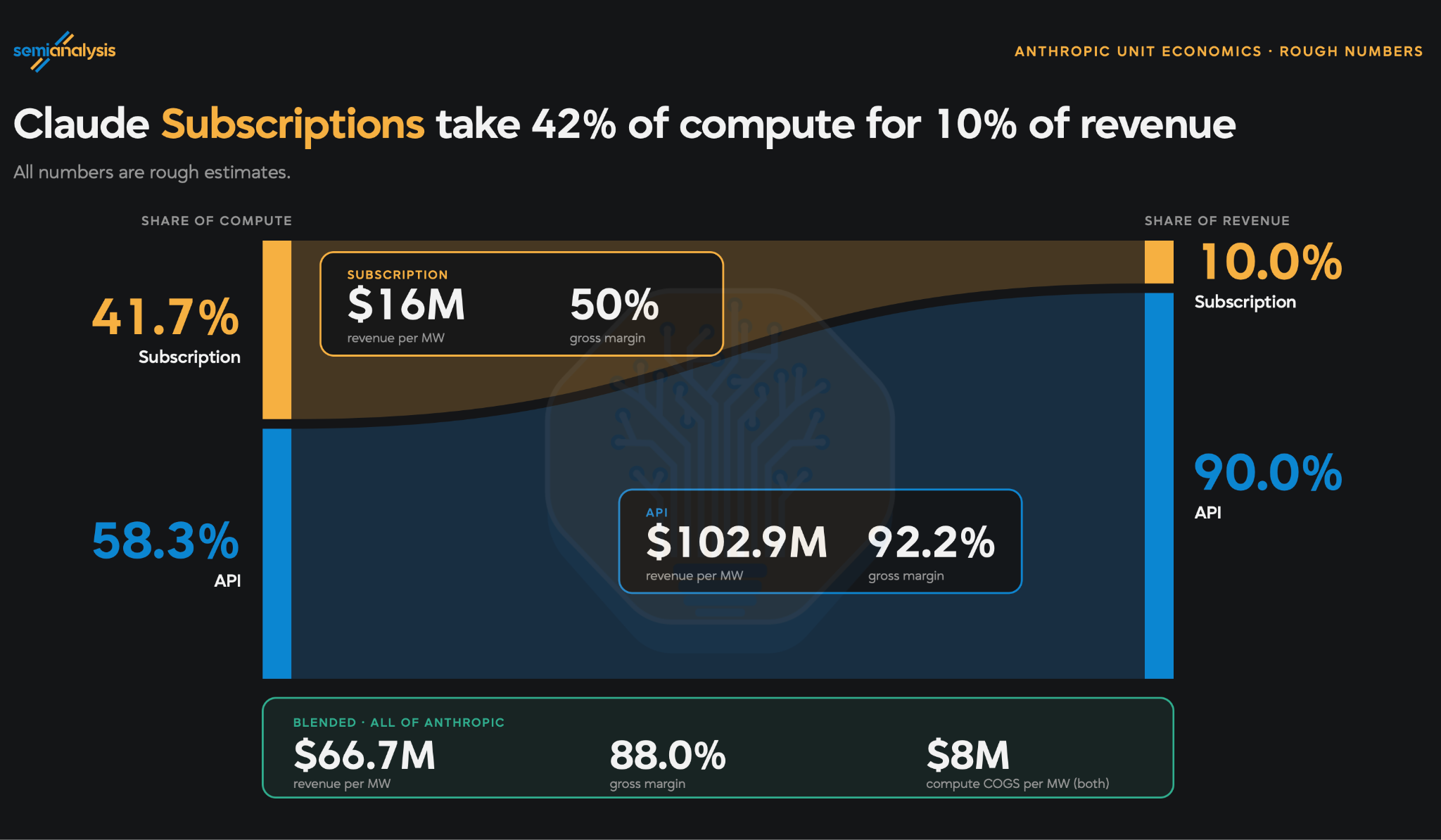
The second lever is the subscription layer. In its October piece on subscription limits, SemiAnalysis estimates Claude subscriptions take ~42% of Anthropic’s inference compute for just ~10% of its revenue. An API megawatt earns ~$103 Million at a ~92% (!!) gross margin; a subscription megawatt earns ~$16 Million at ~50%.
In MBI's model, Anthropic finishes 2026 with 5 GW of compute capacity, 41% of which serves customers, and a $100 billion annualized revenue run-rate. If it redirected enough capacity to increase that share to 60%, the same fleet could theoretically support a $146 billion run-rate, without buying additional hardware.
Similarly, if they reduced the subscription subsidy (aka discount over API pricing) over time so that subscriptions consumed compute in proportion to their revenue contribution, MBI estimates that Anthropic's existing end-2026 fleet could support a $150 billion revenue run-rate instead of $100 billion.
Those are two separate what-if scenarios. For his 2030 model, MBI assumes more modest changes to both levers.
Without the levers, 45% of Anthropic’s fleet serves customers in 2030 and subscriptions still use ~42% of serving compute for ~10% of revenue. With the levers, half the fleet serves customers (42% goes to training and research and 8% to safety), and subscriptions use 20% of serving compute for the same ~10% of revenue. Everything else is identical in both cases: a 25 GW fleet at the end of 2030, ~$10.5 Billion per gigawatt-year of compute cost, revenue-linked costs at 20% of sales, stock-based compensation counted as a cost, and API revenue per gigawatt falling 7.5% a year from today’s ~$75 Billion.
On those assumptions, 2030 revenue is ~$551 Billion compared with ~$362 Billion without the levers, and operating profit is ~$186 Billion compared with ~$34 Billion, a ~34% operating margin instead of ~9%.
Talk about powerful levers!
One thing that jumped out at me in MBI’s model is how much more room this gives Anthropic to withstand falling prices. Without these levers, its operating profit turns negative if API revenue per gigawatt falls more than about 10% a year. With both levers, that increases to about 19%. Even with a 12.5% annual decline, the model still produces a 22% operating margin.
So the labs don’t necessarily need today’s unusually favorable pricing environment to last. They may be able to absorb a pretty brutal price war and still make a lot of money. Assuming there’s enough demand for all that compute, of course.
The big question is how much the labs can fiddle with these knobs without giving up their lead in model capabilities, or ending up with more inference capacity than customers are willing to buy.
There’s also the question of how much flexibility the labs have over their actual spending. Reuters reported that roughly 80% of Anthropic’s $518 billion in long-term infrastructure commitments are payable whether it uses the compute or not.
So turning down training doesn’t necessarily reduce the bills. What it does is free up capacity that could be used to generate revenue instead. That's very valuable… as long as demand is there.
MBI goes through these trade-offs and a bunch of other interesting questions in the full piece, along with an interactive model you can play with.
From the full feed 🔒: OpenAI’s Missing $20bn in ARR (Sort Of)
🧪🔬 Liberty Labs 🧬 🔭
✋ The Structural Dampers on AI Buildout are a Good Thing..?
Gavin Baker posted some thoughts, and one stood out to me:
Finally, from my perspective anything that slows this buildout down is net positive over the long-term as the biggest risk and worst outcome is an *actual* overbuild.
We are structurally short watts, wafers and increasingly capital. That is all good. God forbid we were still in ZIRP, TSM ramped capex to 3x their current plan and we weren’t short turbine blades: there would almost certainly be an overbuild and a bubble. That would be terrible.
Slower and smoother for longer is better both for investors and for the world. A terrible cyber event is the most plausible near term bear case IMHO, but AI cyberdefense ramping quickly and I was happy to hear Sholto say that cyber probably becomes defense dominant in the near future.
It reminds me a little bit of TSMC as the accidental central bank of AI.
There’s certainly all kinds of risks right now, and almost all of them are ameliorated by having at least some bottlenecks and dampers in the system. It gives everyone more time to digest capabilities, do research into safety and alignment, deploy patches to vulnerable software (aka everything out there that has accumulated over decades), and it reduces the amount of leverage that is even possible to have in the system.
Because of competitive pressures and race dynamics, if it was possible for the big AI players to get more chips and more watts, is there any question that they would take them?
Of course, scarcity also helps protect the companies that already have chips, power, and customers. Less overbuilding can mean better utilization and pricing power (see the levers above), but also more expensive compute for startups and everybody else who wants to use AI. What’s best for investors isn’t necessarily what’s best for customers.
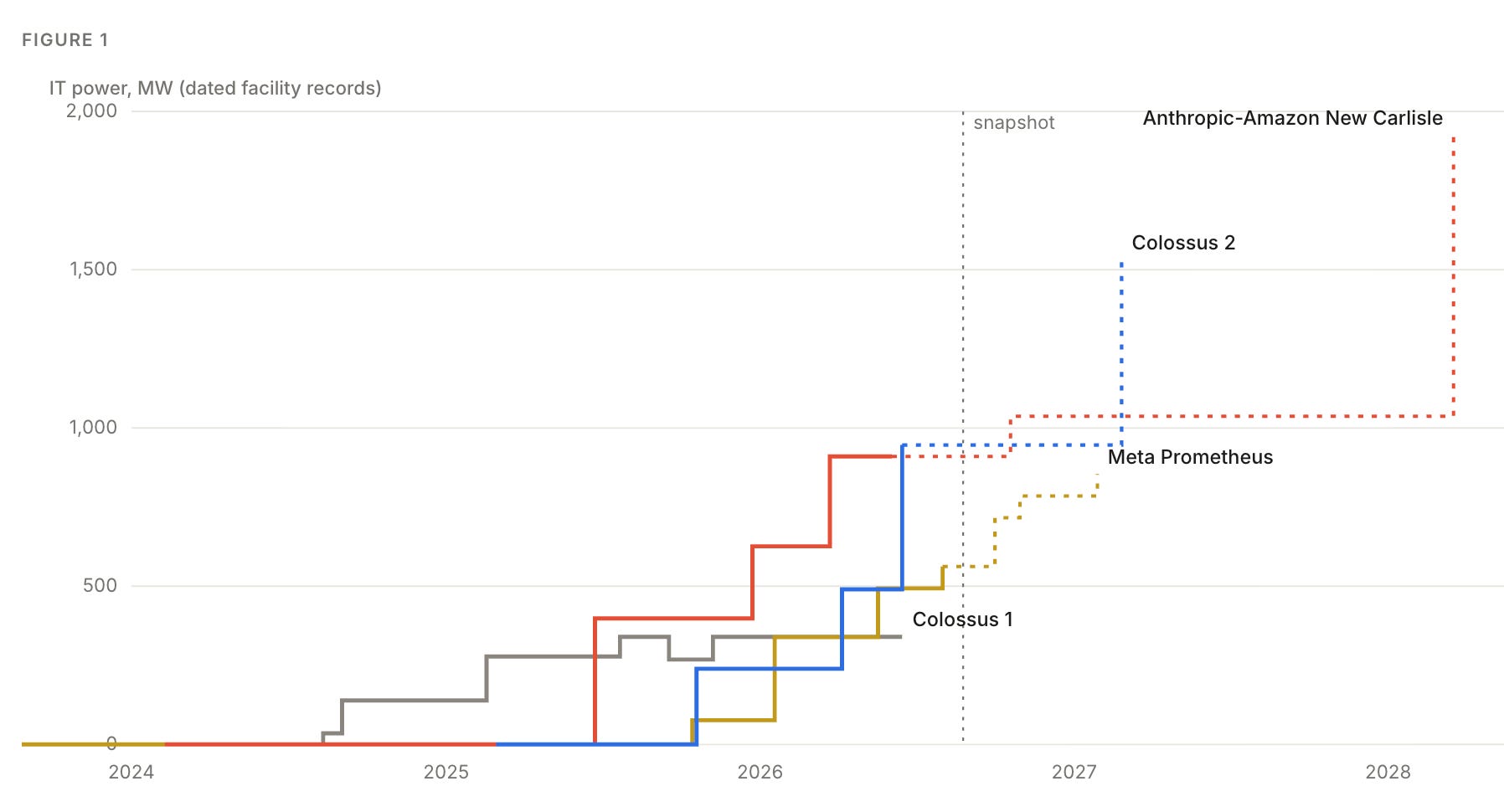
Speaking of AI’s physical infrastructure, MTS Atlas has a few nice ways to visualize it (see above 👆).
What the record shows
The largest facility in the record, Colossus 2, is estimated at 946 MW. All twelve of the largest facility figures are estimates.
Dated construction records show how quickly the biggest campuses can grow, in some cases reaching hundreds of megawatts of IT power within roughly a year, with one announced plan extending to 1,925 MW by 2028.
Official prices vary widely even for the same accelerator. H100 rates run from $4.57 to $18.37 per accelerator-hour across 155 catalog observations, a 4.0× spread within one hardware generation.
The four largest infrastructure spenders reported $425.2B of combined capital expenditures in their latest fiscal years, compared with $130.7B of depreciation. Much of today’s spending will reach the income statement over the useful lives of those assets.
Then we have clusters, which are required for training:
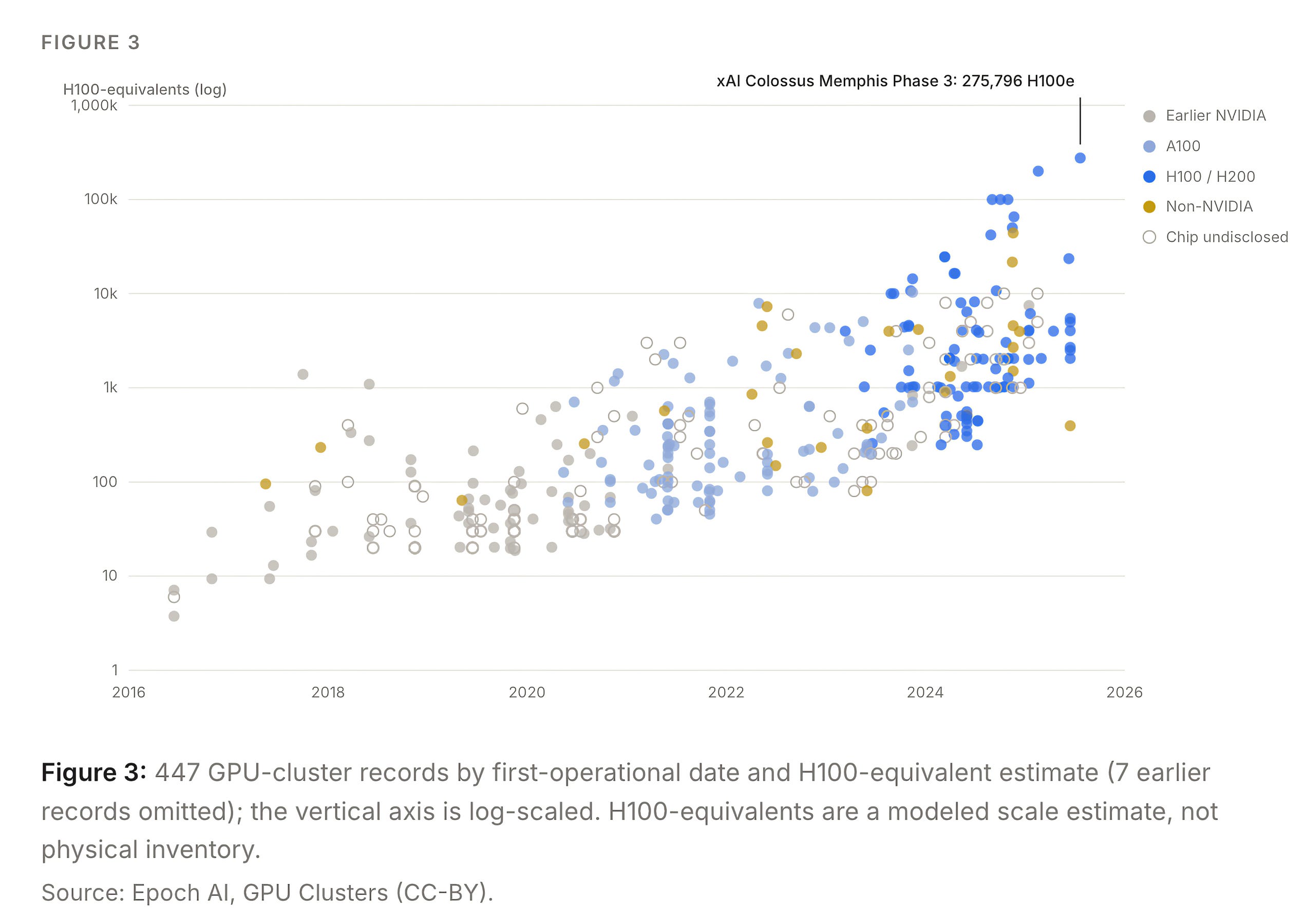
The above shows “every cluster record with a first-operational date and a scale estimate, 2016 to present.” They measure it in H100-equivalent units.
🔐🤖 Microsoft Patched More Security Flaws in One Month Than in All of Last Year
Microsoft just patched more than 1,400 security vulnerabilities in its October Patch release. That’s more than it patched in all of 2025! 😬 September had already set a new monthly record with 974 fixes, and now October just destroyed that.
It seems pretty clear that AI is a big reason why.
Microsoft has built its own system called MDASH, which uses more than 100 specialized AI agents to hunt for security holes in its software.
Its FORGE team helped uncover 140 Windows vulnerabilities patched between May and September, including 52 in September alone. We don’t know how many of October’s 1,400 were found using AI, but you can see how throwing this much automated brainpower at the problem could change things pretty quickly.
I’m glad to see this because the defenders don’t have that much time to harden everything before a big wave of attacks comes (🏴☠️). Windows is one of those high leverage things since so many computers run on it. Hardening Linux and MacOS are also very high-leverage points right now. So I’ve also been glad to see that Apple is shipping more security updates too and Linux is also getting patched (including by Microsoft’s FORGE team).
🔁 Déjà vu: Cybersecurity Reflexivity
🕵️ A Spy at OpenAI, and Buffett’s Cockroaches 🪳🪳🪳
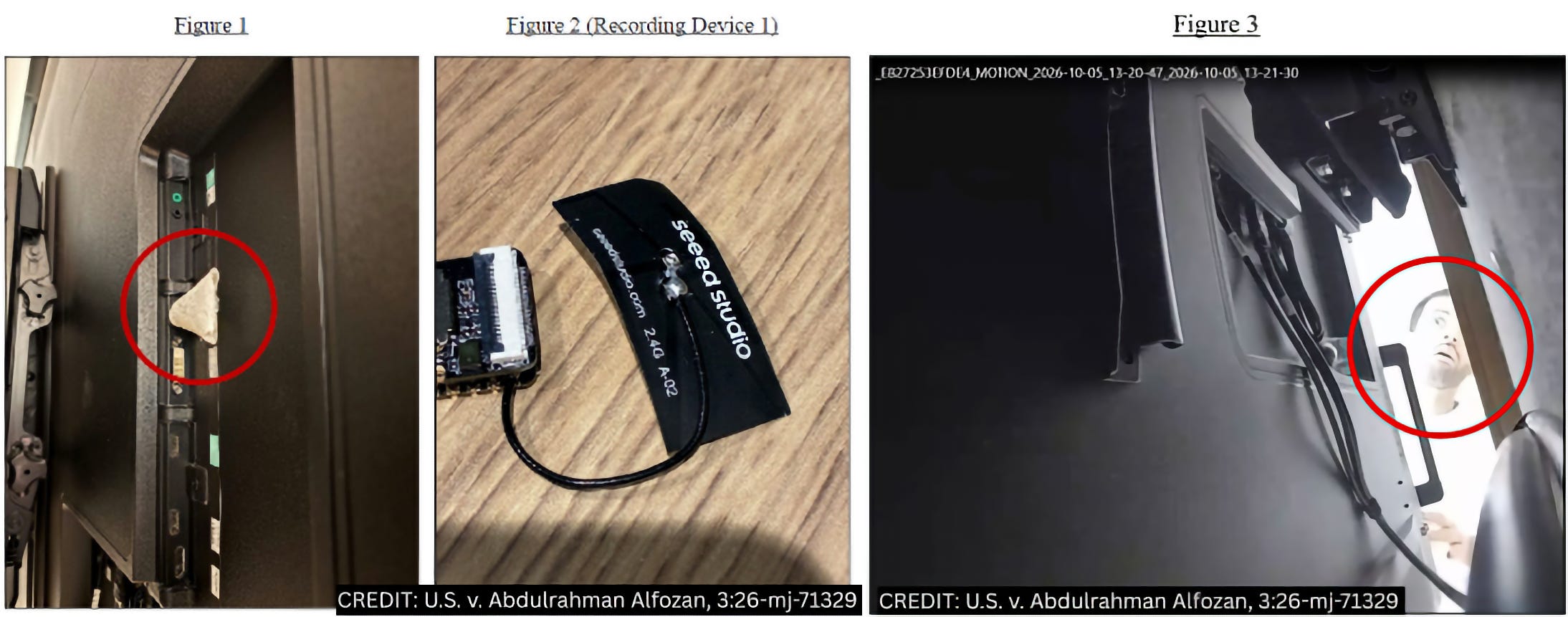
An OpenAI engineer has been arrested after the company found a secret recording device in an executive conference room. It was hidden in toilet paper and plugged into the USB port behind a TV. According to federal prosecutors, he’d been looking up where company executives met, and security later found another recording device in a bag he’d left unattended, along with his wallet and ID. 🪪 😬
It’s tempting to look at this and think: Wow, real-life spies aren’t nearly as sophisticated as the ones in the movies. They’re kind of dumb! 🤣
But then I think of Buffett’s old line from the 1989 letter: “never is there just one cockroach in the kitchen.”
Of course the dumb ones get caught. What about the smart ones?
Considering how many valuable secrets are concentrated in the frontier AI labs, how many other attempts have been made? How many have succeeded? And what have they managed to get away with? 🤔
From the full feed 🔒: Project Glasswing: 135,000 Security Flaws Found. Can We Fix Them Fast Enough?
🎨 🎭 Liberty Studio 👩🎨 🎥

Aliens Expanded: Five Hours Inside the Making of a Classic
I recently watched Aliens (1986) with my 12-year-old son (the extended version, with the sentry turrets!). Forty years later, James Cameron’s sequel still holds up remarkably well. If you haven’t seen it, you should check it out, of course, but what I want to recommend today is something else: Aliens Expanded (2024), a crowdfunded documentary by Ian Nathan that spends 282 minutes exploring how a 137-minute film was made.
Yes, almost five hours devoted to a single movie!
Nathan goes through the film scene by scene, with many of the people who worked on it: James Cameron, Sigourney Weaver, producer Gale Anne Hurd, Michael Biehn, Lance Henriksen, and many of the artists and technicians behind the sets, models, and creatures (sadly, Bill Paxton died in 2017). It’s great to meet the actors who play the marines and see how different they are from their characters.
I love the focus on why things were done a certain way. It’s an education in filmmaking.

One example: Cameron explains that the scene where Ripley enters the Alien Queen’s egg chamber came from a nightmare. He’d walked into a dark room and realized that the walls and ceiling were covered in wasps. If he moved, they’d attack. Cameron wanted Ripley and the audience to feel that same dread, so he slowed the scene down and stripped away the sound before revealing the Queen.
Then there’s the Alien Queen herself. Stan Winston’s team first tested the idea with a crude mock-up wrapped in black garbage bags. The finished creature was a 14-foot-tall puppet, suspended from a crane, with two stunt performers inside and nine more people operating its head, tail, arms, and legs using cables, rods, and hydraulics. Remember, there was no CGI cleanup! So Cameron had to compose the shots to hide all that.
After spending almost five hours learning how they made it, I kind of want to watch Aliens again.
I originally published this on OSV Field Notes. I encourage you to check it out and subscribe. I think you’ll love it.