


All the way back in the Paleoproterozoic era of edition #46, I wrote:
One thing that I always think about when the topic of many of the all-time-great acquisitions pops up is “how much was actually acquired and how much was built by the parent company after the acquisition”.
It’s too easy to say “Look, Google bought YouTube for $1.65bn and now it’s worth $XXXbn, so they have turned $1.65bn into $XXXbn!”.
It’s a hard question, because a lot of the time, even if not much is acquired and almost everything is built afterwards, *it may not have been built without the initial spark/prime mover that was the acquisition*.
But I think a lot of the time, too much value is assigned to the original acquisition, as if the same outcome was inevitable even without the deal. You hear about how they paid X for something and now it’s worth 100X, but it matters to the return if after the acquisition they invested 20X to get it there.
Would Instagram be Instagram if they had stayed independent? Would Booking be as big? Would YouTube or Android have won dominant positions as stand-alones? How about National Indemnity for a more clear-cut case… Probably ‘yes’ for some of them, but likely ‘no’ for others. It’s hard to untangle.
This question is interesting enough to dig a bit deeper into it, and into the various trajectories that I’m seeing companies take after acquisition.
You need to get a few things right to have a truly spectacular result:
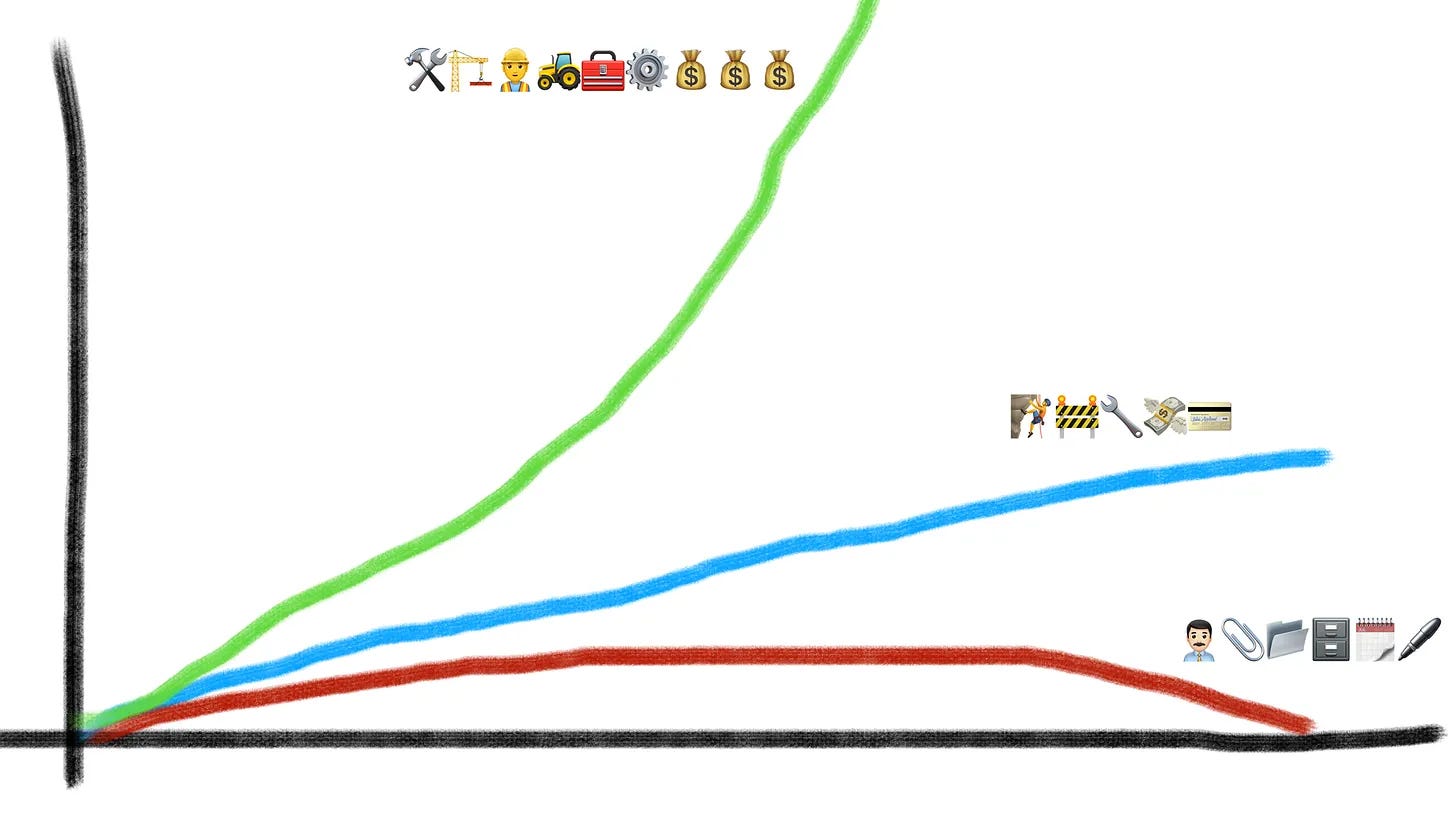
If you have a great company with a bright future (say the blue line above) that gets acquired by some large company that makes it worse than if it had been standalone (usually through bureaucracy, bad leadership, dilution of focus into the larger entity, inability to attract or retain talent, internal politics, etc — *cough* Yahoo *cough*), you can get the red line.
But if you have a company with real product-market-fit (blue line) that gets acquired by a company with a lot more resources, know-how, talent, missing pieces of the puzzle that are difficult to replicate, and good leadership that provides focus, you can get a turbo-charging that turns the blue line more into something like the green line (which is probably what happened to Youtube, Instagram, etc).
It’s not that these companies were necessarily always destined to do as well and become as big as they became — we’ll never know for sure without the ability to rerun history, but we can make informed guesses.
Instagram, YouTube, Android, Booking, etc
YouTube without Google was having trouble keeping up with the infrastructure needs of serving up all that video back in the day when bandwidth, storage, and CPU cycles were *a lot* more expensive than they are today, and few companies had true expertise scaling something that large globally. 🌏
They also didn’t have Google’s expertise with digital ads (targeting, customer self-service and auctions, etc)… So who knows what may have happened if the company had stayed independent (same for Twitch and Amazon).
Similarly, Instagram had great traction, but it didn’t have the ad engine to monetize, and who knows how Facebook may have decided to compete with it by building its own clone if it hadn’t been able to buy it (product matters, but so does distribution).
It’s very possible that Instagram may still have had great growth and success, but may have been a more Twitter or Snapchat-sized company rather than the juggernaut that it is today.
This is all just speculation, of course, but it’s the kind of framework I try to use when I think about historical acquisition — how much was acquired and how much was later built under the same name, but provided by the acquirer — and about new acquisitions — is this acquirer likely to nudge things in the green line direction, or the red line?
🧭 This first appeared in Edition 319 of Liberty’s Highlights. New here? I made a page for that: Start Here.
➡️ Read next: Every Company is Schrödinger’s Company — how the same facts can explain a stock rising 20% or falling 20%.