


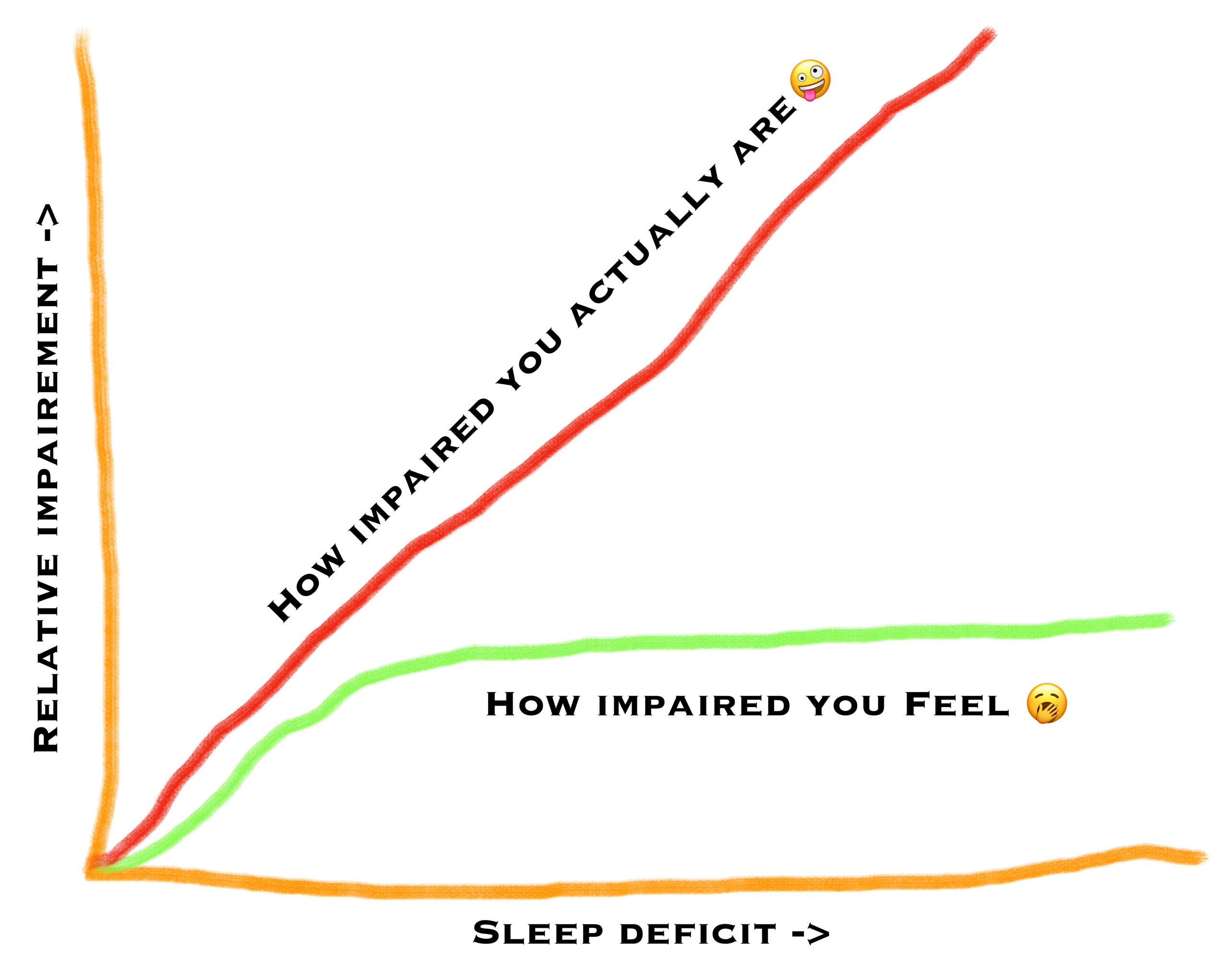
One of the strangest bugs in human OS is that the “how am I doing?” dashboard can break… while the needle is in the red, and you would need to know it most 📊
Most of us know what it feels like to be acutely tired. You pull one all-nighter (or get two nights in a row of awful sleep), and your brain feels like it’s moving through molasses. You can tell you’re impaired.
BUT
Chronic sleep deficit is sneakier.
A 2003 study took 48 healthy adults and randomly assigned them to get either 8, 6, or 4 hours of sleep per night for 14 consecutive days — or no sleep at all for 3 days straight. Everything was monitored in a controlled lab setting.
The results:
Chronic restriction of sleep periods to 4 h or 6 h per night over 14 consecutive days resulted in significant cumulative, dose-dependent deficits in cognitive performance on all tasks. Subjective sleepiness ratings showed an acute response to sleep restriction but only small further increases on subsequent days, and did not significantly differentiate the 6 h and 4 h conditions.
Here’s the part that should make you raise an eyebrow: by the end of 14 days, the people sleeping 6 hours a night were performing as badly as someone who hadn’t slept for two days straight.
But they didn’t feel like it.
Sleepiness ratings suggest that subjects were largely unaware of these increasing cognitive deficits, which may explain why the impact of chronic sleep restriction on waking cognitive functions is often assumed to be benign.
Your brain stops sending you the “I’m tired” signal, but the cognitive impairment keeps accumulating. It’s like a slow carbon monoxide leak: the damage accumulates while you feel nothing…
This is the trap.
Most people who chronically undersleep aren’t walking around thinking “I’m severely impaired right now.” They feel mostly fine. Maybe a little tired. And that’s exactly the problem: the subjective feeling of being okay diverges from actual cognitive performance, and keeps diverging the longer the deprivation lasts. You’re not fine. You just can’t tell that you’re not fine.
I think about this whenever I hear someone brag about only needing 5-6 hours of sleep. The data on genuine short sleepers (people with the genetic mutation who truly need less) suggests they’re extremely rare, way rarer than the number of people who claim to be one. My guess is that most people who “get by” on six hours have just acclimated to a state of impairment they can no longer perceive.
They’ve been driving with the parking brake on for so long, they forgot what it feels like without it.
🧭 This first appeared in Edition 611 of Liberty’s Highlights. New here? I made a page for that: Start Here.