


If you can't describe what you are doing as a process, you don't know what you're doing.
—W. Edwards Deming
🕹 I was chatting with friend-of-the-show and supporter (💚 🥃) Luis V. Sanchez about old Westwood Studios games (Dune 2! Command & Conquer!) and about the future of gaming, AR, VR, etc…
It reminded me of something I’ve thought a lot about over the years: how big an unlock for VR it would be if we could somehow hack our inner-ear in some safe, non-invasive, reversible way.
Imagine if in the back of the VR headset there was some type device that could somehow send signals to the nerves of your inner ear and trick them into either just turning off/nulling out during gameplay, or even better, over-writing with some signals that match what is happening in the headset.
This would be a game-changer (oh—puns, eh?).
Because otherwise, if a large fraction of the population gets nauseous when there’s too much movement and you can’t run around and have fast-twitch motion in games (unlike in non-VR first-person shooters and other action-adventure games), that’s a big limit on the potential of the tech as a platform. Who wants to teleport around in a FPS?
It's a chicken & egg problem, but if that's ever achieved in some lab, there'll be plenty of devs jumping on it afterwards to build an amazing VR future.
🧠 This isn’t a comfortable topic, but it’s true: about half the population has an IQ below 100.
How many people in your social circles would you guess are below 100?
If that number is much lower than 50%, it implies either overestimation, or that your experience of people isn't very representative of the overall population, and you should take that into account when you calibrate your model of large groups of people.
(and before you fire up that angry email, I’m not saying what you think I’m saying, I’m literally just saying what is written above, with none of the other baggage attached to this topic meant to be implied)
🚽 🪠 Follow-up on the thing about sewers from edition #163:
There’s so much of the world that most people never think about, yet is incredibly important and shapes our lives. Out of sight, out of mind.
I wish school-age kids were made to visit water treatment plants, power plants, garbage dumps/incinerators, industrial farms and food processing plants1, etc... 🤔
📖 A 🛀 thought about the Kindle Paperwhite: Why doesn't it have an ambient light sensor to automatically switch between light and dark modes, and dynamically adjust the backlight? Seems like an obvious thing to do with a 50 cent sensor that would massively improve the experience.
It sucks to turn my Kindle on in the dark and have it light up the whole room because the last time I used it was during the day. In fact, it’s even worse, because if it’s set to dark mode, it still lights everything up for a few seconds as it wakes from sleep.
The first Kindle came out 13 years ago. I can’t believe Amazon engineers haven’t had time to implement this… And people wonder why Apple’s culture of attention-to-detail for UX is a hard to replicate.
🍖 I love the pic below. It’s still trippy to see the NL out in the real world — part of my brain still doesn't really believe anyone actually reads it, because it’s just stuff on a computer screen.


One metric that makes me happy about with this project is how often a reader will tell their partner or friends about something they saw here, especially if it’s people who have no interest in finance.
Like, “hey honey, I think we need to buy a meat thermometer and there’s this new pasta shape I want us to try”. That’s cool to me.
💚 🥃 Thank you for your support, it means a lot.
And if you aren’t part of the club yet, it only takes 19 seconds and makes a big difference (if you’re on mobile with Apple or Google Pay, it takes closer to 3 seconds):
Investing & Business
Amazon Q2 Highlights
Just some stuff I felt like noting:
our 3P revenue continues to grow significantly faster than our online store's revenue. Third-party units represented 56% of our total paid units in Q2, up from a 53% mix 1 year ago.
Of course, 3P is much more profitable than 1P, especially if they also use FBA and buy ads…
before COVID-19, we've been growing at a revenue growth rate close to 20%. 2019 full year growth was 22%, and revenue growth for the first 2 months of 2020 was 21%. Once the pandemic hit and lockdowns began in March 2020, the initial growth rate jumped into the mid-30% range. Q1 of last year ended with a revenue growth rate of 27%. [...]
By mid-May of last year, we have made good progress to open up more capacity by adding hundreds of thousands of employees. This allowed our revenue growth rate to jump to the 35% to 45% range and remained at that level through Q1 of this year when we had 41% growth. [...]
Given all this volatility, it's useful to consider the 2-year compounded annual growth rate, which remains strong in the 25% to 30% range. Recall this compares to our pre-pandemic growth rate of 21%.
We've been fortunate to welcome more than 50 million new [Prime] members in the past 18 months
According to its annual report, Costco had 105.5 million members in 2020.
So from a memberships perspective, Amazon added about half a Costco in the past 1.5 year 🤯
Amazon advertising is innovating at a fast clip, launching over 40 new features and self-service capabilities in the quarter, making it easier for sellers, companies and authors to grow their businesses by helping customers discover their brands and products. ‘Other revenue’ increased 83% year-over-year in Q2, excluding the impact of foreign exchange, driven largely by continued acceleration in our ads business
There’s so much money going to slotting fees and endcap displays and such in traditional retail, it’ll really be a golden goose for Amazon for a while longer, I think.
For the trailing 12 months ended Q2, CapEx and equipment finance leases increased 74% versus the prior trailing 12-month period. [...]
we're adding a lot of capacity. If you step back, the Amazon-fulfilled unit volume, so that's the units coming out of our fulfillment centers, both retail and FBA, have doubled in the past 2 years.
AMZL, the delivery arm of our business, has more than doubled in that time period. [...]
It usually takes a multiyear period to tame those assets. And we've literally nearly doubled our network here in the last 18 months from a size standpoint.
Amazon Retail was big 2 years ago, but it’s now twice as big, at least from that unit capacity point of view. Incredible 🤯
[AWS is] now a $59 billion annualized run rate business, and that's up from $43 billion at this time last year.
we have had strong international results in the last 5 quarters or so. Noticeably, there have been positive operating income
Speaking of hyperscale clouds… I was idly wondering about this yesterday:
Which would be easiest to spin out, AWS, Azure, or GCP?
Which newly independent co would do best on its own (relative to the other) without direct mothership support?
Conversely, which mothership would be hurt most be the separation?
Chinese State Media: Videos Games = “Spiritual Opium”
As you can expect, shares of Tencent and NetEase didn’t like that.
China’s most valuable corporation fell as much as 11% after an outlet run by the Xinhua News Agency published a blistering critique of their industry. The Economic Information Daily cited a student as saying some schoolmates played Tencent’s Honor of Kings -- one of its most popular titles -- eight hours a day
Nothing like a moral panic to justify control!

I think the copywriting on “Spiritual opium” is quite good, because of the Karl Marx reference2, but I wonder what else they had on the cutting room floor..? 🤔
-Mental Heroin
-Cognitive Crack
-Cerebral Molly
-Emotional Fentanyl
Interview: Ali Ghodsi, Databricks CEO
I enjoyed this interview with the founder and CEO of Databricks (the Spark people).
There’s a great discussion on the differences between sales and engineering when it comes to culture and incentive.
If you’re in the trenches, maybe you only have to worry about your own group, but managers and CEO certainly have to be able to understand the sometimes very different ways these groups tend to think and the jobs that they have to do, and to create ways for the groups to interface well with each others.
There’s also great segment on the roles/tensions between sales and marketing, and how different org reporting models can create different problems. You’d think these groups would have more similarities than with, say, engineering, so this wouldn’t be such a problem, but he brings up really good points on how it’s easy to structure things in such a way that you hold back the whole organization.
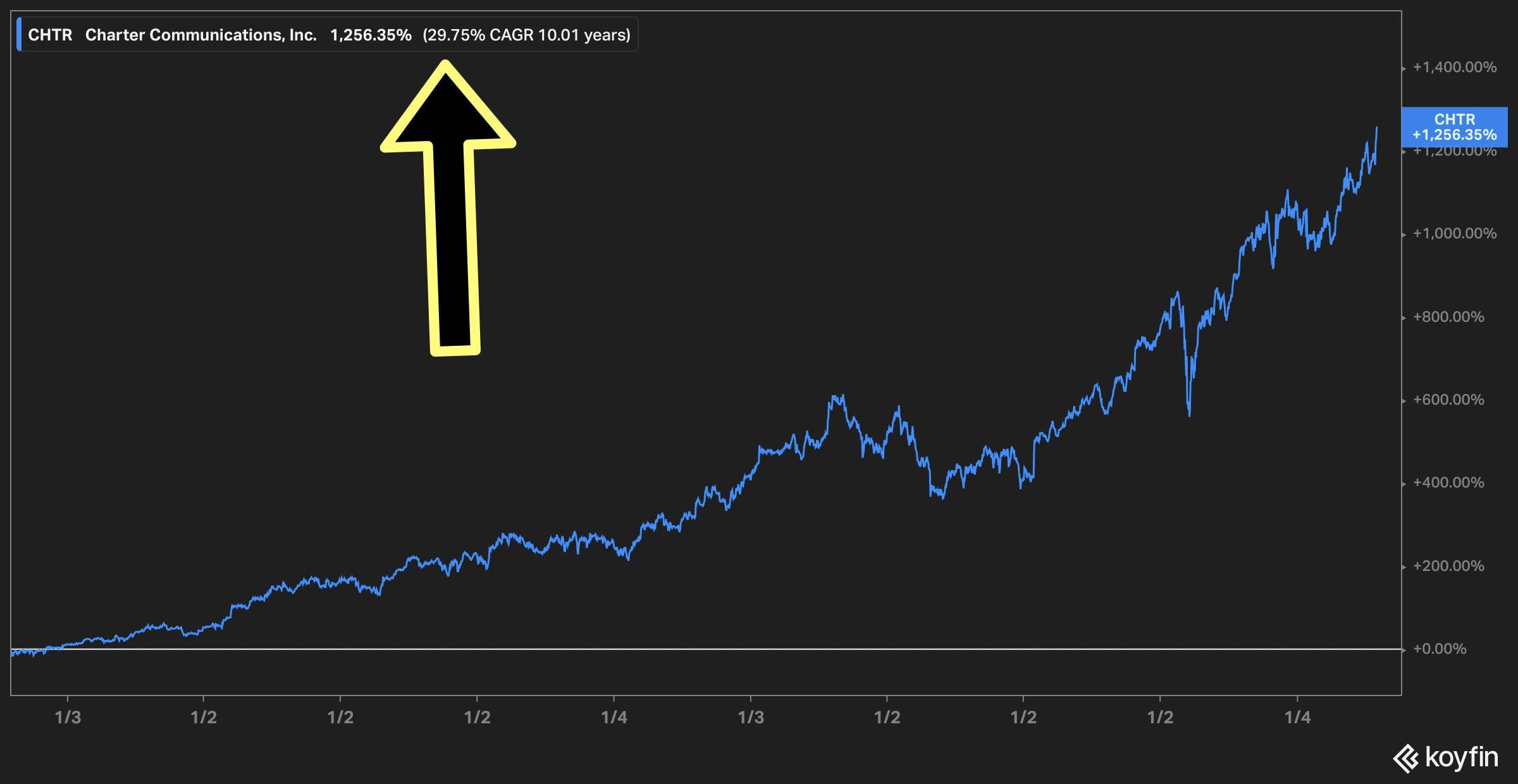
Boring cable company has a 10-year CAGR of almost 30%
Sanctions Accelerating China’s Semiconductor Progress?
Dan Wang in Foreign Affairs, ‘China’s Sputnik Moment’:
In the 1960s, integrated circuits were developed when the National Aeronautics and Space Administration was willing to pay any price for technology that could send astronauts to the moon and bring them safely back. Today, the U.S. government is putting Huawei in NASA’s position: a cash-rich organization willing to pay for critical components on the basis of performance rather than cost. Smaller Chinese companies that previously never stood a chance of selling to Huawei are now sought after as vendors, and they receive infusions of cash and technical expertise that will accelerate their growth. Private and state-owned chip manufacturers are ramping up their operations. Once siloed industries now collaborate in the service of tech innovation: the Chinese Academy of Sciences, for example, has begun coordinating regular sessions that bring together math professors and private companies. China is now undertaking a whole-of-society effort to improve domestic technology, specifically around what Chinese leaders think will drive not only economic growth but also geopolitical power.
h/t Extra-Deluxe (💚💚💚💚💚 🥃) supporter Byrne Hobart (sub required)

Working Age Populations, Demography is Destiny Edition
What a graph!
Wish it included India, though…
h/t Wall St. Dropout
Science & Technology

Tensor SoC: Google’s Pixelated Custom Silicon
10-11 years after Apple unveiled the A4 chip, it looks like Google will make its own custom ARM smartphone SoC for the next Pixel and Pixel Pro (pictured above).
I’m really glad to see this, because it makes the field more interesting, and the users of the devices win when there’s more competition and innovation (and right now Qualcomm isn’t competitive with Apple in silicon design — another reason why it may be cool to see Nvidia buy ARM and inject a bunch of cool IP and R&D capabilities in the mix).
It’s not entirely clear which parts will be custom and which will have been licensed. ie. the ML accelerator part is Google’s, based on work they did on the TPU but modified for the very different mobile thermal envelope, but the CPU and GPU cores may be more or less stock lego bricks licensed from someone else.
The camera bump — or is it a camera band, now? — kinda makes them look like a cartoon android, or maybe a hybrid of Robocop and that guy in Star Trek with the visor thing…

The full announcement is coming in the fall, but in this teaser, Google revealed the Tensor SoC, some of the camera details, and the fact that the screen will do 120hz and there will be a fingerprint sensor underneath, which is cool if it works well.
What I’d like to see in the next iPhone is the iPad’s “Pro Motion” variable refresh-rate technology ported over to the smaller screen. What’s cool about it is that it can ramp up to 120hz when needed, but ramp down to 60hz or even 24 or 30hz when either you need to conserve battery capacity or adjust to content that has 24 frames per seconds.
The Verge has some detail, but not a ton. Lots of marketing speak from Google, but the details will come later.
A Developer’s Life, Byrne Hobart Edition
I just really enjoyed this intro to friend-of-the-show and Extra-Deluxe supporter (💚💚💚💚💚 🥃) Byrne’s recent piece about Twilio’s second act (sub required):
Much of a developer’s life consists of being told to do the impossible by people who have no idea what they are talking about. Whether it is the Product Manager who can’t code or the CEO who thinks reading a16z’s content marketing makes him a technical leader; their idea may sound good but is usually unobtainable.
Sounds fun, eh?
Tour of MKBHD’s New Studio/Office
One of the biggest tech reviewers on Youtube built a new office/studio, and this is a tour of it.
The first 14 minutes are more an intro of the people and their roles, and after that it goes to the different rooms, their purpose and how they’re set up, the gear and technology, etc.
I thought it was interesting. Nice to see so many motorized standing desks — I still need to get mine ordered at some point.
Lots of Mac Pros — man, the amount of computer power and storage in that room, with all the NAS boxes everywhere (basically a bunch of hard drives stacked in a box, connected via network), must be pretty incredible.
Don’t know if this will interest any of you, but I like seeing how smart people set up their work environments. Especially since I’m usually all by my lonesome at home, in pyjamas.
The Arts & History

Homework: Paul McCartney & Rick Rubin Documentary
In the coming days (weeks? hard to find the time, sometimes), I intend to watch this 6-part documentary where producer extraordinaire Rick Rubin talks with songwriter extraordinaire Paul McCartney about his music over the years.
If you want to watch along, I’ll be posting my thoughts on it when I’ve seen it.
It’s like a book club, but for great beards and musicians.
McCartney 3,2,1 (2021, Hulu)

Studio Ghibli > Disney, for my kids
Recent Miyazaki gifts for the 3yo. He was really happy to get them!
He has watched Ponyo a thousand times, and Totoro and Kiki aren't far behind...
Maybe we’d get more pressure for reform on this system, and especially on the treatment of animals, if more people were aware of what is going on.
Full Marx quote: “Religious suffering is, at one and the same time, the expression of real suffering and a protest against real suffering. Religion is the sigh of the oppressed creature, the heart of a heartless world, and the soul of soulless conditions. It is the opium of the people”
Interview: Ali Ghodsi, Databricks CEO- This was really good. Ali telling his story about his life. And, the Q&A that they get into regarding hiring and tech company decisions. I own Snowflake [Databricks competitor], but I am now a HUGE Ali Ghodsi fan!
Working Age Populations, Demography- COOL GRAPH! I would love to hear/read someone provide a narrative around what the graph is telling us and more importantly, Why. I understand it on the surface, but why are the trends happening? And, I think there is a little statistics on statistics going on there. It is not a criticism, just me loving number clarity. It is looking at changes in rates of change. [I think.]
Put differently for example- Why is the data forecasting that the US continues to go up, and China is going down? I don't know if I was expecting that.
Smart people come rescue me with an attempt at an explanation. I will not hold you to it. We can call it a straw-person narrative.