


The point of modern propaganda isn't only to misinform or push an agenda. It is to exhaust your critical thinking, to annihilate truth.
—Garry Kasparov

6️⃣🎂🗓️🚢 Monday, July 20th, 2026, was the sixth anniversary of this here place.
Has it been 72 months already? 2,191 days? 52,600 hours? 3.15 million minutes? (ok, I’m stopping now)
When I started going clickety-clack on my keyboard, my oldest boy was 6yo, and my youngest was 2yo. As Dave Chappelle once said, I see my age in my children. I also see my age in this project.
You can’t live through all those minutes without changing.
It’s the old Heraclitean idea: No man ever steps in the same river twice, for it's not the same river and he's not the same man. And creating 640+ Editions does leave a mark (almost 700 if you count the podcasts, text interviews, and now Workbench issues…). My fingers may be callused from playing guitar, but after six years, my brain feels callused by this project (hopefully the good kind that allows you to play better and faster, but you be the judge of that 😅).

I recently came back from a family vacation. We went to Sandbanks Provincial Park in Prince Edward County, Ontario (🇨🇦). It has long, beautiful sand beaches on the shores of Lake Ontario and the largest baymouth barrier dune formation in the world.
A few days before we went, I watched Dune 1 & 2 with my oldest boy, so we kept making jokes about sandworms and Fremen popping out of the dunes. Just two nerds!
Ironically, I was extremely productive during my vacation. I can’t help it. When I have time to think, I have lots and lots of ideas ¯\_(ツ)_/¯
So I spent my days doing stuff with my family, or reading a book in the shade at the beach while the kids played nearby. And after everyone went to sleep, I’d pull out the laptop and work on various projects until past midnight. ☀️🏖️🌙💻
Among other things, I created a new post format for this Steamboat. I called it Liberty Workbench, and the concept is to let a single idea have more space to breathe.

So far, I’ve published two pieces. I can already feel how the format is shaping the content. I’m excited to do more, and they won’t all be philosophical like the first two. Some may be about a business, a technology, a film, a book, whatever I feel deserves a more thorough exploration.
Because I wasn’t thinking about the day-to-day, I had a chance to zoom out. I improved dozens of corners of the newsletter. Parts that I had not even thought about in years. The About page was dusty and full of cobwebs. I refreshed welcome emails, headers and footers. I created a Start Here page for new readers to discover favorites from the hundreds of Editions and thousands of pieces of writing in the archive.
Even if you’ve been around for a while, I bet you’ll find things you like on the Start Here page.
None of this happens without you, though. It’s not as fun if you’re alone, just a guy in pyjamas typing stuff on the computer up here in Canada. I appreciate you 💚🥃
So six years.
The next six would bring us to July 2032.
What will the world look like then? Who will I have become after 2,191 additional days of exploring, learning, thinking, and (hopefully) growing?
Who will you be?
💚 🥃 The paid subscription includes the full feed, every podcast, Zoom Q&As with me, and access to the private Discord clubhouse, where a core group of us hang out and discuss the interesting stuff we find:
🏦 💰 Liberty Capital 💳 💴
🇨🇳 China’s Open-Model Calculus: Open Today, Leverage Tomorrow 🧨
Ben Thompson (💚 🥃 🎩) had a strong piece on Monday, doing a 360-degree overview of Chinese open weights models and their impact on U.S. AI labs and national security.
Here’s one highlight:
The strategy for China is obvious: commoditize your complements. Note that Xi explicitly ties openness to AI “moving from the digital world into the physical world”; the physical world is the world dominated by China, and the country’s lead in areas like robotics is going to massively benefit from widely available AI models.
Along the same lines, China does not want the U.S. to gain an asymmetric advantage in AI; to the extent that China can weaken the U.S. frontier labs while strengthening any and all potential U.S. adversaries so much the better, and it can benefit from the innovation that will attach itself to an open ecosystem.
All this got me thinking about China’s approach, and to better organize my thoughts, I decided to write them out. I’m focusing here on potential downsides. A vibrant global open model ecosystem has many benefits, but that’s for another day. Keep this in mind, no pitchforks.
Also, I’m not assuming a single master plan. Much of this can emerge from separate actors following local incentives. But decentralized incentives can still add up to a coherent strategy.
Priority zero for the CCP is that they don’t want to be dependent on American AI technology. The logical conclusion is they need to create their own AI.
Strategy on the Supply Side
Because they don’t have a competitive domestic source of compute, they need to build up their own semiconductor supply chain. This takes time and aligned incentives (both sticks 🪈 and carrots 🥕), and in the meantime they have to make up for their lesser access to compute.
To be clear: lesser doesn’t mean small. There’s a lot of compute available to Chinese labs, across a mix of Nvidia GPUs they bought before export controls took effect (and even after that, enforcement seriously lacks resources), GPUs smuggled into the country, GPUs hosted in the cloud elsewhere, and, increasingly, locally designed and made GPUs and ASICs.
American labs won’t be buying Huawei Ascends any time soon, so the scale has to come from Chinese labs being incentivized or pressured to move their models over.
Distillation & Benchmaxxing
That’s still not enough to match the big American labs who are training models on as many of the latest GPUs and TPUs as they can get plugged in. So a lot of the gap appears to be closed through distillation of the frontier models, acting as a relatively cheap ingredient that makes the recipe better. 👨🍳
There are all kinds of ways to infer how certain models are distilling others, and Anthropic says it identified industrial-scale extraction campaigns by DeepSeek, Moonshot, and MiniMax.
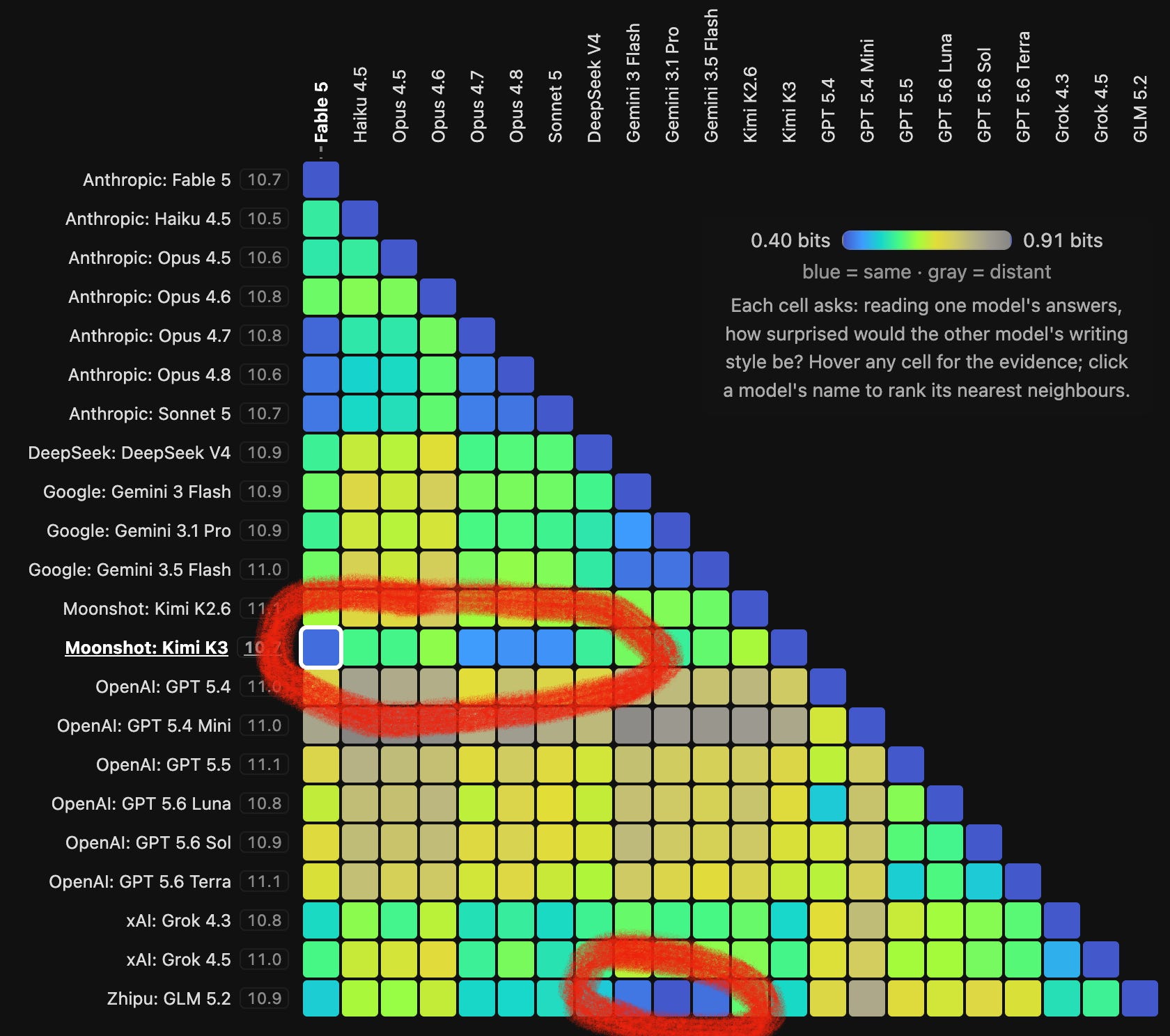
The above was made by Typebulb and is a clever one based on cross-entropy, using the stylistic fingerprints of each model to see which models sound like each other. You can see for yourself.
The two clusters I circled are Kimi K3 being most similar to Anthropic’s Fable 5, Opus 4.7, Opus 4.8, and Sonnet 5, and GLM 5.2 being most similar to Gemini (and also having a pretty strong similarity with Anthropic’s model too, though not as high as with Gemini).
I guess Claude was the favorite lately, because the stylistic distances from GPT are much higher ¯\_(ツ)_/¯
But Sol 5.6 just came out, so I wouldn’t be surprised to see stylistic similarity increase in future versions of open models.
The stylistic comparison between models doesn’t prove anything, but as one of many, many data points, it paints a pretty clear picture of a lot of distillation going on. I’m not saying it’s necessarily wrong. It’s a very rational strategy when it comes to sprinting up the trail as a fast-follower.
But it probably does make it harder to get past the frontier models that you're distilling and blaze the trail yourself, especially when combined with another thing that seems to be happening: Benchmaxxing.
A recurring pattern is that a lot of the Chinese models come out with amazing benchmarks, “Close to Fable 5!” Then users get to try them with real-world stuff for a few days or a few weeks, and the excitement dies down. They’re very competent, they’re very good, but in practice they are farther behind the frontier than just the benchmarks would lead you to believe. Or they are more expensive than the cost/million tokens make it seem because they are less token-efficient (this is one of the main criticisms of Kimi K3).
Benchmaxxing is also a rational strategy.
(To be clear, every model is optimized for benchmarks to various degrees, either on purpose or because some benchmark materials leak into training data. But some push it much further than others. The Llama 4 saga is a good example of that.)
If OpenAI and Anthropic are getting all of the attention, how do you convince users to switch and try your thing? There's friction there. You need activation energy. So you need to make a big splash and convince them that you're not offering a second-rate thing, but a first-rate thing at a really low price. And that's exactly the hype cycle with these models.
So that's the supply side.
Strategy on the Demand Side
The next part of the strategy is to release the models as open weights rather than try to compete with the big American labs with proprietary models.
Why?
"Commoditize your complements," of course. But what is the complement here?
China is behind at the model layer, but it dominates the physical layer those models plug into: robotics, manufacturing, hardware, and energy. The physical world is home turf. 🏭🏭🏭🏗️🦾
Driving the price of AI toward zero doesn’t just hurt the labs charging for it. It actively helps the layer where China is already winning.
That’s arguably the biggest reason. But there are two more that make open weights specifically attractive.
First, releasing strong models for free can hurt U.S. AI efforts. Any paid inference done on Kimi or GLM instead of Claude or GPT is diverting $ away from them, which they could reinvest in R&D and capex. 👨🔬
Not 1:1, because if you run Kimi on a U.S. hyperscaler, that money can still go in capex and stay in that ecosystem, but the dollar amounts are lower, and the labs are not getting it, so there are still fewer dollars going into U.S. AI progress.
The counterargument is that cheap models expand the market, creating workloads that otherwise wouldn’t exist and increasing demand for American clouds and Nvidia hardware. Both effects can be true. The question is which one dominates and which has the biggest effect on the rate of frontier progress.
Second, a widely adopted open model is a dormant asset in a conflict.
There are two ways to turn a model everyone uses into a weapon. The obvious way, and the smarter way. It looks like China is doing the latter.
The obvious one is to poison it: subtle vulnerabilities in the code it generates, backdoors, something that quietly phones data home (🏴☠️). The trouble is that going full black-hat is a one-time move. You eventually get caught and the models get banned, and you’ve spent all that hard-won adoption on a limited exploit, and probably not at the time of your choosing. So now you’ve got no access and no trust.
BUT
The patient version is scarier: just ship genuinely good models and don't do anything nefarious with them.
Sure, censor Tiananmen and Winnie the Pooh. Whatever. But nothing that would justify a ban. The models are free, they're good, they keep improving, and they work their way into many corners of the Western IT stack (in ways that are probably impossible for anyone to track).
Then, if a real conflict ever comes, you can decide to stop shipping. Freeze the weights, stop releasing updates, and let the pain ripple out through everything that depends on these models.
Sure, they can keep using the last version you shipped (can’t unring that bell 🔔). The weapon isn’t a kill switch. But it’s control over the upgrade path. At AI metabolic rates, any model version will age quickly, and whole industries built around these open models risk falling behind. In normal times, this may not matter too much, but I assume this card would be played in a conflict situation (🃏), where a few months could be decisive.
The second-order damage matters too. For years, those free, excellent models were soaking up the oxygen (aka token share/revenue) that might otherwise have gone to Mistral, Thinking Machines, Nvidia Nemotron, and the rest of the Western open ecosystem.
When you pull back, whatever's left to fall back on is weaker than it would've been if you'd never competed at all. That’s what ties reasons 1 and 2 together: flooding the zone with free models is what almost assures the fallback is weakened at the exact moment you'd want to pull the rug. And it cuts both ways: the same flood that weakens Western alternatives has been strengthening China's own ecosystem through usage data (on APIs), evals, better-tuned models for various hardware stacks, code contributions, etc.
Then again, this is partially self-correcting. The moment the threat gets legible, the West’s incentive to de-risk kicks in: the more credible the embargo looks as a weapon, the more reason the West has to build the fallback that defuses it.
Bringing It All Back Home (and I don’t mean the Dylan album)
So it looks like: growing AI independence, a maturing domestic chip industry with built-in demand, a cheap fast-follower pipeline, revenue drained away from rivals, cheap AI flooding the physical-world layer where China already leads, and a pressure point you can flip later. As a bonus, it makes you look great as the “open” one, the rebels fighting the “closed” empire.
I've described this as if there's a war room in Beijing directing the playbook. There probably isn't one, or at least, not one masterminding the full thing. A lot of this is just separate actors following local incentives: labs chasing benchmarks to get noticed, companies picking the cheapest good-enough model, the state wanting off American tech.
But the dots can connect whether or not anyone's coordinating them.
See also:
Steve Jobs Fired Two Board Members for Agreeing With Him 🍎🥾🚪

Friend of the show David Senra (📚🎙️) had a great conversation with Ed Catmull:
I recommend the whole thing (and Creativity, Inc.), but one thing Catmull said stood out:
Ed Catmull: Pixar was a public company for 10 years, starting in ‘95, when we went public, until 10 years later, when we were acquired by Disney. In that 10-year period, Steve fired two members of the board of directors at Pixar.
The reason he fired them was that they never disagreed, and he said, “If they don’t disagree with me, then they aren’t bringing any value to the company.”
That’s an unusual way of thinking, and he really believed that. Our board meetings were lively; they were loud, and they were thrilling. And you know, we made great progress.
The rest of the people on the board had very strong opinions, did not agree, and Steve loved that. And I would say, a lot of executives probably say they want that, but Steve really meant it. He and I disagreed a lot. We didn’t argue. We disagreed, and we’d have week-long discussions about something.
And in the end, about a third of the time, I would realize he was right, and about a third of the time, he would realize I was right. But the other third of the time, I just did what I wanted, and he was fine with that because we had discussed it.
What’s the actual goal of doing this?
If you do it because you love the jousting and drama, you’ve copied the ritual but not the reason. Feynman would call it a cargo cult.
The disagreement isn’t the point. In fact, I can easily imagine some bosses mangling it and applying this anecdote mechanically, incentivizing reflexive contrarianism and making the collective thinking worse.
Disagreement is a means, not the end. It’s useful *only* when it surfaces something the room would otherwise miss.
Catmull explains the distinction:
Ed Catmull: The whole point is, how do you get to the insight? How do you surface things? Because it’s hard to get underneath things. I would say that a lot of people like to go down one layer. […] You can’t do that. You’ve got to keep peeling away the layers to figure out what’s really underneath it. […]
And getting at underlying factors is inherently a long-term strategy, and it’s a difficult one […], and you need different mechanisms within an organization in order to get to better insight. [...]
[T]he discussion is always about the topic. It isn’t about who’s right.
Sometimes going deeper is a pleasure. Sometimes it means uncovering one delight after another.
But sometimes going deeper is painful.
Sometimes it means admitting you were wrong. Maybe admitting you were wrong in public for a long time. Maybe it means admitting you’re not as smart as you thought you were, and you should be listening more to other people who are smarter than you.
Hope for delight, but be ready for humility.
👨💼📋 A Tale of Two Cities Workforces, AI Edition 📁🖇️
Noam Segal and Lenny Rachitsky surveyed about 6,000 people across product, engineering, design, research, marketing, and other tech roles to see how the vibes are out there (and how they compare to last year, this being the second year they run the survey).
They did a podcast where they discuss the results in depth:
My takeaway is there’s quite a severe bifurcation out there, and the vibes are very Yin Yang.

Some are having the time of their lives. They’re more creative, they can do things they couldn’t have before, and they can go out of their silos and touch more things (designers writing code, engineers doing design, etc). They are exploring, learning fast, and growing.
Others feel burnt out and anxious. Like any productivity gains just mean they’re expected to do even more, keep track of more things, ship more PRs per day, review more projects in parallel, work 24/7 because agents never take breaks.
The line that stood out to me from the podcast was “full gas on neutral.”
Noam Segal: One explanation, for example, is that at the top of the pyramid, VPs are benefiting more from AI because they’re getting all of this stream of information and knowledge being processed by AI, making their jobs a lot easier, whereas ICs are each scrambling to build all of these micro SaaS products within the companies they work for.
No one knows what anyone else is doing. There’s a lot of duplicative work. It’s a lot easier to build products these days, but a lot harder to maintain them. And so I think a lot of ICs are feeling like, there’s a saying, full gas on neutral.
You are pushing the pedal to the metal in your car, but you’re in neutral gear, you’re not going anywhere. I think that’s the feeling that a lot of ICs are having these days with these technologies. I keep building these things, but I’m not having the impact I want. Everyone else is building too.
There’s lots of confusion, and it’s just not worth it anymore.
This disconnect is dangerous.
Those having a ball should do more to connect with the other side, to understand and empathize better. Not only because it’s the right thing to do on a human level, but also because all this resentment and negative energy will probably be harnessed by those who will promise to fix it all, and these politicians may not do it in a smart way and end up doing more damage than good.
Personally, my life is incredibly richer thanks to these tools. I do dozens and dozens of queries per day about various projects or questions that pop into my head, or things I don't understand, or problems around the house that I can find fixes for. I learn faster than ever before.
I even find I'm a better parent to my kids because I can explain more things to them than just what I already know. I can find intuitive explanations about all kinds of things that I may not take the time to Google and research and synthesize otherwise.
So I probably fall more on the excited side of it.
But, as it always is, life is more nuanced and complex than that. It doesn’t mean I don’t have worries. It doesn’t mean I don’t feel the uncertainty. It doesn’t mean I don’t wonder what my kids will do to earn a living when they’re grown up. And it doesn’t feel great to not have answers and to just hope for the best.
Part of it is the illusion of certainty. The past was also very uncertain, but looking back makes it seem like it was on rails and everything was simple and obvious all along. Still, it’s probably true that during fast-moving technological transitions, uncertainty ratchets up even higher than normal.
The way I look at it is a bit like this Venn diagram that my wife has in her office:
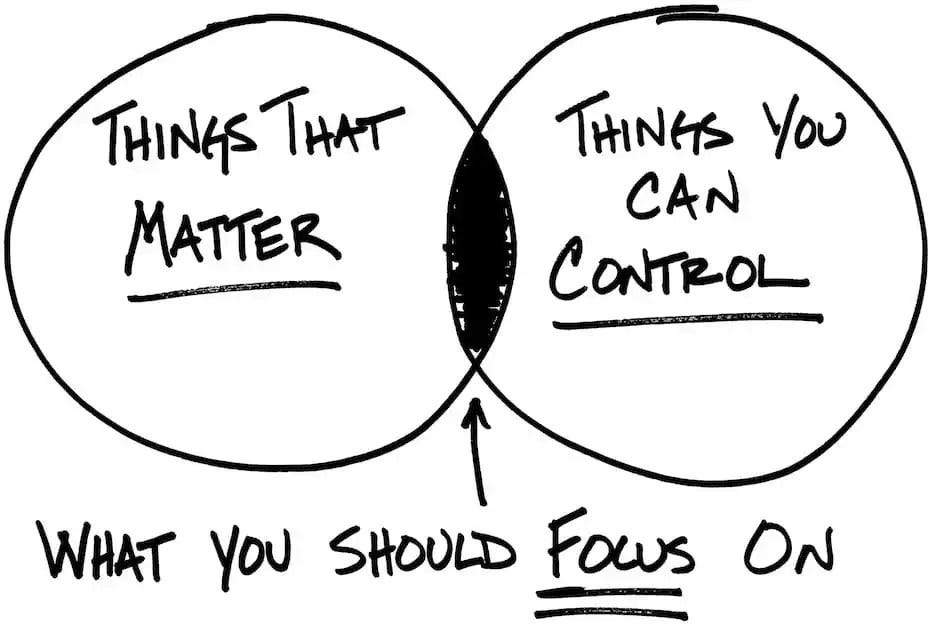
All of the potentially bad things about AI, all of these uncertainties, I can't really do anything about personally. I can observe the field, but I don't have impact.
But all of the good aspects of this, I can harness in my life. I can use these tools to explore, to teach myself, to help my kids.
My oldest boy has been vibe coding a 16-bit Nintendo-style video game. I've advised him a little bit, but he's mostly been doing it by himself. When he doesn't know how to do something, he can ask the AI to explain it, and then we discuss what he learned together, and I give him some advice. But I let him execute it, I don’t want to do it for him. It's like having both a tutor and an engineering team on call… as a 12yo!
He's having a blast, and I'm very proud of him. I'll write more about the specifics of that project at some point in the future.
But that's just to say that if I decided not to use AI just because of the negative aspects, I would be missing out on some of the great aspects, punishing myself, yet not really having an impact on how things unfold at the macro level.
🧪🔬 Liberty Labs 🧬 🔭
📽️ IMAX 70mm is a Lost Art?! 🎞️
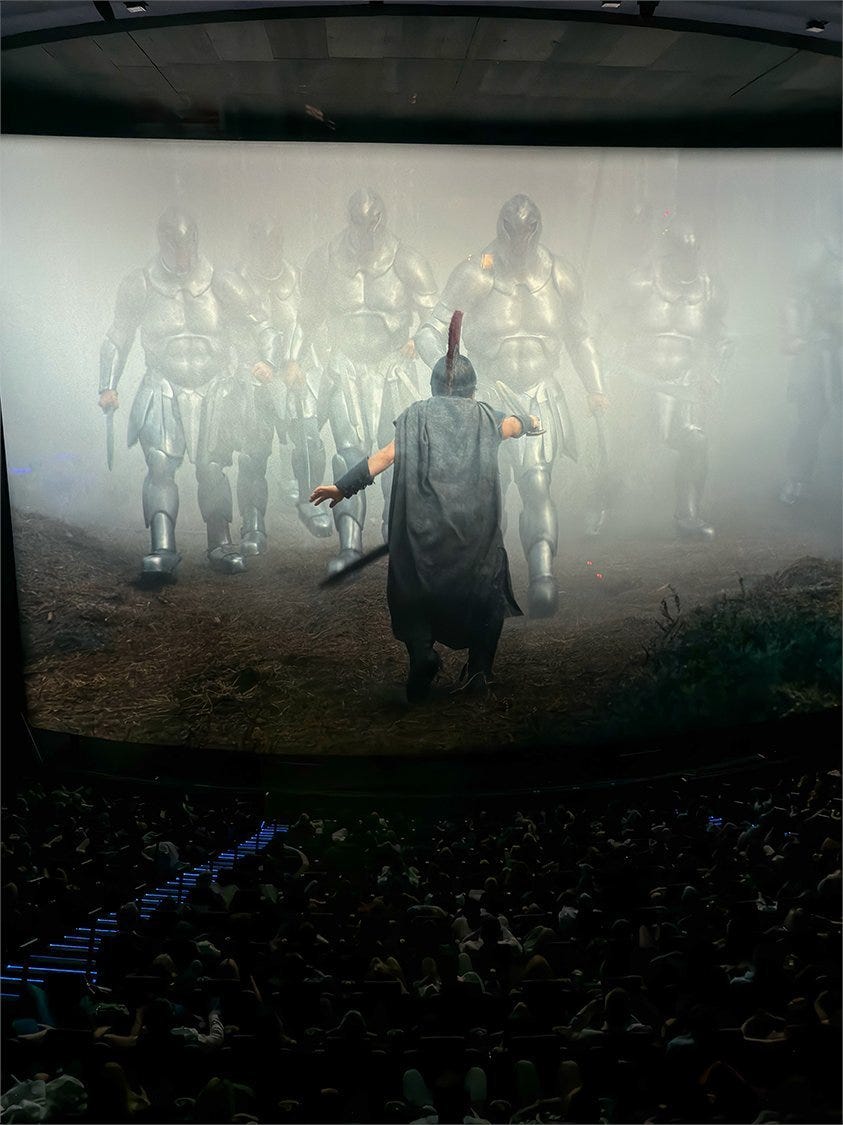
I haven't seen The Odyssey yet, but I keep hearing about the experience of seeing it in IMAX (my friend Ed was just telling me he’s going for a second time). And I fell down this rabbit hole about how the very best version of IMAX is a lost art that we don't really know how to build anymore. 🤯
Here’s a video of one 70mm copy of the film being delivered. It weighs over 600 pounds!

(The shipment in this video is claimed to be 846 lbs, although projectionists describe the film print itself as weighing about 600 lbs. I’m guessing the difference is the platter, crates, or other shipping hardware, but I couldn’t find a precise breakdown.)
A recent Variety piece explains what’s going on:
Only 25 theaters in the U.S. are equipped to project “The Odyssey” in true Imax 70mm film, prompting moviegoers to embark on cross-country road trips (and even delaying pregnancies) to experience the cinematic milestone. [...]
“We’re sold out in some theaters into the fifth week already,” Gelfond told Variety. “There’s certainly more demand. The problem is they haven’t made new Imax film projectors in about 50 years. So we retrofit them, rebuild them and part of our strategy is to see how far we can take it. But certainly, demand-driven, I’d like to see more.”
50 years?!?
I didn’t realize IMAX went back that far. I had to look it up: The company was founded in 1967, and its first projection system debuted in 1970.
Sources at Imax confirmed to Variety that many of the parts needed to build these specialized film projectors “simply no longer exist.” The original design files were created roughly half a century ago, but as Gelfond alludes to, they were never properly maintained. As a result, Imax no longer has a complete manufacturing blueprint — and much like the lost tribal knowledge of the Apollo-era spacecraft, very few engineers working today fully understand the systems.
The loss of institutional knowledge can also be traced to Hollywood’s transition from film to digital projection that began in the late 2000s. As theaters began converting to digital projectors, which are cheaper and easier to maintain, manufacturers stopped producing film projectors and the replacement parts that go with them. Only in recent years, thanks to auteurs like Nolan and Denis Villeneuve, has interest in the format begun to rebound, even if the format remains a niche experience
Theaters can’t beat the living room on convenience, so leaning into spectacular formats like IMAX 70mm that people can’t reproduce at home seems like a no-brainer. They help make films into special events.
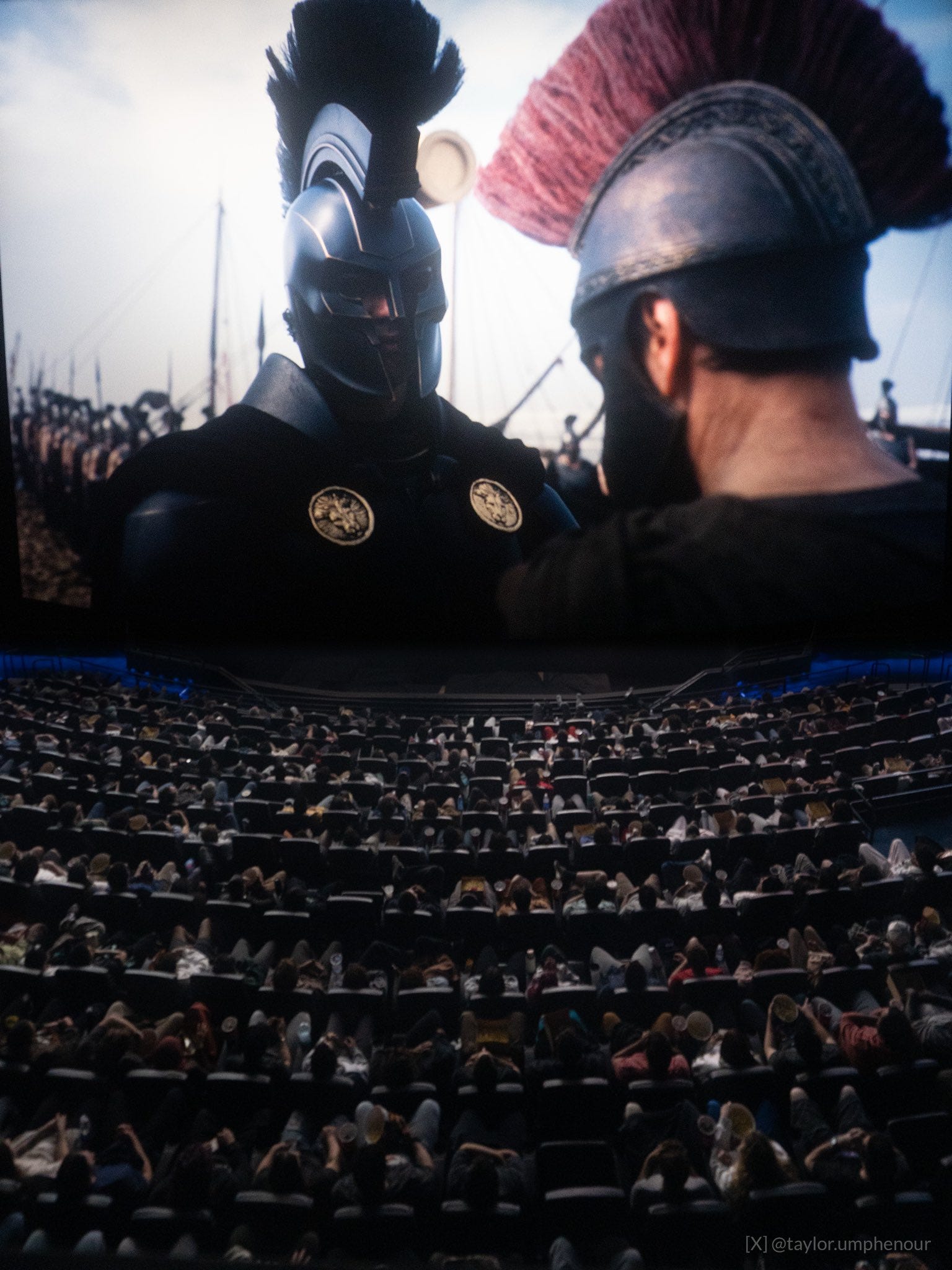
Getting just 11 more projectors running for The Odyssey was itself an, er… odyssey:
After reaching a near-record year at the box office in 2023, fueled by Nolan’s “Oppenheimer,” Imax knew it needed to expand its fleet of 70mm film projectors ahead of “The Odyssey.” For over a year, Imax embarked on a massive effort to track down broken, abandoned and often-forgotten projectors, salvaging parts to refurbish and install additional projectors. The strenuous process also required training 60 new projectionists from scratch. [...]
The effort ultimately resulted in 41 Imax 70mm locations worldwide for “The Odyssey,” up from 30 for “Oppenheimer.”
IMAX let the industrial knowledge behind these projectors disappear. Now, to meet renewed demand, it has to excavate it.
That’s technological archaeology.



🗣️💬🌏🔍🤖 We need auto-translation everywhere, stat!

I agree with friend-of-the-show Rohit (💚 🥃).
Machine translation has existed for years. The product breakthrough is making it good and cheap enough to disappear into a default background process that doesn’t require an explicit action.
As I’ve said many, many times, friction matters more than people think. If you have to click even once to read that Japanese message, most people won’t do it. They may do it once in a while, but they won’t hang out on Japanese Twitter or forums.
Not only that, but the friction runs both ways. It’s a two-sided chicken-and-egg problem. 🐓🥚
Even if *you’ve* always been willing to translate other people’s posts, that doesn’t help much if they aren’t doing the same. They may never discover your stuff, reply to it, or make themselves known to you.
Auto-translation changes both sides of the network: It helps you discover them, and them discover you. ↔
I hope auto-translation diffuses rapidly to all corners of the Internet (Reddit, comments on Instagram, whatever) and helps tear down language barriers around the world.
What is Google Doing⁉, Part 2 🤨
Follow-up to:
What is Google Doing? 🤔 (Edition #644)
🧠 Is Google Experiencing a Brain Drain? 🔋🪫 (Edition #645)
The Goog just released a bunch of new models, with Gemini 3.6 Flash being the flagship of that crop. On paper, it seems like a pretty decent upgrade over 3.5 Flash, particularly when it comes to token efficiency. On top of that, they’ve also cut output price from $9/million tokens to $7.50/million tokens.
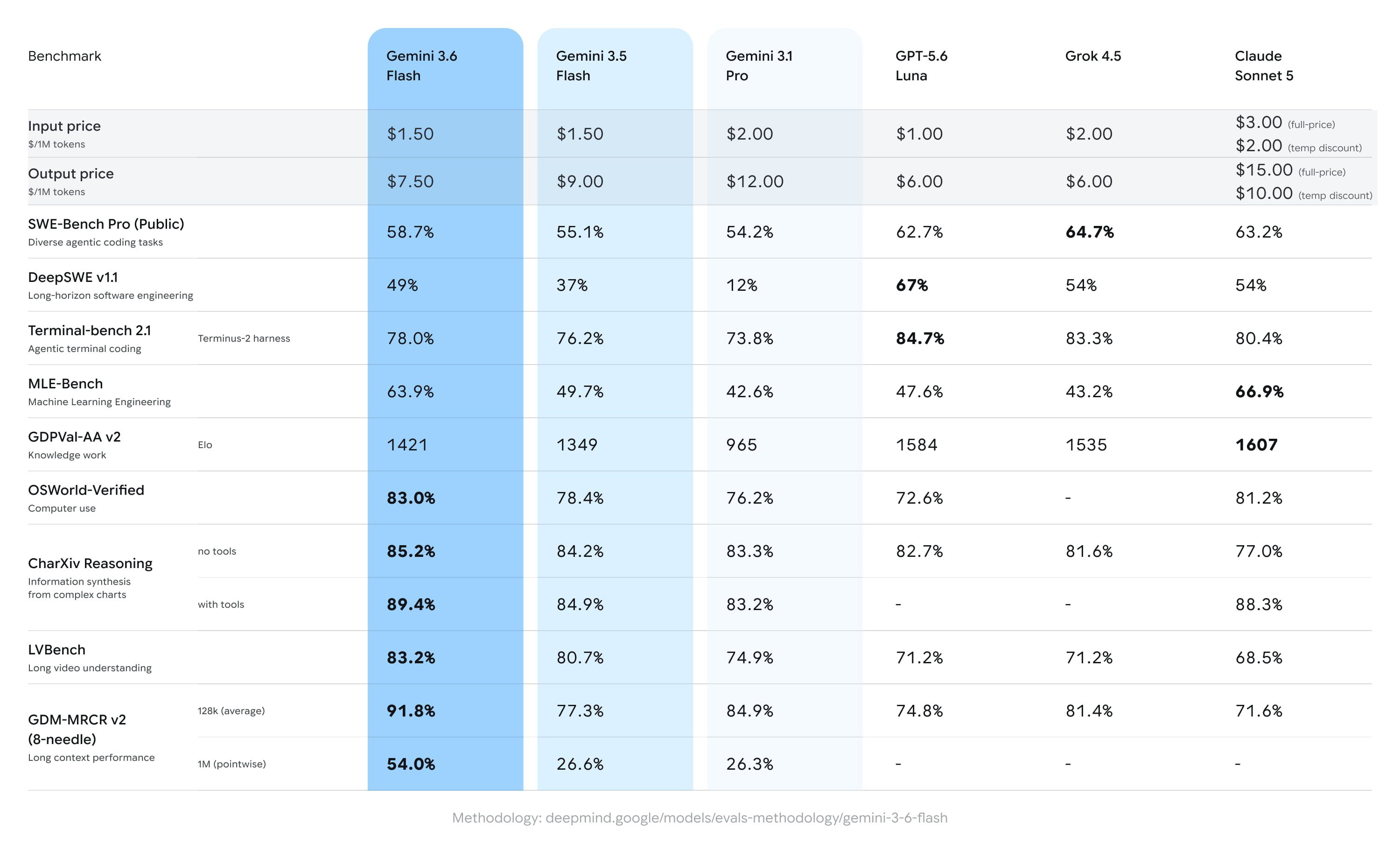
Sounds pretty good, right?
Except that whenever I try Gemini, I catch it making all kinds of errors that ChatGPT and Claude rarely make anymore.
On the VERY FIRST THING I asked Flash 3.6, it made the dumbest error that it should have caught and corrected while reasoning and before writing its user-visible output.
Here’s a play tragedy comedy in three acts:
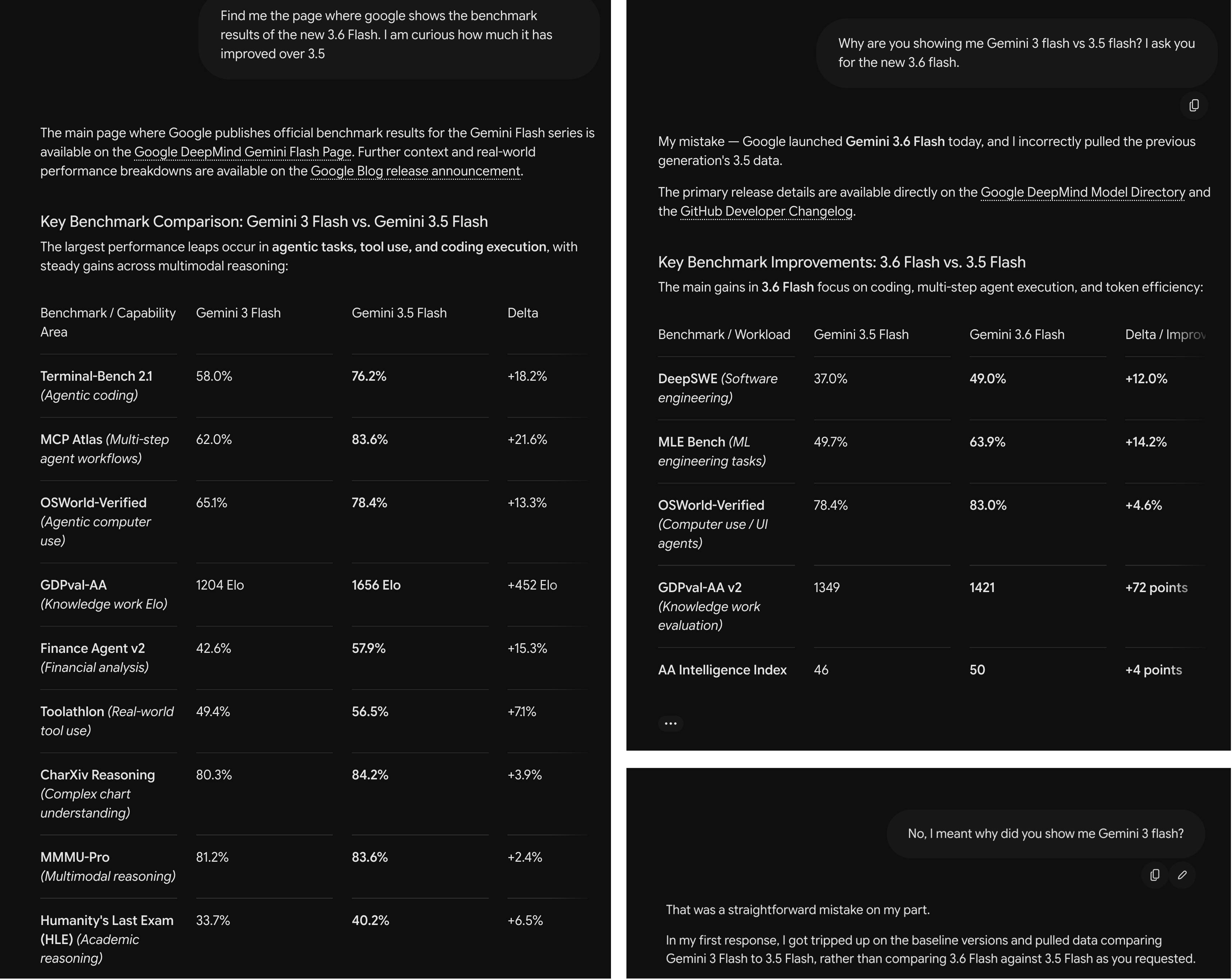
I asked it to give me the benchmarks of 3.5 Flash vs 3.6 Flash. Simple enough, right?
It gives me 3 Flash vs 3.5 Flash.
I asked it why it gave me Gemini 3 Flash when I specifically asked it about 3.6?
It says my mistake, but then it doesn’t describe the actual mistake it made. It doesn’t mention 3.0, just 3.5. So I have to tell it again, and it finally admits the error. 🙄
This kind of stuff feels very 2024 to me, not 2026.
The other bad news is that Gemini 3.5 Pro is still nowhere to be found, so 3.6 Flash is now better on benchmarks than 3.1 Pro. That’s embarrassing.
It’s also sad how slowly their harnesses improve. The Gemini website hasn’t improved much in ages (at least not in ways I can detect). I’ve given up on even trying the desktop Mac app for now because it was so bad, and I never hear coders talk about using Antigravity.
Google said:
Beyond today’s releases, Gemini 3.5 Pro is currently testing with partners and we plan to make it broadly available as soon as it’s ready. In parallel, our team is already focusing on building the next generation of models. We have started our most ambitious pre-training run yet, for Gemini 4, and are excited by the progress.
Ok, but promises promises… At this point, you need to deliver deliver.
What matters is whether the models that Google releases help them catch up to the frontier, or if the Giant with more money, compute, and AI talent than anyone just can’t transmit all that power from the engine to the wheels anymore.
Where are you, Demis?


🎨 🎭 Liberty Studio 👩🎨 🎥

🎖️ 1917: You Only Know What They Know + My War Films Project
This is an expanded version of a piece originally published on OSV Field Notes. If you aren’t already a subscriber, I think you would love it. Check it out.
I’ve started watching war films with my 12-year-old. Not Rambo III or Commando. The more historically grounded ones. It started when I mentioned that something happened “during World War II” and realized the words meant almost nothing to him. How could they? My own love of history began with films rather than textbooks. They aren’t always accurate, but they gave those words meaning. Now I’m trying to do the same for my son.
So I built us a little curriculum: 1917, Saving Private Ryan, and Band of Brothers. They’re more violent than what I usually watch with him, but I know my kid, and the violence isn’t gratuitous. It’s supposed to be horrible.
We started with 1917 because I wanted to begin with the First World War before moving to the Second. I’d already seen it twice, including in the theater, and Roger Deakins is my favorite cinematographer.
Everyone talks about how it’s made to look like a single continuous shot, unfolding in near real time. It’s neat, but it’s not what I care about. What makes it special is that the camera never leaves the soldiers. You see nothing they don’t see, you know nothing they don’t know. There are no establishing aerial shots of the battlefield, no cutaways to the Germans setting their trap, no shot of Blake’s brother waiting at the other end. That absence denies us the reassurance of knowing more than they do.
In 1917, you’re just there. It’s the closest a film has gotten me to what it might feel like to be a young soldier having to cross no man’s land. I pointed out to my son how many of the soldiers looked like teenagers, or barely out of their teens.
The violence happens the way it often does in life: fast, brutal, unannounced, no slow motion.
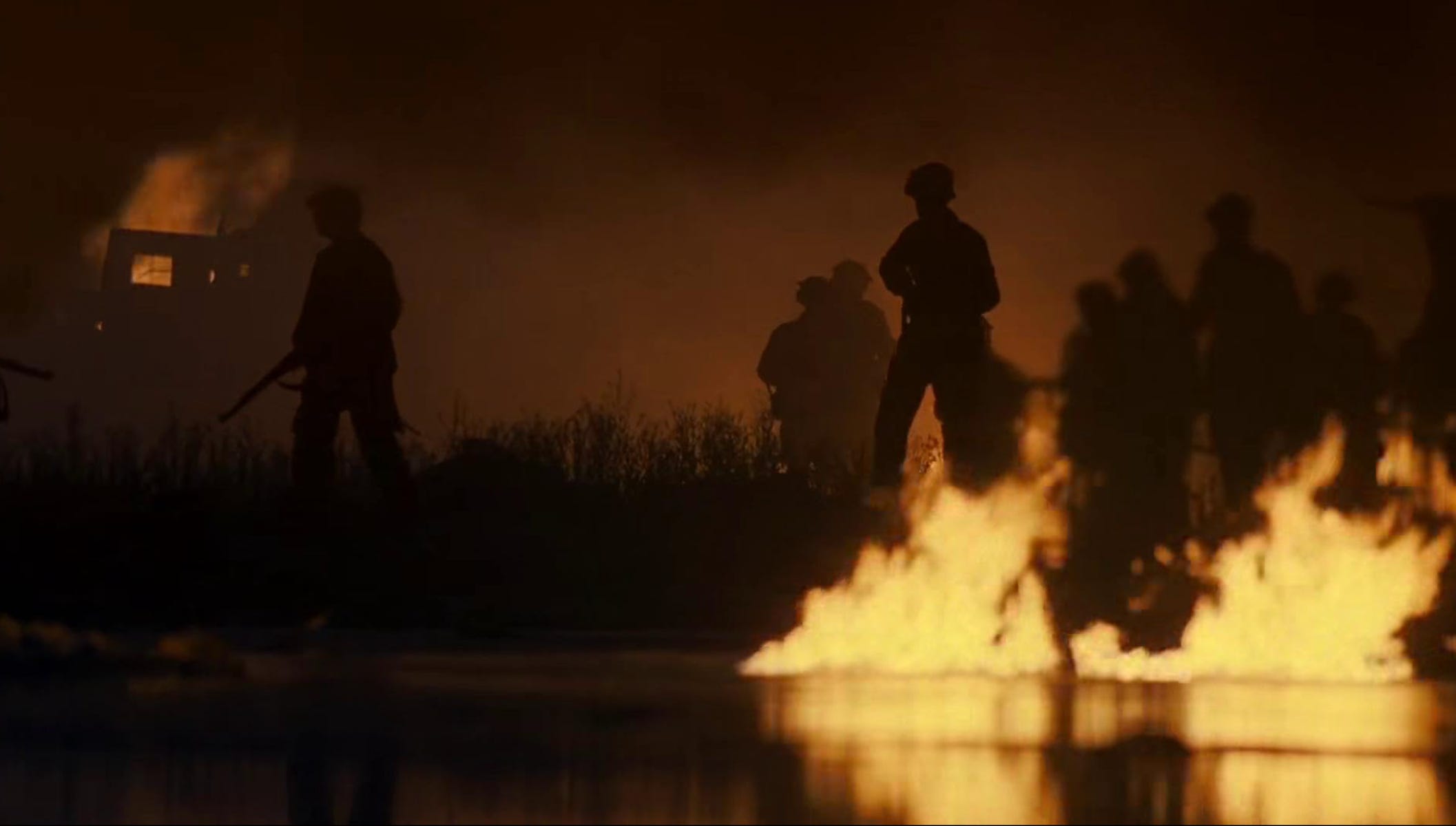
The filmmaking is incredible. Sequences that would be the highlight of another director’s entire career are just stacked one after another. The ruined town at night, lit by drifting flares and fire, is out of this world.
Being told about a war and seeing one are very different. The next time I tell my son something happened in 1917, he won’t hear only a date.
🪖 The Project Continues: Band of Brothers & More
I wasn’t sure where to go next. Saving Private Ryan was my first idea, then I thought maybe Dunkirk. I ended up going for the amazing Band of Brothers because it follows these men across a longer period, from boot camp to the end of the war, and I think the D-Day scenes in Saving Private Ryan will be even more effective *after* this.
So far we’ve seen three episodes, and my son loves it. We have tons of discussions during (we pause it) and after the episodes. The captured German soldier who grew up in Oregon sparked a good discussion.

I had forgotten how intense parts of the Carentan episode are, but confronting how bad things can get is part of the point. And we haven’t even got to Bastogne yet.
This whole show is such an incredible achievement. I was due for a rewatch anyway, but I’m glad I get to share it with my boy. In a few years, I’ll do the same with my younger son.

Thank you, love the newsletter