


Usually, the better someone does their job, the easier it looks. You rarely realize how hard it is until you try it yourself.
–James Clear

👨🍳🍳 A friend and I once had a good laugh at me being a ‘cast iron influencer’. (👋 Hey Jimmy!)
It’s been a while since I wrote about my skillets. These days, I use my carbon steel Matfer Bourgeat and my stainless steel All Clad and Misen the most… but every once in a while, the big boy Lodge cast-iron skillet comes out, and it’s always glorious!
Anyway, I’ve got a reputation to maintain, so I’ll recommend to you a piece by my friend Taylor about Lodge Manufacturing, the cast-iron cookware company founded by Joseph Lodge in South Pittsburg, Tennessee, in 1896.
130 years later, it’s still family-owned 🕰️ They’ve survived fires, the Great Depression, teflon, and tough competition all around.
Here are my highlights:
In the late 1980s Lodge replaced its pension plan with profit-sharing. Today 20 percent of pretax profits goes to employees, half as quarterly bonuses and half into retirement accounts. The family takes 10 percent as dividends. When demand slumped after the pandemic boom, the family suspended its dividends for 2022 so the employee profit-sharing could continue. [...]
A decision that changed the course of everything came in 2002. For a century, buying a cast-iron skillet meant buying a chore. New pans came coated in wax, and the owner had to scrub them and bake in a layer of oil before cooking anything. Under Bob Kellermann, Lodge began seasoning its pans at the foundry, so a skillet could go from the box to the stove. It was an industry first, and it became the industry standard. By 2007, every piece Lodge made left the factory pre-seasoned. The Wall Street Journal calls it the company’s turn toward growth and profitability. Annual revenue has since grown more than tenfold.
I think I’ll grill something in my big Lodge pan in their honor 🤔
🏋️♂️🏄♂️ Some of you, including long-time friend-of-the show and supporter Sebastian Alvarez, have asked for an update on my exercise/fitness saga.
After bouncing back strong last summer, it’s been hit & miss since. I still try to do a few big compound lifts and do some bodyweight stuff, but not as regularly as I should.
I think the thing I’m most happy about is that I’ve graduated from the cylinder to the little ball on the balance board. I can now stand on the board with just that hard rubber ball under it for sometimes 10-20 seconds (which seems a long time in that context!).
With winter coming, we’ll see if my cat reflexes and improved balance helped when it gets icy on the sidewalk. I’m pretty sure it saved my bacon a few times in recent years (and you never know how one of these falls will go… hitting your head on the concrete isn’t great 😬).
💚 🥃 To keep this steamboat alive and afloat, I need supporters. Like you! 🚢
The paid subscription includes the full feed, every podcast, Zoom Q&As with me, and access to the private Discord clubhouse, where a core group of us hang out and discuss the interesting stuff we find:
🏦 💰 Liberty Capital 💳 💴

🧊🔥 Hackers Are Defrosting Europe’s Supermarkets 🛒
Apparently, it starts with the fridges…
On Monday, supermarkets in Sweden, Belgium, Ireland, and several other European countries reported cyberattacks on their refrigeration systems. This forced many stores to throw away food.
A sales manager in a story in Stockholm told Reuters:
“There has been a cyberattack and all our freezers reached 50 degrees (Celsius).”
“Everything is destroyed.”
50 Celsius! Clearly they’re running the defrost cycle that should only be run during maintenance with empty fridges.
A similar attack hit around 700 supermarkets in France earlier in October. According to Le Monde, the hackers extended the defrost cycle from one hour to eight hours, delaying alarms and causing more damage.
What’s a little scary is it didn’t require particularly sophisticated hacking. The head of France’s cybersecurity agency says the October attack exploited basic security failures, including equipment directly exposed to the internet and weak passwords. These systems are connected so technicians can monitor and adjust them remotely. Very useful, until someone else gets access.
Hospitals, laboratories, and pharmacies also use similar refrigeration systems to store vaccines and other sensitive materials. 🏥🚑
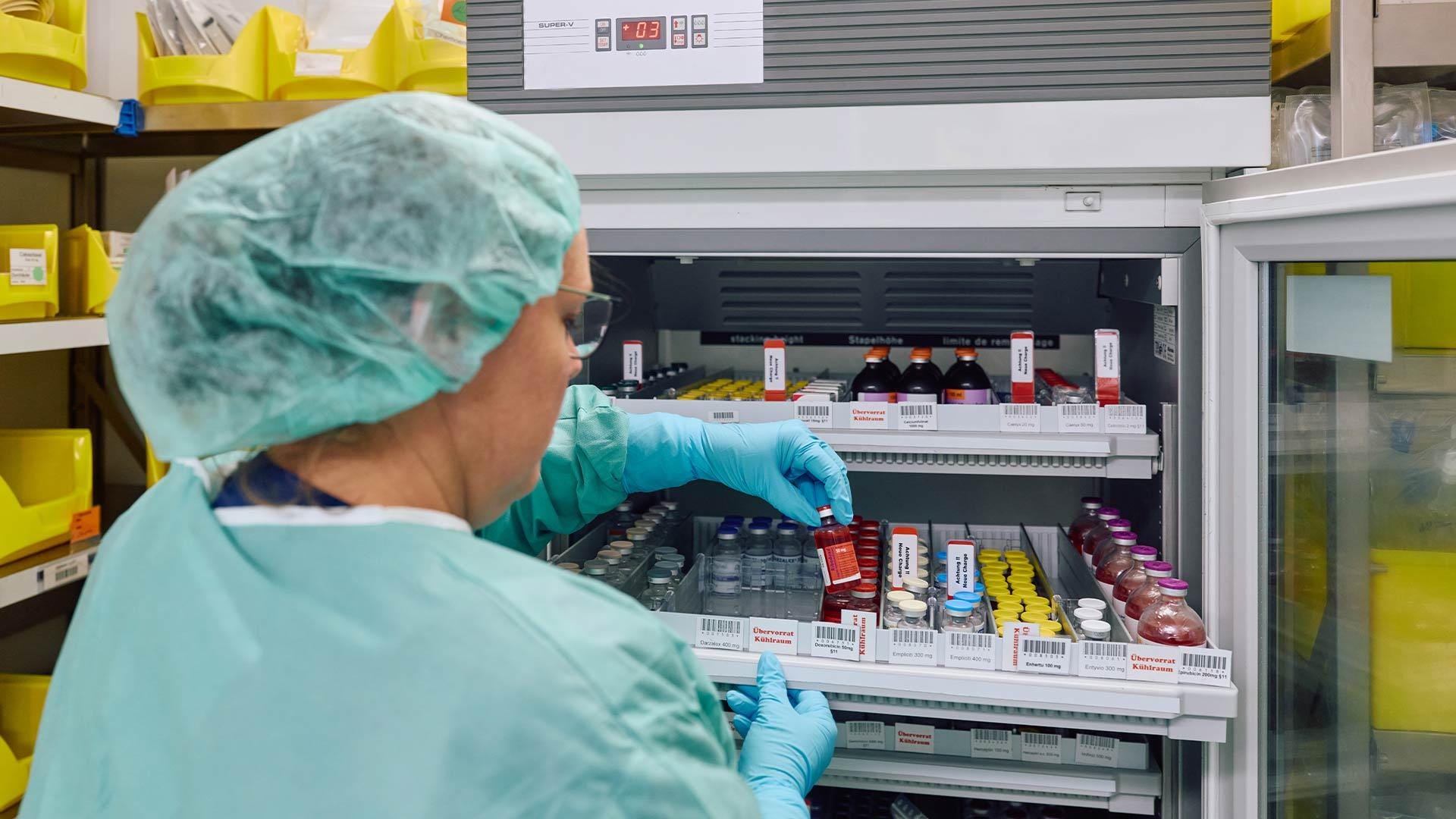
Hmm, who could possibly be behind attacks on a large part of Europe 🤔
Maybe the White House should put together another joint task force on cybersecurity with the Russians like they proposed in 2017 🙄
There’s no evidence so far that AI was involved in these attacks. With weak passwords and equipment exposed to the internet, it may not have been needed. But the fact that the vulnerabilities have been there for a long time and are only now being exploited may be a sign that the thing that has changed is the addition of agentic AI with cyber-attack capabilities to the landscape.
In any case, AI is making it easier for attackers to find vulnerable systems, figure out how to exploit them, and scale up attacks.
Defenders have access to AI too. But I wonder how many of these forgotten little computers connected to the physical world will get secured before a breach happens. 🤔
Last Minute Update: Reuters reported on November 4 that refrigeration control systems at three French regional blood-bank facilities had also been attacked. Thankfully, staff received warnings and transferred the blood to unaffected refrigeration units. No blood supplies were lost. 🇫🇷🩸
👁️💰 HEICO's Billionaire Eye Doctor (and Another 30-Year Shareholder)
My friend MBI (🇧🇩🇺🇸) shared this tweet by Sidecar Investor in our group chat
. It contains this exchange from the latest HEICO quarterly call transcript:
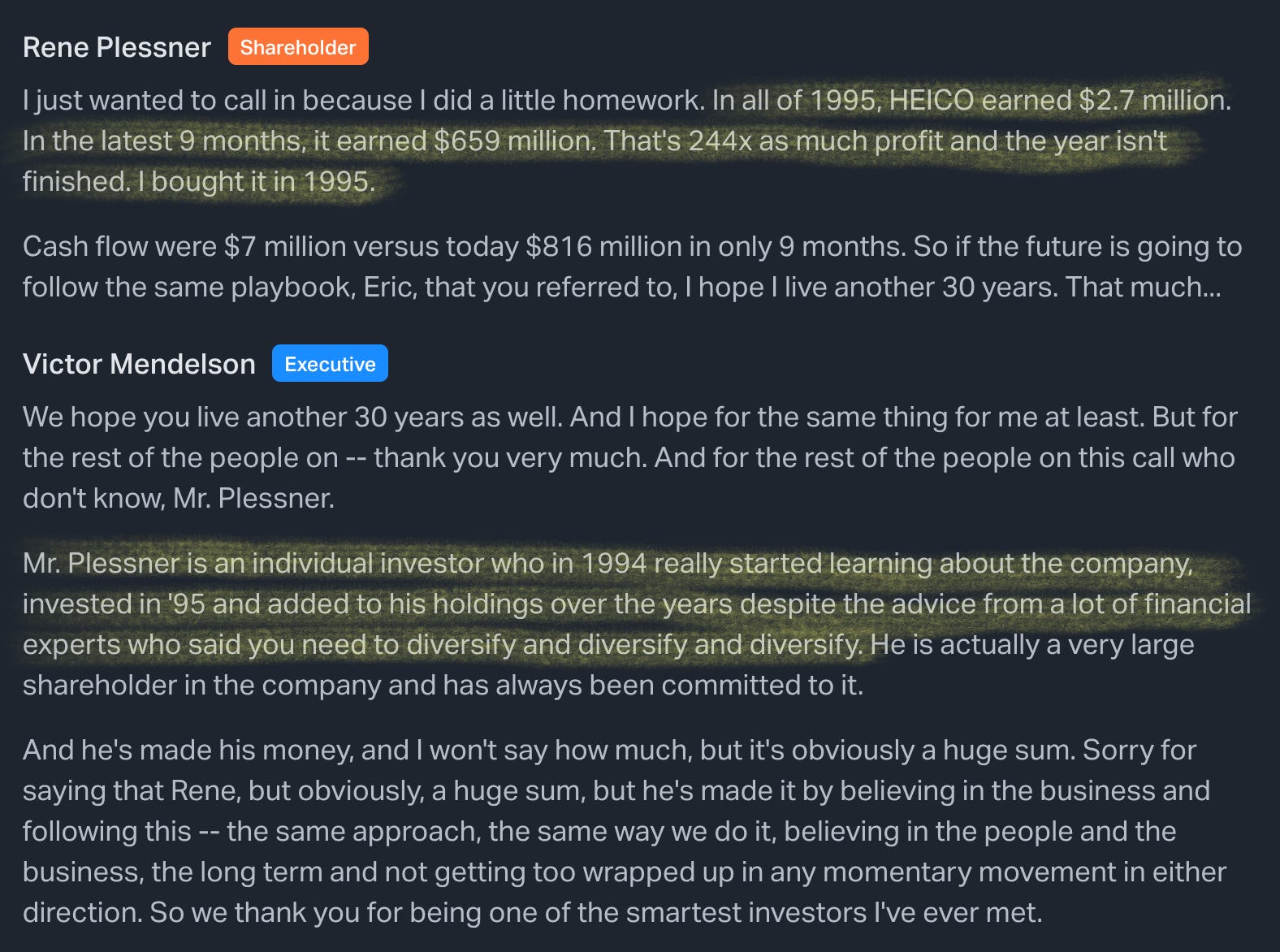
Pretty amazing! I thought I knew this story, but I didn’t look closely enough at the name. I thought Mr. Plessner was the eye doctor, but he isn’t. His story is just similar!
Who’s the eye doctor?
Dr. Herbie Wertheim:

Forbes wrote a profile of him in 2019. The gist was that:
Wertheim had a difficult childhood, struggled with dyslexia, and at 16 was given a choice by a judge: reform school or the Navy. He chose the Navy, where he discovered he had an aptitude for science and engineering.
He later became an optometrist, invented technologies for tinting and protecting eyeglass lenses, and founded a company called Brain Power Inc. in 1970. He used the profits from that business to invest in stocks.
And it turns out he was very good at it.
His approach was unusual. He spent about 12 hours a week studying patents and trying to understand companies’ intellectual property and technological advantages. He bought Microsoft shares at its IPO in 1986, Apple shares at its IPO in 1980 (and added more later), and many other technology and industrial companies.
HEICO was one of his biggest winners, and he wasn’t just passive.
Wertheim had known Larry Mendelson since the 1970s.
When the Mendelsons (Larry and his two sons) were looking at taking control of the struggling aerospace-parts company, Wertheim helped them study the business, drawing on his own experience with aviation in the Navy.
He began buying shares in the early 1990s, when HEICO was still a tiny company whose stock had traded for pennies.
According to Forbes, his original $5 million investment had grown to more than $800 million by 2019 (that was just one of his holdings. Forbes estimated his total fortune at $2.3 billion at the time.)
That made me curious. What happened to the doctor since 2019?
He’s still alive, now 87, and Forbes currently estimates his net worth at $4.8 billion.
I checked HEICO’s latest annual proxy. Wertheim and his family trusts, charitable foundation, etc, have about 4.1 million regular shares and 6.5 million Class A shares.
At HEICO’s November 2, 2026 closing prices, those shares would be worth approximately... *does napkin math*
$3 BILLION 💰💰💰🛩️
So HEICO has produced at least two extraordinary long-term investors, both of whom developed relationships with the Mendelsons and spent decades owning the business.
I wonder how many more stories like these are out there that we’ve never heard about 🤔
🦅 CrowdStrike Wants to Keep an Eye on Your AI Workers 🤖 👀🔐
CrowdStrike is spending about $495 million to acquire two AI security startups.
Dreadnode ($95m) tries to break AI agents before they’re deployed, looking for vulnerabilities like prompt injection and jailbreaks.
Fiddler AI ($400m) monitors what agents actually do after deployment and helps explain their decisions.
CrowdStrike also announced an AI kill switch that allows security teams to cut off rogue agents' access to AI models (IF they detect the problem…).
CrowdStrike is also working with Nvidia to extend its security software into Nvidia’s AI infrastructure. A planned integration with Nvidia Sentry would allow security rules to be enforced on separate BlueField-4 chips, outside the AI agent’s own software. So even if an agent is compromised, it can’t simply turn off its own watchdog.
An AI agent doesn’t have to be hacked to cause damage. Give it legitimate access to company systems, and a bad decision could lead to big damage, even though all the usual security checks passed. ✅ ✅ ✅
If software is becoming a kind of labor, it also brings some of the risks of labor. Employees make mistakes, do dumb things, or fall for attackers’ tricks sometimes.
I think companies like CrowdStrike and Palo Alto are well positioned to sell these additional layers of security. They’re already deep inside their customers’ IT systems, with access and visibility that newcomers would struggle to replicate.
But that advantage cuts both ways. Remember CrowdStrike’s disastrous 2024 update that crashed 8.5 million Windows computers? That wasn’t even an attack! What happens if a major AI security failure causes massive damage to customers who thought they were protected? 😬
🍎 Apple vs the Rest of Big Tech in the AI Era (so far) 📊
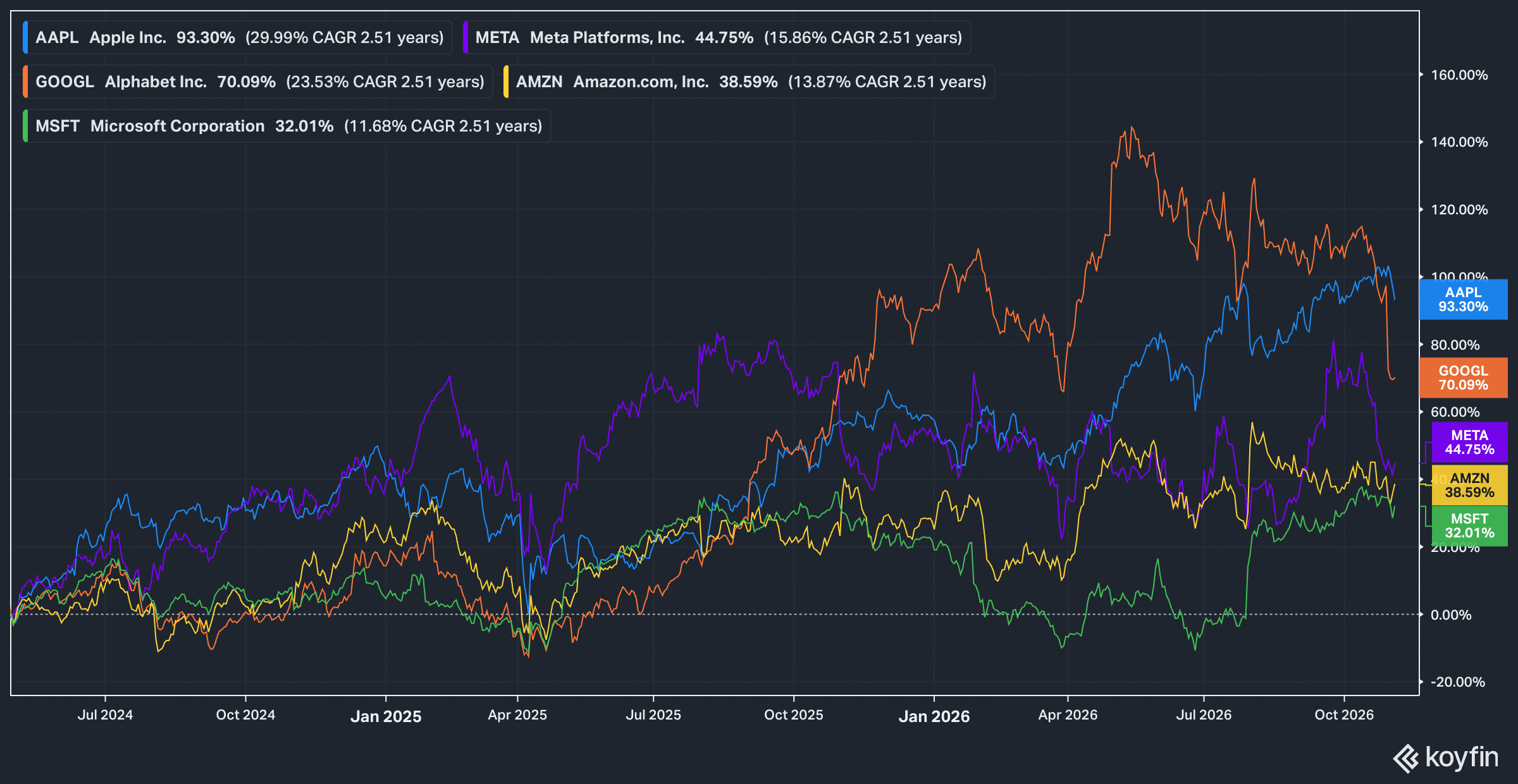
Look at this.
Granted, it’s an arbitrary starting point and if you change it one direction or the other you can end up with different results.
But I still find it interesting that in the past 2.5 years (the most insane part of the AI era… so far), Apple stock has outperformed the rest of the traditional Big Tech (not Nvidia, obviously, but Nvidia wasn’t considered to be part of the group until recently).
And lately, Apple’s lack of massive AI spending has become part of the bull case. Who would’ve expected that a few years ago? ¯\_(ツ)_/¯
What if Apple can buy much of the AI intelligence it needs from companies competing to provide it, while keeping the customer relationship for itself? That could turn out to be a pretty good position. But it’s also a pretty big gamble.
Among investors, at least the ones I hang out with, few have been excited about them for a while, yet they just keep chugging along. This doesn’t mean Apple’s AI strategy is winning, or that the stock will outperform. But it’s a snapshot in time. 📸
From the full feed 🔒: The AI Bubble Question: Are We Counting the Same Dollars Twice? 🔄
🧪🔬 Liberty Labs 🧬 🔭

🔄🧠 Claude is Learning to Design the Chips That Will Run Claude
According to The Information, Anthropic’s new 15-person chip-design team is already using Claude to help develop its own custom AI chips. I wrote about Anthropic’s chip-design plans in Edition #652, but now we’re getting a better idea of how they’re using their own models to speed things up. Engineers reportedly say Claude is cutting down design time compared with their estimates of traditional workflows at companies like Nvidia and AMD. Anthropic is also hiring researchers to train Claude specifically on chip design and verification, teaching it to generate circuit designs, test whether they work, and improve them.
Meanwhile, OpenAI says its own models helped it and Broadcom develop its Jalapeño chip from initial design to tape-out (when the completed design is sent for manufacturing) in just nine months. I wrote about Jalapeño in Edition #656, including how AI was already helping optimize the software running on the chip. 🔄
This is another example of what I’ve been calling the Escher Hands era. In Living One Model Ahead, I extended that beyond just software to the whole organization:
better model → better software/chips/infrastructure/company → better model
AI models are evolving much faster than the chips that run them. Designing and manufacturing a new chip can take years, so semi-engineers have to make guesses about what future models will need. If AI can shorten the design cycle significantly, hardware could be designed much closer to the models it will run.
Of course, making the design process faster doesn’t mean that manufacturing and deployment will speed up by the same amount. But at least the engineers wouldn’t have to guess quite so far into the future about what they’re designing for. 🔄
🧾 🔐🤖 A Cryptographic Receipt for AI: Proving Which Model Answered You
Say you pay for a top-of-the-line frontier model through a third-party service.
How do you know they’re not quietly giving you answers from a cheaper model and pocketing the difference? 😅 (it might be easy to detect if they did it all the time, but if they do it just once in a while, it could be pretty hard to notice 🤔)
There’s also the recent story where Anthropic accused DeepSeek and Moonshot (Kimi) of secretly routing some requests to Claude and passing off its answers as their own (as a way to get data to train their models and distill Claude ⚗️🧪).
How do you fix this?
Anthropic researchers created FlashProve, a way to attach a cryptographic proof to an AI response showing that it came from the exact model weights the provider committed to, without revealing those weights. You can verify the proof without having to run the giant model yourself. It’s a kind of mathematical receipt for the computation. 🧾
We’re far from implementing that everywhere, though. Generating these proofs currently takes about 70–95x more GPU time than ordinary inference, and each ~19 MB proof checks just one generated token, with up to 1,024 tokens of context. 😅
But if they can make it lighter, I suspect it'll first be used by independent model auditors and customers who want proof they're getting the expensive model they're paying for.
🔐🛜 Cloudflare Zero Wire: When Finding Security Bugs is the Easy Part 🐛
I’ve written a few times about how models like Mythos are getting super-human at finding security vulnerabilities, including bugs and holes that have been there for decades.
But finding the bugs is only part of the problem. 🕵️♂️
Someone still has to figure out which systems are affected, how serious each vulnerability is, whether hackers are already exploiting it, and what to fix first.
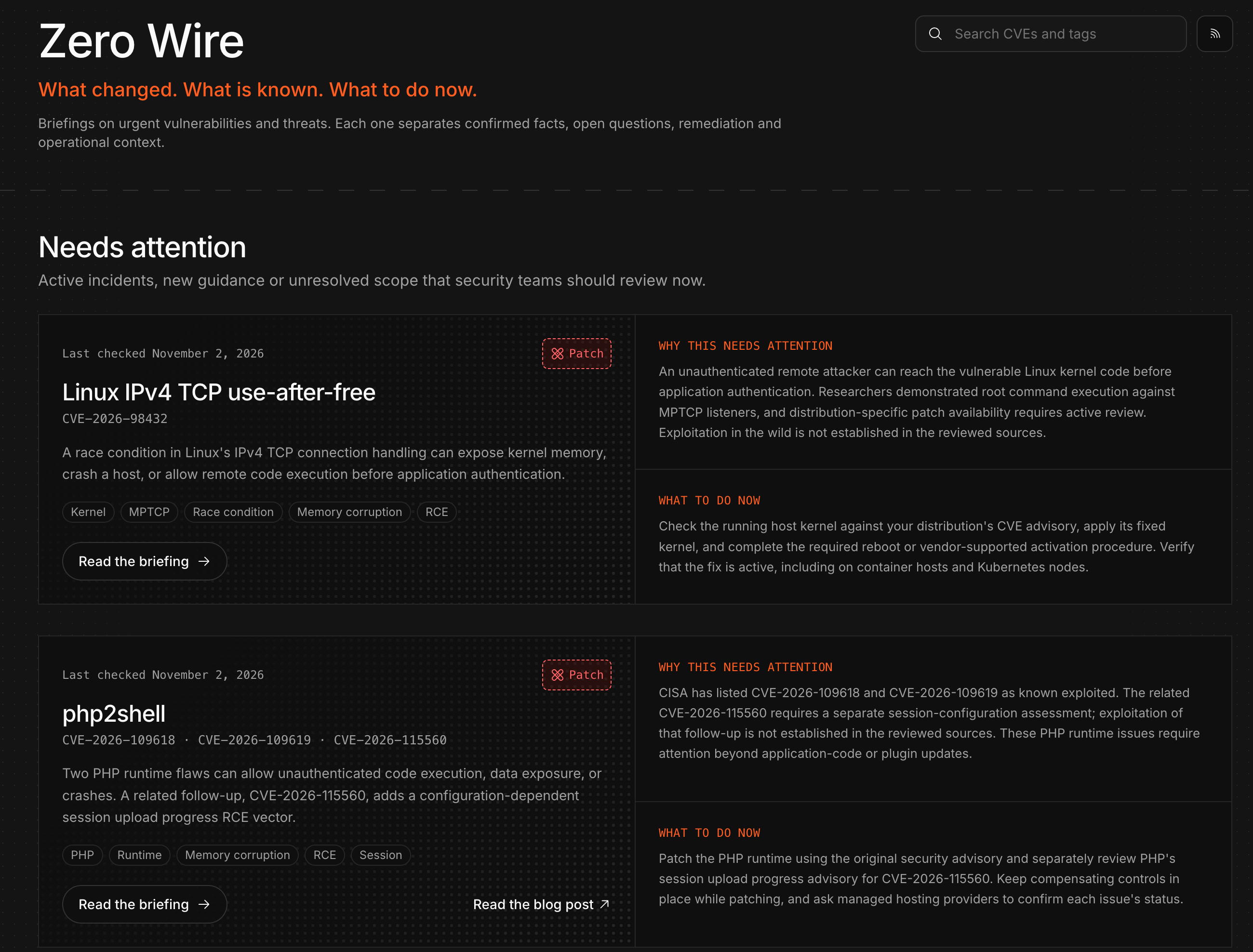
Cloudflare just launched Zero Wire, a free public feed that collects important security vulnerabilities and turns them into short, practical briefings: what happened, who’s affected, what evidence exists, and what to do about it. It’s a news wire for critical security holes. 🕳️
One cool thing: each briefing includes a ready-made prompt for an AI agent to investigate whether your own infrastructure is affected. That’s clever AND going to help implementation of the fixes (y’know what I always say about the power of friction, and reducing it…).
If the agent has access to your systems, it can check which software versions you’re running, identify possible exposure, and recommend next steps (the prompt says its read-only, so it shouldn’t go around changing things without explicit permission). 🧯
From the full feed 🔒: A Possible Dwarf Planet In the Solar System Hiding in Plain Sight Since 2016
🎨 🎭 Liberty Studio 👩🎨 🎥
🎬 ‘You Can See Everything’ Pregame 🍿💉🩸
I got my ticket, going to see this tomorrow evening. By myself, because it’s hard to find a way for my wife and I to coordinate for a 3h+ film (if you count trailers and ads before the film starts).
This feels like one that you should see before spoilers start entering the popular culture. I’ve heard from so many people I respect who have seen it that they’re glad they did and that it was quite an experience. So I figured I should not wait for it to be available on streaming and just go for it. I encourage you to do the same.
My main worry is that all the praise has raised my expectations. But I still have almost no idea what kind of film I'm going to see, so maybe that will help. ¯\_(ツ)_/¯
So the (optional) homework for you is to also go see it. Once we both have, I will discuss it in a spoiler-marked section. 👨🏫